
A perfect first layer is the difference between a successful print and a tangled mess of filament spaghetti. For PLA users, achieving that reliable bed adhesion often means fighting with warped corners, lifting edges, and prints that detach mid-job. The right adhesive eliminates these frustrations, turning a finicky process into a reliable one.
I’m Mohammad Maruf — the founder and writer behind Drink4Good. My focus is on deep market research and analyzing the chemical formulations and application methods that separate effective bed adhesives from the rest.
The best glue for 3d printing pla must provide strong initial tack, maintain grip through temperature changes, and allow for clean part release once the build plate cools, all without leaving a sticky residue that requires harsh solvents to remove.
How To Choose The Best Glue For 3D Printing PLA
Finding a reliable bed adhesive for PLA involves more than picking the cheapest option. You need to consider the formula’s strength, how it interacts with your specific build plate material, and how easy it is to clean.
Liquid vs. Stick: Which Application Method Wins?
Liquid adhesives in bottles with sponge or foam applicators generally provide a thinner, more consistent layer compared to solid glue sticks. This uniformity prevents high spots and uneven adhesion that can cause first-layer defects. Liquids also spread faster across the build plate.
Water Solubility: The Cleanup Factor
Most modern PLA bed glues are water-soluble, meaning a damp cloth is all you need to remove residue after printing. This is critical for maintaining the integrity of delicate build plate coatings, especially PEI sheets, where harsh solvents like acetone can cause irreversible damage over time.
Filament Compatibility and Heat Tolerance
While PLA prints at lower temperatures, you may also want a glue that works with PETG or ABS for future projects. A universal formula that maintains grip across a range of bed temperatures (50°C to 110°C) offers more flexibility and saves you from buying separate adhesives for each filament type.
Quick Comparison
On smaller screens, swipe sideways to see the full table.
| Model | Category | Best For | Key Spec | Amazon |
|---|---|---|---|---|
| ENOMAKER Bamboo Lab | Liquid Tube | High-speed printing on smooth plates | 60ml volume per tube | Amazon |
| UniTak3D Compatible | Liquid Bottle | Bambu Lab printer owners | 60ml volume per bottle | Amazon |
| Prevailent T-80 | Liquid Bottle | Large format / high-volume prints | 118ml (4 fl oz) per bottle | Amazon |
| Vision Miner Nano Polymer | Nano Polymer | Engineering-grade filaments / PEI beds | 50ml per bottle | Amazon |
| ELEGOO Adhesive Glue (2-pack) | Liquid Bottle | Budget-friendly multi-pack use | 60ml x 2 bottles | Amazon |
In‑Depth Reviews
1. ENOMAKER Bamboo Lab 3D Printer Bed Adhesive

The ENOMAKER Bamboo Lab adhesive is engineered for high-speed printing, where vibration and rapid movement can shake a print loose. Its liquid formula provides a strong grip that prevents edge lifting and warping, even during fast first-layer passes on smooth build plates like glass or PEO.
Users consistently note that a thin coat lasts multiple prints before requiring reapplication, making the 60ml tube surprisingly economical. The water-soluble formula cleans off with a wet rag, leaving no tacky residue on either the plate or the bottom of the model. It works reliably with PLA, ABS, PETG, and TPU.
The push-to-open applicator head controls flow well, but it is best applied to a cold bed to avoid premature drying. Once the bed cools after printing, parts release with minimal force, eliminating the need for scraping tools that can scratch your build surface.
Why it’s great
- Excellent grip during high-speed prints
- Thin layer lasts for multiple print jobs
- Completely water-soluble clean up
Good to know
- Requires application on a cool bed for best results
- 60ml tube may seem small for very large build plates
2. UniTak3D Compatible 3D Printer Adhesive Glue

The UniTak3D adhesive is formulated specifically to address the common first-layer adhesion failures on Bambu Lab printers, including the A1, A1 Mini, P1S, and X1C. Its liquid consistency spreads evenly over textured PEI plates, filling microscopic pores that solid glue sticks often miss.
Reviewers report that it resolved persistent issues with PETG and ABS prints lifting off the bed mid-job, and the low-odor formula makes it suitable for home and office environments. It cleans off with water and a cloth, leaving no sticky film that could affect future print adhesion.
The bottle design allows for precise application, but the manufacturer advises against applying multiple coats. If adhesion is insufficient, it is better to slightly raise the bed temperature rather than adding more glue. This approach prevents the build-up that can create uneven surfaces.
Why it’s great
- Specifically designed for Bambu Lab printer beds
- Fills textured PEI pores for a secure bond
- Low odor and easy water cleanup
Good to know
- Not recommended for multiple coats
- Works best with a properly heated bed
3. Prevailent T-80 3D Printer Bed Adhesive
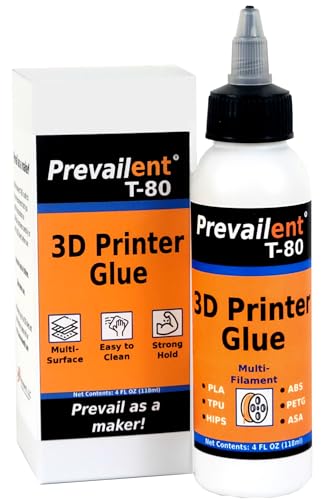
The Prevailent T-80 stands out for its generous 118ml bottle, which offers nearly double the volume of most competitors at a mid-range price point. This makes it the most economical choice for users with large build plates or those who print frequently and want to reduce per-print consumable costs.
Its natural, renewable formula is certified safe and non-toxic, and it has demonstrated a 99.9% success rate in production environments printing ABS parts. The twist-top applicator with a sponge brush delivers a controlled, even layer that prevents the blobbing and clumping associated with glue sticks.
It works effectively on borosilicate glass, PEI, and painter’s tape, though it has not been tested on bare metal surfaces. Users recommend using a very light touch during application, as a thin coat provides the best balance of adhesion and clean release once the plate cools.
Why it’s great
- Largest volume per bottle (118ml) for the price
- Natural, non-toxic formula certified safe
- Proven success with high-volume ABS production
Good to know
- Not tested on bare metal build plates
- Does not solve warping on all printer models (e.g., A1 Mini)
4. Vision Miner Nano Polymer Adhesive (50ml)
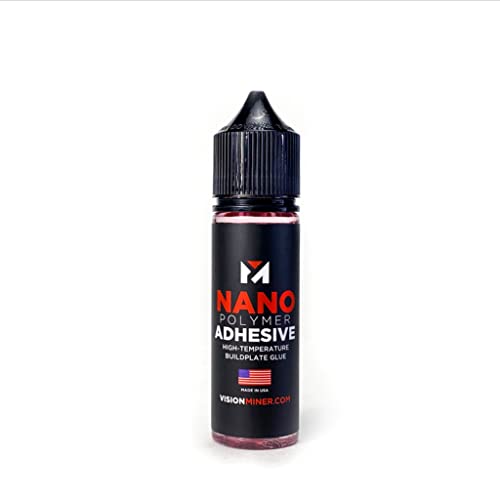
The Vision Miner Nano Polymer Adhesive is the premium solution for users who print with challenging engineering-grade filaments like PEEK, ULTEM, Nylon, Polycarbonate, and carbon fiber composites. Its advanced nano-polymer chemistry creates a robust chemical bond that resists the high shrinkage forces of these materials better than any PVA-based glue.
One application can last for several prints, making the 50ml bottle remarkably long-lasting despite its small size. It dries clear and leaves zero residue on the bottom of your prints, preserving the surface finish of your models. It works on virtually any build surface, including smooth PEI where traditional adhesives often fail.
The formula has a brief isopropyl alcohol-like smell during application that dissipates quickly. While the upfront cost is higher, users report that a single bottle can last months of regular use, and it completely eliminates the need for glue sticks, hairspray, or other messy alternatives for demanding materials.
Why it’s great
- Works with PEEK, Nylon, PC, and other engineering filaments
- One application lasts multiple prints
- Leaves zero residue on print surface
Good to know
- Higher upfront cost per bottle
- Brief solvent smell during application
5. ELEGOO 3D Printer Adhesive Glue (2-pack)
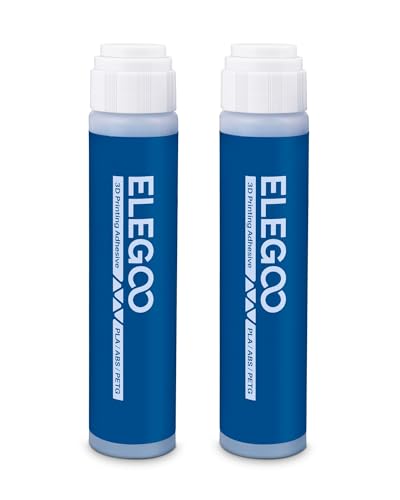
The ELEGOO 3D Printer Adhesive Glue comes as a two-pack of 60ml bottles, providing double the adhesion for a very accessible price. Its water-based polymer formula is specifically designed to reduce warping for PLA, ABS, PETG, and TPU filaments on smooth or textured PEI, glass, and aluminum beds.
The low-odor formulation makes it ideal for enclosed spaces like classrooms and home studios. Users report that it completely eliminated adhesion failures they had experienced with cheaper solid glue sticks. The liquid form spreads evenly without the clumping that can ruin a first layer.
While the application requires a bit more care compared to the precise sponge tip of some competitors, the results are consistent and reliable. The water-soluble clean up is straightforward. For the money, this two-pack offers the best value for solo users who want a backup bottle or for households with multiple printers.
Why it’s great
- Two 60ml bottles for long-term supply
- Low-odor formula suitable for shared spaces
- Consistent results with PLA and PETG
Good to know
- Application requires careful control to avoid drips
- Minor learning curve compared to glue sticks
FAQ
Can I use a glue stick for PLA instead of liquid glue?
How many prints can I get from one application of liquid glue?
Will liquid glue damage my PEI build plate?
Final Thoughts: The Verdict
For most users, the glue for 3d printing pla winner is the ENOMAKER Bamboo Lab because it offers the best balance of strong grip during high-speed printing, easy water cleanup, and reliable multi-print longevity. If you need to tackle engineering-grade filaments like Nylon or Polycarbonate, grab the Vision Miner Nano Polymer for its unmatched chemical bond. And for budget-conscious users printing PLA and PETG on multiple machines, nothing beats the value of the ELEGOO 2-pack.