
Nothing kills a 14-hour print faster than a corner that lifts off the bed halfway through. A reliable adhesive layer is the difference between a perfect first layer and a failed project that wastes filament and time.
I’m Mohammad Maruf — the founder and writer behind Drink4Good. I’ve spent years analyzing filament adhesion chemistry, applicator designs, and real-world user data across hundreds of 3D printing build plates.
This guide breaks down the top liquid adhesives based on formula type, ease of application, and surface versatility — so you can confidently find the glue for 3d printing that matches your materials and workflow.
How To Choose The Best Glue For 3D Printing
Not all adhesives are created equal when it comes to bed adhesion. A formula that works perfectly for PLA on a smooth PEI surface may cause excessive sticking on a textured plate, or fail entirely with ABS. Understanding the adhesive’s chemical makeup, drying time, and release behavior will save you from failed prints and messy cleanup.
Filament Compatibility
Some filaments — like PLA and PETG — adhere easily to most hot beds with a light adhesive layer. Others, such as ABS, nylon, and PEEK, require a high-grip formula that can withstand temperature swings without delaminating. Check that the glue is explicitly rated for the materials you print most often.
Application and Cleanup
Liquid applicators with a sponge or brush tip allow for a thin, even coat without streaks or globs. Water-soluble formulas make post-print cleanup as simple as a damp cloth. Avoid adhesives that leave stubborn residue on the build plate or the bottom of your model.
Build Plate Surface
Glass, PEI, PEO, BuildTak, and aluminum each react differently to adhesive chemistry. A formula that bonds aggressively to textured PEI may be too strong for a glass plate, causing difficult removal. Match the glue to your specific plate type for optimal grip and release.
Quick Comparison
On smaller screens, swipe sideways to see the full table.
| Model | Category | Best For | Key Spec | Amazon |
|---|---|---|---|---|
| Vision Miner Nano Polymer | Premium | Advanced filaments (PEEK, Nylon) | 50ml nano-polymer formula | Amazon |
| ELEGOO 60mL (2-pack) | Mid-Range | Multi-material, multi-plate use | 120ml total, water-based polymer | Amazon |
| ENOMAKER Bamboo Lab | Mid-Range | Bambu Lab A1/P1/X1 printers | 60ml, warp-resistant liquid | Amazon |
| UniTak3D Compatible | Budget | PLA/PETG on PEI/glass plates | 60ml liquid, low-odor resin | Amazon |
| Prevailent T-80 | Mid-Range | PLA/ABS on borosilicate glass | 118ml, twist-top applicator | Amazon |
In‑Depth Reviews
1. Vision Miner Nano Polymer Adhesive (50ml)
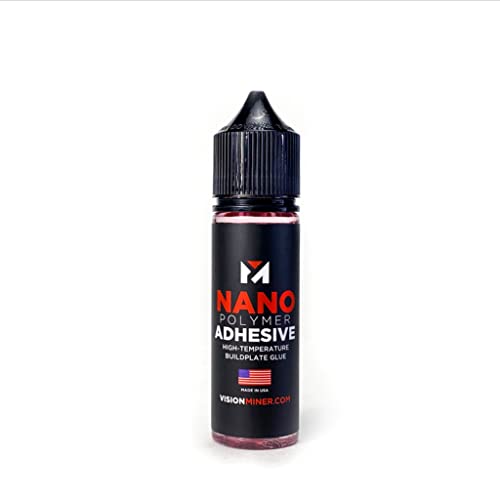
The Vision Miner Nano Polymer Adhesive is formulated for the toughest materials — PEEK, ULTEM, PPSU, and nylon — while handling everyday PLA and PETG without issue. It dries crystal-clear and leaves zero residue on prints or the build plate, which means less scrubbing between jobs.
Users report that a single thin layer lasts multiple prints, even on large 350mm beds, and that it solves adhesion failures on smooth PEY or PEI surfaces where other glues simply lift. The nano-polymer formula is non-toxic and odorless after the brief alcohol scent dissipates.
Because of its premium price and advanced material support, this glue is overkill for casual PLA-only users. But if you print engineering-grade thermoplastics or want a one-bottle solution that works on everything from glass to carbon fiber, this is the definitive choice.
Why it’s great
- Works with high-temp filaments like PEEK and nylon
- Dries clear, no residue on prints or plate
- Small bottle lasts many prints
Good to know
- Cost per ounce is higher than most competitors
- May leave slight film on smooth beds after many uses
2. ELEGOO 3D Printer Adhesive Glue (60mL x 2)
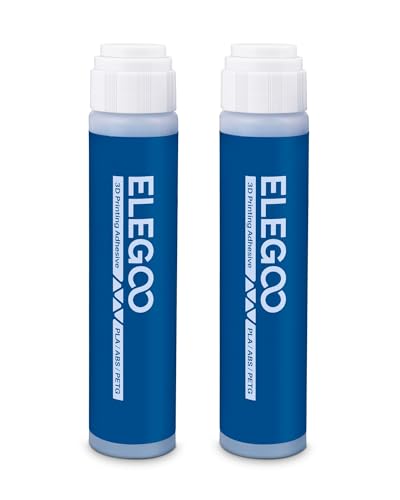
The ELEGOO adhesive uses a water-based polymer formula that bonds strongly with ABS, PLA, PETG, and TPU on smooth or textured PEI, tempered glass, PEO, PET, and aluminum plates. It is designed to reduce warping on complex models without requiring a thick, goopy layer.
Users consistently note that it solves adhesion problems completely — no edge lifting, no first-layer failures. The low-odor formula makes it suitable for classrooms and home studios, and the water-soluble cleanup takes only a damp cloth. The twin-pack provides 120ml total, which is more than enough for dozens of prints.
The applicator requires a bit more effort to spread evenly than a sponge-tip dispenser, but the consistency and reliable hold make this a solid choice for anyone who prints a variety of materials and wants extra value.
Why it’s great
- Two bottles for extended use across multiple printers
- Low odor, safe for indoor environments
- Works on glass and all common PEI plates
Good to know
- Application can be slightly less uniform than sponge-tip bottles
- Not designed for ultra-high-temp materials like PEEK
3. ENOMAKER Bamboo Lab Bed Adhesive (60ml)

The ENOMAKER Bamboo Lab adhesive is developed specifically for Bambu Lab printers — A1, A1 Mini, P1, and X1. Its warp-resistant liquid delivers consistent grip during high-speed printing, preventing lifting on materials like ABS, PETG, PLA, and TPU.
The porous sponge applicator spreads a thin, even coat more reliably than solid glue sticks, and the water-soluble formula cleans off entirely with a wet rag. Users report that prints release cleanly after the bed cools, with no residue marring the model bottom or the build plate.
While the 60ml volume is standard, the glue requires reapplication before each print for best results, so heavy users will go through bottles faster than with more concentrated nano-polymer options.
Why it’s great
- Optimized for Bambu Lab high-speed printing
- Even application with sponge tip
- Zero residue after cleanup
Good to know
- Best results require fresh coat each print
- Not recommended for multi-layer buildup
4. Prevailent T-80 3D Printer Bed Adhesive (118ml)
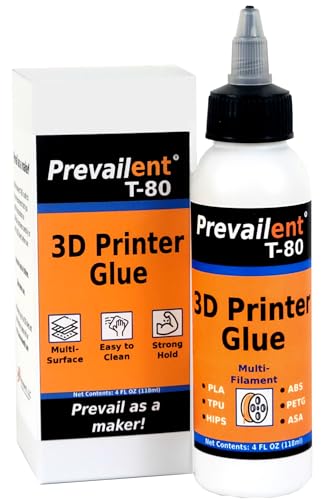
The Prevailent T-80 is a 118ml liquid adhesive made from natural, renewable resources. It is certified non-toxic and works across borosilicate glass, PEI, and blue painter’s tape. The twist-top applicator with a sponge brush enables precise, mess-free control on cold or warm beds.
Users highlight that a very light coat prevents warping on large prints — one reviewer ran thousands of ABS production parts with a 99.9% success rate after switching to T-80. The water-soluble residue washes off instantly, and the foam brush stays reusable when rinsed between applications.
Some users found it less effective on certain Bambu Lab A1 Mini plates, and the large bottle means you may need to shake it occasionally to keep the natural ingredients properly mixed.
Why it’s great
- Large 118ml bottle extends runtime between refills
- Non-toxic, natural-sourced ingredients
- Light coat prevents warping on large ABS prints
Good to know
- May not solve warping on all Bambu A1 Mini plates
- Natural formula can settle over time
5. UniTak3D Compatible Bambu Lab Adhesive Glue (60ml)

The UniTak3D liquid glue is positioned as a compatible option for Bambu Lab printers. It delivers strong bed adhesion for PLA, ABS, PETG, PC, PA, and TPU filaments on low-temp, high-temp, textured, and smooth plates including glass, PEI, PEO, and BuildTak.
Users report that it applies smoothly and cleans off with water and a cloth, leaving no residue. The low-odor formula is noticeably less pungent than many budget glues, which is a meaningful advantage for smaller workspaces. The 60ml bottle is a standard volume, but the manufacturer advises against applying multiple coats — if adhesion is insufficient, raising the bed temperature is the recommended fix.
This glue performs best on PLA and PETG. Users printing advanced materials like pure nylon or polycarbonate may find the grip insufficient without a hotter bed.
Why it’s great
- Very low odor compared to similar-priced options
- Easy water-based cleanup
- Works on a wide range of build plates
Good to know
- Not recommended for layered application
- May need higher bed temps for difficult filaments
FAQ
Can I use glue meant for Bambu Lab printers on a Creality or Prusa machine?
How often should I reapply liquid bed adhesive?
Will liquid glue damage my PEI sheet or glass bed?
Final Thoughts: The Verdict
For most users, the glue for 3d printing winner is the Vision Miner Nano Polymer Adhesive because it handles everything from everyday PLA to engineering-grade PEEK with zero residue. If you want a high-value two-pack for general use, grab the ELEGOO 60mL twin-pack. And for Bambu Lab owners who want a simpler applicator and warp-free prints, nothing beats the ENOMAKER Bamboo Lab adhesive.