
Automotive plastic cracks, snaps, and splits under the constant cycle of heat, vibration, and road stress. A bumper tab breaks off in a parking lot scrape, a dashboard panel develops a hairline fracture, or a headlight housing clip gives way — and suddenly a simple repair threatens a costly dealership visit. The right adhesive or welding tool makes the difference between a permanent hold and a part that fails again in a month.
I’m Mohammad Maruf — the founder and writer behind Drink4Good. I’ve spent years analyzing automotive repair materials, testing bond strengths across temperature extremes, and evaluating which plastic repair methods actually hold up under hood and inside the cabin.
After comparing cyanoacrylate adhesives with hot-staple welding kits for their grip on ABS, polypropylene, and composite trims, I’ve narrowed the field to five solutions that deliver real staying power. Here is my breakdown of the glue for automotive plastic that actually works under the dash, in the engine bay, and on bumpers exposed to summer heat.
How To Choose The Best Glue For Automotive Plastic
Automotive plastic repair is not a one-glue-fits-all category. The plastic type, the location of the crack, and the stress the part endures all dictate whether a liquid adhesive or a heat-based welder is the right tool. Below are the critical factors to weigh before you buy.
Plastic Type: ABS vs. Polypropylene vs. Composite
Most dashboards, trim panels, and bumper covers are made from ABS, which bonds well with cyanoacrylate adhesives and responds beautifully to hot-staple welding. Polypropylene, common in interior clips and some under-hood components, resists nearly all standard glues — you need a welder or a specialty two-part epoxy that specifically lists PP compatibility. Composite plastics found in modern headlight housings often require the capillary action of a thin liquid CA glue to seep into microcracks.
Bond Type: Chemical vs. Mechanical
Chemical bonds from cyanoacrylate glue create strong adhesion on smooth surfaces but can shear under heavy shock or twisting force. Mechanical bonds from hot-staple welding embed metal staples into the plastic itself, forming a connection that withstands vibration, heat cycling, and impact. For load-bearing repairs like bumper brackets or seat mounts, a welder is the correct answer. For cosmetic cracks and non-structural clips, a quality glue saves time and leaves a cleaner finish.
Temperature and Oil Resistance
Underhood repairs face underhood temperatures that can exceed 200°F, along with oil mist, coolant splashes, and grime. A general-purpose super glue will soften and fail in this environment. Look for a formula explicitly rated for automotive use — one that states heat resistance up to at least 200°F and resists oil and gasoline exposure. For cabin repairs, standard CA works fine since the temperature range is much milder.
Quick Comparison
On smaller screens, swipe sideways to see the full table.
| Model | Category | Best For | Key Spec | Amazon |
|---|---|---|---|---|
| ATOLS Upgraded Plastic Welder | Hot Stapler Kit | Stress joints & bumper cracks | Pure copper transformer, 1-2 sec heat | Amazon |
| SONNLER 2 in 1 Welding Kit | Complete Repair Kit | Professional-grade bumper restoration | 100W, 752°F heating, 1000 staples | Amazon |
| KRAFTPROTZ Automotive Super Glue | Cyanoacrylate Liquid | Tight cracks & trim clips | Thin CA, heat resistant to 230°F | Amazon |
| WEP 960-V Plastic Welder | Plastic Welder Kit | Headlight housing & gas tank repairs | 50W, LED light, 200 hot staples | Amazon |
| WRDLOSY Plastic Welder | Budget Welder Kit | DIY dash & household plastic fixes | 1200PCS staples, portable case | Amazon |
In‑Depth Reviews
1. ATOLS Upgraded Plastic Welder

The ATOLS welder stands out from the budget offerings because it uses a pure copper transformer instead of a generic iron-core one. That translates to consistent heating in 1 to 2 seconds and a stable temperature that doesn’t drop off when you embed multiple staples in a row. The 1000-piece staple assortment includes six types — flat, wave, inside corner, and outside corner — covering every angle you run into on a bumper or dashboard crack.
Owners report using this kit to reattach completely broken chair legs that hold over 300 pounds, weld cracked car keys, and fix UV-damaged LDPE recycle bins where glue fails entirely. The rubber grip handle reduces hand fatigue during long repairs, and the front-mounted LED light actually illuminates the work area rather than being a dim afterthought. The included side cutters are near-universally described as unusable — you will want a good pair of flush cuts or a Dremel to trim the staple legs cleanly.
For anyone tackling structural plastic repairs — bumper brackets, dashboard mounting points, spoiler attachments — the ATOLS kit delivers a mechanical bond that glue simply cannot match. The sheer variety of staple sizes means you can tailor the repair to the plastic thickness, and the pure copper core gives this tool a lifespan that justifies the mid-range investment.
Why it’s great
- Pure copper transformer delivers rapid, consistent heat for strong staple fusion.
- Six staple types cover corner, flat, and wave profiles for any crack geometry.
- Ergonomic rubber handle reduces vibration fatigue during long bumper repairs.
Good to know
- Included side cutters are too small and dull; plan to use your own flush-cut pliers.
- Carrying case is compact — staple bins must be organized separately.
2. SONNLER 2 in 1 Plastic Welding Kit

The SONNLER kit goes beyond hot-staple welding by adding a soldering-iron-style heating tool, metal reinforcing mesh, plastic welding rods, abrasive paper, and aluminum tape. This makes it the most comprehensive plastic repair system for someone who wants to restore bumper covers to near-original appearance. The 100-watt element reaches 752°F in 2 to 3 seconds — hot enough to melt ABS filler rods and fuse them into a crack, creating a substrate that can be sanded and painted.
Professional body repair technicians have reported using this kit to fix a Camero factory windscreen and restore inner door panels with results that look factory-finished. The staple gun itself has a solid, hefty feel that buyers describe as making lighter wands feel like toys. The main trade-off is that the plastic welding iron runs hot — some users found it scorches plastic if you hold it in place too long, so practice on scrap material first. The included spatula tool requires firm pressure to spread melted plastic and is the weakest component in the box.
If your goal is cosmetic restoration — filling and smoothing cracks before painting — the SONNLER’s combination of staples, filler rods, and abrasive paper gives you everything in one purchase. You will want to supplement with a dedicated flush cutter and a small grinder for final surface prep, but the core toolset covers more ground than any other kit at this tier.
Why it’s great
- Includes filler rods and mesh for sandable, paintable bumper repairs beyond staple-only fixes.
- Hefty staple gun with smooth trigger feels durable and provides consistent staple insertion.
- 100W power handles thick ABS and polypropylene with enough heat reserve for continuous work.
Good to know
- Plastic welding iron runs very hot — practice on scrap to avoid burning the work piece.
- Case is too small for all staple bins and accessories; expect to reorganize.
3. KRAFTPROTZ Automotive Super Glue
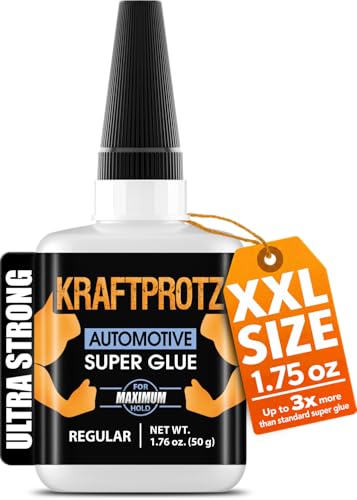
Unlike thick gel super glues that sit on the surface, the KRAFTPROTZ formula is a thin liquid that uses capillary action to wick into microcracks and tight gaps — exactly what you need for a hairline crack in a headlight housing or a loose trim clip that won’t hold with surface glue. The 1.76-ounce bottle is oversized for the category, giving you enough adhesive for multiple repairs or a single large job like reattaching a full bumper trim piece. The precision dropper tip lets you control flow even in cramped engine bay spaces.
The heat and oil resistance rating is critical here: this glue withstands temperatures from -40°F to 230°F and resists oil exposure, which means it survives underhood conditions that would turn standard super glue into a brittle mess. Owners have used it to reattach a side mirror housing after a garbage-can impact, fix a front bumper separating from a Golf R, and secure rubber RV molding — all with months of hold time. The slightly slower setup time compared to instant-dry adhesives is actually an advantage, giving you 2 to 3 minutes to position parts before clamping.
For non-structural repairs where a mechanical staple would be overkill or cosmetically unacceptable, this liquid CA glue is the cleanest solution. The German-engineered formula stays stable on the shelf longer than drugstore cyanoacrylate, and the anti-clog cap prevents the crusting that wastes so many standard glue bottles. Just note that it has a strong chemical odor — work with ventilation.
Why it’s great
- Thin capillary-action formula seeps into hairline cracks where gel glue cannot reach.
- Rated for 230°F heat and oil exposure — survives underhood conditions.
- Large 1.76 oz bottle with anti-clog tip provides many repairs per purchase.
Good to know
- Strong chemical odor requires ventilation during application.
- Requires 2-3 minutes of clamping pressure for full initial set.
4. WEP 960-V Plastic Welder Kit
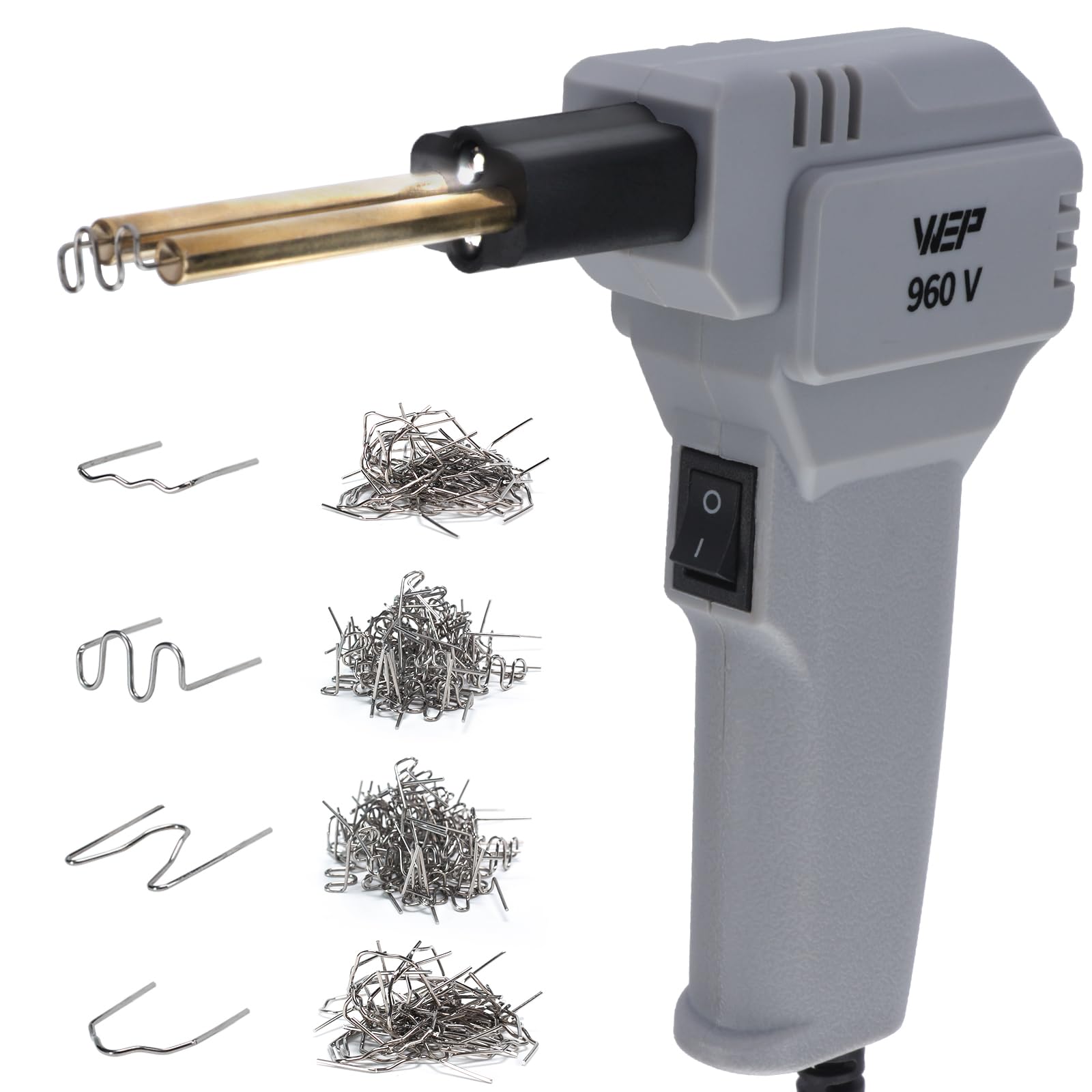
The WEP 960-V is a focused tool designed primarily for mechanics who need a no-frills plastic welder for specific, repeatable repairs. The 50-watt power rating is lower than the premium kits, but it heats the staple sufficiently for ABS bumper repairs and dashboard cracks. The built-in LED light is genuinely useful — it shines directly at the weld point, helping you see hairline fractures in the shadowy spaces behind a bumper or under a dash. The kit includes 200 staples in four profiles: outer corner, inner corner, small/straight, and large/curved, which covers the most common crack patterns without overwhelming you with choices.
Users report saving hundreds of dollars by using this welder to fix a tractor headlight housing and a Jeep glove box, noting that the tool is intuitive enough for first-time plastic welders. The anti-overheat protection is a welcome safety feature for extended repairs, and the 53.9-inch power cord gives you enough reach to work around a vehicle without an extension cord. The main limitation is the relatively low staple count — 200 staples means you will need to restock sooner if you tackle large bumper repairs, and the included pliers are functional but not premium.
For the DIY mechanic who owns one or two cars and wants to fix specific cracks without investing in a full workshop kit, the WEP 960-V is the right entry point. It does the core job — embedding hot staples into plastic — without the extra filler rods and mesh that add cost and complexity. Just remember that this tool produces fumes during operation; use a respirator mask in enclosed spaces.
Why it’s great
- LED light provides clear illumination on the weld point in low-light under-vehicle areas.
- Ergonomic handle and light weight reduce hand fatigue during multi-staple repairs.
- Anti-overheat protection adds safety for continuous use on large cracks.
Good to know
- Only 200 staples included — high-volume bumper work requires additional staple packs.
- Lower 50W power may struggle with very thick or dense plastic parts.
5. WRDLOSY Plastic Welder Kit
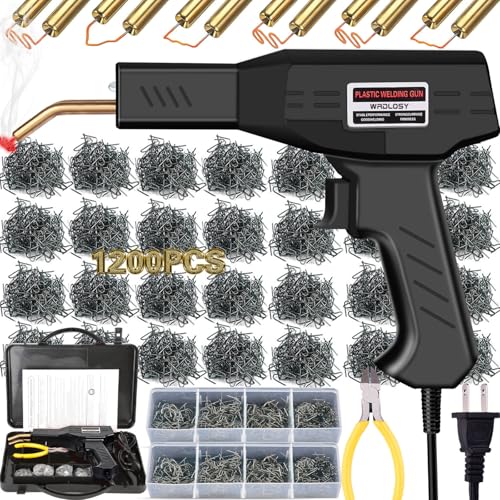
The WRDLOSY kit aims squarely at the budget-conscious DIYer who wants the highest possible staple count for the lowest entry price. The 1200-piece staple assortment — 200 outside corner, 200 inside corner, 300 flat, and 500 wave staples — ensures you won’t run out mid-project, even on a full bumper restoration. The tool itself heats up quickly and owners have successfully used it to fix cracked dash panels on a C4 Corvette, repair plastic snow shovels, and reinforce car bumpers. The ergonomic design fits comfortably in the palm, and the front light helps you see the repair area clearly.
The trade-offs are typical for this tier: the tool body gets noticeably hot during extended use, so you will need to pause between staple runs on large repairs. The included cutting pliers are functional but cheap — several users recommend replacing them with proper flush-cut pliers for clean leg trimming. The carrying case stores everything together, but it is a snug fit; spending a few minutes reorganizing staples into small bins improves the experience considerably. Some buyers noted that the instructions are minimal, so watching a few YouTube tutorials before your first repair is a smart move.
If you are new to plastic welding and want to test the waters without a significant financial commitment, the WRDLOSY kit gives you the full experience at the lowest possible cost. The 1200 staples alone justify the purchase if you plan multiple repairs, and the tool reliably performs the core task. Just pair it with a quality pair of cutters and take breaks to avoid overheating the device.
Why it’s great
- 1200 staples in four profiles provide enough material for a dozen or more repair jobs.
- Heats up quickly and holds the temperature well enough for dash and bumper cracks.
- Portable toolbox case keeps everything organized and easy to transport.
Good to know
- Tool body gets hot with continuous use — require breaks during larger repairs.
- Included cutting pliers are low quality; budget for a separate flush-cut plier.
FAQ
Can I use regular super glue on automotive plastic?
Is a plastic welder stronger than glue for bumper repairs?
How do I know if my plastic part is ABS or polypropylene?
Final Thoughts: The Verdict
For most users, the glue for automotive plastic winner is the ATOLS Upgraded Plastic Welder because its pure copper transformer and six-staple assortment deliver reliable mechanical holds on bumper cracks, dashboard breaks, and stressed joints without the premium price of professional-grade kits. If you want a liquid adhesive for tight cracks and non-structural trim repairs, grab the KRAFTPROTZ Automotive Super Glue. And for a complete restoration system with filler rods and sanding mesh, nothing beats the SONNLER 2 in 1 Plastic Welding Kit.