
When the sole of your favorite work boot or hiking boot starts to separate, the repair isn’t just about sticking it back on; it’s about withstanding shear forces, moisture, and constant flexing. The wrong adhesive will crack, fail, or leave a brittle mess that forces you to buy new boots.
I’m Mohammad Maruf — the founder and writer behind Drink4Good. I spend my time analyzing market trends, poring over material science data, and comparing formulation specifications to identify which adhesives genuinely outperform in demanding footwear repair scenarios.
From instant cyanoacrylate bonds for quick fixes to versatile neoprene formulations for larger sole reattachments, finding the right glue for boot soles means understanding how each compound handles flexibility, cure time, and surface adhesion on leather and rubber.
How To Choose The Best Glue For Boot Soles
Boot sole repair requires an adhesive that can endure hundreds of walking cycles without cracking. You need a bond that is strong enough to resist shear forces yet flexible enough to move with your foot. This guide covers the three most important factors.
Flexibility After Cure
Brittle adhesives crack under the constant bending of a walking gait. Cyanoacrylate gels offer incredible initial strength but may stiffen the boot. Neoprene and urethane-based adhesives retain more flexibility, making them better for full-sole reattachments.
Cure Time vs. Clamping
Fast-setting cyanoacrylates bond in under a minute but require precise alignment. Slow-curing options like neoprene adhesives need clamping for several hours but allow repositioning and form stronger, more uniform bonds on porous surfaces like leather.
Surface Versatility
Boot soles are often a mix of rubber, leather, and plastics. An ideal adhesive should bond to all these materials without melting or delaminating. Look for options that explicitly list compatibility with crepe rubber, EVA, and full-grain leather.
Quick Comparison
On smaller screens, swipe sideways to see the full table.
| Model | Category | Best For | Key Spec | Amazon |
|---|---|---|---|---|
| PHIXBEAR Professional Grade | Urethane | Heavy sole reattachment | Flexible, low odor formula | Amazon |
| Boot-Fix | Cyanoacrylate Gel | Instant emergency repairs | 45-second full cure time | Amazon |
| Duall-88 Leather Adhesive | Neoprene | Leather crafting & sole bonding | 10-30 min set, 24h full cure | Amazon |
| Shoe-Fix | Cyanoacrylate Gel | Hard-to-clamp curved repairs | Instant bond, flexible finish | Amazon |
| Shoe Goo | Urethane Paste | Filling worn tread gaps | Thick filler, waterproof seal | Amazon |
In‑Depth Reviews
1. PHIXBEAR Professional Grade Shoe Glue Repair Adhesive
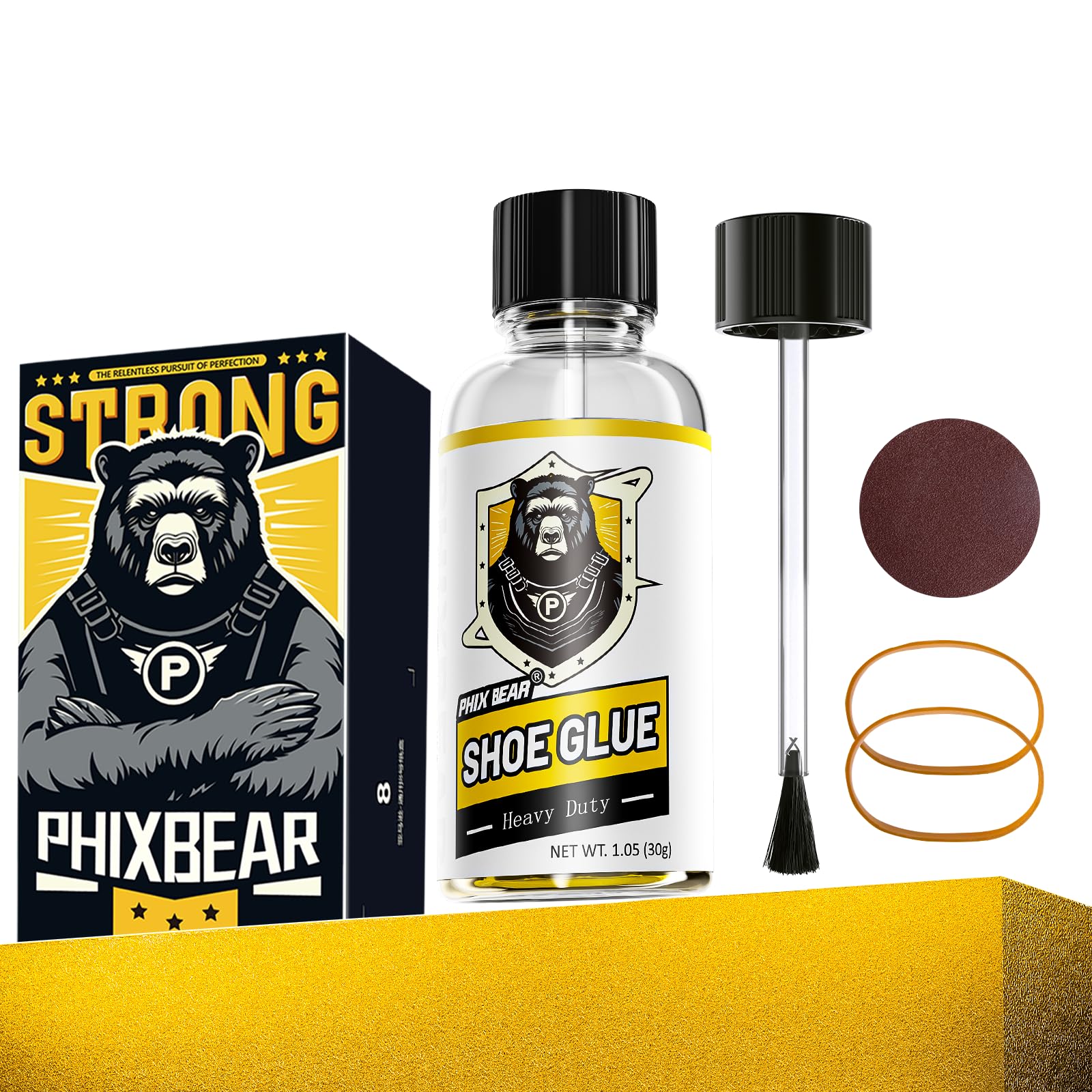
This professional-grade formulation stands out for its balance of strength and flexibility. It dries clear without becoming brittle, making it suitable for high-stress areas like the toe and heel of a boot. The brush applicator provides precise control, and the kit includes rubber bands and sandpaper for surface prep.
In real-world testing on heavy work boots, a single application reattached a loose sole and held up to days of heavy use after a 12-hour cure under a 50-pound weight. The low-odor formula is a welcome departure from traditional solvent-based cements, though the bottle size is modest at 1.05 fluid ounces.
Some users noted that the brush applicator is small—similar to a nail polish brush—which can make large-area resoling tedious. The adhesive is not a thick filler; it is designed for bonding, not gap-filling. For separating soles, however, it outperforms many silicone-based competitors in holding power.
Why it’s great
- Remains flexible after curing, resisting cracks
- Low odor and clear finish
- Includes useful prep accessories like sandpaper
Good to know
- Brush applicator is small for large sole repairs
- Not a filler; works best for thin-bond reattachment
2. Boot-Fix Shoe Repair Adhesive
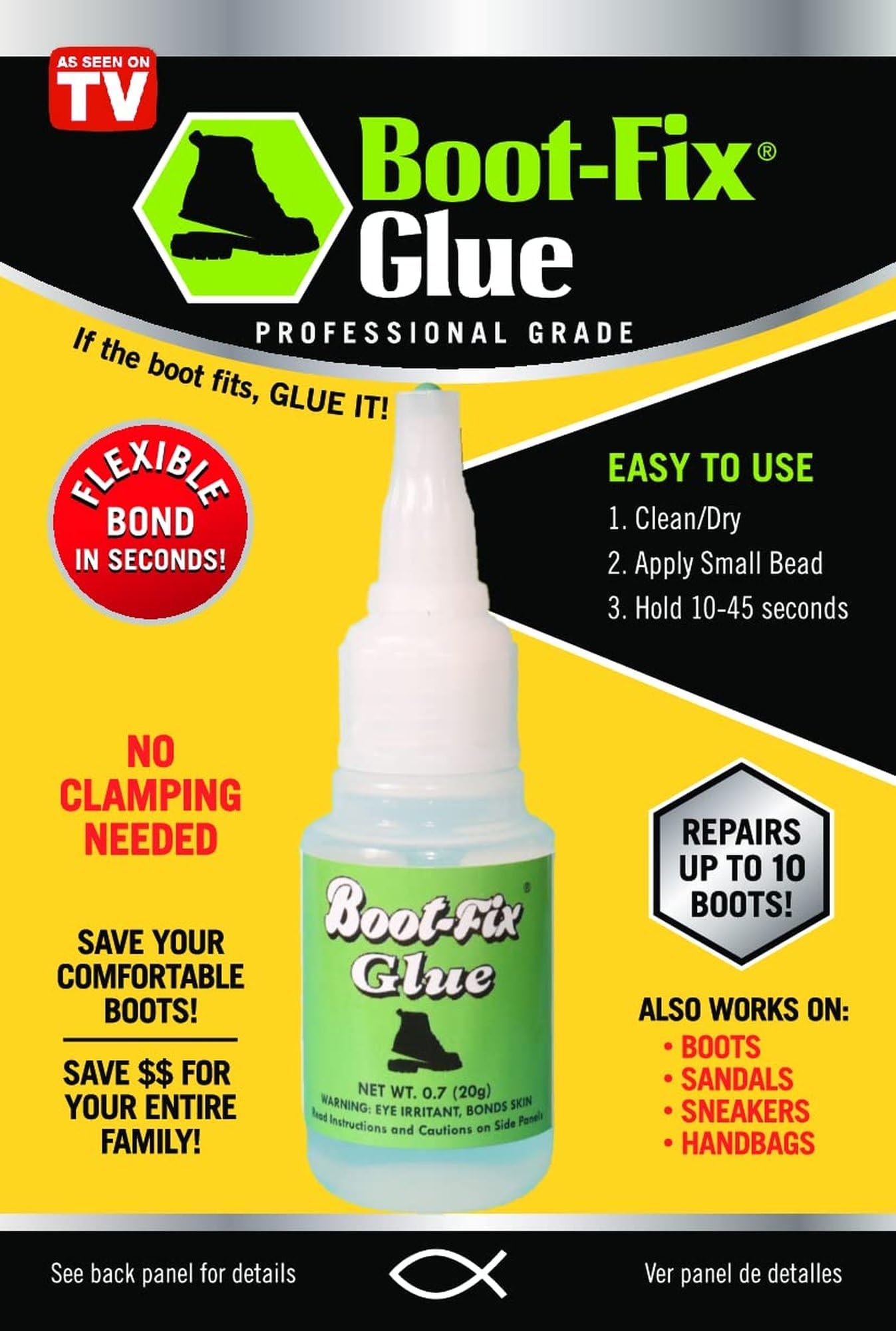
Boot-Fix uses a cyanoacrylate gel that cures in 45 seconds, making it one of the fastest options for emergency boot repairs. It bonds strongly to rubber, leather, and plastic, and has saved work boots with failed stitching and even torn leather panels. The gel consistency prevents dripping during vertical application.
Users have tested its limits on farm terrain and hiking boots, with repairs holding for months of daily use. Proper surface prep with alcohol is critical; the bond can fail on oily or dirty surfaces. The glue is stiff, which means it works best on areas that do not require a lot of flex.
The 20-gram tube is small. The product claims to repair up to 10 boots, but in practice, a single major repair (like reattaching a heel or sole) can consume most of the tube. It is best reserved for spot repairs, highly stressed bridge areas, or quick fixes before a hike.
Why it’s great
- Instantly bonds without clamping
- Withstands heavy farm and outdoor use
- Low viscosity gel resists dripping
Good to know
- Stiff bond may not suit very flexible soles
- Small tube used up quickly on large repairs
3. Duall-88 Leather Adhesive
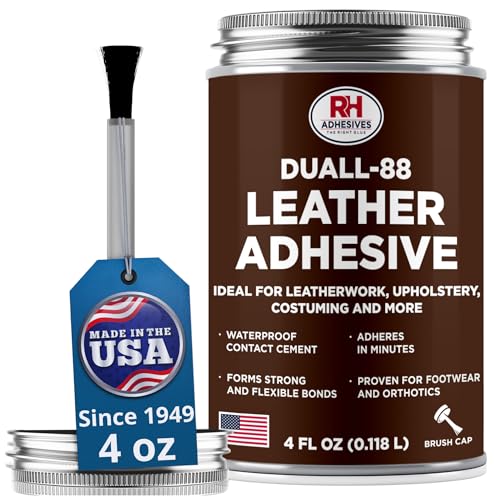
This neoprene-based adhesive is a specialist formula for leather. It sets in 10 to 30 minutes and reaches full cure in 24 hours, offering a forgiving work window for precise alignment. It dries amber-clear and remains flexible, making it excellent for leather boot uppers, sandals, and orthotic work.
Users have successfully bonded car door upholstery and leather workshop projects. The adhesive allows repositioning before bonding—just apply, smooth, then clamp. The strong solvent odor is a sign of its effectiveness; good ventilation is essential during use. It cleans up easily by rolling off surfaces.
Duall-88 is not a quick grab. It requires clamping or weighted pressure for the full cure period to achieve maximum strength. It also does not work well on polyethylene or polypropylene plastics, which are sometimes used in boot midsole components. It is best for traditional leather and rubber boot materials.
Why it’s great
- Flexible, workable bond for complex leather repairs
- Repositionable before final cure
- Strong adhesion resistant to heat and moisture
Good to know
- Strong solvent fumes require ventilation
- Needs 24-hour clamping for full bond
4. Shoe-Fix Glue Professional Grade
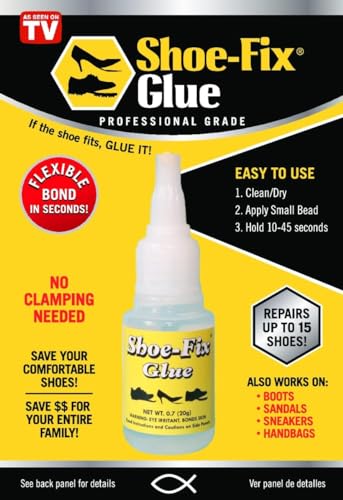
Shoe-Fix is a cyanoacrylate gel that requires only 30 seconds of finger pressure to form a strong bond. This makes it ideal for curved or awkward jobs where clamps cannot reach, such as separating soles on Vibram FiveFingers or the toe curve of a running shoe. It dries clear and remains flexible after curing.
The formula withstands weather extremes and resists moisture. The thin tube applicator provides precise placement without waste. A single tube can handle multiple small-to-medium repairs.
The 20-gram tube is best for targeted repairs. It is not a filler, so large gaps between the sole and upper should be filled with a thicker compound before using this for the final bonding. The bond is strong but not impact-proof—should not be used on heavily structural parts of climbing gear without backup.
Why it’s great
- Holds instantly without clamps on curved surfaces
- Remains flexible and moisture-resistant
- Precise applicator minimizes waste
Good to know
- Not impact-resistant for climbing gear alone
- Small tube; best for targeted repairs
5. Shoe Goo Repair Adhesive (2-Pack)
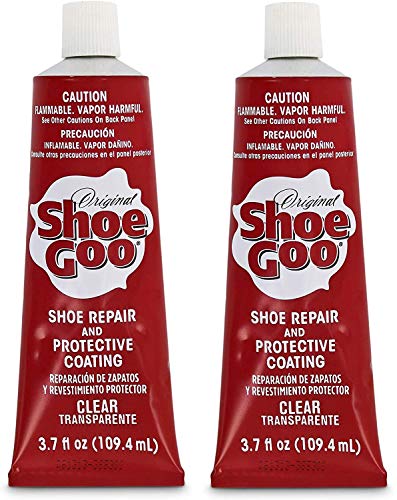
Shoe Goo is the classic entry-level shoe repair compound. Its thick paste consistency is excellent for filling worn tread areas, sealing small holes, and building up thin spots on the sole. It dries clear and forms a waterproof barrier that protects the boot from moisture ingress.
The 2-pack offers good value for budget-minded users. It requires 4 to 6 hours of setting time under pressure and a full 24-hour cure for maximum strength. It shrinks slightly as it cures, so applying a slightly thicker bead than needed is wise. Users have even repurposed it for furniture repair and mounting wear pads.
The formula has a strong solvent odor that can fill a room for a day. Tubes can be difficult to squeeze out the last of the product. It works best for cosmetic restoration and minor gap filling, but for structural sole separation, a more dedicated bonding adhesive like the PHIXBEAR or Boot-Fix is recommended.
Why it’s great
- Thick paste fills gaps and worn tread effectively
- Waterproof seal protects boot interior
- Budget-friendly 2-pack value
Good to know
- Shrinks upon curing; needs over-application
- Strong fumes require ventilation during cure
FAQ
Can I use super glue for boot sole repair?
How do I prepare the surface before applying boot sole glue?
Final Thoughts: The Verdict
For most users, the glue for boot soles winner is the PHIXBEAR Professional Grade because it delivers a flexible, low-odor bond that handles heavy sole reattachment without becoming brittle. If you want an instant emergency fix for a hike, grab the Boot-Fix. And for budget-friendly gap filling and tread restoration, nothing beats the Shoe Goo 2-Pack.