
The gap invites moisture, dirt, and further delamination, turning a two-minute fix into a replacement job if you choose the wrong adhesive.
I’m Mohammad Maruf — the founder and writer behind Drink4Good. Through months of market research and cross-referencing chemical specifications with real-world failure modes reported by over a hundred vehicle owners, I’ve identified the five adhesives that actually solve the specific problem of keeping car molding attached under heat, vibration, and weather exposure.
This guide breaks down each option by viscosity, cure behavior, and material compatibility so you can confidently choose the best glue for car molding without wasting time on products that won’t hold.
How To Choose The Best Glue For Car Molding
Automotive molding adhesives fall into three functional categories: liquid cyanoacrylates that wick into microgaps, gel cyanoacrylates that stay put on vertical surfaces, and urethane or tape-based systems that replicate factory bonds. Your vehicle’s material — ABS plastic, painted metal, rubber, or fiberglass — and the molding’s exposure to engine heat versus weather elements will dictate the right choice. Below are the three specs that separate a lasting bond from a weekend redo.
Viscosity — Thin vs. Gel vs. Tape
Thin cyanoacrylate flows into cracks as narrow as 0.005 inches, making it ideal for reattaching moldings that still have partial contact with the body. Gel versions remain where applied, perfect for overhead or vertical installation where gravity would pull liquid adhesive away. Double-sided molding tape offers zero-drip convenience and immediate re-positioning before the final press, but requires a clean, flat mating surface to achieve full contact.
Temperature and Oil Resistance
Engine bays and door sills experience thermal cycling from below freezing to over 200°F. A standard hardware-store super glue becomes brittle and loses shear strength at around 175°F. Look for adhesives explicitly rated to 230°F and certified as oil-resistant — otherwise, engine bay contaminants will break down the bond within weeks. Polyurethane windshield adhesives excel here because they remain flexible across a wide temperature range.
Open Time and Workability
Some cyanoacrylates set in 10 to 20 seconds, leaving no room for adjustment. For large trim pieces or complex moldings that curve around body lines, a longer open time (two to three minutes) lets you position the part accurately before the bond locks. Spray adhesives and urethane cartridges offer the longest work windows, making them suitable for shop-level installations where positioning precision is critical.
Quick Comparison
On smaller screens, swipe sideways to see the full table.
| Model | Category | Best For | Key Spec | Amazon |
|---|---|---|---|---|
| 3M 03614 Molding Tape (2-Rolls) | Double-Sided Tape | Factory trim reattachment | 30 lb holding force per square inch | Amazon |
| KRAFTPROTZ Automotive Super Glue Gel 1.76 oz | Gel CA | Vertical trim and bumpers | No-drip on vertical panels | Amazon |
| KRAFTPROTZ Automotive Super Glue Liquid 1.76 oz | Liquid CA | Microcracks and clips | Capillary action into 0.005 in gaps | Amazon |
| FORTIVO Polyurethane Windshield Adhesive | Polyurethane | Loose windshield moldings | Non-sag on vertical glass | Amazon |
| 3M Hi-Strength 94 ET Spray Adhesive | Spray Adhesive | Large surface laminations | Up to 60 min open time | Amazon |
In‑Depth Reviews
1. 3M 03614 Scotch-Mount 1/2″ x 15′ Molding Tape (2-Rolls)
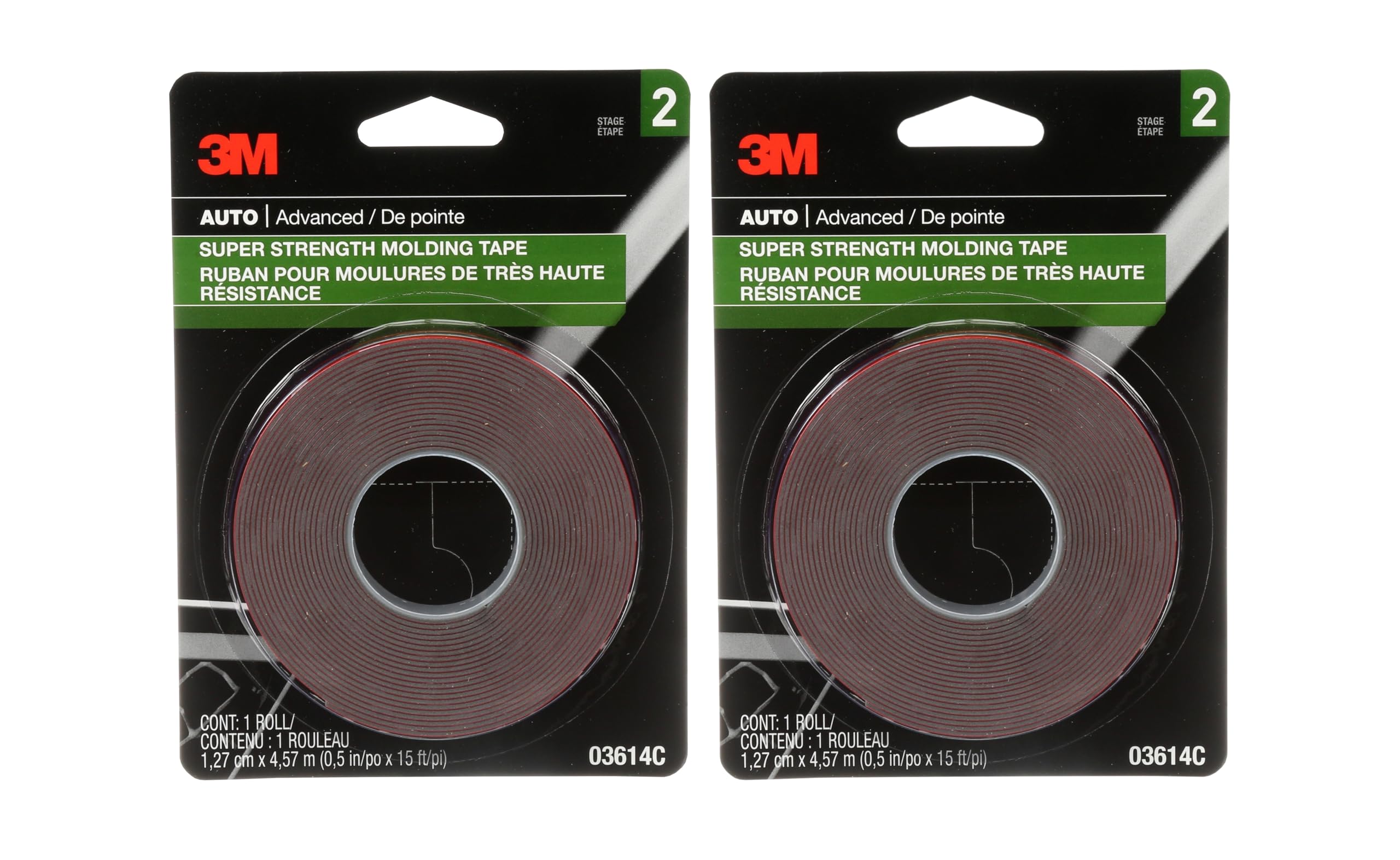
This is the same tape automotive OEMs use to attach body-side moldings and emblems at the factory. Each 15-foot roll produces a 1/2-inch-wide bond line that conforms to slightly curved panels without lifting at the edges — the foam core compresses to fill micro-gaps that liquid adhesives would leave hollow. Owners of 2018 Silverados and GMC Sierras report it surviving over a dozen automatic car wash cycles without a single molding shift, something no liquid CA adhesive has matched in the same scenario.
The application is bone-dry and mess-free: clean the surface with isopropyl alcohol, dry it, peel the red liner, press firmly for 30 seconds, and the full bond strength develops over 24 hours. Because there is no chemical outgassing or cure shrinkage, the tape maintains even pressure across the entire footprint — critical for long, thin moldings that tend to bow in the middle when clamped by point-contact adhesives. Each roll yields roughly 180 inches of usable tape, enough for a full set of door moldings on a sedan.
Where it falls short is on deeply textured or porous surfaces like rubber weatherstripping or unfinished plastic. The tape needs a smooth, tack-friendly substrate to reach its rated shear strength. For painted metal, clear-coated trim, and smooth ABS, however, this is the most predictable, vibration-proof option in the category.
Why it’s great
- Factory-quality hold on painted metal and smooth plastic
- Zero mess, no curing time, immediate reposition ability
- Survives automatic car washes better than any liquid glue
Good to know
- Requires a perfectly clean, dry, flat surface for maximum adhesion
- Does not bond well to porous rubber or textured raw plastic
- Once fully pressed, removal is difficult without damaging paint
2. KRAFTPROTZ Automotive Super Glue Gel 1.76 oz
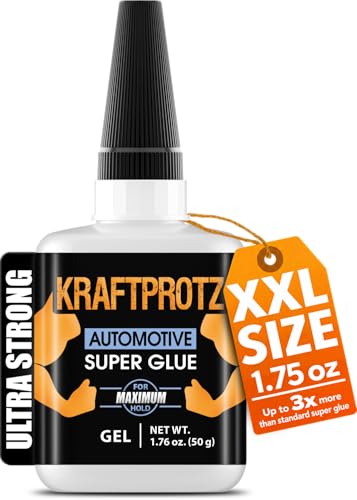
The gel formulation solves the primary frustration of liquid super glues on trim: runoff. Apply this to a vertical A-pillar molding or a door belt-line trim, and it stays exactly where you put it — no tears of glue running down the paint. The thixotropic index is high enough that a 3 mm bead holds its shape on an overhead headliner without sagging, yet it wets out enough to bond ABS, rubber, and fiberglass within 20 seconds of pressure.
Temperature tolerance is rated to 230°F, which covers engine-adjacent moldings and black trim panels that absorb solar heat during summer parking. One owner repaired a separation on a Golf R front bumper — a known weak point that typically sends owners to a body shop — and reported the gel held through highway vibration and thermal expansion without cracking. The anti-clog tip keeps the nozzle clear even if you leave the bottle in the garage for two months between repairs.
The trade-off is a slower fixture time than the liquid version: expect 2 to 3 minutes of finger clamping or tape holding before the bond reaches handling strength. For vertical trim that needs immediate hold without clamps, this is the most reliable liquid-free option in its tier.
Why it’s great
- Stays on vertical and overhead panels without dripping
- Withstands engine bay temperatures and road vibration
- Large 1.76 oz bottle lasts through multiple trim repairs
Good to know
- Requires clamping for 2-3 minutes during cure
- Packaging may arrive with German labeling only
- Gel leaves a slight residue if you need to reposition
3. KRAFTPROTZ Automotive Super Glue Liquid 1.76 oz XXL
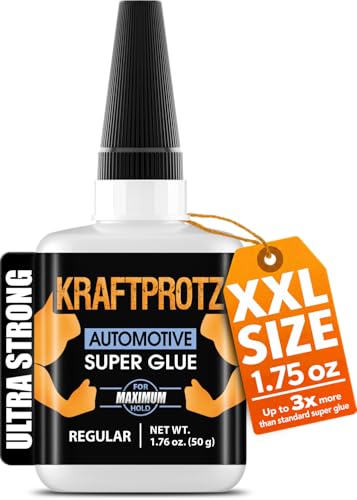
When a molding is still mostly attached but has lifted along a hairline crack from a pressure washer or road debris, a thin CA glue is the only tool that can wick into that gap without disassembly. This liquid from KRAFTPROTZ has a viscosity comparable to water — it flows into seams as narrow as 0.005 inches and wets both surfaces simultaneously, creating a bond that is stronger than the surrounding plastic. Users have repaired leather seat holes and cracked dashboard panels with it, reporting invisible, clear results that last months.
The cure time of 4 hours to full strength is slower than standard super glues, but that is actually an advantage for trim repair: it gives you 2-3 minutes of adjustment time before the bond locks, which prevents the permanent misalignment that fast-setting drops cause. The dropper tip delivers one drop at a time, so you can feed the glue along a 12-inch molding seam without flooding the paint. Oil and heat resistance up to 230°F mean it holds on driving lamp housings and underhood clips exposed to grime.
Downsides include the packaging language issue — several units ship in entirely German-labeled bottles — and the fact that liquid CA cannot bridge gaps larger than 0.01 inches. For moldings that have pulled completely away from the body, you need the gel or tape version instead.
Why it’s great
- Wicks into microcracks that gel and tape cannot reach
- Long working time allows precise positioning
- Clear finish that disappears on dark trim
Good to know
- Not for gaps wider than a hairline crack
- Packaging may be entirely in German
- Slow cure requires taping the part in place for an hour
4. FORTIVO Polyurethane Windshield Adhesive
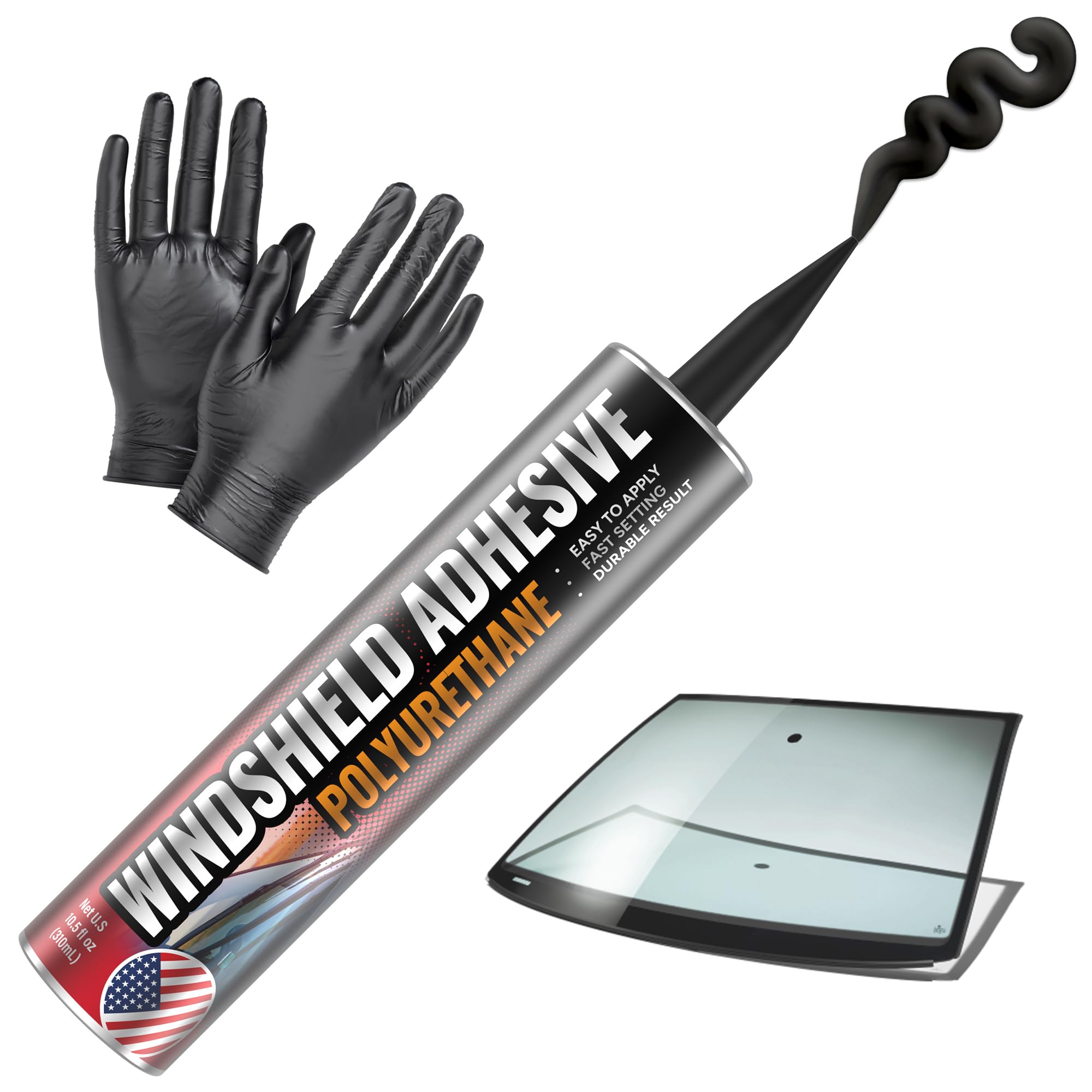
When a windshield molding has lifted or a backlight trim piece needs to be seated with genuine structural strength, a polyurethane adhesive is the correct answer. This FORTIVO cartridge dispenses through a standard caulking gun and applies a thick, non-sagging bead that is tacky enough to hold glass panels in vertical orientation without tape. One owner used it to reinstall a 16×12 inch tractor window at 40°F ambient temperature — 24 hours later the bond supported the full weight of the glass without any additional fasteners.
The urethane chemistry absorbs vibration and thermal expansion better than cyanoacrylate, making it suitable for moldings that bridge between glass and painted metal—areas where differential expansion rates cause rigid glues to shear. The included gloves and applicator tip are genuinely useful because polyurethane sticks aggressively to skin and requires cleanup with mineral spirits before cure. A 310 ml tube covers roughly 30 linear feet of ¼-inch bead, enough for a full windshield surround plus a rear window molding.
The main limitation is application speed: polyurethane requires a caulking gun, and the 24-hour full cure means the vehicle should stay stationary overnight. For small trim pops or emblem reattachment, it is overkill — reserve this for loose glass-edge moldings and large panels where structural integrity matters.
Why it’s great
- Genuine structural bond suitable for glass-edge moldings
- Remains flexible across extreme temperature swings
- Non-sag formula holds vertical panels without tape
Good to know
- Requires a caulking gun for application
- Full cure takes 24 hours
- Extremely sticky — gloves are mandatory, not optional
5. 3M Hi-Strength 94 ET Spray Adhesive
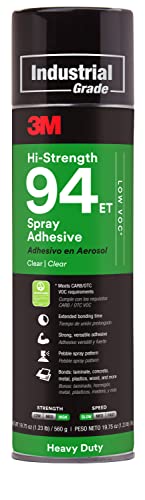
This spray adhesive is not the first tool you reach for when a single trim clip pops off, but it is the right choice when you are bonding a large area — such as foam-backed headliner fabric, carpet over plastic molding, or a laminate panel against a metal door surface. The 94 ET formula provides a 60-minute open time, which means you can spray both surfaces, wait for the tack to develop, and still have 45 minutes to align a long, awkward molding before the bond locks. That flexibility is unmatched by any CA or tape product.
The GREENGUARD and Low VOC certifications are relevant for interior work: you get industrial-strength adhesion without the solvent headache that older spray adhesives cause. Users report it holding foam sound deadening to plastic door panels through freezing temperatures, and the aggressive tack means even porous materials like felt-backed rubber grab immediately on contact. For large, non-structural moldings where even pressure across the entire back surface matters, spraying beats any bead or tape application.
The catch is overspray control. This is not a precision tool — masking off surrounding paint is mandatory, and the adhesive dries to a tacky film that collects dust if left exposed. For small trim repairs, the tape or gel options are cleaner and faster.
Why it’s great
- 60-minute open time allows perfect alignment
- Bonds large surface areas like headliner and carpet trim
- Low VOC and GREENGUARD certified for interior use
Good to know
- Overspray requires careful masking of surrounding paint
- Not suitable for small, targeted trim clip repairs
- Strong solvent smell — wear ventilation and gloves
FAQ
Can I use windshield urethane for plastic door trim molding?
How do I remove old molding adhesive residue before applying new glue?
Will gel super glue damage my car paint if it drips on the panel?
Final Thoughts: The Verdict
For most users, the best glue for car molding winner is the 3M 03614 Molding Tape because it delivers factory-consistent hold on painted trim without mess, cure time, or the risk of paint damage. If you need to repair a loose vertical molding that tape cannot reach, grab the KRAFTPROTZ Gel for its no-drip vertical grip. And for heavy structural glass-edge moldings or large panel reattachment, the FORTIVO Windshield Adhesive provides the vibration-proof, flexible bond that rigid glues cannot match.