
Nothing ruins a fresh linoleum install faster than peeling edges, bubbling seams, or tiles that shift underfoot. The wrong adhesive turns a weekend project into a constant maintenance headache, leaving you with gaps that collect dirt and moisture.
I’m Mohammad Maruf — the founder and writer behind Drink4Good. I’ve spent hundreds of hours analyzing adhesive chemistry, reading through technical data sheets, and cross-referencing real-world feedback to find the glue that actually holds linoleum flat, season after season.
After digging through certifications, cure times, and substrate requirements, the clear choice for most installations is glue for linoleum flooring that balances immediate grab with long-term moisture resistance.
How To Choose The Best Glue For Linoleum Flooring
Linoleum is a dense, natural material made from linseed oil, cork dust, and wood flour. It doesn’t absorb water the way wood does, so the adhesive must create a mechanical and chemical bond on a non-porous surface. Choosing the wrong glue leads to delamination within months.
Open Time and Tack
Open time is the window you have to place and adjust the linoleum after applying adhesive. A glue with at least 30 minutes of open time gives you room to align sheets perfectly. Tack — the initial stickiness — must be aggressive enough to hold the material flat without constant weighting.
Moisture and Solvent Resistance
Linoleum floors are common in kitchens and bathrooms where spills happen. The adhesive must resist water penetration at the seams and prevent the linoleum from curling when exposed to humidity. Look for adhesives that pass Type II water-resistance testing or list moisture resistance explicitly in the specifications.
VOC Compliance and Indoor Air Quality
Solvent-based adhesives often produce strong fumes during application. GREENGUARD certification and CARB compliance mean the glue meets strict limits on volatile organic compounds, making it safer for indoor use, especially in enclosed spaces where ventilation is limited.
Substrate Compatibility
Not every glue bonds to every subfloor. Concrete, plywood, terrazzo, and existing vinyl each require a specific adhesive chemistry. Check that the adhesive explicitly lists your subfloor material before buying, and avoid universal claims that don’t specify tested surfaces.
Quick Comparison
On smaller screens, swipe sideways to see the full table.
| Model | Category | Best For | Key Spec | Amazon |
|---|---|---|---|---|
| 3M Hi-Strength 94 ET Spray Adhesive | Spray | Large surface laminations | 60-minute open time | Amazon |
| Roberts 3085 Multipurpose Adhesive | Trowel | Felt-back sheet vinyl | Solvent-free SBR latex | Amazon |
| 3M Hi-Strength 90 CA Spray Adhesive | Spray | Permanent bond to concrete | Adjustable nozzle spray pattern | Amazon |
| ROBERTS Universal Resilient Flooring Adhesive | Trowel | LVT and vinyl-backed tile | Microban antimicrobial protection | Amazon |
| Titebond 2104 Tongue and Groove Glue | Bottle | Floating floor groove sealing | Type II water-resistant | Amazon |
In‑Depth Reviews
1. 3M Hi-Strength 94 ET Spray Adhesive
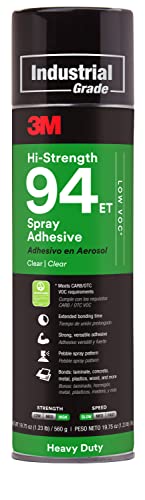
The 3M Hi-Strength 94 ET delivers a 60-minute bonding range, giving you a full hour to position linoleum sheets before the adhesive sets. That long open time is a practical advantage when aligning large sheets with tight seams. The spray format applies evenly across wide surfaces without the ridges or puddles that trowel-applied glues sometimes create.
This adhesive is GREENGUARD certified and CARB compliant, which keeps the solvent fumes under control compared to older spray adhesives. Customers report reliable bonding to plastic and foam substrates, which mirrors the non-porous challenge linoleum presents. The aggressive tack holds material flat even in cold conditions, reducing the risk of curling edges during installation.
The 19.75-ounce can covers roughly 30 to 40 square feet depending on spray thickness, and the full cure completes in 24 hours. The strong smell during application calls for good ventilation, but the long-lasting hold and low VOC profile make this a versatile choice for linoleum installations that demand repositioning flexibility.
Why it’s great
- 60-minute open time allows precise sheet alignment
- GREENGUARD certified with low VOC emissions
- Uniform spray coverage prevents bonding weak spots
Good to know
- Strong chemical smell requires ventilation during use
- Spray overspray must be masked off from adjacent areas
2. Roberts 3085 Multipurpose Adhesive
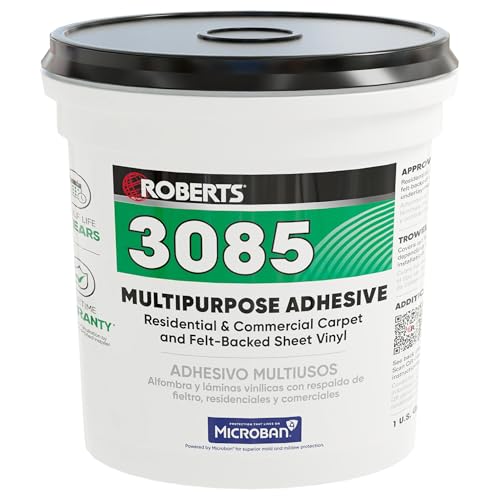
The Roberts 3085 is a solvent-free SBR latex adhesive formulated specifically for felt-back sheet vinyl and acoustical cork underlayment — two materials that share linoleum’s dense, non-woven backing. The fast-setting formula allows floor traffic within 30 minutes of application, which accelerates installation compared to glues that require overnight drying before walking.
This glue bonds to concrete, APA-rated plywood, terrazzo, and properly prepared VCT, covering the most common subfloor types found in kitchens and bathrooms. Real users report covering roughly 92 square feet per gallon when applied in a thin layer, making it a cost-effective option for medium-sized rooms. The low odor compared to solvent-based adhesives makes it more tolerable for indoor use without respiratory gear.
The main caveat is packaging consistency — some units arrive with broken seals or leaking lids, so inspect the pail before opening. The adhesive works best on smooth, clean substrates, and rough or dusty subfloors may reduce the bond strength. For a basic linoleum installation over plywood, this is a reliable, no-fuss choice.
Why it’s great
- Solvent-free formula with minimal odor
- Fast 30-minute set time for quick foot traffic
- Economical coverage at roughly 90 sq ft per gallon
Good to know
- Packaging may arrive with leaking seals
- Not ideal for vertical applications or high-moisture areas
3. 3M Hi-Strength 90 CA Spray Adhesive

The 3M Hi-Strength 90 CA is the heavy-duty sibling of the 94 ET, engineered for permanent bonds on dense materials like laminate, concrete, and metal. Its adjustable nozzle lets you choose between a wide fan pattern for large linoleum sheets and a narrow stream for edges and seams. The contact-type formula requires applying adhesive to both surfaces, letting it dry, then pressing them together for an immediate high-strength bond.
This glue resists moisture and high temperatures, which is critical in kitchens where warm floors and spills are daily realities. Real-world users report success bonding linoleum directly over 1960s ceramic tile, solving the adhesion problem that self-stick tiles could not handle. The fast tack means there is no repositioning window — alignment must be perfect on the first attempt.
At 19 ounces, the can covers roughly 25 to 35 square feet per spray coat, and the adhesive dries clear. The strong fumes demand excellent ventilation and respiratory protection. The spray pattern can sometimes come out lumpy like silly string if the nozzle is not adjusted correctly, so test on a scrap piece first.
Why it’s great
- Adjustable nozzle fits large sheets and detail work
- Permanent bond resists moisture and heat
- Works over difficult substrates like existing tile
Good to know
- No repositioning window after contact
- Strong fumes require good ventilation and PPE
4. ROBERTS Universal Resilient Flooring Adhesive

The ROBERTS Universal Resilient Flooring Adhesive uses an acrylic latex, solvent-free, pressure-sensitive formula that generates high initial strength without the strong fumes of spray adhesives. It is designed for luxury vinyl tile, luxury vinyl plank, vinyl composition tile, vinyl sheet goods, and vinyl-backed carpet tile — all materials that bond similarly to linoleum. The pressure-sensitive chemistry means the floor remains slightly repositionable immediately after laying, then locks permanently as the adhesive cures.
Microban antimicrobial protection is built into the formula to inhibit bacterial and fungal growth beneath the flooring, which is a meaningful advantage in damp basements or bathrooms where mold can form between the subfloor and the linoleum. Users report that the glue remains workable for a long time — enough to spread a full room before placing the floor — and that it holds firmly even in outdoor conditions with snow, mud, and rain.
The one-gallon pail covers roughly 50 to 60 square feet depending on trowel notch size, and the full cure takes about 24 hours. Some pails arrive with leaking lids, so check the seal at delivery. The adhesive dries clear, which prevents ugly squeeze-out stains along seams.
Why it’s great
- Microban protection fights mold under flooring
- Long working time for room-wide spreading
- Dries clear to hide seam squeeze-out
Good to know
- Some pails arrive with damaged seals
- Medium odor requires some ventilation
5. Titebond 2104 Tongue and Groove Glue

The Titebond 2104 is formulated specifically for tongue and groove laminate and floating floors, but its water-resistant properties make it a smart choice for gluing linoleum seams in moisture-prone areas. The polymer or synthetic rubber-based formulation passes Type II water-resistance testing, meaning it holds up against incidental moisture without breaking down at the edges.
The ergonomic bottle with a precision tip makes it easy to run a bead along groove channels without excess squeeze-out. Customers report that one 16-ounce bottle covers roughly 100 square feet when working with 3-inch-wide boards, and the bond strength often exceeds the material itself — the floor will tear before the glue joint fails. It is also FloorScore certified, which means it meets strict indoor air quality standards for low emissions.
This glue works best as a supplemental seam sealer alongside a primary linoleum adhesive rather than as the sole bonding agent for full sheets. The cure time is shorter than trowel-applied adhesives, but the bottle format limits its use to edge and groove applications rather than full-surface coverage.
Why it’s great
- Type II water-resistant for moisture-prone seams
- Precision tip applicator controls bead placement
- FloorScore certified for low emissions
Good to know
- Best used as a seam sealer, not full-surface adhesive
- Small bottle format limits large-area coverage
FAQ
Can I use spray adhesive instead of trowel-applied glue for linoleum?
How long does linoleum glue need to dry before walking on it?
What is the difference between Type I and Type II water resistance in floor adhesives?
Final Thoughts: The Verdict
For most users, the glue for linoleum flooring winner is the 3M Hi-Strength 94 ET Spray Adhesive because its 60-minute open time and GREENGUARD certification deliver both flexibility and safety for indoor installation. If you want a solvent-free option with fast set time, grab the Roberts 3085 Multipurpose Adhesive. And for permanent bonding over difficult substrates like existing tile, nothing beats the 3M Hi-Strength 90 CA Spray Adhesive.