
Plastic model kits from Bandai, Tamiya, and Games Workshop demand a glue that chemically fuses polystyrene rather than simply coating the surface. The wrong adhesive leaves chalky residue, brittle joints, or warped panels that ruin hours of careful assembly.
I’m Mohammad Maruf — the founder and writer behind Drink4Good. I’ve analyzed dozens of solvent cements and tube adhesives, comparing evaporation rates, applicator precision, bond strength on bare plastic, and gap-filling behavior to separate the formulas that deliver seamless joins from those that frustrate modelers.
Whether you are snap-fitting Gunpla or scratch-building a diorama, the right glue for plastic models determines whether your project looks like a factory piece or a failed experiment.
How To Choose The Best Glue For Plastic Models
Selecting the right cement comes down to the plastic type, the joint gap, and your working speed. Tube glues build thicker fillets for filling seams, while thin solvents wick into tight joints without swelling the surface.
Thin vs Thick Viscosity
Thin cements like Tamiya Extra Thin flow by capillary action into hairline gaps and set in seconds. Thicker tube cements remain workable longer and bridge larger gaps but require clamping and can leave visible residue if over-applied.
Applicator Type
Brush applicators allow controlled spreading over long seams, while fine-tip nozzles target small contact points. A dropper bottle without a brush demands steady hands to avoid pooling that melts unintended areas.
Solvent Strength and Plastic Compatibility
Most styrene-based kits bond with butanone or methyl ethyl ketone solvents. ABS plastics need a stronger MEK blend. Epoxy and resin materials reject solvent cements entirely and require cyanoacrylate or two-part epoxy.
Quick Comparison
On smaller screens, swipe sideways to see the full table.
| Model | Category | Best For | Key Spec | Amazon |
|---|---|---|---|---|
| Tamiya 87038 Extra Thin Cement 2-Pack | Thin Solvent | Accuracy on small parts | Capillary-action brush bottle | Amazon |
| Tamiya 87012 Plastic Cement 3-Piece Set | Thin Solvent | Multiple open bottles | Brush applicator, 20ml bottles | Amazon |
| Tamiya 87038 Extra Thin Cement 3-Pack | Thin Solvent | Long-term supply | 1-hour full cure time | Amazon |
| Testors Cement & Pixiss Tool Kit | Thick Paste | All-in-one starter kit | 2 tubes 0.88 fl oz each | Amazon |
| The Army Painter Hobby Tool Kit | Mixed Kit | Wargaming miniatures | Includes super glue & 6 tools | Amazon |
In‑Depth Reviews
1. Tamiya 87038 Extra Thin Cement 2-Pack

This two-bottle Tamiya Extra Thin set delivers the benchmark blend of solvent strength and capillary flow that serious modelers rely on for seamless joins on bare polystyrene. The brush-in-cap applicator lets you touch the seam and watch the glue wick across the joint — no pooling, no melted fingerprints.
Packed in 40ml bottles with a semi-runny viscosity that dries in under a minute, it handles everything from Gunpla armors to Warhammer infantry arms. Several users confirm the glue melts plastic to fuse parts permanently, and they mix it with sprue goo to fill gaps and sink holes with a matching material.
The compact bottle fits easily in hand, and two bottles provide enough adhesive for dozens of kits. Strong fumes require open workspace or ventilation, and the thin formula can ruin surface detail if it seeps under masking tape, but careful application avoids those risks completely.
Why it’s great
- Capillary-action brush spreads glue precisely along seams
- Solvent-welds polystyrene for strongest plastic-to-plastic bond
- 2-bottle pack provides long-lasting supply
Good to know
- Thin formula can overspill and damage surface detail if over-applied
- Strong fumes require good ventilation
2. Tamiya 87012 Plastic Cement 3-Piece Set
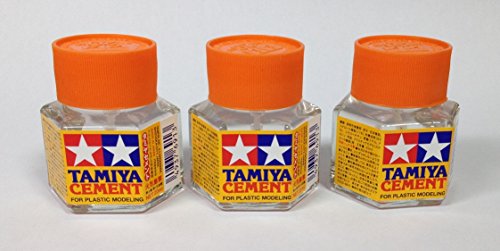
This three-bottle set provides 20ml each of Tamiya’s standard thin cement, perfect for modelers who keep separate bottles for different workstations or want a backup supply. The brush applicator delivers a consistent wet bead along long seams and into recessed joints without wasting adhesive.
Users report a slightly thicker viscosity than the Extra Thin line, giving about ten seconds of repositioning time before the bond sets. It still solvent-welds styrene for permanent fusion, and the bottles last several months each under regular use. Several veteran builders call it the best general-purpose plastic cement available.
The Japanese retail packaging includes instructions only in Japanese, but the glue itself needs no translation—brush on, press, hold, done. Strong odor is consistent with solvent cements, so ventilate your work area. The tubes are small enough to pack in toolboxes for travel builds.
Why it’s great
- Three bottles provide ample supply for extended projects
- Brush applicator reaches tight joints with minimal waste
- Dries fast but allows brief repositioning of parts
Good to know
- Stronger odor than some budget adhesives
- Instructions are in Japanese only
3. Tamiya 87038 Extra Thin Cement 3-Pack

The three-bottle version of Tamiya’s Extra Thin formula gives heavy-duty builders a rotating stock so they never run dry mid-project. Each 40ml bottle contains the same capillary-action solvent that melts polystyrene into a single piece, leaving no gap or glue ridge.
Multiple customer reviews highlight the ability to mix spilled sprue into the glue to create spruegoo — a gap-filling paste identical in color and composition to the kit plastic. The glue dries clear and fast, and primer adheres to the cured surface without issues. Modelers report each bottle lasting six to eight months with regular use.
The fine-tip applicator offers more control than the brush-in-cap design of the standard thin cement, making it better for delicate areas where any overflow would ruin panel lines. Still, the thin formula demands steady hands and a calm environment—fumbled caps cause leaks that melt through plastic bins.
Why it’s great
- Extra-thin formula wicks into the tightest seams by capillary action
- Can be mixed with sprue to create custom gap-filler paste
- Three bottles offer excellent long-term value
Good to know
- Leaks can damage storage containers if caps are loose
- Does not work on resin, metal, or 3D-printed materials
4. Testors Cement & Pixiss Model Tool Kit

This bundle pairs two 0.88-ounce tubes of Testors plastic cement with a full 12-piece Pixiss tool kit, including cutters, tweezers, polishing bars, and a storage case. It is designed for beginners who need both adhesive and basic assembly instruments in one purchase.
Testors cement is a thicker, slower-drying paste that builds fillets on visible seams and takes longer to sand smooth. It works well on larger vehicle and mecha kits where you want to fill gaps before painting, but the thicker viscosity makes it less suitable for delicate or highly detailed parts where precision matters.
The included tools cover the essentials—side cutters for removing parts from sprue, tweezers for handling small decals, and sanding bars for seam cleanup. The transparent carrying case keeps everything organized. Several users noted the glue forms strong bonds on polystyrene and ABS, but beginners should apply sparingly to avoid squeeze-out on visible surfaces.
Why it’s great
- Complete starter kit with tools and glue in one bundle
- Thicker paste fills gaps and seams effectively
- Quick-drying formula sets faster than standard tube cement
Good to know
- Thick glue not ideal for tiny or delicate joints
- Requires careful application to avoid visible residue on seams
5. The Army Painter Hobby Tool Kit
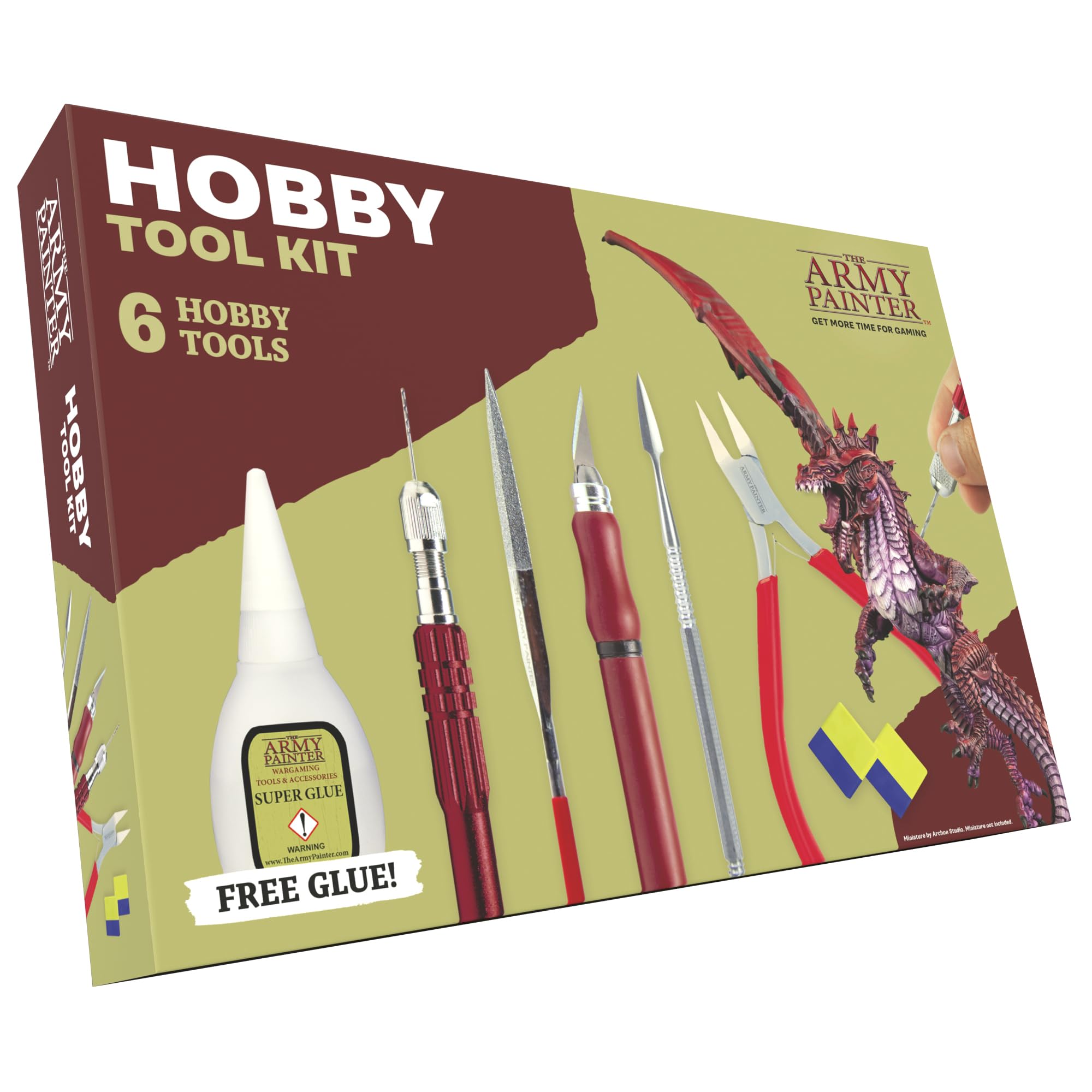
The Army Painter kit targets wargamers building Warhammer and D&D miniatures from plastic, resin, and metal—materials that reject standard polystyrene cement. This set includes a 5g super glue that bonds those non-styrene surfaces in seconds without waiting for solvent evaporation.
Beyond the adhesive, the toolkit contains a hobby knife with a sharp blade, side cutters for sprue removal, a hand drill with three bits, a sculpting tool, and Green Stuff epoxy putty for converting and gap-filling. The included painting technique guide helps new painters start their miniature armies.
User feedback praises the precision of the tools, especially the hand drill and razor handle, though the super glue tends to string and dry slower than some dedicated cyanoacrylates. Some customers reported the glue was missing from their package, which is a packaging inconsistency to check upon delivery.
Why it’s great
- Super glue works on plastic, resin, and metal miniatures
- Includes six essential tools for assembly and conversion work
- Green Stuff putty and painting guide add value for beginners
Good to know
- Super glue dries slowly and tends to form strings
- Some units arrived without the advertised free glue tube
FAQ
Can thin cement glue be used on painted plastic models?
What is spruegoo and how does it relate to plastic cement?
Does plastic model glue work on resin or 3D-printed miniatures?
Final Thoughts: The Verdict
For most users, the glue for plastic models winner is the Tamiya 87038 Extra Thin Cement 2-Pack because it combines precision capillary action, fast cure, and two-bottle value that suits both Gunpla builders and Warhammer hobbyists. If you want a complete starter kit with tools and thick-paste glue, grab the Testors Cement & Pixiss Tool Kit. And for wargamers assembling mixed-material miniatures, nothing beats the The Army Painter Hobby Tool Kit for its super glue and versatile tools in one box.