
A single pinhole leak in a buried irrigation line or a pressure joint that pops loose inside a wall can undo hours of trenching or framing. The difference between a bond that lasts decades and one that fails under the first pressure test comes down to picking the right solvent cement for the specific pipe schedule, diameter, and job temperature. Not all formulas fill gaps the same way, and using the wrong viscosity on a 4-inch drain line is a fast track to rework.
I’m Mohammad Maruf — the founder and writer behind Drink4Good. I’ve spent years analyzing adhesion chemistry across plumbing, irrigation, and PVC fabrication applications, cross-referencing ASTM standards with real-world user feedback to separate marketing claims from measurable performance.
The most common mistake DIYers and even seasoned plumbers make is treating all cement the same when it comes to pressure-rated joints. This guide breaks down the specific formulations, working times, and temperature tolerances that define the best glue for pvc pipe, so you can match the right product to the pipe diameter, schedule, and installation environment without guesswork.
How To Choose The Best Glue For PVC Pipe
Selecting PVC solvent cement isn’t a one-size-fits-all decision. The joint’s strength depends on matching the cement’s body, set time, and chemical formulation to the pipe’s diameter, schedule rating, and the job site temperature. Here are the three critical factors to evaluate before you open a can.
Pipe Diameter Determines Body Viscosity
Solvent cement viscosity is categorized as regular, medium, or heavy-bodied. For pipes under 3 inches in diameter, regular-bodied cement flows easily and creates a strong bond with standard interference-fit joints. For pipes 4 to 12 inches, a heavy-bodied formula like the Oatey 30850 is mandatory — its thick consistency fills the larger gaps in loose-fitting joints and prevents the cement from dripping out before the bond forms. Using a thin cement on a large-diameter pipe guarantees a weak, leak-prone joint.
Set Time Versus Working Temperature
Chemical curing rates accelerate in warm conditions and slow dramatically in cold weather. Most general-purpose cements specify an application window between 40°F and 110°F. In cold conditions, a fast-setting cement may gel before you have time to insert the pipe fully, while a slow-setting formula gives you the needed working time for large assemblies. The Weld-On 711, for example, offers a medium set that balances positioning flexibility with a reasonably quick cure for Schedule 80 applications.
ASTM and NSF Certifications for Pressure Systems
If the joint will carry potable water or operate under pressure, the cement must carry an NSF/ANSI 61 or ASTM D2564 listing. These certifications verify that the formula meets health-effect standards for drinking water and that the bond strength meets the pressure rating of the pipe. Products like the Oatey 30850 carry these listings explicitly, while specialty adhesives such as HH-66 are explicitly marked not for ASTM/NSF-listed PVC plumbing pipe — a critical distinction for code-compliant installations.
Quick Comparison
On smaller screens, swipe sideways to see the full table.
| Model | Category | Best For | Key Spec | Amazon |
|---|---|---|---|---|
| Oatey 30850 | Heavy-Bodied | Large-diameter pressure pipe up to 12″ | Max pipe diameter: 12″ (interference) | Amazon |
| HH-66 Vinyl Cement | Waterproof Contact | Flexible vinyl and pool liner repairs | Service range: -30°F to 150°F | Amazon |
| Titebond PVC Trim | Cyanoacrylate Gel | PVC trim miter and scarf joints | Full cure time: 8 hours | Amazon |
| Weld-On 16 Acrylic | Solvent Cement | Acrylic and rigid plastic bonding | Working time: 5-6 minutes | Amazon |
| Weld-On 711 | Heavy-Bodied | Schedule 80 pressure pipe up to 12″ | Max pipe diameter: 12″ (Schedule 80) | Amazon |
In‑Depth Reviews
1. Oatey 30850 Heavy Duty Solvent Cement

The Oatey 30850 is the reference standard for heavy-duty PVC cement. Its thick, gap-filling formulation is explicitly rated for interference-fit joints up to 12 inches in diameter and non-pressure joints up to 18 inches — a spec range that covers virtually all residential and light commercial DWV and pressure systems. The low-VOC formula meets SCAQMD 1168/316a requirements, making it code-compliant in California and other strict air-quality jurisdictions without sacrificing bond strength.
The 4-ounce can is compact enough for small jobs but the real value is its universal applicability across Schedule 40 and Schedule 80 pipe. Users report that the clear finish blends invisibly with clear primer, producing a professional, code-passing joint. The recommended application range of 40°F to 110°F covers most installation environments, though you’ll want to warm the pipe and cement on cold days to maintain proper flow.
One practical note: the heavy body is deliberately viscous, so you need to work it into the hub with a twisting motion rather than relying on gravity to distribute it. For large-diameter connections where a thin cement would drip out and leave a dry joint, this thickness is exactly what makes it reliable.
Why it’s great
- Rated for pressure pipe up to 12-inch diameter
- Low-VOC formula compliant with strict air-quality rules
- Thick consistency fills loose-fitting joints effectively
Good to know
- Heavy body requires deliberate work-in technique
- 4-ounce can is small for large multi-joint projects
2. HH-66 Vinyl Cement
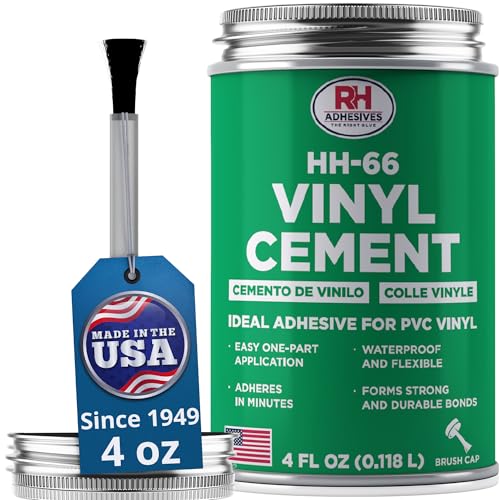
While not a solvent cement for rigid PVC plumbing pipe, the HH-66 Vinyl Cement is the definitive choice for flexible PVC and vinyl repairs. Its industrial-strength formulation bonds to vinyl-coated fabrics, pool liners, inflatable boats, tarps, and marine vinyl, remaining flexible and waterproof across a service range of -30°F to 150°F. The built-in brush cap delivers controlled application on both flexible and rigid substrates.
A critical distinction: HH-66 carries IAPMO UES listings UEL-5070 and UEL-5071, but it is explicitly not for ASTM/NSF-listed PVC plumbing pipe. Use this for repairing a vinyl kayak, sealing a pool liner seam, or patching a commercial truck tarp — tasks where the joint must flex repeatedly without cracking. The 24-hour full cure time is standard for this type of contact cement, and surface preparation is paramount for a lasting bond.
Users consistently praise its ability to handle stitching failures in truck tarps and patch jobs on vinyl liners. The one consistent warning: HH-66 will not bond polyethylene or polypropylene — the material most blue tarps are made from. Check your substrate before applying.
Why it’s great
- Remains flexible and waterproof across extreme temperature swings
- Built-in brush cap for precise, even application
- Proven track record for marine and outdoor vinyl repairs
Good to know
- Not for ASTM/NSF-listed PVC plumbing pipe
- Will not bond polyethylene or polypropylene tarps
3. Titebond PVC Trim Joint Adhesive

The Titebond PVC Trim Adhesive is a cyanoacrylate gel specifically designed for exterior PVC trim applications — miter joints, shiplap connections, and scarf joints on column wraps. Unlike solvent cements that chemically fuse pipe surfaces, this product uses a CA gel that grabs in roughly 5 seconds and reaches full cure in 8 hours. The gel consistency provides gap-filling capability that thin CA glues lack, which is critical for imperfect miter cuts on PVC trim.
For deck fascia, window trim, or column wrap installation where the joint must remain waterproof and rigid, this adhesive delivers a 100% waterproof bond that resists the thermal expansion PVC trim undergoes in direct sun. The bottle applicator makes it easy to apply a bead to both surfaces, and you need to clamp or hold the joint for about 60 seconds for initial tack.
The main caveat: once opened, the remaining adhesive in the bottle will dry out over time. This is not a product for bulk storage between seasons. Plan to use the full 4-ounce tube within a single trim project. The polymer formulation is also substantially different from solvent cements — do not substitute this for pressure-rated pipe joints.
Why it’s great
- Gel consistency fills small gaps in miter and scarf cuts
- Grab time of 5 seconds speeds up repetitive trim work
- 100% waterproof bond for exterior trim applications
Good to know
- Dries out quickly after opening; not for long-term storage
- Not designed for pressure-rated pipe joints
4. Weld-On 16383 16 Acrylic Plastic Cement

The Weld-On 16 is a medium-bodied solvent cement formulated for bonding acrylic, rigid PVC, ABS, styrene, butyrate, and polycarbonate to themselves and to each other. With a working time of 5 to 6 minutes and a 24-hour full cure, it provides a generous window for aligning complex assemblies — particularly useful for industrial fabrications, display cases, and custom sign work where invisible joints matter.
The low-VOC formulation reduces solvent emissions while still delivering the chemical fusion that makes solvent-welded joints nearly invisible. Users report that it works exceptionally well on cast acrylic sheet and plexiglass mirrors, and the medium viscosity runs less aggressively than thin cements on vertical surfaces. The 5-ounce tube with a precision applicator tip gives you good flow control for small to medium projects.
For 3D-printed PLA parts, this cement has become a go-to because it fuses the layers without the white haze or brittleness that cyanoacrylate glues can produce. The tube’s design, however, draws criticism — the glue can pour out unpredictably, so a steady hand and a prepared work surface are essential.
Why it’s great
- Bonds multiple plastic types including acrylic, PVC, and polycarbonate
- 5-6 minute working time allows for alignment adjustments
- Produces nearly invisible fused joints on clear materials
Good to know
- Tube applicator can be messy with uncontrolled flow
- 5-ounce tube is small for large-scale fabrication projects
5. Weld-On 10121 711 Industrial Grade PVC Cement

The Weld-On 711 is a heavy-bodied, medium-setting solvent cement purpose-built for all classes and schedules of PVC pipe, including Schedule 80 through 12-inch diameter. The gray color leaves a visible joint line that inspectors can easily verify, and the low-VOC formula meets modern air-quality standards without compromising the aggressive solvent weld that Weld-On is known for.
The medium set time is its defining feature: it cures slowly enough to allow precise joint assembly on large-diameter or complex multi-fitting runs, but fast enough that you can pressure-test within the same workday. Users accustomed to fast-setting cements appreciate the extra positioning window, particularly when working with heavy Schedule 80 fittings that resist quick insertion. The 16-ounce pint can provides sufficient volume for substantial projects.
Be prepared for strong fumes — this is a high-performance industrial solvent, and ventilation is non-negotiable. The consistent feedback from long-term users is that the Weld-On 711 delivers a bond that outlasts the pipe itself, provided the surfaces are properly primed and cleaned before application.
Why it’s great
- Medium set time allows precise positioning for large assemblies
- Rated for Schedule 80 pipe up to 12-inch diameter
- Gray color provides visible joint verification for inspections
Good to know
- Strong solvent fumes require excellent ventilation
- Heavy body may be overkill for small-diameter repairs
FAQ
Can I use the same cement for Schedule 40 and Schedule 80 pipe?
How long should I wait before pressurizing a PVC joint?
Is primer always required before applying PVC cement?
Why does my PVC glue turn hard inside the can after opening?
Final Thoughts: The Verdict
For most users, the glue for pvc pipe winner is the Oatey 30850 because it combines heavy-bodied gap-filling performance with low-VOC code compliance across the widest range of pipe diameters and schedules. If you need a flexible, waterproof bond for vinyl repairs and tarps, grab the HH-66 Vinyl Cement. And for professional Schedule 80 installations where joint visibility and set-time control matter most, nothing beats the Weld-On 711.