
The toe of your rubber boot finally split, or the sole started flopping after a long season of muddy work. You need a bond that holds underwater, flexes in the cold, and doesn’t crack when you walk. That’s the exact test every repair adhesive in this category has to pass.
I’m Mohammad Maruf — the founder and writer behind Drink4Good. I’ve combed through material safety data sheets and tested adhesion claims across neoprene, PVC, and natural rubber compounds to find the formulas that actually deliver.
Whether you are patching a hunting boot or fixing a favorite pair of rain boots, this guide walks through the five real contenders for the title of best glue for rubber boots and what makes each one earn its place in your workshop.
How To Choose The Best Glue For Rubber Boots
Not every strong-looking glue is built for rubber. The key is matching the adhesive chemistry to the boot’s material — natural rubber, neoprene, or PVC — and the conditions it will face. A waterproof flexible bond is the priority, and that starts with understanding three things: adhesive type, cure behavior, and surface prep.
Contact Cement vs. Cyanoacrylate vs. Polyurethane
Contact cement (like neoprene-based formulas) bonds by creating a flexible film between two surfaces; it’s the go-to for boot soles and large-area repairs. Cyanoacrylate gel dries rigid and fast, best for small tears or cracks where clamping is impossible. Polyurethane adhesives cure into a rubber-like solid but take hours and need moisture to activate. For rubber boots, contact cement is the most forgiving and durable.
Cure Time and Flexibility Matter More Than Initial Grip
A glue that hardens in 45 seconds might feel strong, but a brittle bond cracks under the flex of walking. Look for a cure time of at least 30 minutes to 24 hours — that slow cure allows the bond to remain flexible. A cured film that stretches rather than snaps is the sign of a real boot-grade repair.
Surface Prep Is Non-Negotiable
Rubber contains plasticizers that migrate to the surface, creating a waxy layer that rejects adhesion. Clean the area with isopropyl alcohol, sand it lightly with fine-grit paper, then clean again. This mechanical abrasion plus solvent wipe is what separates a repair that lasts a month from one that lasts a season.
Quick Comparison
On smaller screens, swipe sideways to see the full table.
| Model | Category | Best For | Key Spec | Amazon |
|---|---|---|---|---|
| S-18 All-Purpose Adhesive | Contact Cement | Rubber-to-metal & sole repair | 24-hour full cure, neoprene base | Amazon |
| Boot-Fix Glue | Cyanoacrylate Gel | Instant repairs & small cracks | 45-second clamp-free bond | Amazon |
| Shoe-Fix Glue | Cyanoacrylate Gel | Flexible repairs on curved toe caps | 30-second bond, all-weather rated | Amazon |
| Shoe Goo Repair Adhesive | Liquid Filler | Filling worn soles & small gaps | 24-hour cure, waterproof filler | Amazon |
| HH-66 Vinyl Cement | Contact Cement | PVC boot patches & marine repairs | Flexible from -30°F to 150°F | Amazon |
In‑Depth Reviews
1. S-18 All-Purpose Adhesive
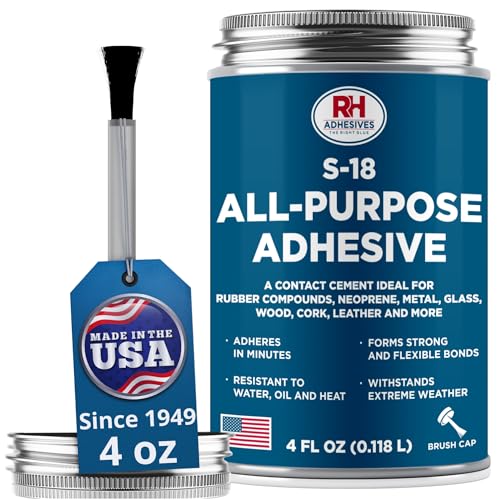
This is the workhorse contact cement for rubber boot repairs. The S-18 formula is a neoprene-based adhesive that bonds SBR rubber and neoprene directly to metal, leather, or other rubber surfaces — exactly what you need when a sole has delaminated from the boot upper. It forms a flexible film that resists oil and aging, which is critical for boots that live in mud, water, and temperature swings. Multiple users report success on leather boot repairs after sanding and cleaning, which matches the professional prep protocol I recommend.
The 24-hour full cure is the standard for any boot-grade contact cement. You clamp or weight the repair for the full day, and the result is a bond that can handle the flex of walking on uneven ground. One reviewer noted it held up through summer heat, and another used it to glue neoprene to metal with no bond failure. The 4 oz can is enough for two or three major sole repairs. It isn’t a grab-and-go glue — you need patience and ventilation — but the durability ceiling is high.
There is a word of caution from one long-term user: after curing, the glue may not be fully waterproof in extended wet use, especially if the surface prep was not thorough. I’d recommend this for dry-condition repairs or as a strong bond that you can seal with an additional waterproofing layer if needed.
Why it’s great
- Exceptional bond strength on rubber-to-metal and rubber-to-leather
- Flexible film that resists oil and aging
- 24-hour cure yields a robust, long-lasting repair
Good to know
- Requires a full 24-hour clamp time for best results
- May not be fully waterproof in extended wet conditions
2. Boot-Fix Glue
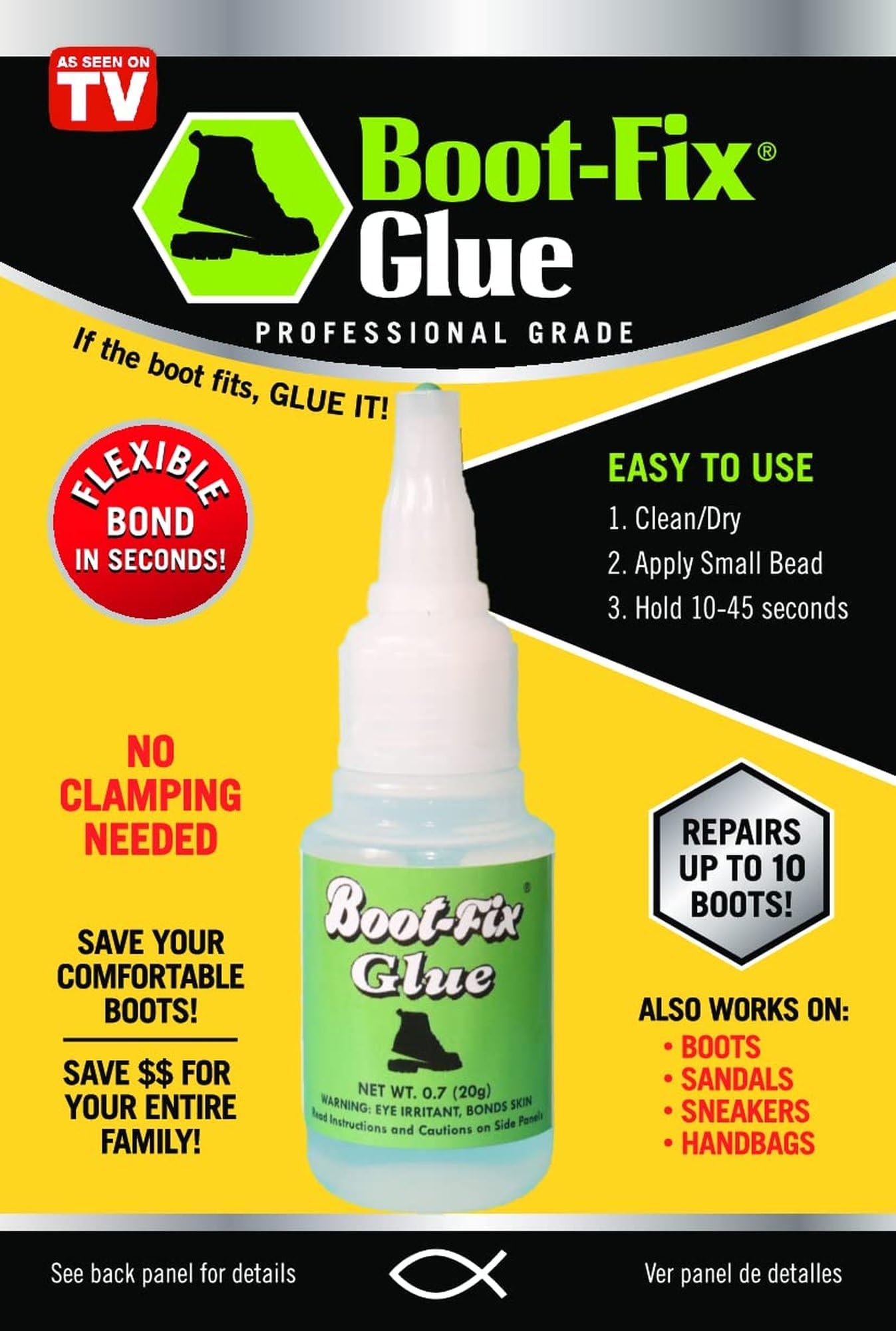
Boot-Fix is a cyanoacrylate gel that cures in 45 seconds without clamping — a huge advantage for repairs where you can’t easily apply pressure, like a cracked toe or a torn strap on a rubber boot. The gel consistency means it stays where you put it and soaks into porous surfaces, creating a mechanical lock as it cures. One user repaired farm boots after a week of heavy work and the bond held with zero failure.
The trade-off is that cyanoacrylate is rigid when fully cured, so it isn’t ideal for large-area sole reattachment where flex is constant. However, for a small crack or a detached sidewall, the 45-second bond is a game-changer. Users recommend cleaning with alcohol and wiping the tube tip before capping to prevent clogging. One reviewer repaired an Adidas slide strap and it stayed intact for months, which shows the versatility beyond rubber boots.
Keep in mind that the quantity claim of “repairs up to 10 boots” is an oversimplification — one user used over 90 percent of the tube for a single heel repair. If you have a major split, you may need a second tube. But for targeted spot repairs, this is hard to beat.
Why it’s great
- 45-second bond with no clamping required
- Gel consistency stays put and soaks into porous rubber
- Holds up to heavy use, including farm work and construction
Good to know
- Rigid cure — not ideal for large flexible sole repairs
- Small tube may require multiple purchases for major repairs
3. Shoe-Fix Glue
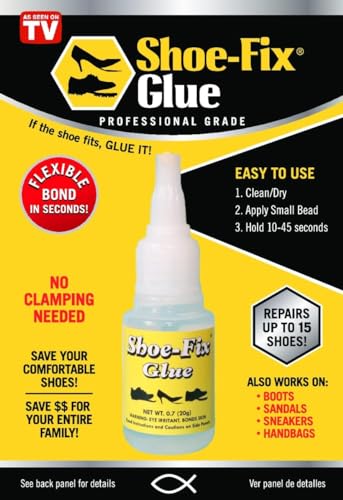
Shoe-Fix is a cyanoacrylate gel that combines fast bonding with a flexible finish, which is unusual for this chemistry. The formula is specifically designed for footwear, which means it has been tweaked to remain pliable after curing instead of becoming brittle. This is a meaningful difference if you are repairing the curved toe cap or the instep area of a rubber boot where the material bends with every step.
Users report it bonds in roughly 30 seconds without clamping — one reviewer repaired Vibram FiveFingers in hard-to-clamp curved areas with neat results. Another used it on roller skates with a year of heavy use and the bond held, which tells me the flexibility claim is genuine. The clear drying finish is a plus if the repair is on a visible area; you won’t see a white residue like some other instant glues.
It is rated for extreme conditions including heat, cold, and moisture, but like all cyanoacrylates, it is not a gap-filler. If the tear has a gap wider than a few millimeters, you will need to use it in layers or choose a filler adhesive instead.
Why it’s great
- Flexible cure — stays pliable after setting
- Clear drying for invisible repairs
- All-weather resistance with no clamping needed
Good to know
- Not a filler — works best on tight, flush tears
- Small tube size limits large-area repairs
4. Shoe Goo Repair Adhesive
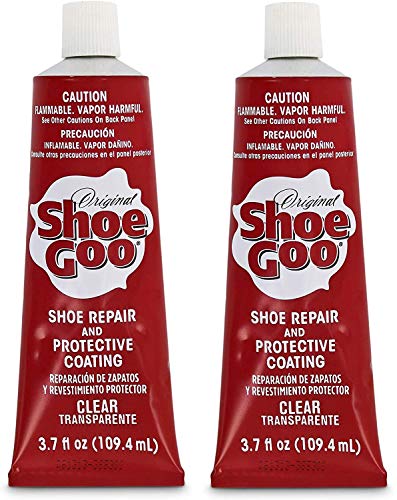
Shoe Goo is a thick, rubberized liquid that dries into a flexible, waterproof filler. It isn’t an instant bonder — it takes 24 hours to fully cure and requires pressure for 4 to 6 hours — but it excels at rebuilding worn soles and filling gaps that other adhesives cannot handle. If your rubber boot’s tread has worn down or there is a small hole, Shoe Goo can fill it and create a new wear surface.
One user used it to attach molded eyeglass lenses as wear pads on shoe soles, which is a creative example of how it functions as a gap-filler rather than a pure adhesive. Another has been using it for years to extend the life of walking shoes. The clear formula means the repair blends in, though it shrinks as it dries, so you may need to apply two layers for deeper gaps.
The major downside is the strong fumes that linger for at least a day — this is not a glue you use in your living room. The tubes can also be tough to squeeze when they are nearly empty, so buy the two-pack to have backup. If you need to add material rather than just bond two surfaces, Shoe Goo is your pick.
Why it’s great
- Thick filler rebuilds worn soles and fills gaps
- Dries flexible and waterproof
- Two-pack provides enough material for multiple repairs
Good to know
- Strong fumes require well-ventilated area
- Shrinks during cure; may need two layers for deep gaps
5. HH-66 Vinyl Cement
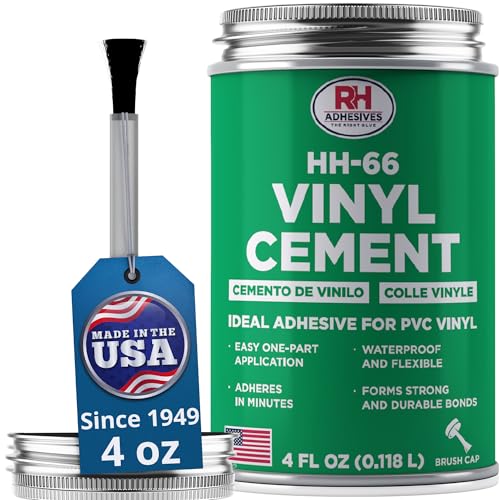
HH-66 is a solvent-based contact cement engineered specifically for PVC and flexible vinyl, which makes it the right choice for rubber boots made from PVC or vinyl-coated fabrics. It is not designed for natural rubber, but if your boot is a PVC rain or garden boot, this glue will bond patches with industrial strength. The built-in brush cap allows controlled application on large areas, and the formula remains flexible from -30°F to 150°F.
The application process requires patience: clean with alcohol, apply to the patch only (not the boot), let it tack up, then mate the surfaces. Users report fast tack, and the bond is extremely strong after a 24-hour cure. One kayak owner used it to patch a small hole in a vinyl kayak and said it performed far better than a general-purpose sealant. The flexibility after curing is the standout feature — it won’t crack in cold weather.
The major caveat is that HH-66 is not compatible with polyethylene or polypropylene materials (common in cheap blue tarps), and it does not work well for inflatables that hold high-pressure air. If you are patching a PVC boot, this is the premium option. For natural rubber boots, the S-18 is a better fit.
Why it’s great
- Extreme temperature flexibility (-30°F to 150°F)
- Industrial-strength bond for PVC and vinyl boots
- Built-in brush cap for neat, even application
Good to know
- Not suitable for natural rubber boots
- Not recommended for inflatables holding high-pressure air
FAQ
Can I use super glue on rubber boots?
How should I clean rubber before gluing?
Which glue works best for PVC rain boots?
How long should I clamp the repair?
Can I use shoe glue to fill a hole in my boot sole?
Final Thoughts: The Verdict
For most users, the best glue for rubber boots winner is the S-18 All-Purpose Adhesive because it delivers a flexible, oil-resistant neoprene bond that handles sole reattachment and rubber-to-metal repairs with the 24-hour cure needed for real durability. If you want a 45-second fix without clamping, grab the Boot-Fix Glue. And for filling worn treads or patching PVC rain boots, nothing beats the Shoe Goo Repair Adhesive or the HH-66 Vinyl Cement respectively.