
Bonding rubber to metal is one of the trickiest jobs in any workshop. The two materials expand and contract at different rates, and many common adhesives fail the first time the joint flexes. You need a glue that handles that mismatch without cracking or peeling.
I’m Mohammad Maruf — the founder and writer behind Drink4Good. I spend my time digging into the chemical makeup of adhesives, comparing peel strength ratings, cure times, and real-world heat resistance to separate the formulas that actually hold from the ones that let go.
Getting the bond right often starts with matching the adhesive type to your specific load. I’ve sorted through the best options to find a reliable glue for rubber to metal that will stick when the going gets tough.
How To Choose The Best Glue For Rubber To Metal
Selecting a rubber-to-metal adhesive comes down to three things: the flexibility of the cured bond, the operating temperature, and the surface area you need to cover. A rigid epoxy is great for a solid fill, but a flexible contact cement handles vibration far better on larger panels or door seals.
Flexibility vs. Rigidity
Rubber stretches and compresses under load; metal barely moves at all. If the glue line is too stiff, the joint will shear apart with the first real flex. Contact cements and neoprene-based adhesives stay slightly elastic after curing, which lets the bond absorb movement without cracking.
Heat and Moisture Tolerance
Outdoor assemblies or parts near an engine bay need an adhesive that can handle summer heat without turning gummy and rain without delaminating. Many epoxies resist extreme temperatures but can become brittle over time, while some spray adhesives break down quickly in direct sunlight.
Application Method
Thin liquids wick into tight gaps, pastes fill voids, and sprays cover large flat areas evenly. For a small repair like a rubber pad on a metal bracket, a brush-on contact cement gives you control. For a wide panel like a sheet of rubber glued to a steel plate, a spray is faster and more uniform.
Quick Comparison
On smaller screens, swipe sideways to see the full table.
| Model | Category | Best For | Key Spec | Amazon |
|---|---|---|---|---|
| J-B Weld 8281 | Epoxy Paste | High-strength structural repairs | 5020 PSI tensile strength | Amazon |
| WEICON GMK 2410 | Contact Cement | Flexible vibration-resistant bonds | 1-component brush-on formula | Amazon |
| 3M Max Strength 90 | Spray Adhesive | Large panel coverage | 10-minute max bond | Amazon |
| PEGATANKE Epoxy | Epoxy Paste | Underwater and high-pressure repairs | 120 PSI pressure rating | Amazon |
| RH Adhesives S-18 | Neoprene Adhesive | Universal rubber and neoprene bonding | 24-hour full cure time | Amazon |
In‑Depth Reviews
1. J-B Weld 8281 Professional Size Steel Reinforced Epoxy

J-B Weld Original is the closest thing to liquid steel you can buy in a tube. The two-part epoxy cures to a dark grey finish that can be drilled, tapped, sanded, and painted — exactly what you want when a rubber part needs a structural attachment to a metal bracket. The 5,020 PSI tensile rating means it handles serious mechanical loads, and the 550°F temperature ceiling keeps the bond intact near hot engine components.
Surface prep matters enormously with this one. Both the rubber and the metal must be clean, dry, and roughened for the epoxy to key in properly. The 15-hour full cure is longer than some alternatives, but the trade-off is a repair that often outlasts the original part. Users have successfully fixed cracked radiators, leaking rain barrel valves, and broken mirror mounts after super glues failed.
One quirk is that the tubes can contain air pockets, reducing the usable volume by about a third. The mix is messy, so wear gloves and work on a disposable surface. Despite that, the bond strength and versatility make it the go-to for anyone who needs a permanent metal-to-metal or rubber-to-metal structural fix.
Why it’s great
- Steel-reinforced formula with extreme tensile strength
- Withstands high heat and chemical exposure
- Cures to a machinable, drillable state
Good to know
- Requires 15–24 hours for full cure strength
- Mixing is messy and tubes may have air voids
2. WEICON GMK 2410 Rubber Metal Adhesive

WEICON GMK 2410 is a one-part contact cement formulated specifically for flexible rubber-to-metal bonds. Unlike epoxy, it stays slightly elastic after curing, which makes it the right choice for parts that experience constant vibration — door seals, rubber feet on chair legs, or insulation panels mounted to steel frames. The brush-on liquid applies cleanly and doesn’t require any mixing or special equipment.
The application process follows standard contact cement rules: apply a thin coat to both surfaces, let the solvent flash off until the adhesive is tacky, then press the parts together. The bond gains strength as the solvent evaporates, and full cure takes about 24 hours. Users report excellent long-term hold on EPDM foam strips and natural rubber, even in outdoor weather conditions.
There is an important limitation: the formula does not bond well to aluminum, polyethylene, polypropylene, or polystyrene foam. A few users found their aluminum-to-rubber joints popped apart in a vise overnight, so stick to steel, wood, and most rigid plastics. For general automotive and household rubber-to-metal jobs, this German-made adhesive provides a consistent, flexible hold that resists shearing.
Why it’s great
- Stays flexible for vibration-dampening joints
- Simple one-component, no-mix application
- Proven durability on automotive door and trim seals
Good to know
- Does not bond to aluminum, PE, or PP
- Requires careful surface preparation for best results
3. 3M Max Strength 90 Multi-Surface Contact Adhesive
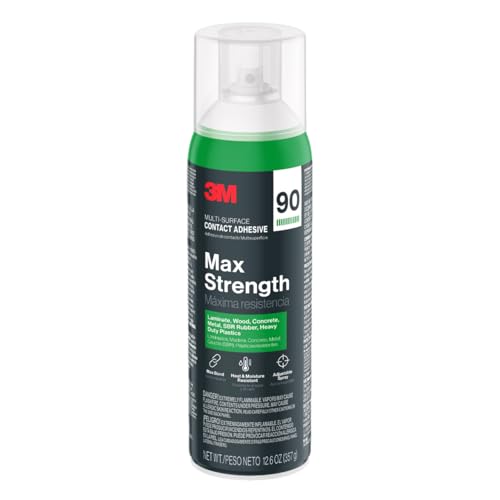
When your project involves large sheets of rubber bonded to metal panels, a spray adhesive saves hours of brushing. 3M Max Strength 90 delivers a controlled fan pattern that covers wide areas evenly with minimal waste. The web spray design lets you build up layers for stronger bonds, and the adjustable nozzle helps you dial in the pattern for precision work around edges.
The bond reaches max strength in just ten minutes, which is significantly faster than any epoxy or brush-on contact cement. The formula resists both heat and moisture, making it a solid choice for marine interiors, sound deadening installations, and carpet-to-foam-deadener layers in vehicle builds. Users consistently report that the bond holds tight in hot cars and damp bilge areas without lifting.
The main trade-off is the working window. The adhesive dries quickly, so you have a narrow window to align the parts before the bond locks in. Over-spray can also be an issue if you are not masking the surrounding area. For speed, coverage, and reliability on flat surfaces, this is the spray adhesive that serious DIYers reach for first.
Why it’s great
- Excellent for large-surface rubber-to-metal bonding
- 10-minute max bond speeds up assembly
- Heat and moisture resistant for marine use
Good to know
- Short open time requires quick alignment
- Over-spray needs careful masking
4. PEGATANKE Black 2 Part Epoxy Resin & Cold Weld Adhesive

PEGATANKE is a thick, black epoxy paste designed for the most demanding environments: exhaust systems, fuel tanks, coolant reservoirs, and underwater components. The two-part formula mixes to a putty-like consistency that fills gaps and will not run or sag on vertical surfaces. A single 1.48-ounce batch supports 550 pounds of dead weight and resists 120 PSI of pressure, which makes it a legitimate cold-weld solution for structural cracks.
The paste sets in about 30 minutes in direct sunlight or 90 minutes in the shade, with full cure taking around 8 hours. It bonds tenaciously to steel, aluminum, copper, ceramic, wood, glass, PVC, and fiberglass — but not acrylic. Users have successfully repaired cracked radiator tanks, shattered rearview mirror mounts on windshields, and underwater hull fittings without any leakage.
The thick consistency can be challenging to spread evenly, especially in tight crevices. The color is a matte black, which blends well on dark rubber parts but stands out on light-colored metals. If you need a high-strength, waterproof repair that can handle pressure and temperature swings, this epoxy delivers results that other adhesives cannot match.
Why it’s great
- Withstands 120 PSI pressure and high heat
- Thick paste fills gaps and won’t run
- Bonds underwater for marine repairs
Good to know
- Thick consistency hard to spread in tight spaces
- Not effective on acrylic surfaces
5. RH Adhesives S-18 All-Purpose Adhesive
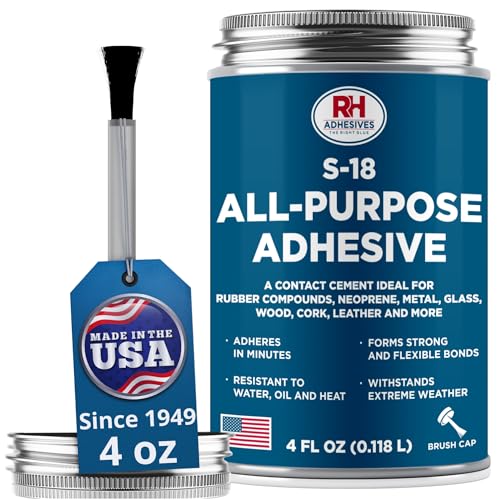
The S-18 formula from RH Adhesives is a classic neoprene contact cement that has been made in the United States since 1949. It bonds SBR rubber, neoprene, felt, leather, wood, glass, and ceramics to metal with a flexible, water-resistant film. The liquid consistency wicks into porous surfaces better than thicker pastes, which helps create a strong mechanical lock on rough rubber.
Users have found great success repairing leather boot soles, neoprene yoga mats, and even flexible marine gaskets. The 24-hour full cure is standard for this adhesive type, and the bond remains somewhat elastic to handle moderate flex. The off-white color dries clear-ish, which keeps the glue line unobtrusive on most projects.
Ventilation is critical with this adhesive — it contains strong solvents that can cause dizziness in enclosed spaces. A few users reported that the bond degraded under sustained outdoor heat and rain, so it is better suited for indoor or mild-climate applications. For a simple, affordable, and time-tested neoprene-to-metal glue, the S-18 is hard to beat.
Why it’s great
- Proven neoprene formula in production since 1949
- Creates flexible, water-resistant films
- Bonds a wide range of porous and non-porous materials
Good to know
- Requires very good ventilation during use
- Outdoor heat and rain may degrade the bond over time
FAQ
What is the best surface preparation for bonding rubber to metal?
Can I use super glue for rubber to metal bonding?
Final Thoughts: The Verdict
For most users, the glue for rubber to metal winner is the J-B Weld 8281 because its steel-reinforced epoxy delivers unmatched tensile strength for structural repairs that need to last. If you want a flexible bond that shrugs off vibration, grab the WEICON GMK 2410. And for covering large panels fast, nothing beats the 3M Max Strength 90 spray adhesive.