
Stainless steel is notoriously slick, and most household glues bead up and fail the moment the surface flexes or gets wet. You need a formulation engineered for non-porous, low-energy metals — something that establishes a chemical grip, not just a surface tack.
I’m Mohammad Maruf — the founder and writer behind Drink4Good. I’ve analyzed the tensile strength, thermal thresholds, and set-time windows of dozens of industrial and consumer-grade bonding agents to isolate the ones that actually hold stainless steel under real-world loads.
The margin between a repair that lasts years and one that snaps in a week is almost always down to choosing the right glue for stainless steel, so understanding a few core specs before you buy saves you time, money, and frustration.
How To Choose The Best Glue For Stainless Steel
Stainless steel’s chromium oxide layer makes it resistant to corrosion and also to weak adhesives. That’s why the right glue has to overcome a smooth, high-density surface. Below are the three most important considerations to filter the options effectively.
Bond Strength and Tensile Rating
The tensile strength, measured in PSI (pounds per square inch), tells you how much pulling force the cured glue can withstand before the joint breaks. For stainless steel repairs that bear any load, look for a rating above 3,000 PSI. Epoxies in the 5,000–6,000 PSI range, like those engineered as cold-weld systems, create a bond that can actually exceed the strength of the surrounding metal.
Work Life vs. Cure Time
Work life is the window you have to position the parts after mixing; cure time is how long before you can put the item back in service. A 20-minute work life is generous for larger assemblies, while a 4–6 minute window demands quick, precise clamping. Longer cure times (15–24 hours) usually deliver a stronger, more complete cross-link in the polymer, especially important on non-porous stainless steel where there’s no substrate absorption to assist the bond.
Thermal and Chemical Resistance
If the repair will sit near an engine, a grill, or an outdoor appliance, the glue must handle heat and exposure. Epoxies rated for up to 550°F (287°C) remain stable under hood and on cookware. Waterproof and chemical-resistant formulations are non-negotiable for marine, kitchen, or automotive environments where the bond meets moisture, oil, or detergents constantly.
Quick Comparison
On smaller screens, swipe sideways to see the full table.
| Model | Category | Best For | Key Spec | Amazon |
|---|---|---|---|---|
| J-B Weld 8265S-2 | Epoxy | Heavy structural repairs | 6,220 PSI tensile strength | Amazon |
| 3M Scotch-Weld DP100 Plus | Acrylic | Crystal-clear, rapid bonding | 1 hour full cure | Amazon |
| Gorilla Max Construction Adhesive | Hybrid | Gap filling and outdoor use | Waterproof, paintable finish | Amazon |
| J-B Weld 8281 | Epoxy | General steel reinforced repairs | 5,020 PSI, heat resistant to 550°F | Amazon |
| Brampton Extra Strength Epoxy | Epoxy | Large or vertical surface projects | 20-minute work life, impact resistant | Amazon |
In‑Depth Reviews
1. J-B Weld Original Epoxy 8265S-2
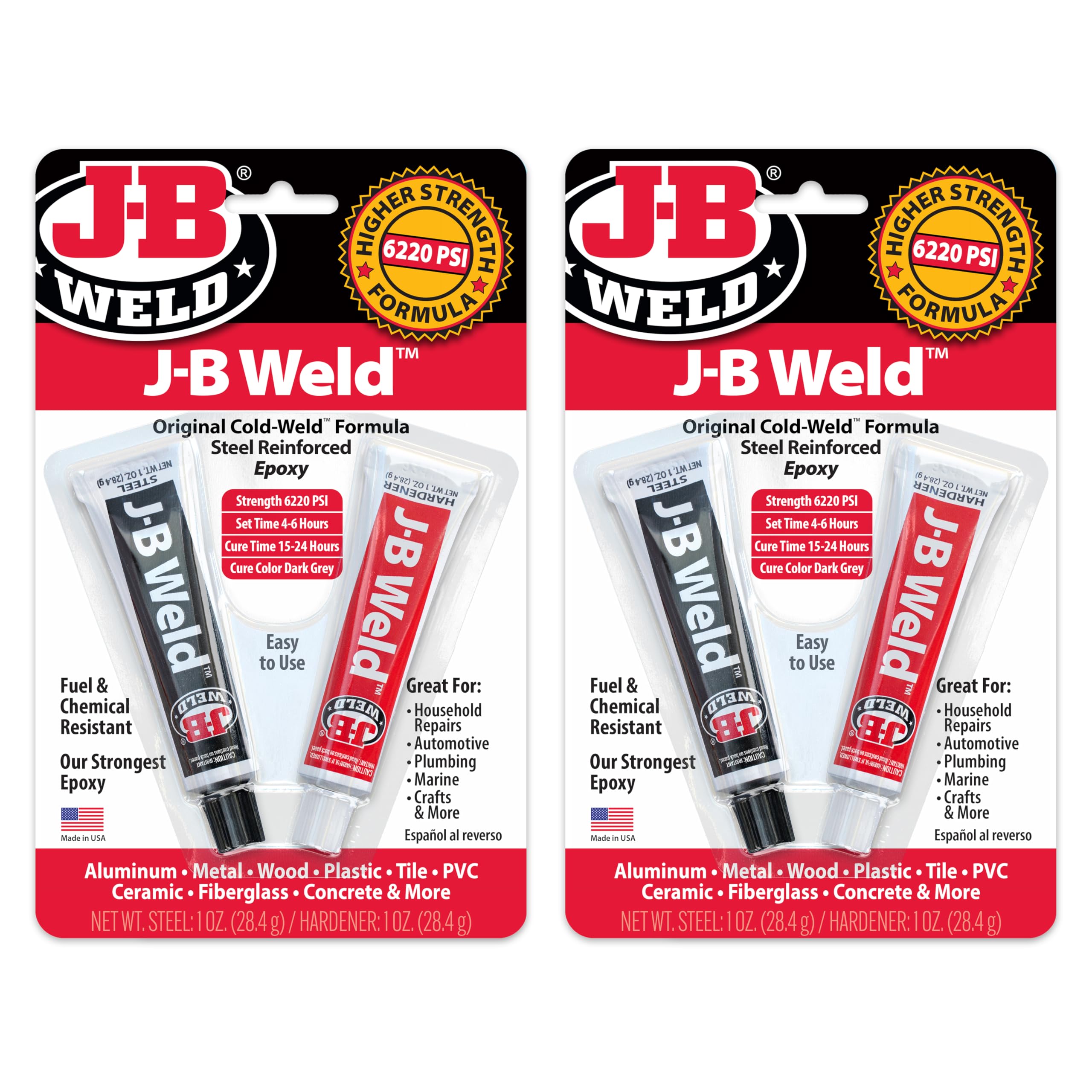
This two-pack of the 8265S-2 delivers the highest tensile strength on the list — 6,220 PSI in a steel-reinforced epoxy that acts as a true cold weld. Once fully cured after 15–24 hours, it can be drilled, tapped, sanded, and painted without compromising the bond line. For load-bearing stainless steel repairs, such as reattaching a blade on a windmill or fixing a structural bracket, this formulation stands apart from standard consumer adhesives.
The dark grey color blends well with most metal surfaces, though it isn’t clear. Users consistently report that parts cleaned and roughened before application produce a bond that outlasts the original mechanical fasteners. The 4–6 hour set time allows adequate positioning, but you will need a clamping strategy for vertical or overhead work.
It withstands continuous heat up to 550°F and resists petroleum, chemicals, and water, making it a strong candidate for automotive and marine environments. The 2-ounce tube size per pair is economical for a few targeted repairs rather than large-area coverage.
Why it’s great
- Highest PSI rating (6,220) on this list for maximum load capacity
- Machinable after cure — can be tapped and drilled like metal
- Thermal resistance to 550°F suits engine and exhaust proximity repairs
Good to know
- Dark grey finish will not match clear or light-colored stainless appliances
- Full 15–24 hour cure requires patience and stable clamping
2. 3M Scotch-Weld Epoxy Adhesive DP100 Plus
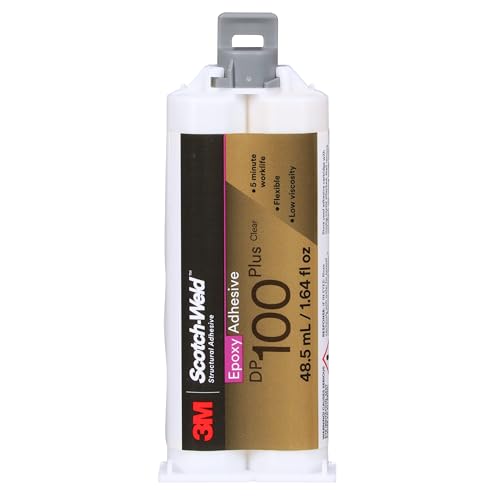
When the bond line needs to remain optically clear, the 3M DP100 Plus is the professional-grade choice. It cures in just one hour — a drastic improvement over the 15–24 hour epoxy standard — while still delivering the thermal cycling resistance required for applications that undergo regular heating and cooling. It bonds stainless steel as reliably as it bonds glass, ceramics, and nylon composites, and its 2–5 minute open working time is perfect for small, precise assemblies.
The 48.5 mL duo-pak cartridge requires a compatible dispensing gun, which adds a small upfront investment but ensures perfect 1:1 mixing every time. This is an industrial-grade system (UL 94 HB certified) that excels in transportation, electrical, and sporting goods repairs. Users have successfully used it to secure fixtures to sinks and repair composite engine components exposed to under-hood heat.
Because it is not designed for large gap filling, the surfaces must fit together closely. Any gap over a few thousandths of an inch will compromise the bond. It is also the priciest option here, but for applications where transparency and speed are critical, it justifies the premium.
Why it’s great
- Cures crystal clear — invisible bond on stainless appliances and fixtures
- Full cure in 1 hour significantly reduces downtime
- Proven thermal cycling performance for demanding environments
Good to know
- Requires a separate dispensing gun for proper mixing
- Not a gap filler — bond strength relies on tight surface contact
3. Gorilla Max Strength Construction Adhesive
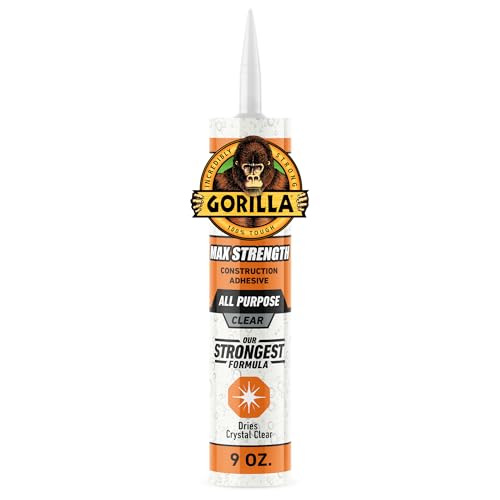
Where epoxies require perfect mating surfaces, this hybrid construction adhesive excels at filling gaps. The 9-ounce cartridge formula is two times stronger than Gorilla’s own heavy-duty construction adhesive, and it cures to a clear, paintable finish that leaves a discreet bond line on stainless steel projects. It is completely waterproof, which makes it a strong candidate for outdoor applications like attaching signs, repairing vinyl-to-steel moisture barriers, or sealing marine fittings.
The cartridge format requires a standard caulking gun for application. Unlike epoxy, this adhesive remains flexible after curing, which is beneficial when bonding stainless steel to materials that expand and contract at different rates. Users report excellent grip on granite, vinyl, and painted surfaces, but the flexible nature means it won’t reach the sheer load capacity of a rigid epoxy for weight-bearing structural repairs.
One point to note is that this glue is not UV-stable for long-term direct sunlight exposure — some users saw yellowing after a year on a convertible top. For interior stainless steel bonding or concealed outdoor joins, this is a reliable, user-friendly option that doesn’t require precise mixing ratios.
Why it’s great
- Fills large gaps without losing bond strength
- Dries clear and can be painted over for seamless repairs
- Remains flexible — ideal for materials with different expansion rates
Good to know
- Not UV-stable — may yellow or degrade in prolonged direct sun
- Requires a caulk gun; not suitable for detail work or small beads
4. J-B Weld 8281 Professional Size Steel Reinforced Epoxy

The professional 10-ounce size of J-B Weld Original gives you nearly three times the volume of the standard 2-ounce packs at a reasonable per-ounce cost. The 5,020 PSI tensile strength is slightly lower than the 8265S-2 version but still more than enough for nearly any household, automotive, or marine stainless steel repair. It handles temperatures up to 550°F and resists petroleum, chemicals, and water once fully cured after 15–24 hours.
Like the smaller pack, this is a two-part epoxy that mixes at a 1:1 ratio and creates a dark grey finish. Users have successfully repaired leaky rain barrel valves, broken concrete pieces, and metal brackets. The larger tube size is ideal when you have multiple repairs or a single large bonding area. Some users noted that the tubes contained air pockets, shortening the usable material by about a third, which is worth factoring in if you have an exact volume requirement.
The 4–6 hour set time allows plenty of adjustment, but the paste consistency requires firm clamping to maintain alignment. The cured material can be sanded and painted, so a clean cosmetic finish is achievable with some post-processing effort.
Why it’s great
- Largest volume (10 oz total) for bulk and multi-repair needs
- 5,020 PSI strength exceeds most non-industrial bonding requirements
- Heat, chemical, and water resistant after full cure
Good to know
- Some tube waste due to air pockets in the packaging
- Requires 24 hours for maximum strength — not a quick fix
5. Brampton Extra Strength Epoxy, 8 oz
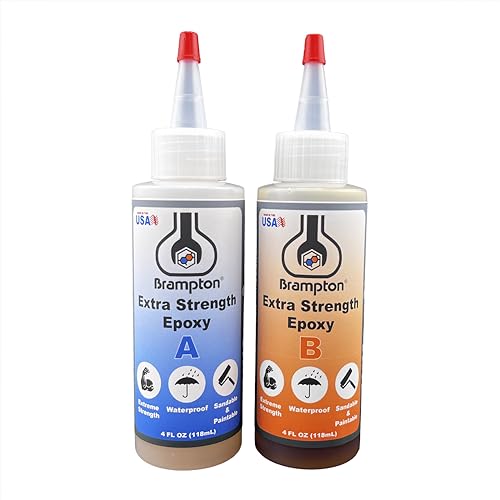
Brampton’s 8-ounce kit distinguishes itself with a long 20-minute work life and a formulation that prioritizes impact resistance. This is the go-to epoxy when you are bonding large assemblies, vertical surfaces, or parts that will face repeated shock loads. It cures to an amber color — not clear as some may expect — so it is best used where the bond line is hidden or where color doesn’t matter. The full cure time is 15 hours, with sandability and paintability available after 20 hours.
The 1:1 mix ratio by volume (Part A and Part B) is straightforward, though the two bottles have slightly different densities, so a scale is more reliable than visual measurement. Users have successfully used it to attach knife handle scales, repair ceramic lids, and fix pool light assemblies. The shock-resistant compounds help the bond survive drops and vibrations better than standard brittle epoxies.
It bonds to metal, glass, wood, ceramic, and most plastics, but the amber tint limits its cosmetic applications. The manufacturer recommends an ideal application temperature of 72°F, so cold-weather projects may need a heated workspace to achieve optimal results.
Why it’s great
- 20-minute work life offers generous positioning time for complex assemblies
- Impact-resistant formula withstands vibration and shock better than standard epoxies
- Suitable for vertical surfaces with minimal drip
Good to know
- Cures to an amber color, not transparent — visible bond lines
- Density difference between parts requires careful measuring for best results
FAQ
Why do most glues fail on stainless steel?
Can I use super glue on stainless steel?
How do I prepare stainless steel for gluing?
Final Thoughts: The Verdict
For most users, the glue for stainless steel winner is the J-B Weld 8265S-2 because its 6,220 PSI cold-weld strength covers everything from automotive brackets to home structural repairs. If you need a crystal-clear bond that cures in one hour, grab the 3M Scotch-Weld DP100 Plus. And for large gap-filling projects where flexibility matters, nothing beats the Gorilla Max Construction Adhesive.