
One wrong squeeze of the glue bottle and that perfect Styrofoam cut dissolves into a crumbled, melted mess. Standard solvent-based adhesives eat through expanded polystyrene (EPS) and extruded polystyrene (XPS) foam on contact, leaving you with a pitted surface that can’t hold anything. The fix isn’t about finding something sticky enough—it’s about finding a formula chemically inert to Styrofoam’s cellular structure, one that bonds without dissolving.
I’m Mohammad Maruf — the founder and writer behind Drink4Good. After analyzing dozens of adhesive formulations for compatibility with closed-cell foam, water content, and open time, I’ve built a shortlist that spares you the trial-and-error burn.
glue for styrofoam to styrofoam must pass two non-negotiable tests: zero melting on contact and a cured bond stronger than the foam itself. This guide isolates the adhesives that survive both.
How To Choose The Best Glue For Styrofoam To Styrofoam
The biggest mistake buyers make is reaching for a multi-surface super glue or a solvent-based contact cement. Both destroy Styrofoam. You need a formula specifically engineered to avoid the chemical reaction—typically a water-based acrylic, a PVA emulsion, or a modified alkoxyethyl cyanoacrylate that lacks the aggressive solvents found in standard instant adhesives.
Foam Safety Index
Check the bottle for explicit “foam safe” language. If it says “bonds plastic” without specifying Styrofoam or polystyrene foam, assume it will melt. True foam-safe formulas list EPS, XPS, or Styrofoam in their compatible materials. They use carrier solvents that evaporate without attacking the closed-cell bead structure.
Open Time vs. Clamping Pressure
Thin liquid glues soak into Styrofoam’s porous surface quickly; you have 5–15 seconds to position parts before the bond sets. Thicker gel formulas or contact cements give you up to 30 minutes to reposition, but require firm clamping and a minimum cure window of 6 hours for full shear strength. Match the working speed to your project scale.
Bond Flexibility
Styrofoam expands and contracts with temperature changes, especially in model aircraft and outdoor displays. A brittle, rigid glue line will snap under thermal stress. Look for adhesives that cure to a rubbery or slightly flexible finish—these absorb movement without fracturing the foam around the joint.
Quick Comparison
On smaller screens, swipe sideways to see the full table.
| Model | Category | Best For | Key Spec | Amazon |
|---|---|---|---|---|
| Beacon Foam-Tac | Contact Cement | RC plane repairs | 5ml per tube, flexible cure | Amazon |
| Bob Smith Industries Super-Gold | Foam Safe CA | Diorama & model crafting | 5-15 sec bond, odorless | Amazon |
| Delux Materials AD34 Foam 2 Foam | Contact Cement | EPO & EPS aircraft | 50ml bottle, high tack | Amazon |
| Woodland Scenics Foam Tack Glue | PVA Emulsion | Model railroad layouts | 12 fl oz, dries rubbery | Amazon |
| Elmer’s All Purpose Glue Sticks | PVA Stick | Classroom crafts | 22g sticks, washable | Amazon |
In‑Depth Reviews
1. Beacon Adhesives Foam-Tac

The Beacon Foam-Tac is a contact cement formulated specifically for closed-cell foams used in RC aircraft. It dries clear and stays flexible, which means thermal expansion on a hot runway won’t crack the joint. Users report that the bond outlasts the surrounding foam—when stress-testing repairs, the foam tears before the glue line fails.
This six-tube pack gives you 5ml per tube, which is an ideal field repair size. The application technique is standard contact-cement procedure: apply a bead to both surfaces, wait for the tack to develop, then press together. Full cure takes 30–40 minutes, but the bond holds securely in about 10 minutes. RC fliers consider this the go-to for reattaching control surfaces and repairing crash damage.
One detail worth noting: the metal tubes require serious finger pressure to squeeze, which can be frustrating during precise work. The formula itself has no solvent smell and won’t melt EPS or EPO foam on contact. For hobbyists who need a repair that won’t self-destruct in the sun, this is the benchmark.
Why it’s great
- Cures flexible, absorbing thermal stress without cracking
- Foam-safe on EPS, EPO, and XPS with zero melting
- Fast tack time allows assembly within 10 minutes
Good to know
- Metal tubes are stiff and difficult to squeeze when cold
- Contact cement method requires patience for tack development
2. Bob Smith Industries Super-Gold
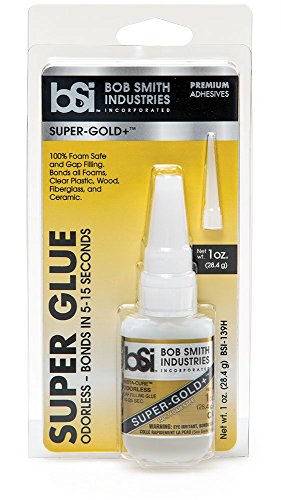
Bob Smith’s Super-Gold is an odorless, foam-safe cyanoacrylate that bonds in 5 to 15 seconds. It is one of the few super glues that won’t attack Styrofoam because its alkoxyethyl cyanoacrylate monomer lacks the aggressive solvents found in standard ethyl cyanoacrylates. This makes it exceptional for fine work where instant grab is needed and no clamping is practical.
Users crafting D&D terrain from XPS foam report that a single drop flows across the joint with capillary action and locks parts in seconds. The 1 oz bottle includes an extender tip for precise placement, which is critical when gluing small foam bricks or beads together. The bond remains clear and does not frost, so the joint is invisible on finished surfaces.
The biggest drawback is the short open time—once the tip touches the foam, you have roughly 8 seconds before the glue sets. Part alignment must be perfect on the first try. Also, the cap must be kept sealed and stored upright; leaking has been reported in transit, though the seller resolved replacement quickly. For precision foam-to-foam work where speed matters, this formula is unmatched.
Why it’s great
- Zero odor and completely foam-safe with no melting risk
- Bonds in 5-15 seconds with capillary flow into tight joints
- Dries clear and remains invisible on finished models
Good to know
- Open time is extremely short—position must be perfect instantly
- Bottle must be stored upright to prevent cap clogging and leaks
3. Delux Materials AD34 Foam 2 Foam

The Delux Materials AD34 is a high-tack contact glue designed for EPO and EPS foam. It applies as a clear liquid, requires a 5-minute dry-to-tack period, and then forms a bond strong enough to hold RC airplane wings together under flight loads. Users who build foam scale models find it superior to CA glue when they have time to let the assembly sit.
The 50 ml bottle is large enough for multiple repairs. The adhesive flows easily from the nozzle without clogging and stays workable for about 30 minutes if you need to reposition parts before final pressure. Because it is a contact cement, both surfaces must be coated and allowed to dry before mating—the initial bond is instant once the tacky surfaces touch.
If you are building multiple models, it pays to shop around. The glue itself performs reliably, leaving a clear, strong joint that won’t embrittle with age. For traditional foam aircraft construction, this is a trustworthy staple.
Why it’s great
- High tack formula creates instant bond when surfaces meet dry
- Clear cure preserves the visual finish of painted foam
- Repair strength exceeds foam substrate even under flight load
Good to know
- Requires 5-minute tack-to-dry phase before bonding
- Price may be lower at specialty hobby retailers
4. Woodland Scenics Foam Tack Glue

Woodland Scenics Foam Tack Glue is a thick, white PVA-based emulsion that dries into a surprisingly rubbery, flexible layer. Unlike standard white glue that cures hard and brittle, this formula stays slightly elastic—ideal for applications where the foam joint will be flexed or cut through with a hot wire after assembly. Model railroad hobbyists use it to bond foam sheets together for terrain bases and scenery risers.
The 12 oz bottle is generous for layout-scale projects. Users recommend letting the glue set for about 30 minutes before applying track or ballast, and the full cure takes around 6 hours. Once dry, it rubs off cleanly from tools with water, and excess can be trimmed with a knife without damaging the foam. It also bonds cork and Homasote board, expanding its utility beyond pure foam-to-foam work.
The trade-off is speed: this is not a fast glue. It requires clamping or weighted pressure during cure, and the water content means it can warp thin foam sheets if overapplied. For RC modelers who need flexible hinges on foam control surfaces, the rubbery finish works beautifully. For quick structural repairs, a faster-drying contact cement is a better fit.
Why it’s great
- Cures rubbery and flexible, absorbing vibration and movement
- Water cleanup and non-toxic for safe indoor use
- Holds foam, wood, cork, and board in a single adhesive
Good to know
- Full cure takes 6 hours with clamping required
- Water content can warp thin foam if applied heavily
5. Elmer’s All Purpose School Glue Sticks
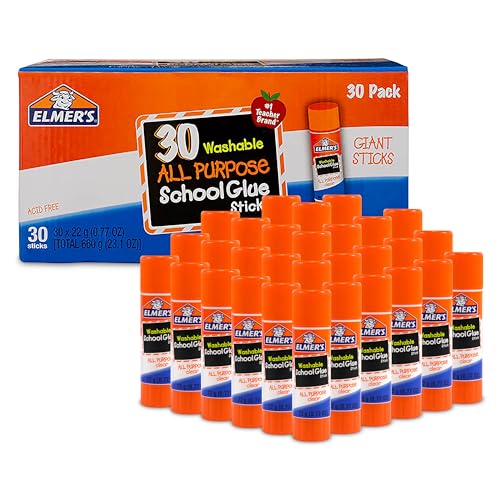
Elmer’s glue sticks are not a specialty foam adhesive, but they are a safe, melt-free option for low-stress foam bonding in classroom or craft environments. The solid PVA stick applies dry—no solvent, no water creep, no risk of dissolving Styrofoam. For attaching craft foam sheets to each other or gluing foam board display corners, this works reliably.
The 30-count bulk pack at 22 grams each is clearly designed for volume use. The glue spreads smoothly without clumps and dries clear within a few minutes. Because the bond is washable and acid-free, it is the best choice for supervised kids’ projects where toxicity is a concern. The adhesion strength is moderate—it holds foam board together for presentation displays but will not survive flight loads or outdoor temperature swings.
The limitation is structural capacity. This glue stick cannot handle shear stress between two large foam panels or sustain a flexible joint. It functions best for lightweight assembly where the foam itself is the structural material. For classrooms, art departments, or quick mock-ups, the convenience and safety outweigh the lack of industrial-grade hold.
Why it’s great
- Completely safe and non-toxic for children’s craft use
- No solvents or water to warp or melt Styrofoam
- Applies dry, dries clear, and washes out of fabric easily
Good to know
- Not load-bearing—fails under shear stress between foam panels
- Not suitable for outdoor or high-temperature applications
FAQ
Can I use regular super glue on Styrofoam if I apply a thin layer?
What is the fastest way to bond two pieces of Styrofoam together?
Does hot glue work on Styrofoam without melting it?
Final Thoughts: The Verdict
For most users, the glue for styrofoam to styrofoam winner is the Beacon Foam-Tac because its flexible cure handles both RC aircraft stress and thermal expansion without cracking. If you want instant-bond precision with zero smell, grab the Bob Smith Industries Super-Gold. And for large-scale model railroad or terrain projects where a rubbery, clamp-tolerant joint is needed, nothing beats the Woodland Scenics Foam Tack Glue.