
Nothing kills the satisfaction of a new floor like the hollow echo of a loose plank underfoot. The adhesive you choose determines whether your vinyl plank floor stays silent, solid, and gap-free through seasons of temperature swings and heavy foot traffic. A poor glue choice leads to edge curling, moisture wicking up through seams, and planks that shift just enough to drive you crazy.
I’m Mohammad Maruf — the founder and writer behind Drink4Good. I’ve spent years analyzing floor adhesive formulations, studying manufacturer compatibility charts, and cross-referencing real-world user data to separate the products that actually bond vinyl plank from those that simply claim to.
The selection you make comes down to three variables: the type of vinyl plank (click-lock versus glue-down), the subfloor material, and the moisture exposure level. This guide breaks down the top contenders to help you find the best glue for vinyl plank flooring based on those exact conditions.
How To Choose The Best Glue For Vinyl Plank Flooring
Selecting the right adhesive means understanding that not all vinyl plank floors are the same. A click-lock LVP (luxury vinyl plank) floating floor requires a tongue-and-groove glue that locks the seams without bonding to the subfloor. A full glue-down LVP needs a pressure-sensitive adhesive that bonds the entire plank to the substrate. Repair scenarios call for a low-viscosity injection adhesive that seeps into hollow spots. Using the wrong type results in bond failure, mess, or damage to the plank surface.
Subfloor Compatibility and Moisture Control
Concrete slabs release moisture vapor that can break down water-based adhesives over time. If your subfloor is concrete, you must use either a solvent-free acrylic latex adhesive formulated for moisture resistance, or install a dedicated vapor barrier film underneath. Plywood subfloors are more forgiving but still require a glue that resists water and doesn’t cause the wood fibers to swell. Always check the adhesive’s listed compatible materials — many acrylic latex formulas explicitly list concrete, APA-rated plywood, and existing well-bonded vinyl tile.
Application Method and Working Time
Full-spread adhesives like a bucket of pressure-sensitive glue give you a long open time — sometimes six or more hours — allowing you to trowel an entire room and then lay planks at a relaxed pace. Tongue-and-groove glues come in squeeze bottles with precision tips for fast application to the groove edge only. Repair adhesives in squeeze tubes require drilling tiny holes and injecting product, then waiting 5 to 24 hours for full cure. Choose based on whether you’re doing a new full-room installation or fixing a single loose plank.
Certifications and Indoor Air Quality
Vinyl plank flooring is often installed in living spaces, bedrooms, and kitchens where off-gassing matters. Look for adhesives that carry FloorScore certification — an independent standard for low VOC emissions. Solvent-free acrylic latex formulations avoid the harsh fumes associated with older solvent-based adhesives. If the installation area is enclosed or has limited ventilation, a solvent-free product with low odor is the smarter choice for both safety and comfort during the workday.
Quick Comparison
On smaller screens, swipe sideways to see the full table.
| Model | Category | Best For | Key Spec | Amazon |
|---|---|---|---|---|
| ROBERTS Universal Resilient Flooring Adhesive | Full-Spread | New LVP/LVT installations | 1 gal. / 3.78 L pail | Amazon |
| Titebond 2104 Tongue and Groove Glue | T&G / Floating | Click-lock floating floors | 16 oz bottle, passes Type II | Amazon |
| Fix-A-Floor Squeezy 2-Pack | Repair Adhesive | Loose / hollow plank repair | Low viscosity, self-levels | Amazon |
| Art3d Peel and Stick Vinyl Tiles | Self-Adhesive Tile | Budget-friendly DIY room updates | 30 sq ft per pack, 12×12 in | Amazon |
| ROBERTS 70-115 Moisture Barricade | Vapor Barrier | Moisture protection under floating floors | 6 mil thick, 120 sq ft roll | Amazon |
In‑Depth Reviews
1. ROBERTS Universal Resilient Flooring & Vinyl-Backed Carpet Tile Adhesive

This is the go-to full-spread adhesive for anyone installing new luxury vinyl plank or luxury vinyl tile. It’s an acrylic latex, solvent-free formula that delivers high initial tack — meaning planks stay put the moment you lay them down rather than sliding around during installation. The inclusion of Microban antimicrobial protection is a real differentiator, helping prevent mold and bacterial growth within the adhesive layer in areas like bathrooms or basements.
Working with the one-gallon pail is straightforward: you trowel it onto the prepared subfloor, and the long open time (users report six or more hours before skin-over) gives you plenty of room to reposition planks and adjust alignment. It dries clear enough that you can still see chalk lines through it, which is a nice convenience for pattern matching. The bond strength holds up through real-world abuse — tested after six months in environments with snow, mud, and rain exposure with zero edge lifting.
The compatibility list is extensive: concrete, APA-rated plywood, marble, terrazzo, and existing well-bonded vinyl tile (excluding self-stick). The only practical downside is cleanup — if the adhesive dries on tools or skin, it requires immediate attention. Overall, this is the adhesive professional installers reach for when the job demands reliability across a full room.
Why it’s great
- Microban additive resists stain-causing microbes in the bond layer
- Very long working time eliminates rushed installation pressure
- Dries clear to preserve subfloor markings
Good to know
- One gallon covers roughly 80-100 sq ft depending on trowel notch size
- Cleanup requires soap and water only while wet — dried adhesive is stubborn
2. Titebond 2104 Tongue and Groove Glue

This is the industry standard for locking together the tongues and grooves of floating vinyl plank floors. Unlike full-spread adhesives that bond the plank to the subfloor, Titebond 2104 is designed to bond plank to plank — creating a unified floating surface that moves as one piece. The 16-ounce bottle with its ergonomic precision tip makes applying a thin, controlled bead into the groove fast and clean, which matters when you’re working on your knees across an entire room.
The formulation passes Type II water-resistance testing, meaning the bond holds even in environments with occasional moisture exposure — bathrooms are a common use case. Users consistently report that the bond strength exceeds the strength of the plank material itself, which is exactly what you want in a floating floor joint. The lower chalk temperature also means it performs well when working in cooler conditions where some adhesives become stiff and hard to extrude.
Coverage is roughly one bottle per 100 square feet for standard 3-inch wide planks. One nuance: the applicator tip needs to be cut carefully — too large a cut and you’ll over-apply, creating mess and squeeze-out between seams. A light application is all it takes. FloorScore certification ensures low VOC emissions, making this a safe choice for indoor living spaces even with limited ventilation during installation.
Why it’s great
- Superior bond strength that exceeds the board material integrity
- Ergonomic bottle design with precision tip reduces hand fatigue
- FloorScore certified for low VOC emissions
Good to know
- Not for full glue-down installations — only for tongue and groove seams
- Over-application causes messy squeeze-out; a conservative bead is better
3. Fix-A-Floor Squeezy 2-Pack
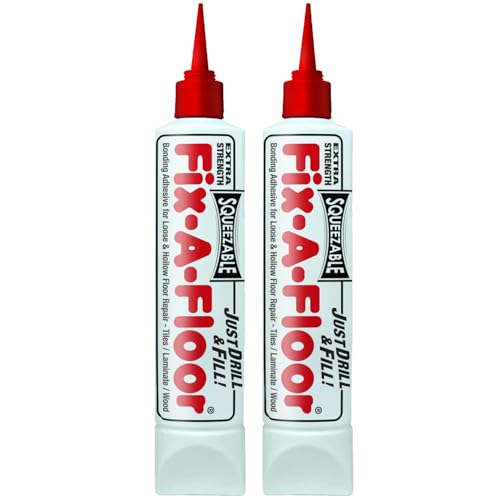
This product solves a very specific but very common problem: loose, hollow, or creaky vinyl planks that have already been installed. The low-viscosity formula is designed to self-level after injection, meaning it flows under the plank through tiny drilled holes and fills the void between the plank and the subfloor. The process is simple — drill small holes (about 1/8 to 1/4 inch) at the seams or through grout lines, inject the adhesive, and weigh the area down for 5 to 24 hours with the included precision applicator tip.
The two-pack gives you enough material to tackle multiple problem spots without needing to buy a full gallon of full-spread adhesive. Users have had success fixing loose tiles in luxury vinyl plank floors that had started to hollow out over time. The elastomeric properties allow it to work with radiant heating systems, and the self-leveling nature means it finds its way into gaps that a thicker adhesive simply couldn’t penetrate. It also works on ceramic, porcelain, stone, and wood — not just vinyl.
The main constraint is that Fix-A-Floor states it is not recommended for use on floating floors. The precision tip is also fairly large — some users note the minimum hole size is around 1/4 inch, which can be too wide for thin vinyl plank gaps. For standard LVP with hollow spots, this is a fast, affordable fix that avoids pulling up the entire floor.
Why it’s great
- Self-leveling formula penetrates voids without needing full plank removal
- Non-toxic and non-hazardous for indoor use
- Works with under-floor radiant heating systems
Good to know
- Not suitable for floating floors — only for direct-bond installations
- Full cure takes up to 24 hours before the floor can bear weight
4. Art3d Peel and Stick Vinyl Floor Tiles

While not an adhesive you apply separately, this product represents an entire category of self-adhesive vinyl tiles that bundle the glue directly onto the plank backing. For a budget-conscious DIY installation in small rooms like laundry rooms, half-bathrooms, or rental spaces, the peel-and-stick approach eliminates the need to buy and spread a separate adhesive. The 30-pack covers 30 square feet with 12×12 inch tiles, and the rigid PVC core is both 100% waterproof and fireproof.
The installation process is the fastest of any option here — clean the subfloor, peel off the backing, and press the tile into place. The adhesive backing delivers a strong initial grab on clean, smooth concrete or flat plywood. The taupe ash finish has a wood-look pattern that mimics real hardwood visually, and the tiles are thick enough to hide small subfloor imperfections better than budget peel-and-stick options from other brands.
The inconsistency is real, though. Some users report the adhesive backing is difficult to peel off, and a minority experience tiles that don’t stick well over time. The tiles also arrive out of pattern sequence in the box, requiring extra sorting time to match the grain. For a temporary or low-traffic area, this is an affordable solution — but for a permanent main-room floor, a full-spread adhesive with separate plank material is more reliable.
Why it’s great
- No separate adhesive needed — peel, stick, and done
- Thick, rigid PVC construction with waterproof core
- Budget-friendly entry point for small room DIY renovations
Good to know
- Adhesive performance varies on uneven or dirty subfloors
- Not recommended for high-moisture basements or heavy commercial traffic
5. ROBERTS 70-115 Moisture Barricade Underlayment Film

This is not an adhesive itself, but it is the unsung hero of any vinyl plank flooring installation on a concrete slab. Moisture vapor migrating up through concrete is one of the top causes of adhesive failure — over time, the moisture breaks down the bond between the glue and the subfloor, leading to peeling edges and plank separation. The ROBERTS 70-115 is a heavy-duty 6 mil polyethylene vapor barrier that stops that moisture path cold. It rolls out easily, lies flat without curling at the edges, and includes an integrated adhesive strip to seal the seams between sheets.
The film covers 120 square feet per roll (unfolding to a 10-foot by 12-foot area), and the 6 mil thickness exceeds NWFA (National Wood Flooring Association) requirements for moisture barriers under floating floors. It works with vinyl plank, laminate, SPC, and engineered wood — any floating floor type that needs a barrier between the subfloor and the underlayment. Users consistently praise the no-odor installation and the way it cuts cleanly with a utility knife.
For anyone laying vinyl plank over concrete — especially in basements, ground-level rooms, or areas with known humidity — using this film underneath your floating floor adds a critical layer of protection that extends the life of both the glue joints and the planks themselves. The only catch is that you’ll need to tape the seams where the adhesive strip ends, typically at the roll edges. Pair this with a quality tongue-and-groove glue for a complete moisture defense system.
Why it’s great
- 6 mil thickness provides robust puncture resistance during installation
- Integrated adhesive seam tape simplifies sealing overlaps
- Exceeds NWFA vapor barrier standards for concrete subfloors
Good to know
- Must be used under, not over, the underlayment pad
- Seam tape may require additional pressure to fully bond on textured concrete
FAQ
Can I use regular wood glue for vinyl plank flooring?
How long does vinyl plank flooring glue take to dry before walking on it?
Final Thoughts: The Verdict
For most users, the glue for vinyl plank flooring winner is the ROBERTS Universal Resilient Flooring Adhesive because it combines a long working time, broad subfloor compatibility, and Microban antimicrobial protection in a solvent-free formula that professional installers trust. If you need a precise tongue-and-groove glue for a floating click-lock floor, grab the Titebond 2104. And for fixing loose planks without pulling up the whole floor, nothing beats the Fix-A-Floor Squeezy 2-Pack.