
A vinyl repair that fails under summer heat or winter flex isn’t just frustrating—it wastes your time and material. The wrong glue cracks, peels, or never truly bonds to slick vinyl surfaces, leaving you with a mess instead of a fix. The right adhesive penetrates the surface, stays flexible after curing, and withstands the same conditions the vinyl was designed for.
I’m Mohammad Maruf — the founder and writer behind Drink4Good. I analyze thousands of product specs and customer reports to identify which adhesives actually deliver durable, flexible bonds on vinyl and PVC substrates.
This guide covers the top contenders for glue for vinyl, focusing on contact cements and fabric adhesives that resist water, temperature swings, and regular wear without turning brittle.
How To Choose The Best Glue For Vinyl
Selecting the right adhesive for vinyl projects comes down to the substrate’s flexibility, the environment it will face, and the bond strength required. Not every glue marked “vinyl-compatible” actually stays pliable after curing, which is the primary cause of seam failure on inflatables, upholstery, and marine covers.
Prioritize Flexibility Over Initial Grip
A rigid bond cracks when the vinyl flexes, bends, or expands with temperature. Look for adhesives explicitly labeled as “flexible” or “contact cement” formulations, which maintain elasticity after a 24-hour full cure. Neoprene-based cements, like those in the HH-66 and Duall-88 families, are engineered to move with the substrate without delaminating.
Match Adhesive Chemistry to Vinyl Type
Thick vinyl sheeting used in pool liners and tonneau covers bonds well with solvent-based vinyl cement that slightly softens the surface for a weld. Vinyl-coated fabrics (marine upholstery, convertible tops) respond better to contact adhesives that grab aggressively during the tacky phase. Avoid general-purpose super glues—they lack the plasticizer compatibility needed for long-term adhesion on flexible PVC.
Check Open Time for Complex Repairs
Open time refers to how long the glue remains tacky after application. Shorter open times (30 seconds to 3 minutes) demand precise placement, while extended open times (15–60 minutes) allow repositioning. For large panels or awkward angles, choose an adhesive with a longer open time to avoid permanent misalignment.
Quick Comparison
On smaller screens, swipe sideways to see the full table.
| Model | Category | Best For | Key Spec | Amazon |
|---|---|---|---|---|
| RH Adhesives HH-66 Vinyl Cement | Industrial Vinyl Cement | Pool liners, inflatables, marine vinyl | Toluene-free contact cement | Amazon |
| DAP Weldwood Landau Top & Trim | Spray Contact Adhesive | Automotive upholstery, foam, vinyl | High heat resistance | Amazon |
| 3M Hi-Strength 94 ET Spray | Spray Adhesive | Large surface laminations, foam | 60-minute open time | Amazon |
| Duall-88 Leather Adhesive | Neoprene Contact Cement | Leather, shoe repair, upholstery | Repositionable during set | Amazon |
| FITTDYHE Fabric Glue | Fabric Adhesive | Fabric patches, rhinestones, hem repairs | Washable, clear finish | Amazon |
In‑Depth Reviews
1. RH Adhesives HH-66 Toluene Free Vinyl Cement

The HH-66 is the professional-grade standard for bonding vinyl sheeting and coated fabrics. Its toluene-free formula penetrates PVC surfaces to create a flexible, waterproof weld that stays serviceable from -30°F to 150°F. The built-in brush cap delivers controlled application, making it easy to coat patch edges evenly without waste. Users consistently report successful repairs on pool liners, inflatable boats, and marine upholstery—even when applied directly underwater.
Full cure takes 24 hours, but the adhesive sets within 3 minutes after the two surfaces are pressed together. This rapid grab leaves no room for repositioning, so measure and align carefully before joining. The moderate solvent odor demands ventilation, though it dissipates fully after curing. One 4-ounce can covers multiple small repairs or one large patch on a tonneau cover.
Customer feedback highlights its reliability on thick vinyl where other glues fail. A verified review describes using HH-66 to fix a 6-inch tear in an above-waterline pool liner; the patch held solidly after weeks of rain and heavy use. Another user repaired an L.L.Bean waterproof duffel that survived baggage checks. The only substrate limitation is polyethylene—it will not bond standard blue tarps.
Why it’s great
- Forms a waterproof, flexible bond that withstands temperature extremes
- Can be applied in cold weather or even underwater
- Toluene-free formulation reduces harsh solvent exposure
Good to know
- Sets fast (3 minutes)—no room for alignment adjustments
- Not compatible with polyethylene tarp material
- Requires good ventilation during application
2. DAP Weldwood Landau Top & Trim Contact Adhesive
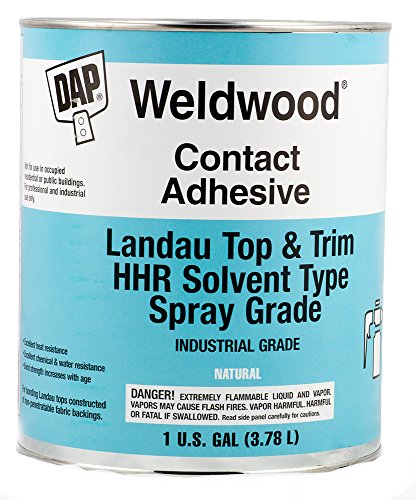
DAP Weldwood Landau Top & Trim is a spray-grade contact adhesive designed specifically for automotive upholstery, foam, and vinyl materials. Its solvent-based formulation delivers a permanent bond that resists high heat and water exposure, making it suitable for interior and exterior use. The 1-gallon can is intended for siphon-feed spray guns, allowing fast coverage on large surfaces like headliners, door panels, and convertible tops.
Application requires careful reading of the instructions: the adhesive must be sprayed evenly onto both surfaces, left to dry until tacky (typically 15–30 minutes), then pressed together. This contact-cement method creates an immediate high-strength bond without clamping. Users report excellent results on automotive headliners and foam-backed vinyl panels, with one review noting the bond held perfectly after months in a vehicle.
The large format and spray-only application make this overkill for small repairs around the house. Ventilation is critical—the solvent fumes are flammable and strong, so use in a well-ventilated area and keep air compressors outside the workspace. The high price point reflects industrial-grade performance; for occasional small-patch repairs, a smaller can of HH-66 is more practical.
Why it’s great
- Permanent bond engineered for automotive heat and moisture conditions
- Spray application covers large panels efficiently
- Water-resistant and suitable for exterior use on vehicles
Good to know
- Requires spray gun or siphon setup—not brush-on
- Strong flammable fumes demand excellent ventilation
- Large gallon size is expensive and excessive for small repairs
3. 3M Hi-Strength 94 ET Spray Adhesive
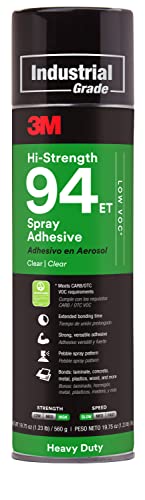
This spray adhesive from 3M is built for large-surface laminations where you need time to align the substrate before the bond sets. The 94 ET formula offers an open time of up to 60 minutes, making it ideal for bonding foam to plastic, fabric to wood, or carpet to flooring. The aggressive tack grabs firmly once the two surfaces meet, but the extended window before that point allows for repositioning—a rare feature in strong adhesives.
The low-VOC formula is GREENGUARD Certified and can contribute to LEED credits, which matters for indoor projects where air quality is a concern. Users note the smell is still present (similar to airplane glue) but dissipates faster than traditional solvent-based sprays. The 19.75-ounce can provides generous coverage, and one coat is often enough for porous materials like foam.
While 3M 94 ET bonds to a wide range of materials, it is not a dedicated vinyl cement. On slick vinyl surfaces, the bond may not achieve the same plasticizing weld that HH-66 delivers. Best results on vinyl come when both surfaces are clean and slightly porous. A verified review reports excellent adhesion sticking foam soundproofing to plastic in freezing temperatures—a testament to its cold-weather performance.
Why it’s great
- 60-minute open time allows careful alignment of large panels
- Low-VOC, GREENGUARD Certified for indoor use
- Aggressive tack bonds foam, fabric, and wood securely
Good to know
- Not formulated to plasticize vinyl like a dedicated cement
- Spray application requires masking off surrounding areas
- Moderate solvent odor despite low-VOC rating
4. Duall-88 Leather Adhesive, RH Adhesives
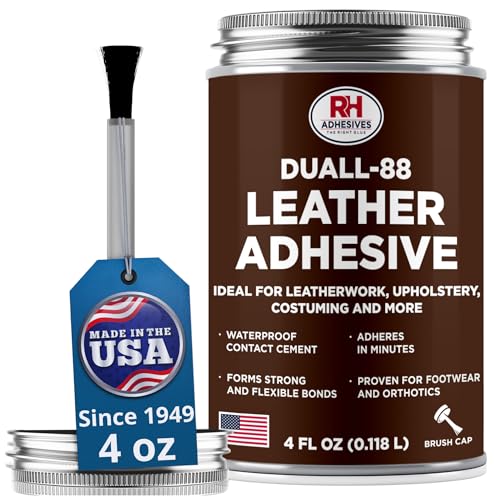
Duall-88 is a neoprene-based contact cement from the same manufacturer as HH-66, but formulated with a slightly longer open time that allows repositioning before the permanent bond sets. It dries to an amber clear finish, making it suitable for visible repairs on leather goods, shoes, and upholstery where appearance matters. The adhesive sets within 10–30 minutes depending on environmental conditions, giving you a comfortable window to align patch edges.
The formula bonds more than leather—it works on crepe rubber, EVA foam, metals, and some plastics, making it a versatile addition to any repair kit. Users have successfully repaired car upholstery panels that peel in summer heat, leather sandals, and even vintage sofa cushions. The 4-ounce can is small but concentrated; one coat on each surface is sufficient for most repairs.
The main trade-off is flexibility—Duall-88 remains more rigid than HH-66 after full cure. For applications requiring constant flex, like inflatable boat seams, HH-66 is a better choice. Also, the strong odor is comparable to other solvent-based cements, so ventilation remains essential. Cleanup is easier than most contact cements—the glue can be rolled off surfaces before it fully cures.
Why it’s great
- Dries clear, ideal for visible repairs on leather and vinyl
- 10–30 minute open time allows repositioning before permanent bond
- Versatile adhesion to rubber, foam, metal, and plastics
Good to know
- Less flexible than dedicated vinyl cement after full cure
- Strong solvent fumes require well-ventilated workspace
- 4-ounce can is small for large-area projects
5. FITTDYHE Fabric Glue, 3-Pack

If your vinyl project involves attaching fabric patches, rhinestones, or hem repairs rather than bonding vinyl-to-vinyl seams, this washable fabric glue offers a non-toxic, easy-to-use alternative. The 3-pack includes precision needle tips that control glue flow and an anti-clogging cap that keeps the nozzle from drying out between uses. The glue dries clear and maintains adhesion through multiple wash cycles, though it is not as durable as stitched seams or chemical vinyl welds.
Application is straightforward: apply a thin layer to one surface, spread evenly with the included glue spreader, and clamp using the provided clips. Full cure takes 24–48 hours, and the manufacturer warns against checking progress before the glue has fully dried. Users report good results on denim, cotton, leather, and polyester—fabrics that are often attached to vinyl backing in crafts and doll repairs.
The primary limitation is adhesion strength on slick vinyl surfaces. This glue is designed to bond fabric fibers, not to plasticize vinyl. For vinyl-to-vinyl repairs, choose one of the contact cements above. However, for gluing patches onto vinyl garments or repairing vinyl doll clothes, this budget-friendly option works without the fumes and toxicity of solvent-based cements.
Why it’s great
- Non-toxic and washable, suitable for clothing repairs
- Three bottles with precision tips for controlled application
- Dries clear and remains flexible on fabric substrates
Good to know
- Not designed for vinyl-to-vinyl bonding—use contact cement instead
- 24–48 hour cure time is longer than solvent-based adhesives
- Bond strength is less durable than stitched seams
FAQ
Can I use super glue to repair vinyl tears?
How do I prepare vinyl surfaces before applying adhesive?
Why does my vinyl glue smell so strong?
Can I use fabric glue to repair a vinyl pool liner?
How long should I wait before using a repaired vinyl item?
Final Thoughts: The Verdict
For most users, the glue for vinyl winner is the RH Adhesives HH-66 Toluene Free Vinyl Cement because it delivers a flexible, waterproof bond that holds up under extreme temperatures and repeated flexing—exactly what vinyl repairs demand. If you need a high-heat automotive-grade adhesive for large panels, grab the DAP Weldwood Landau Top & Trim. And for non-toxic fabric-to-vinyl patch repairs around the house, nothing beats the FITTDYHE Fabric Glue 3-Pack.