
A wood veneer project lives or dies by the adhesive you choose — one wrong pick and you’re fighting bubbling edges, creeping lift, or a bond that fails under seasonal humidity swings. The right glue for wood veneer must bridge two opposing demands: it needs aggressive tack to grab the thin sheet instantly, yet enough flexibility to expand and contract with the substrate underneath without telegraphing every imperfection.
I’m Mohammad Maruf — the founder and writer behind Drink4Good. Over the past 15 years, I’ve analyzed hundreds of adhesive formulations across the woodworking and furniture restoration categories, focusing specifically on how each formula behaves when applied to thin-profile veneers over MDF, plywood, and particleboard substrates.
Whether you’re laying a bookmatched walnut top on a mid-century credenza or re-skinning a worn kitchen island, finding the right glue for wood veneer means weighing open time, heat resistance, and the specific application method that matches your workspace and skill level.
How To Choose The Best Glue For Wood Veneer
Selecting a veneer adhesive isn’t about grabbing the strongest glue on the shelf — it’s about matching the formula’s working characteristics to your project size, the substrate material, and your experience applying contact adhesives. The three factors below separate a smooth, permanent bond from a frustrating re-do.
Open time and tack level
Open time is the window between applying the adhesive and pressing the surfaces together. Brush-on contact cements typically offer an open time of 10–15 minutes before the adhesive becomes too dry to bond. Spray adhesives vary widely — some grab in two minutes, others allow up to an hour of repositioning. For large veneer panels where alignment is tricky, a longer open time reduces anxiety. For small repairs or trim work, a fast grab is preferable because it minimizes clamping time.
Application method: brush vs. spray
Brush-on contact cement gives you precise control over coverage and eliminates overspray, making it ideal for small pieces and indoor workshops without extensive ventilation systems. Spray adhesives cover large surfaces evenly and quickly, but they require masking and proper air filtration. The 3M spray options in this review offer adjustable nozzles and low-VOC formulations that reduce airborne solvent levels, but no spray adhesive should be used without respiratory protection.
Heat and moisture resistance
Veneered tabletops in kitchens, bathroom vanities, or sunlit rooms experience thermal cycling and occasional moisture. Neoprene-based contact cements (the industry standard) typically hold up to 250°F before degrading. Waterproof formulations prevent delamination when humidity spikes. Check the label for a specific temperature rating and a waterproof claim — both specs appear clearly on the products below.
Quick Comparison
On smaller screens, swipe sideways to see the full table.
| Model | Category | Best For | Key Spec | Amazon |
|---|---|---|---|---|
| 3M Max Strength 90 | Spray | Large veneer panels | 10-minute bond, 12.6 oz can | Amazon |
| 3M Hi-Strength 94 ET | Spray | Large surface laminations | 60-minute open time, 19.75 oz | Amazon |
| Clear-Tite Contact Cement | Brush-on | Countertops and tabletops | Heat resistant to 250°F, 4 oz | Amazon |
| S-18 All-Purpose Adhesive | Brush-on | Multi-material bonding | Water resistant, 4 oz can | Amazon |
| Wonshine Contact Cement | Brush-on | Small repairs and crafts | Built-in brush tip, 4.16 oz | Amazon |
In‑Depth Reviews
1. 3M Max Strength 90 Multi-Surface Contact Adhesive
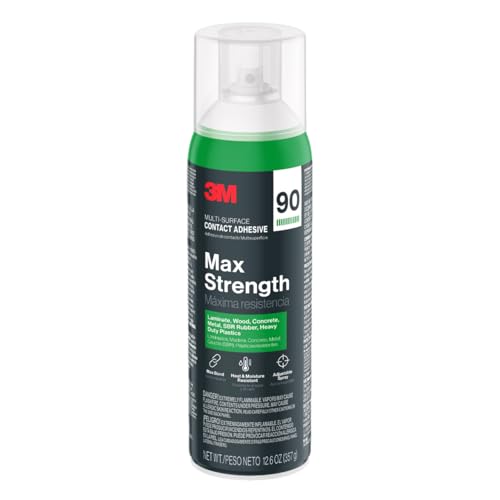
The 3M Max Strength 90 strikes an ideal balance between rapid bond formation and user control. Its spray pattern covers large veneer sheets evenly without puddling, and the adjustable nozzle lets you dial in a narrow stream for edge work or a wide fan for full-surface application. The 10-minute bond time means you can coat both the substrate and the veneer back, let the solvent flash off, and then press together for an immediate grab that doesn’t require clamping.
Heat and moisture resistance are built into the formulation — verified by users who have employed it in marine environments and hot Southern climates without delamination. The low-VOC chemistry meets California Air Resources Board standards, which reduces the harsh solvent odor compared to traditional contact cements. At 12.6 ounces, one can covers roughly 25 square feet of veneer surface, making it cost-efficient for medium to large projects.
The web spray application produces a consistent film that minimizes waste, but you’ll still need to mask adjacent surfaces if you’re working on a partially assembled piece. Users report that the bond remains flexible enough to accommodate seasonal wood movement, a critical characteristic for veneer that would otherwise crack or bubble at the seams.
Why it’s great
- Even spray pattern prevents pooling and uneven adhesion
- Heat and moisture resistant for demanding environments
- Low-VOC formula reduces respiratory irritation
Good to know
- Requires masking to protect surrounding surfaces from overspray
- 10-minute open time is short for large or complex layouts
2. 3M Hi-Strength 94 ET Spray Adhesive
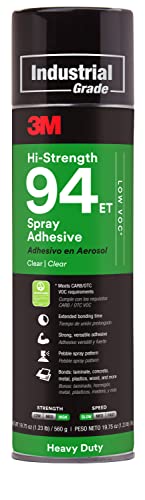
The 3M Hi-Strength 94 ET is the choice for anyone laying large veneer sheets where alignment is critical. Its standout feature is a 60-minute open time — the longest in this review — which gives you a full hour to position, reposition, and burnish the veneer before the adhesive sets permanently. That cushion is invaluable when you’re bookmatching a four-foot walnut panel or centering a patterned veneer on a cabinet door.
The aggressive tack remains active through the entire window, so the veneer won’t slip once it contacts the adhesive film. The 19.75-ounce can delivers the highest coverage per unit in the roundup, suitable for multiple tabletops or a full set of kitchen cabinet fronts. Greenguard certification confirms low chemical emissions, which matters if you’re working in a living space or a shop without dedicated exhaust.
Users have applied it successfully to bond foam soundproofing to metal and carpet to butyl deadener, demonstrating its versatility beyond veneer work. The solvent odor is noticeable — reviewers consistently recommend a respirator and good ventilation — but the bond strength and repositionability are unmatched for the category. The 24-hour full cure time is typical for spray adhesives and should be factored into your project timeline.
Why it’s great
- 60-minute open time allows precise veneer alignment
- Large 19.75 oz can covers extensive projects
- Greenguard certified for lower VOC emissions
Good to know
- Requires good ventilation and respiratory protection
- Full cure takes 24 hours before handling
3. Clear-Tite Contact Cement

The Clear-Tite Contact Cement from RH Adhesives is a classic brush-on contact cement specifically formulated for laminate and veneer applications. Its neoprene base delivers a bond strength that has been trusted by commercial cabinet and countertop manufacturers for decades. The 4-ounce can includes a built-in brush in the cap, letting you apply thin, even coats directly from the container without needing a separate disposable brush.
The formula is rated to withstand temperatures up to 250°F, a critical spec for veneered surfaces near ovens, stovetops, or direct sunlight. Users have successfully bonded Formica laminate to particleboard for countertops and repaired rubber elements on shoe soles, confirming its flexibility across different substrates. The light beige color dries transparent yellow, not water-clear — a detail noted by buyers who expected a truly invisible bond line.
Application is straightforward: coat both surfaces, wait 10–15 minutes until the adhesive is tacky and glossy, then press together. The bond forms immediately on contact, requiring no clamping for most flat panels. The 24-hour full cure time is standard for contact cements, but the initial grab is strong enough for the veneer to be handled within minutes of the layup.
Why it’s great
- Heat resistant to 250°F for kitchen and sunny applications
- Convenient built-in brush applicator in the cap
- Proven commercial track record in cabinetry and countertop fabrication
Good to know
- Dries transparent yellow, not completely clear
- Small 4 oz can is best for single countertop or small projects
4. S-18 All-Purpose Adhesive
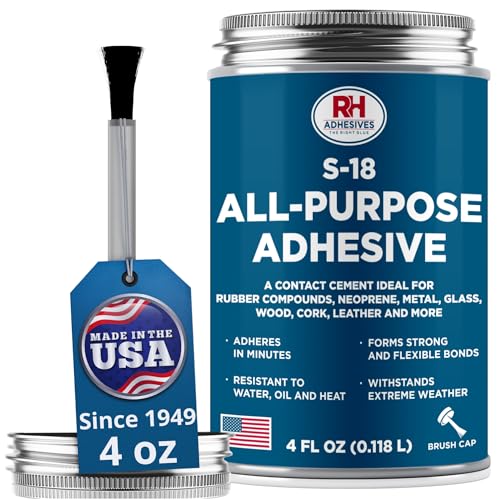
The S-18 All-Purpose Adhesive is a versatile neoprene formula that bonds porous and non-porous materials alike, making it a solid entry-level choice for wood veneer attachment. Manufactured in the United States since 1949, this adhesive is designed to form strong films with excellent peel strength and resistance to oil and aging. The 4-ounce can is small, but the formula is potent enough to handle furniture touch-ups, leather repairs, and small veneer patches.
Water resistance is a key advantage here — the S-18 is intended for marine applications, which means it can tolerate the humidity fluctuations that plague veneered tabletops or bathroom cabinetry. Users have successfully used it to repair leather boots and neoprene yoga mats, indicating that the bond flexes well with rubber and fabric substrates. One reviewer noted that the glue weakened over time if the can sat unused, so plan to use it within a few months of opening.
The adhesive requires thorough surface preparation — old glue must be sanded away before application — and the manufacturer stresses using it in a very well-ventilated area due to solvent fumes. The 24-hour cure time is standard, but the initial tack is strong enough to hold the veneer in place during the drying period without clamps. For small projects where you want one adhesive to cover multiple repair scenarios, the S-18 is a practical, budget-conscious pick.
Why it’s great
- Water-resistant formula suitable for humid environments
- Strong peel strength bonds rubber, leather, and wood
- Made in America with a decades-long production history
Good to know
- Adhesive strength may degrade if can sits unused for extended periods
- Requires strong ventilation and careful surface prep
5. Wonshine Contact Cement Adhesive
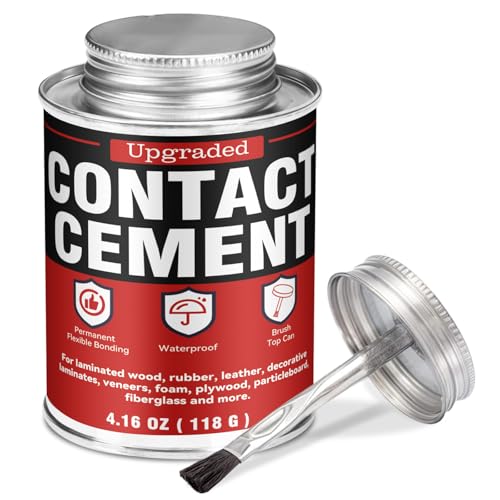
The Wonshine Contact Cement differentiates itself with a built-in brush tip that screws directly onto the can, giving you pinpoint control for small veneer repairs, crafts, and edge banding. The brush channels the neoprene formula precisely where you need it without flooding the surface or wasting adhesive on cleanup. The 4.16-ounce container is compact enough for a tool belt or a crowded workbench drawer.
The formula is waterproof and remains flexible after cure, a necessary characteristic for veneer that spans across panel gaps or curved surfaces. Users report strong bonds on rubber feet, cutting boards, and laminate trim — all scenarios where a rigid adhesive would fail. The 10–15 minute open time is standard for contact cements, and the manufacturer specifies that the surfaces should be joined when the glue is “slightly dry and glossy” for maximum adhesion.
Shipping quality is a concern flagged by multiple buyers — the can has arrived with the cap not fully tightened, causing leakage inside the packaging. This appears to be a packing issue rather than a formula defect, but it’s worth ordering from a seller with good fulfillment practices. If you receive an intact can, the adhesive performs on par with established brands at a lower per-ounce cost, making it a sensible option for hobbyists and occasional users.
Why it’s great
- Built-in brush tip for precise, mess-free application
- Waterproof and flexible after full cure
- Affordable price point for small projects and crafts
Good to know
- Shipping packaging sometimes allows the cap to loosen and leak
- Small can volume limits use to minor repairs rather than full panels
FAQ
Is spray adhesive better than brush-on contact cement for wood veneer?
How long should I let contact cement dry before pressing veneer?
Can I use wood glue (PVA) instead of contact cement for veneer?
What does “open time” mean and why does it matter for veneer?
Does contact cement damage veneer or cause discoloration?
Final Thoughts: The Verdict
For most users, the glue for wood veneer winner is the 3M Max Strength 90 because it combines fast 10-minute bonding, a consistent spray pattern that prevents puddling, and heat/moisture resistance that protects the veneer in real-world conditions. If you need maximum repositionability for intricate layouts, grab the 3M Hi-Strength 94 ET with its 60-minute open time. And for small brush-on projects where precision matters more than speed, nothing beats the Clear-Tite Contact Cement with its built-in applicator and commercial-grade heat tolerance.