
Goathead burrs are a menace. One wrong step on a dry lawn or driveway, and you’re pulling a barbed seed from your shoe — or worse, your bike tire. These puncturevine seeds thrive in dry, disturbed soil, and once they establish, a single plant can produce hundreds of seeds. Getting rid of them requires a targeted approach, not a general-purpose spray.
I’m Mohammad Maruf — the founder and writer behind Drink4Good. I’ve analyzed hundreds of herbicide formulations, reading through soil science studies and customer trial data to find the most effective active ingredients for specific weed species.
This guide breaks down the chemical and practical strategies for eliminating goathead burrs. For a reliable, season-long solution, finding the right best goat head weed killer means understanding the difference between pre-emergent prevention and post-emergent burr destruction.
How To Choose The Best Goat Head Weed Killer
Goathead — also known as puncturevine — is a summer annual that germinates when soil temperatures rise. It has a deep taproot that makes it resistant to surface-level sprays. The right killer works in two phases: killing current plants and preventing the next generation.
Active Ingredient Matters — Not Just the Brand
The chemical backbone of your spray determines its potency on goathead. Triclopyr is a selective brush killer that works on woody vines and broadleaves, including puncturevine. Mesotrione offers both pre- and post-emergent activity, which is powerful because it stops seeds from sprouting while killing young plants. Atrazine is effective on established goathead in St. Augustine or Centipede lawns.
Pre-Emergent vs. Post-Emergent
Goathead seed can lie dormant in soil for several years. If you only spray visible plants, you will miss the seed bank hiding in the soil. A pre-emergent (applied before soil warms) stops germination. A post-emergent kills the sprouted plant. The most effective strategy uses both: a pre-emergent barricade early in spring, then a post-emergent spot treatment as plants appear.
Concentrate vs. Ready-to-Use
Concentrated formulas like triclopyr or mesotrione require dilution but treat large areas at a lower cost per application. These are best for big lawns, pastures, or gravel driveways. Ready-to-use sprayers are more convenient for spot-treating the occasional burr patch in flower beds or between paver stones.
Quick Comparison
On smaller screens, swipe sideways to see the full table.
| Model | Category | Best For | Key Spec | Amazon |
|---|---|---|---|---|
| Southern AG Brush Weed Killer | Triclopyr Concentrate | Non-lawn areas & brush | 8.8% Triclopyr | Amazon |
| Hi-Yield Atrazine Weed Killer | Selective Atrazine RTS | St. Augustine & Centipede grass | 4% Atrazine, 32 oz | Amazon |
| Bonide Captain Jack’s Deadweed Brew | Organic Ready-to-Use | Fast-acting in gardens | 128 oz RTU, organic | Amazon |
| Liquid Harvest Mesotrione | Pre/Post-Emergent Concentrate | Selective lawn treatment | 8 oz concentrate, 46 species | Amazon |
| Hi-Yield Killzall 365 | Non-Selective Concentrate | Total vegetation spot kill | 32 oz concentrate, 4,300 sqft | Amazon |
In-Depth Reviews
1. Southern AG Brush Weed Killer

Triclopyr is the active ingredient that gives this concentrate its punch against woody vines and deep-rooted broadleaf weeds like goathead. At 8.8% concentration, it surpasses most big-box store formulas, which often dilute the active below an effective threshold. Users report visible burr wilt within days, not weeks. This is a selective brush killer, meaning it targets the tough stuff without sterilizing all soil life.
Coverage is impressive: one gallon of mixed spray covers 512 to 1,024 square feet, making it ideal for large patches along fence lines, in pastures, or on gravel driveways where goathead thrives best. The formula also prevents stump sprouting, which helps if you are cutting back larger burr-producing vines. Application is straightforward with a standard pump sprayer.
Because this is a non-selective herbicide in terms of broadleaf targets, use caution near desirable landscaping plants. It works on non-crop areas, roadsides, rangeland, and pastures — not on lawns you care about. If you have tough goathead brush in an area you want cleared permanently, this is the most effective volume option.
Why it’s great
- High triclopyr concentration kills goathead quickly
- Covers large non-lawn areas efficiently
- Prevents stump regrowth on woody burr stems
Good to know
- Not safe for use on lawns or turf grass
- Does not work on all vine types (strangler fig reported as resistant)
2. Hi-Yield Atrazine Weed Killer RTS
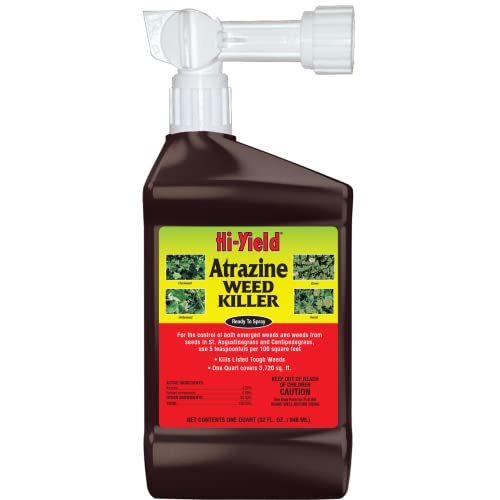
Atrazine is one of the few selective herbicides safe for St. Augustine and Centipede grass lawns while still effective on puncturevine. This ready-to-spray formula connects directly to your garden hose, treating up to 3,720 square feet per bottle. It targets henbit, clover, chickweed, and importantly, the broadleaf goathead weed. No mixing required, which reduces the risk of overdose damage to your lawn.
Customer feedback notes that results become visible around the three-week mark — slower than triclopyr, but the trade-off is lawn safety. Proper application technique matters: hold the nozzle about 12 inches above the grass and apply in 3 to 4 foot strips. Over-application or uneven coverage can scorch turf. Users also report that the bottle lacks measurement markings, so following the label directions precisely is critical.
This product is a strong mid-range option for someone with a St. Augustine or Centipede lawn who wants to kill goathead burrs without destroying the turf. It will not harm grass when applied correctly, but it does have a delayed effect, requiring patience for full burr death.
Why it’s great
- Safely kills goathead without damaging St. Augustine or Centipede
- Ready-to-spray hose attachment for easy coverage
- Treats large lawn areas in one application
Good to know
- Works slowly — may take 3 weeks for full results
- Not effective on wild onion; follow label instructions carefully
3. Bonide Captain Jack’s Deadweed Brew

This ready-to-use formula is a non-selective weed killer approved for organic gardening, meaning it targets all types of weeds and grasses — including goathead — without synthetic persistent chemicals. The active formula is fast-acting, with visible wilting as soon as a few hours after application on a warm, sunny day. It is also waterproof once dry, so a light rain after treatment won’t wash off the effect.
The 128-ounce jug includes an attached power sprayer, making it practical for garden beds, driveways, and fence lines. It works in temperatures as low as 40 degrees Fahrenheit, giving a longer application window than many other formulas. However, because it is non-selective, it cannot be used directly on lawns without killing the grass underneath. Some users who applied it to lawns reported dead patches around the targeted weeds.
For goathead control, this is best reserved for bare ground areas — gravel paths, cracks in patios, or along the base of walls. The ready-to-use nature makes it a strong option for spot treatment without mixing. The price is comparable to concentrates, but you pay for the convenience of the sprayer and the larger ready-to-use volume.
Why it’s great
- Visible goathead death in a few hours
- Approved for organic gardening
- Large gallon-size jug with built-in sprayer
Good to know
- Non-selective — kills any grass it touches
- May only affect leaves, not deep roots; reapplication may be needed
4. Liquid Harvest Mesotrione

Mesotrione is the same active ingredient as the brand-name Tenacity, and this 8-ounce concentrate gives you both pre-emergent and post-emergent action in one bottle. That dual function is the ultimate advantage for goathead control: it kills existing burr plants while also preventing new seeds from germinating in the soil. It works by inhibiting photosynthesis, turning the weed white before it dies, which usually takes 2 to 3 weeks.
This product is suitable for Kentucky Bluegrass, Centipede, Buffalo, Tall Fescue, Perennial Ryegrass, Fine Fescue, and St. Augustine (sod only). That wide turf safety makes it a premium pick for lawns where goathead invades. It requires activation with water — if no rain comes within 10 days, you need to irrigate with about 0.15 inches. Users warn that it is highly concentrated, and a spray dye indicator is recommended to avoid overlapping and damaging the turf.
Pay careful attention to grass types: it damages Bentgrass, Poa annua, kikuyugrass, zoysiagrass, seashore paspalum, and bermudagrass. If you have one of those lawns, this is not the right choice. But for the right grass type, mesotrione is arguably the most comprehensive goathead defense available in a single bottle.
Why it’s great
- Pre-emergent prevents goathead seeds from sprouting
- Post-emergent kills existing burr plants
- Safe for many common lawn grass types
Good to know
- Requires watering in for activation
- Not safe for Bermuda, Zoysia, or Bentgrass lawns
5. Hi-Yield Killzall 365

Killzall 365 is a non-selective, total vegetation killer designed for bare-ground areas. It is not for lawns — the label explicitly warns against using it on turf. But for gravel driveways, parking strips, fence lines, and neglected patches where goathead burrs are taking over, this concentrate is a powerful and affordable tool. One 32-ounce bottle makes enough spray to treat up to 4,300 square feet.
The formula is non-selective, meaning it kills every broadleaf weed and grass it contacts. For spot control of goathead brush and vines, the label recommends mixing 6 ounces of concentrate per gallon of water. For total bare-ground sterilization, the rate goes higher — 7.4 ounces per gallon. Users note that stubborn weeds may require a second application, and the product does not kill moss if that is also a problem.
This is a value choice: it costs significantly less per square foot than ready-to-use alternatives, making it ideal for large-scale burr infestations. However, because it is non-selective, do not let it drift onto desirable plants. The “365” in the name refers to the length of soil residual, meaning reapplication may be needed after a few months for persistent weed pressure.
Why it’s great
- Very cost-effective for large areas
- Kills a broad spectrum of goathead and brush
- High concentrate treats up to 4,300 sqft
Good to know
- Not safe for lawns or turf
- Does not kill moss; may need multiple applications on stubborn burrs
FAQ
Can I use goathead weed killer on my lawn without killing the grass?
How long does it take for goathead weeds to die after spraying?
Do I need a pre-emergent for goathead, or will a spray kill everything?
Final Thoughts: The Verdict
For most users, the best goat head weed killer winner is the Southern AG Brush Weed Killer because its high triclopyr concentration delivers fast, reliable burr death on non-lawn areas like gravel paths and pastures. If you want selective lawn-safe control, grab the Liquid Harvest Mesotrione for its pre-emergent prevention and post-emergent action. And for budget-friendly large-area treatment, nothing beats the Hi-Yield Killzall 365 for total vegetation spot kill on driveways and fence lines.