
A gold bar stamped “24K” that rings like a lead slug. A vintage chain that passes the magnet test but dissolves under acid. The difference between a loss and a confident purchase often comes down to seconds—and the right tool. Finding a reliable gold tester electronic or acid-based verification system means understanding which detection method matches the items you test most.
I’m Mohammad Maruf — the founder and writer behind Drink4Good. I’ve spent hundreds of hours cross-referencing manufacturer specifications, analyzing customer failure reports, and comparing detection methods across dozens of precious-metal verification tools to build this guide.
Whether you need acoustic resonance analysis for silver coins, acid-etch testing for mixed-karat jewelry, or a digital diamond probe for estate-sale finds, this review of the current gold tester electronic market covers seven distinct systems built for different verification scenarios.
How To Choose The Best Gold Tester Electronic
Gold testers fall into two distinct camps: acoustic ping testers that read resonance frequency, and acid-etch kits that rely on chemical reaction to a test stone. Each serves a different primary use case, and picking the wrong method for your inventory type leads to false positives, damaged surfaces, or missed counterfeits.
Acoustic Resonance vs. Acid Etch
Ping testers work best on coins and bullion with consistent density—they compare the ring frequency of your item against known standards. This method is non-destructive and fast, but it requires a free-air chamber and often a smartphone app for frequency analysis. Acid-etch kits require a small rub on a touchstone and a drop of testing solution. The reaction reveals karat value directly. This method works on jewelry with mixed metals, soldered joints, and plated surfaces that confuse acoustic analyzers.
Build Quality and Bottle Volume
Budget acid kits often ship 5 ml bottles that run dry after 30-40 tests. Premium kits use 15 ml or ½ oz bottles that last through hundreds of tests. The test stone itself matters—genuine GTE or JSP stones are non-porous and reusable hundreds of times, while glass-backed imitation stones scratch quickly and produce unreliable color reactions.
Quick Comparison
On smaller screens, swipe sideways to see the full table.
| Model | Category | Best For | Key Spec | Amazon |
|---|---|---|---|---|
| GTE Precious Metal Jewelry Testing Kit (6) | Acid Kit | Comprehensive travel-ready acid testing | 6 test bottles, 30X loupe, 9-slot wooden box | Amazon |
| Gemtone All-in-One (7) | Hybrid Kit | Complete appraisal with digital scale and diamond tester | 15 ml bottles, 0.01 g scale, diamond probe | Amazon |
| Purity Testing Kit for Diamonds Gemstones (5) | Hybrid Kit | Entry-level diamond and karat testing | Digital diamond probe, GTE touchstone, 3×6″ stone | Amazon |
| Gold Silver Jewelry Tester Appraisal Kit (4) | Acid Kit | Home collectors testing karat and silver purity | 5 test solutions, stone tester, neutralizer | Amazon |
| Coin Ping Tester Kit TAOMEELOR (3) | Ping Tester | Serious coin collectors verifying silver rounds | 0.01 mm caliper, magnetic clasp, portable case | Amazon |
| Coin Ping Tester Salcod (1) | Ping Tester | Entry-level coin resonance verification | Food-grade silicone cap, wooden striker | Amazon |
| Gemtone Gold Testing Kit (2) | Acid Kit | Budget-friendly karat identification for beginners | ½ oz JSP bottles, 2×2″ stone, bamboo box | Amazon |
In‑Depth Reviews
1. GTE Precious Metal Jewelry Testing Kit

This GTE kit strikes the best balance between portability and chemical range. Six solution bottles cover 10K, 14K, 18K, 22K, silver, and platinum — enough to handle the vast majority of jewelry and scrap encountered at estate sales or pawn counters. The 2×2-inch test stone includes a rubber backing that stays put on any tabletop, and the 30X triplet loupe is genuinely useful for reading worn karat stamps and inspecting hallmark details.
The wooden storage box is the standout physical feature here. Nine individual slots keep every bottle upright and separated, which prevents accidental cross-contamination and makes this kit genuinely travel-ready. The included diamond needle file lets you shave a tiny sample from bars or thick jewelry pieces that can’t be rubbed directly on the stone. This is a kit designed for repeated field use, not a one-time home experiment.
Customers note that the stone is small and recommend purchasing a larger 3×6 inch stone separately for heavy-volume testing. The silver test requires careful interpretation — a red drop that turns yellow indicates real silver, while a drop that stays purely yellow suggests a fake. Experienced reviewers advise keeping a paper towel nearby to check color changes immediately.
Why it’s great
- Full karat range from 10K through platinum in one portable case
- Rubber-backing test stone stays stable during use
- Triplet loupe provides genuine 30X magnification for stamp verification
Good to know
- Test stone is only 2×2 inches — small for high-volume work
- No neutralizer solution included for cleaning the stone between tests
2. Gemtone All-in-One Gold, Silver, Platinum & Diamond Jewelry Testing Kit
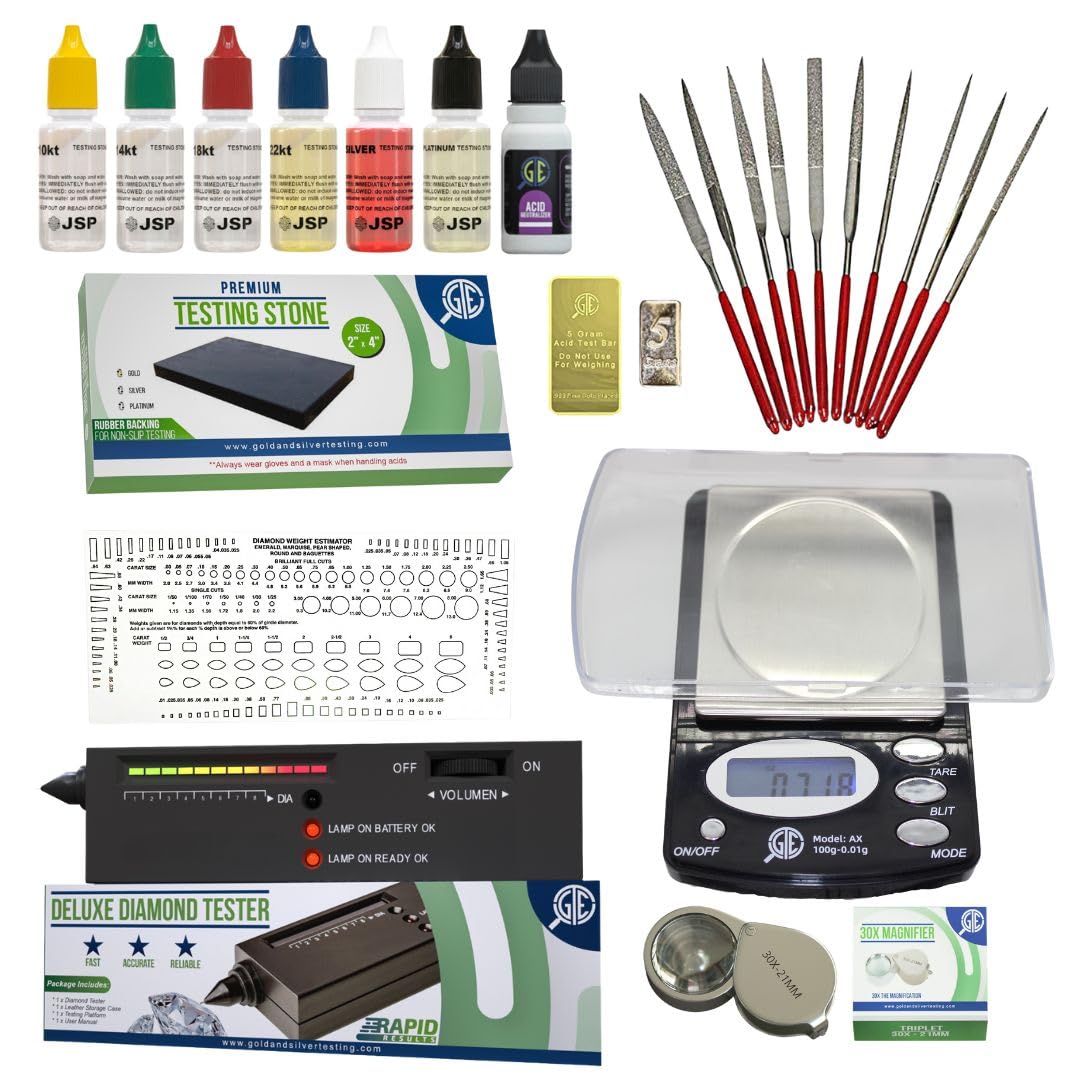
This Gemtone kit is the closest thing to a professional appraisal station you can get without installing bench equipment. The digital scale reads to 0.01 grams across five weighing modes (g, oz, dwt, ozt, ct, gn) with a 100-gram capacity — accurate enough to verify coin weights against mint specifications. The added diamond tester uses thermal conductivity to distinguish genuine diamonds from cubic zirconia, a feature missing from all other kits in this roundup.
The 15 ml solution bottles represent a meaningful upgrade over the 5 ml bottles found in budget kits. You get roughly three times more tests per bottle, which matters when you’re working through a collection of inherited jewelry or buying scrap lots. The included reference bars (a 5 gn silver bar and a 5 gm gold-plated bar) let you practice reading color reactions before testing valuable items, reducing the learning-curve errors that plague beginners.
One reviewer reported that the gold testing liquids produced inconsistent results on known dental gold, suggesting the 22K solution may not be perfectly calibrated for non-jewelry alloys. The diamond tester reliably identified mined and lab-grown diamonds while correctly rejecting CZ, making the diamond verification function the most trustworthy component in this kit.
Why it’s great
- Largest solution bottles in the roundup at 15 ml each
- Digital scale with 0.01 g accuracy and multiple weighing modes
- Thermal diamond probe correctly distinguishes diamonds from simulants
Good to know
- Gold testing solutions may read inconsistently on non-jewelry gold alloys
- No storage case for the scale or probe — components feel slightly disjointed
3. Purity Testing Kit for Diamonds Gemstones Moissanites Gold Silver and Platinum

This GTE-branded kit bundles a digital diamond tester with the standard acid-test suite, making it a strong option for anyone who buys second-hand jewelry that might include stones. The diamond tester uses a heated thermoelectric probe — when you touch it to a stone, the device measures how quickly heat dissipates. Diamonds conduct heat much faster than moissanite or CZ, producing a clean pass/fail reading on the LED display.
The 3×6 inch GTE touchstone is notably larger than the 2×2 inch stones included in most budget kits. That extra surface area allows you to run multiple acid tests side by side without overlapping streaks, which speeds up comparison testing when you’re sorting a mixed-lot purchase. The included triplet magnifier adds visual inspection capability for reading worn karat stamps and identifying hallmark symbols.
A common complaint is that the included testing stone is glass rather than genuine agate or ceramic. Glass-based stones scratch faster and can produce unreliable color reactions after repeated use. Several reviewers recommend buying a separate SE brand real-stone tester for more consistent acid reactions. The kit also lacks a carrying case — components arrive loose in packaging, which makes field use less convenient.
Why it’s great
- Digital diamond probe reliably separates diamonds from CZ and glass imitations
- Large 3×6 inch touchstone allows side-by-side acid comparisons
- Includes acid neutralizer for cleaning the touchstone between tests
Good to know
- Testing stone is glass, not true agate — scratches easily under repeated use
- No organized storage case; components arrive loose in the package
4. Gold Silver Jewelry Tester Appraisal Kit 10K 14K 18K 22K 24K

This compact Gemtone kit focuses exclusively on karat and silver purity testing without adding unnecessary extras. The five solution bottles cover 10K through 24K gold plus 999 and 925 silver, and the included neutralizer solution lets you clean the test stone between reactions — a detail many budget kits omit. The organized case keeps everything in dedicated slots, which is practical for home storage and prevents bottle mix-ups.
The testing process follows the standard rub-and-drop method. You file a small notch on the jewelry item, rub the exposed metal across the touchstone, then apply the corresponding acid drop. The color and speed of the reaction tell you whether the metal matches or falls below the stated karat value. Customers consistently report accurate results on common gold alloys including white gold and rose gold, though plated items require filing through the layer first.
The stone tester included for gemstones is a basic thermal-conductivity tool that works on loose stones but struggles with stones already set in metal mounts. The neutralizer bottle is a genuine plus — it makes the kit self-sufficient without needing to buy separate cleaning supplies. Several users mention that the bottles feel smaller than expected, though Gemtone lists them at standard 5 ml volume.
Why it’s great
- Includes neutralizer solution — no separate purchase needed for stone cleaning
- Organized case with dedicated slots prevents bottle cross-contamination
- Accurate karat readings on common gold alloys including white and rose gold
Good to know
- Stone tester struggles with mounted gemstones — works best on loose stones
- Solution bottles are standard 5 ml — run dry faster than larger alternatives
5. Coin Ping Tester Kit TAOMEELOR
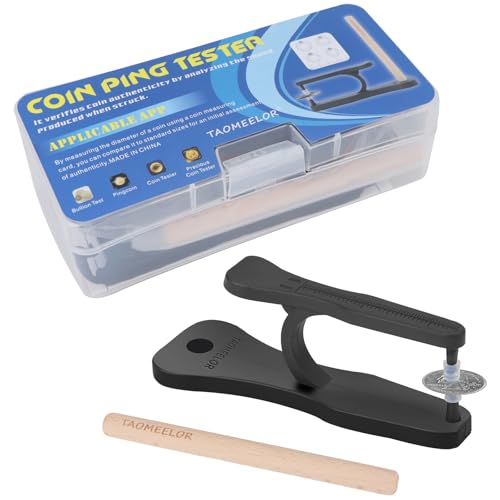
This TAOMEELOR ping tester kit represents a significant step up from basic coin holders. It combines acoustic resonance verification with a laser-calibrated caliper that measures coin diameter to 0.01 mm accuracy — precise enough to spot diameter deviations against official mint specifications. The included magnetic clasp tests for ferromagnetic content, which is a quick way to catch steel-core counterfeits plated with silver or gold.
The ping test works by suspending the coin in the silicone holder and striking it with the included striker. The resulting resonance frequency is captured by the smartphone app (compatible with Precious Coin Tester, Pingcoin, Bullion Test, and Coin Tester platforms) which analyzes the sound profile against a database of known coins. One reviewer reported that the ping test caught a counterfeit batch of silver rounds from China — all but one coin failed the acoustic analysis, and subsequent weight testing confirmed the discrepancy.
The kit ships in a compact 4×5 inch carrying case that fits in a jacket pocket, making it genuinely portable for use at coin shows or dealer meetups. The silicone holder accommodates coins from 1/10 oz fractional gold up to 10 oz silver rounds. Customers note that the smartphone app requires a paid subscription for full frequency analysis — the free tier offers basic ping detection but lacks the spectral analysis needed for authentication documentation.
Why it’s great
- Laser-calibrated caliper measures coin diameter to 0.01 mm accuracy
- Magnetic clasp provides instant ferromagnetic counterfeit detection
- Compact carry case fits in a pocket for show-day use
Good to know
- Smartphone app requires paid subscription for full spectral analysis
- Acoustic test less reliable on coins with heavy toning or surface damage
6. Coin Ping Tester Salcod

The Salcod Coin Ping Tester strips the verification process down to its essentials: a silicone cap holder, a wooden striker, and a caliper for diameter comparison. No batteries, no screens, no app subscriptions required. You place the coin in the ultra-soft food-grade silicone cap, tap it with the wooden stick, and listen for the characteristic clear ring that authentic precious metals produce compared to the dull thud of base-metal counterfeits.
The silicone clamping cap deserves specific praise — it’s made from food-grade material that won’t scratch proof or high-relief coins, a real concern for collectors who handle expensive numismatic pieces. The base can be placed on a countertop for stable testing or held in hand for quick checks. The diameter caliper compares your coin against standard mint sizes, which catches coins that have the right weight but wrong dimensions.
Several customers report that the companion app (required for frequency-based analysis) is difficult to obtain or requires an unexpected paid subscription. Many experienced stackers simply skip the app entirely and rely on their ear — the resonant ping of a genuine silver American Eagle is distinctly different from a plated tungsten or steel counterfeit. For basic go/no-go verification of common bullion, this tester is effective without software.
Why it’s great
- Food-grade silicone cap protects high-relief and proof coins from scratches
- No batteries or electronics to fail — purely mechanical operation
- Compact size fits in a pocket for on-the-go coin show use
Good to know
- Companion app is hard to find and requires a paid subscription
- Relies on user ear rather than frequency analysis for authenticity judgment
7. Gemtone Gold Testing Kit 10K 14K 18K

The Gemtone Gold Testing Kit is the simplest entry point for anyone who needs to verify 10K, 14K, and 18K gold without the complexity of a full appraisal system. The three JSP-brand solution bottles are a reassuring detail — JSP is an established name in precious-metal testing chemicals, and these ½ oz bottles contain enough solution for dozens of tests before needing replacement.
The 2×2 inch GTE test stone features a rubber backing that prevents sliding on smooth countertops, a small but meaningful design choice that makes single-handed testing easier. The bamboo storage box keeps everything organized and the lid seals tightly enough to prevent solution evaporation between sessions. The included instruction guide and color chart walk you through the rub-and-drop process clearly enough that a first-time user can get reliable readings within minutes.
This kit is deliberately limited to three karat values — 10K, 14K, and 18K — which covers the vast majority of commercial gold jewelry you’ll encounter in the US market. If you regularly test 22K or 24K items, or need silver and platinum verification, you’ll outgrow this kit quickly. The compact bamboo box is attractive on a shelf but doesn’t provide the same protection as a padded case for travel use.
Why it’s great
- JSP brand solutions are a trusted name in precious-metal testing chemistry
- Rubber-backed test stone stays in place during single-handed use
- Compact bamboo box looks professional and keeps solutions organized
Good to know
- Only covers 10K, 14K, and 18K — no 22K, 24K, silver, or platinum testing
- Bamboo box lacks padding for safe transport to estate sales or shows
FAQ
Can an acid test damage my gold jewelry?
Why does my gold tester give different results on white gold versus yellow gold?
Do I need a subscription app for ping testers to work?
Final Thoughts: The Verdict
For most users, the gold tester electronic that delivers the best overall value is the GTE Precious Metal Jewelry Testing Kit because it combines full karat-range acid testing with genuine portability in a wooden case that prevents handling errors. If you need diamond verification alongside metal testing, grab the Gemtone All-in-One Kit for its digital scale and thermal probe. And for coin stackers who want non-destructive verification without chemicals, nothing beats the TAOMEELOR Coin Ping Tester Kit with its laser-calibrated caliper and magnetic clasp for multi-factor authentication.