
Finding the right golf ball for a child is about more than just picking the smallest or cheapest option. Kids need balls that limit flight distance to keep them in the yard, are soft enough to not break a window or injure a pet, and provide enough feedback to actually learn how a club interacts with the ball. Without these three traits, practice sessions turn into either a dangerous game of long-distance retrieval or a frustrating exercise in hitting a rock-hard object.
I’m Mohammad Maruf — the founder and writer behind Drink4Good. I’ve spent hundreds of hours cross-referencing foam densities, plastic wall thicknesses, and real-world user durability reports specifically for junior and training golf balls to pinpoint which sets actually hold up to a child’s swing.
After analyzing the construction, flight characteristics, and safety profiles of dozens of options, I’ve built a clear ranking of the golf balls for kids that are best for learning, safety, and keeping the fun in the backyard where it belongs.
How To Choose The Best Golf Balls For Kids
Not every practice ball is built the same. A ball that’s great for an adult hitting into a net can be a terrible choice for a six-year-old learning the game in the yard. You need to match the ball’s construction, flight behavior, and safety profile to the child’s age, swing speed, and practice environment.
Construction Material: Plastic vs. Foam
Hollow plastic balls are lightweight and cheap, but they have a hard shell that can dent easily and sometimes crack along the seam when struck with a wedge. Foam balls are softer, safer for indoor use, and far more forgiving on impact, making them the better choice for younger kids who are still developing control. Foam also compresses slightly on the clubface, giving a more realistic feel and audible feedback.
Flight Distance and Ball Diameter
Standard golf balls are 1.68 inches in diameter. Many kids’ practice balls are slightly smaller, which can throw off hand-eye coordination training. Look for balls with a diameter above 1.6 inches to maintain some consistency with a real ball. A proper limited-flight design — usually achieved with a dense pattern of dimples or holes — should keep the ball within a 50-to-75-foot range on a full swing, which is ideal for a backyard setup.
Durability and Seam Strength
A child’s swing path is unpredictable. Balls that are molded in two halves are prone to splitting at the seam when struck off-center. Solid-core foam balls or one-piece molded plastic balls tend to last much longer. If a product’s reviews mention “dent easily” or “splits in half,” it’s a red flag for junior use.
Quick Comparison
On smaller screens, swipe sideways to see the full table.
| Model | Category | Best For | Key Spec | Amazon |
|---|---|---|---|---|
| QEOCP 54-Pack Foam | Foam | All-around junior practice | Resin PU rubber construction, 54 balls | Amazon |
| AlmostGolf 10-Pack | Foam | Realistic feel and feedback | Patented solid core, 1.6 inch diameter | Amazon |
| Junkin 80-Pack Foam | Foam | High-volume durability | PU and foam, 80 balls | Amazon |
| KISEER 90-Pack Plastic | Plastic | Budget bulk for beginners | Hollow plastic, 1.65 inch diameter | Amazon |
| Bac-kitchen 50-Pack Plastic | Plastic | Lowest-cost entry point | Molded plastic, 4.06 cm diameter | Amazon |
In‑Depth Reviews
1. QEOCP 54-Pack Foam Practice Golf Balls
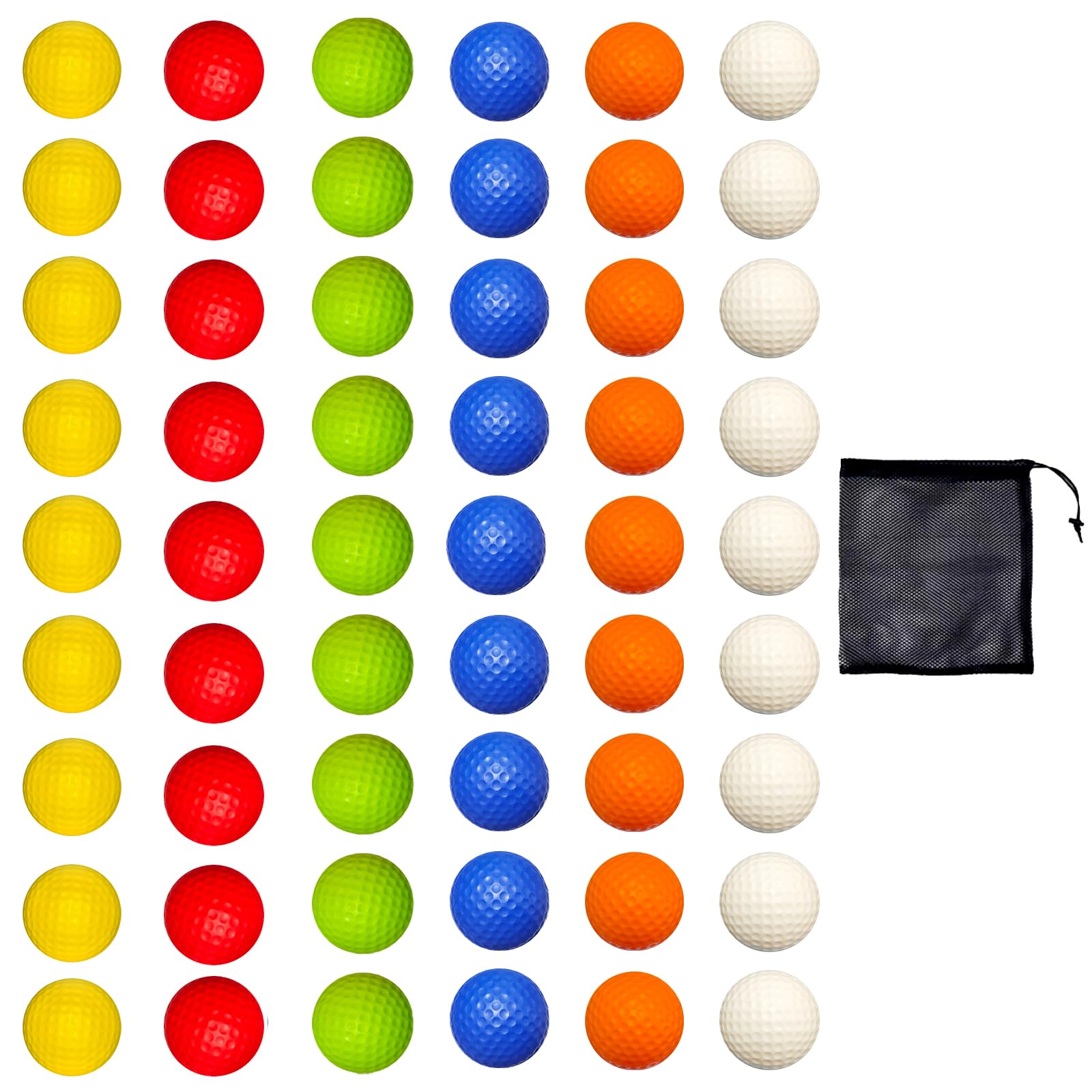
The clear winner for most families, the QEOCP 54-pack uses a Resin PU Rubber construction that strikes a perfect balance between softness and durability. Unlike hollow plastic balls that dent on a single wedge shot, these foam balls compress slightly on impact and spring back, holding their shape even after repeated abuse from a young golfer. The six-color variety makes it easy to find balls in the grass, and the included mesh organizer bag simplifies post-practice cleanup.
Customer feedback highlights this set’s versatility across indoor and backyard use. Parents of eight-year-olds report that kids can safely hit the ball against the side of the house without causing dents or breaks, while the limited-flight design keeps the ball within a manageable 50-foot range on a full swing. The foam construction eliminates the worry of a stray shot breaking a window or injuring a pet.
The only trade-off is that these balls are noticeably lighter than a standard golf ball, which means the feedback on off-center hits is slightly muted compared to denser foam options. But for a child building swing confidence, the safety margin and exceptional durability make this the top pick for the price.
Why it’s great
- Resin PU rubber doesn’t dent or crack like plastic
- Six bright colors with mesh organizer bag included
- Soft enough for safe indoor and backyard use
Good to know
- Lighter feel reduces feedback on mishits
- Foam core may lose shape if stored under heavy weight
2. AlmostGolf 10-Pack Practice Balls

If your child is past the very first stage of learning and needs a practice ball that responds more like a real golf ball, the AlmostGolf 10-pack is the standard-bearer. Its patented solid-core foam construction compresses sharply on impact, producing an audible “pop” off the clubface that mimics a traditional ball’s feel. The ball draws, spins, and fades on command, giving an older junior golfer accurate feedback on swing path and face angle.
Reviewers consistently note that these balls are firmer and less foamy than bulk alternatives. They hold up better in wet conditions and under direct sun without becoming spongy or losing shape. The limited-flight design keeps full swings around 75 feet, which is perfect for a backyard training session without the risk of losing balls into a neighbor’s yard. The bright yellow color makes them easy to spot even in tall grass.
The biggest drawback is the low ball count. At only 10 balls per pack, this is not a set for sharing among siblings or for group practice sessions. One reviewer also noted an occasional out-of-round ball upon arrival, which can affect roll and flight consistency. But for sheer performance feedback, nothing in the kids’ ball category comes close.
Why it’s great
- Best-in-class feel that pops off the clubface like a real ball
- Offers real draw, fade, and spin feedback
- Very durable in sun and wet conditions
Good to know
- Only 10 balls per pack — poor value for groups
- Occasional out-of-round ball reported
3. Junkin 80-Pack Foam Practice Balls
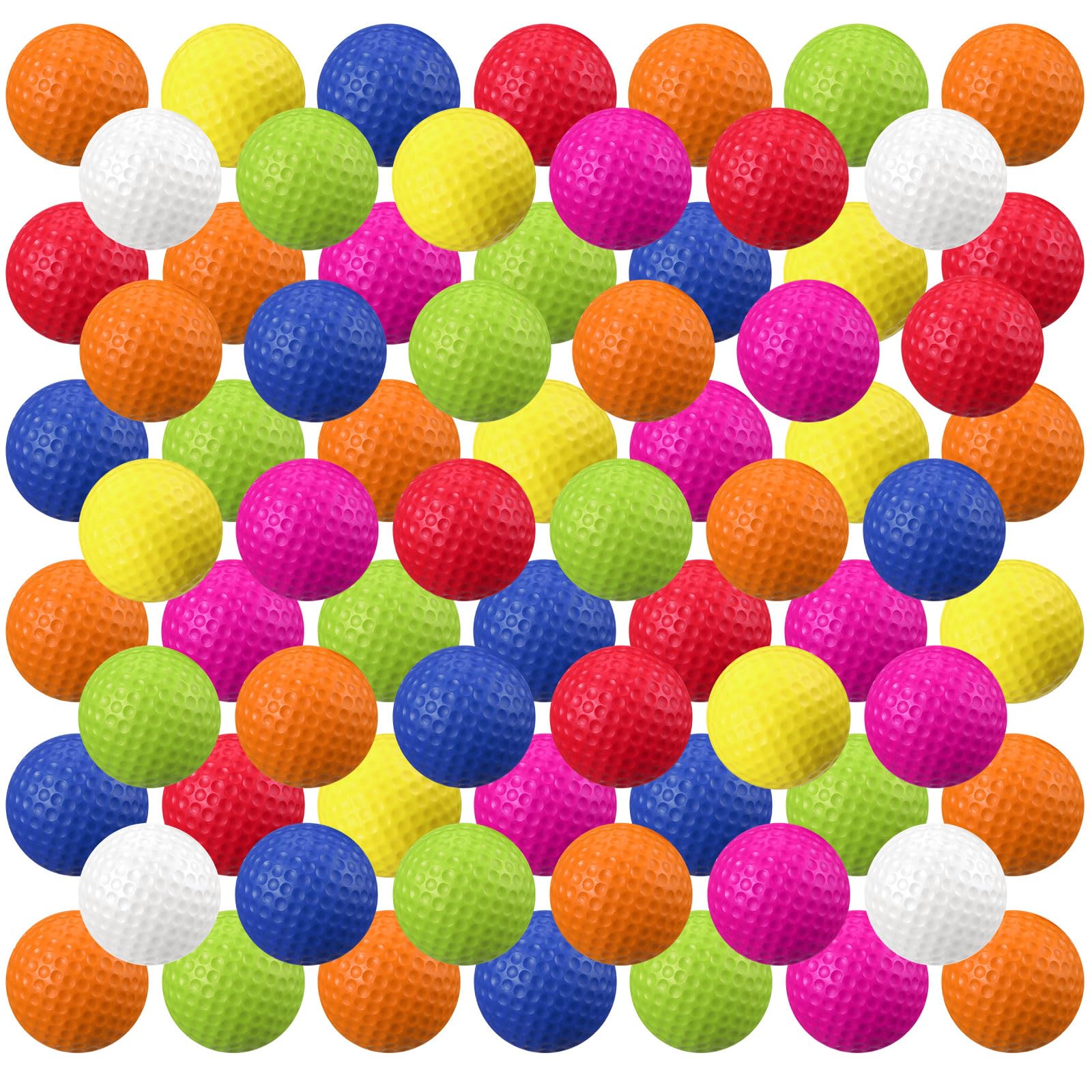
For families with multiple kids or a junior golf camp, the Junkin 80-pack offers the highest ball count in the foam category without sacrificing durability. The PU and foam blend makes these balls soft enough for indoor use but firm enough to provide solid flight feedback. Reviewers note that a full swing sends these about 75 feet, which is the same limited-flight range as the premium AlmostGolf balls but at a fraction of the per-ball cost.
Durability is a strong suit here. Several customer reports mention that even a dog chewing on these balls didn’t destroy them — a huge plus for families with both kids and pets. The mixed-color assortment makes it easy to distinguish your ball from a sibling’s during practice, and the soft construction means you can use them safely near windows, furniture, or a hitting net without worry.
The main downside is that the feel is slightly softer than the AlmostGolf ball, which means the feedback on mishits is less pronounced. For beginner kids, this softness is actually a safety benefit, but it may become a limitation as the child’s swing develops and they need more precise audio-tactile feedback to correct their swing path.
Why it’s great
- 80 balls for group practice and minimal per-ball cost
- Dog-proof foam that survives heavy chewing
- Soft and safe for indoor and window-adjacent use
Good to know
- Softer feel reduces swing feedback for older kids
- Colors can fade with prolonged sun exposure
4. KISEER 90-Pack Plastic Hollow Balls
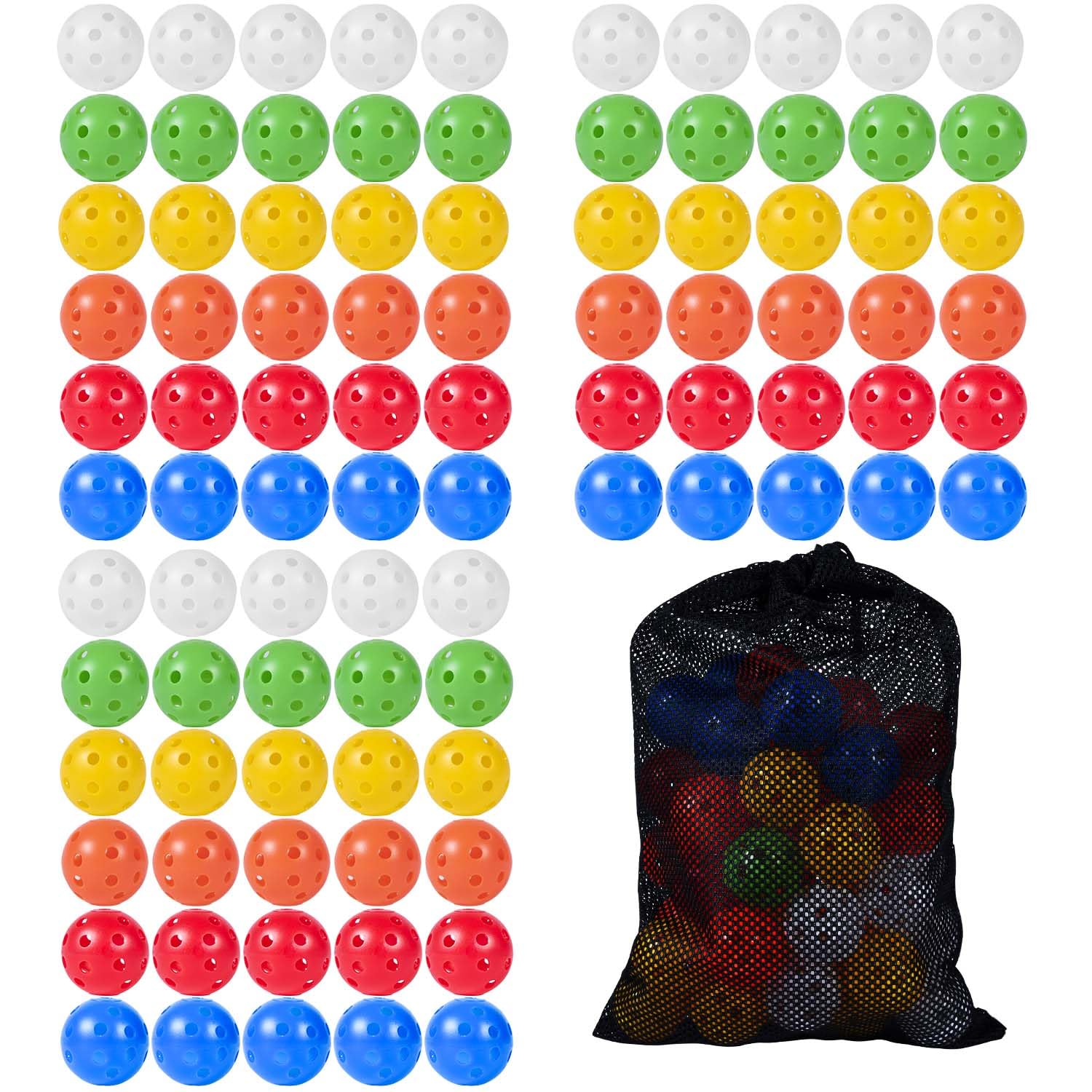
The KISEER 90-pack is the top choice for groups that need a massive quantity of balls at the lowest possible upfront cost. These hollow plastic balls are molded with 26 symmetrical holes to reduce air resistance and mimic the flight of a standard ball. The six-color mix helps keep track of them on the range, and the included mesh bag holds about half the balls for easy carry.
Customer reviews paint a mixed picture on durability. Many users praise these balls for backyard practice and for use as pickleball or puppy play balls, but multiple reviews note that they can crack along the seam when hit with a wedge — especially if the ball is struck thin. They are also slightly smaller than regulation size, which makes them less ideal for building proper swing mechanics.
For pure budget value — getting 90 balls into a kid’s hands for very little — the KISEER set is hard to beat. Just be prepared for the occasional cracked ball, and don’t expect these to survive a full season of heavy use.
Why it’s great
- 90 balls for the lowest per-ball cost in the list
- Six bright colors for easy visibility
- Multi-use for other sports and dog play
Good to know
- Hollow plastic cracks on wedge strikes
- Slightly undersized compared to regulation balls
5. Bac-kitchen 50-Pack Plastic Practice Balls

The Bac-kitchen 50-pack is the budget-friendly entry point for families who just want to get a young child swinging a club without a major investment. These hollow plastic balls are lightweight and small — at just over 4 cm in diameter, they are noticeably smaller than a regulation ball — which makes them less ideal for learning proper alignment but perfectly fine for very young beginners who just need to connect with the ball. The green color is visible on most surfaces except grass, and the included golf tees are a nice bonus.
Customer feedback highlights the balls’ usefulness for indoor swing practice and costume props, but durability is the defining limitation. Several reviews mention that a six-year-old hitting the ball with a proper swing can flatten or dent the plastic shell within a few hits. This makes the set better suited for very soft swings, putting practice, or as a backup set for playdates where breakage is expected. The balls also don’t fly as true as the foam options, with some wobble in flight.
If your goal is to see whether your child has any interest in golf before committing to a pricier foam set, the Bac-kitchen balls serve that purpose. But expect to replace them relatively quickly if your child develops a real swing.
Why it’s great
- Lowest cost option to test interest
- Lightweight and safe for indoor use
- Includes tees for immediate use
Good to know
- Flattens easily with a proper swing
- Green color gets lost on grass
- Smaller diameter is not regulation
FAQ
Are foam golf balls safe for indoor use with kids?
How many practice balls should I get for a single child?
Final Thoughts: The Verdict
For most users, the golf balls for kids winner is the QEOCP 54-Pack Foam because it offers the best mix of soft safety, durability, and bulk count at a reasonable investment. If you want the most realistic feel and swing feedback for an older junior golfer, grab the AlmostGolf 10-Pack. And for large group practices or families with multiple kids, nothing beats the sheer volume of the Junkin 80-Pack Foam.