
Upgrading your golf cart’s power system feels like a choice between climbing a hill on a full charge or pushing it home at dusk. Lead-acid batteries that came with the cart fade fast, require weekly watering, and shed weight that makes your ride feel sluggish on the back nine. Switching to a modern lithium alternative changes everything, but the sheer number of voltage, capacity, and chemistry options can stall the decision before it starts.
I’m Mohammad Maruf — the founder and writer behind Drink4Good. I’ve spent countless hours analyzing specs, cross-referencing real-user capacity tests, and sorting through the performance data to find which 12-volt lithium batteries actually deliver on their promises for golf cart conversions.
Whether you’re replacing eight 6V batteries in a 48V system or swapping out a pair of 12V deep-cycles in a smaller setup, this guide walks you through the essential specs and proven picks to find the right golf cart batteries 12v for your ride.
How To Choose The Best Golf Cart Batteries 12V
Golf cart battery selection boils down to three things: chemistry, capacity, and configuration. Most gas-to-electric conversions or lead-acid upgrades rely on a 48-volt system, which means you’ll either buy a single 48V drop-in battery or wire four 12V batteries in series. Each route has clear trade-offs in weight, cost, and installation complexity.
Chemistry: Why LiFePO4 Wins the Cart Game
Lithium Iron Phosphate (LiFePO4) offers 4,000 to 15,000 cycles versus lead-acid’s 500 to 1,000, holds a flat voltage curve (12.8V nominal) until nearly empty, and weighs roughly 60% less than an equivalent flooded battery. The built-in BMS handles overcharge, over-discharge, and temperature protection — eliminating the weekly watering and terminal corrosion that plagues traditional batteries.
Capacity & Voltage Config: Real Range per Ah
A 100Ah 12V battery delivers 1.28kWh of usable energy. Four wired in series creates a 48V 100Ah system (5.12kWh). On an average golf course, that translates to 25-40 miles of driving depending on terrain, passenger weight, and controller efficiency. If you run a 36V cart, three 12V 100Ah batteries in series gives you 3.84kWh. Always check the continuous discharge rating — a 100A BMS (1,280W at 12.8V) is fine for most stock carts, but lifted carts with high-torque motors may need a 200A BMS.
Quick Comparison
On smaller screens, swipe sideways to see the full table.
| Model | Category | Best For | Key Spec | Amazon |
|---|---|---|---|---|
| GrenerPower 12V 100Ah | Mid-Range | Solar/Off-Grid Backup | 15000 cycles, Grade A+ cylindrical cells | Amazon |
| Dyness 12V 100Ah Bluetooth | Mid-Range | Trolling Motor & Marine | IP65 waterproof, 5-sec cutoff >300A | Amazon |
| FLLYROWER 12V 100Ah | Mid-Range | Included Charger Value | 16500 cycles, Grade A cells, 7A charger included | Amazon |
| Dumfume 12V 150Ah | Mid-Range | Extended Range Carts | 1920Wh, 150Ah capacity, 100A BMS | Amazon |
| ECO-WORTHY 12V 100Ah Bluetooth | Mid-Range | Bluetooth & SOC Display | Bluetooth, LED SOC display, 4P2S expansion | Amazon |
| Yeagulch 2-Pack 12V 100Ah | Premium | Multi-Battery 48V Bank | 6000 cycles at 80% DOD, 2-pack | Amazon |
| Litime 12V 100Ah Trolling Motor (2-Pack) | Premium | High-End Marine & Cart | Bluetooth, IP65, 4000+ deep cycles | Amazon |
| TEMGO 48V 100Ah Golf Cart Kit | Premium | Complete 48V Drop-In Upgrade | 200A BMS, LCD display, 18A charger included | Amazon |
| LOSSIGY 48V 105Ah Conversion Kit | Premium | 48V High-Peak Current Carts | 105Ah, 1000A peak (3-5s), Bluetooth BMS | Amazon |
In‑Depth Reviews
1. TEMGO 48V (51.2V) 100Ah LiFePO4 Golf Cart Battery
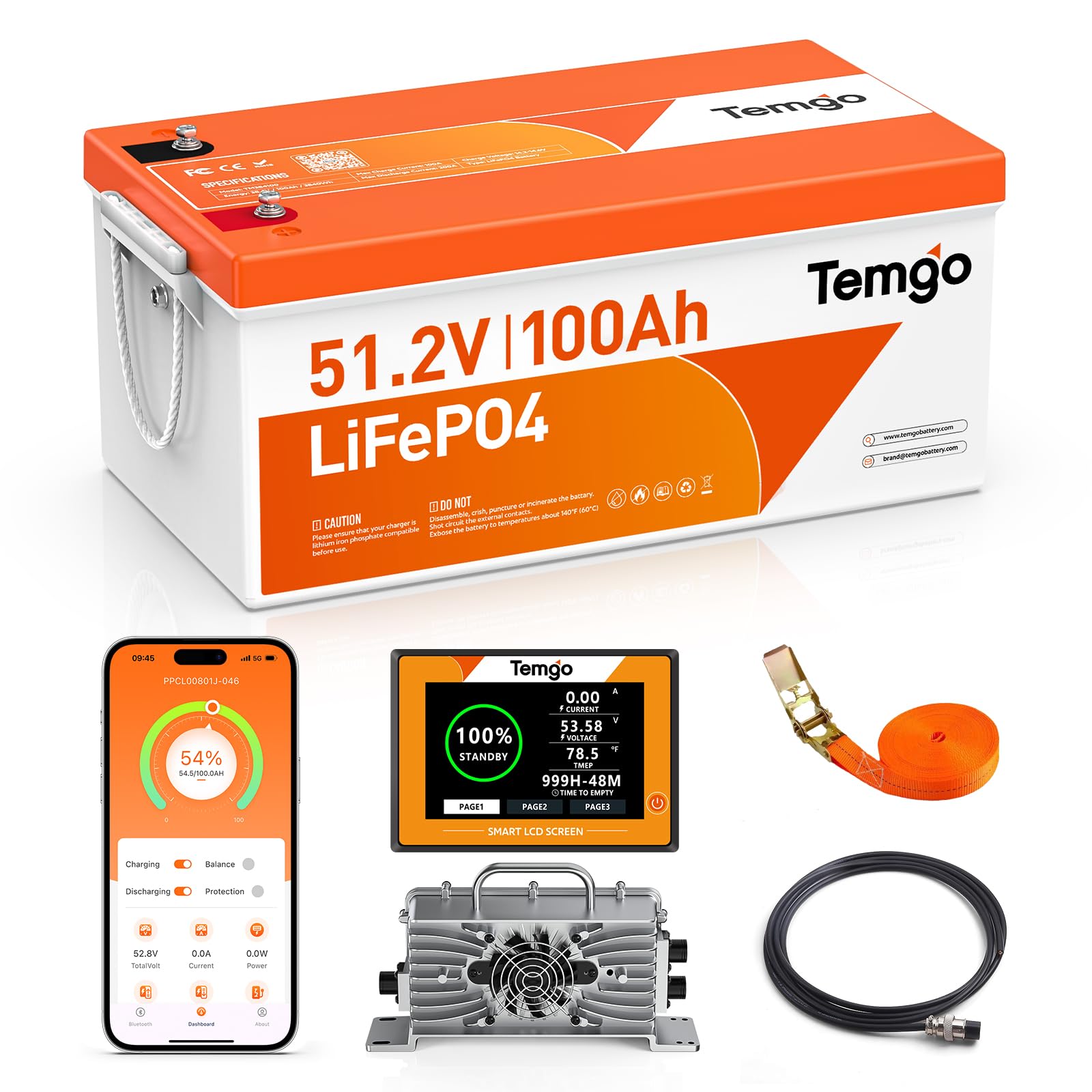
The TEMGO 48V kit is engineered specifically for golf cart conversions, bundling a 51.2V 100Ah LiFePO4 battery with a 58.4V 18A charger, a 2.8-inch LCD touch display, and a retention strap. The built-in 200A BMS handles 200A continuous discharge with a 600A surge for 3 seconds, which comfortably covers the startup spike on lifted carts with torque motors. Real-world tests show a 2003 Club Car DS traveling 18 miles with 71% charge remaining, translating to a theoretical range well over 50 miles on flat terrain.
The Bluetooth app provides live voltage, capacity, and cell-balance data, though owners note the app interface could be more polished. Installation is straightforward for a drop-in replacement — you remove the six 8V lead-acid units, place this single 61.7-lb battery into the tray, and connect the included charger. One minor fitment note: the TEMGO unit is roughly an inch taller than a standard 6x8V stack, so some users raised the seat by 1.5 inches to accommodate it.
Owner feedback repeatedly highlights faster acceleration (0-32 mph in one test) and zero maintenance versus the weekly watering and corrosion of lead-acid. The single unit eliminates the cable failures and cell imbalance common in series-wired banks. The warranty is 1 year, which is shorter than some competitors — a point to weigh if long-term coverage is a priority.
Why it’s great
- Complete kit with charger, LCD, and strap — nothing else to buy
- 200A continuous / 600A peak covers high-torque controllers
- Single 61.7-lb unit replaces 300+ lbs of lead-acid
- Proven 18-mile range with 71% reserve in real-world test
Good to know
- 1 inch taller than some 6x8V stacks; may require seat lift
- 1-year warranty is shorter than many LiFePO4 options
- Not compatible with carts that require CAN/communication protocols
2. LOSSIGY 48V 105Ah LiFePO4 Golf Cart Conversion Kit
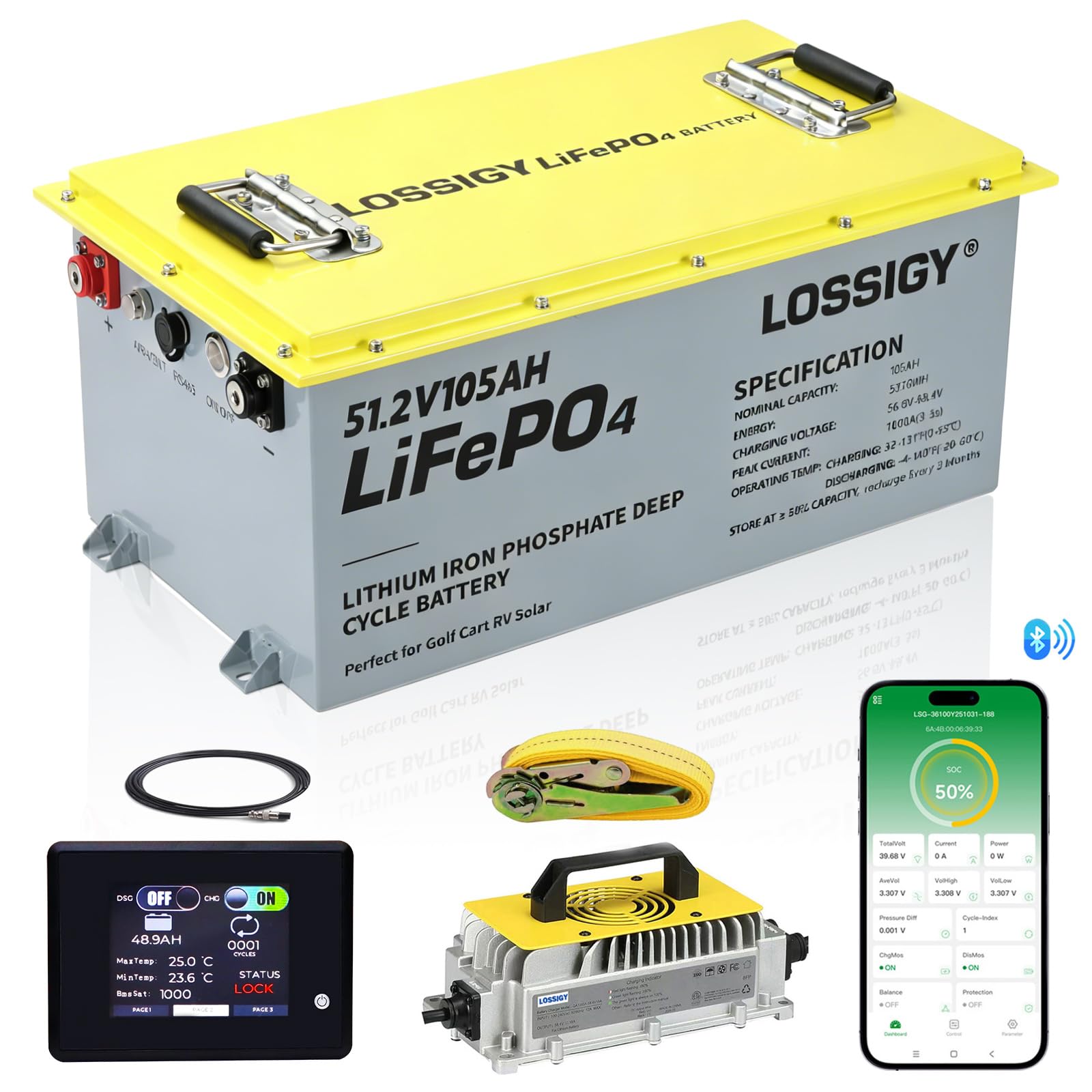
LOSSIGY’s 48V 105Ah kit pushes the envelope with a 200A smart BMS that can handle a 1000A peak current for 3-5 seconds — an unusually high surge rating engineered for carts with aggressive controllers or heavy loads like three-adult passengers on hilly terrain. Early adopters report a 2014 Club Car Precedent traveling 8-10 miles with 81% charge remaining, indicating a total range well beyond 40 miles.
The kit includes a charger and a remote monitor, but some users found the monitor’s USB cable design lacking. Installation on a 2012 E-Z Go took about 6 hours, requiring a custom wooden platform. The battery itself weighs about 88 pounds, saving roughly 400 pounds versus a typical 8x6V lead-acid setup. That weight reduction alone increases speed by 2-3 mph on stock controllers (from 21 to 24 MPH in one test) and improves hill-climbing torque.
However, another user reported difficulty reaching support via email or website. The 6-year warranty is among the longest in this segment, which adds peace of mind provided the support channel is responsive.
Why it’s great
- 1000A peak current for 3-5s handles high-torque controllers
- 105Ah capacity (5.376kWh) beats standard 100Ah packs
- Saves ~400 lbs over 8x6V lead-acid, improves speed & handling
- 6-year warranty is best-in-class for 48V drop-ins
Good to know
- Requires fabrication (wood platform) in some carts
- Monitor USB cable design is fragile according to users
- Customer support response times are inconsistent
3. Litime 12V 100Ah Trolling Motor LiFePO4 (2-Pack)

Litime’s 12V 100Ah battery is built for trolling motors and marine environments, but its IP65 rating, Bluetooth connectivity, and 4000+ cycle life make it a strong candidate for 48V golf cart banks (four in series). Each battery weighs 22.2 pounds and delivers 1.28kWh. The Bluetooth app auto-connects within seconds, showing real-time voltage, current, capacity, and temperature — a feature that helps you monitor cell balance across a series bank.
The 100A BMS includes low-temperature protection that stops charging below 32°F and discharging below -4°F, which is critical for carts stored in unheated garages. Owners of high-end pontoon boats and fishing kayaks report running Minn Kota 80-lb thrust motors all day and still having 50%+ reserve. For a 48V golf cart, four in series gives a 51.2V 100Ah system with 5.12kWh — enough for a full round of golf plus errands.
The IP65 waterproofing means saltwater splashes and rain won’t damage the internals, a clear edge over bare-case batteries. One drawback: Litime specifies this battery is not recommended for golf cart starting applications, but as a deep-cycle storage battery it works perfectly in a series bank. The 2-pack price is competitive but higher than entry-level options, reflecting the Bluetooth, IP65, and premium cell quality.
Why it’s great
- Bluetooth app monitors voltage, current, capacity, and temp
- IP65 waterproof — handles marine rain and splash
- Low-temp protection (charging stops below 32°F)
- 4000+ deep cycles at 100% DOD for long-term value
Good to know
- Not designed for startup/lead-acid replacement in starter circuits
- Higher per-unit cost than non-smart alternatives
- 2-pack may arrive in separate packages
4. Yeagulch 2-Pack 12V 100Ah LiFePO4 Battery
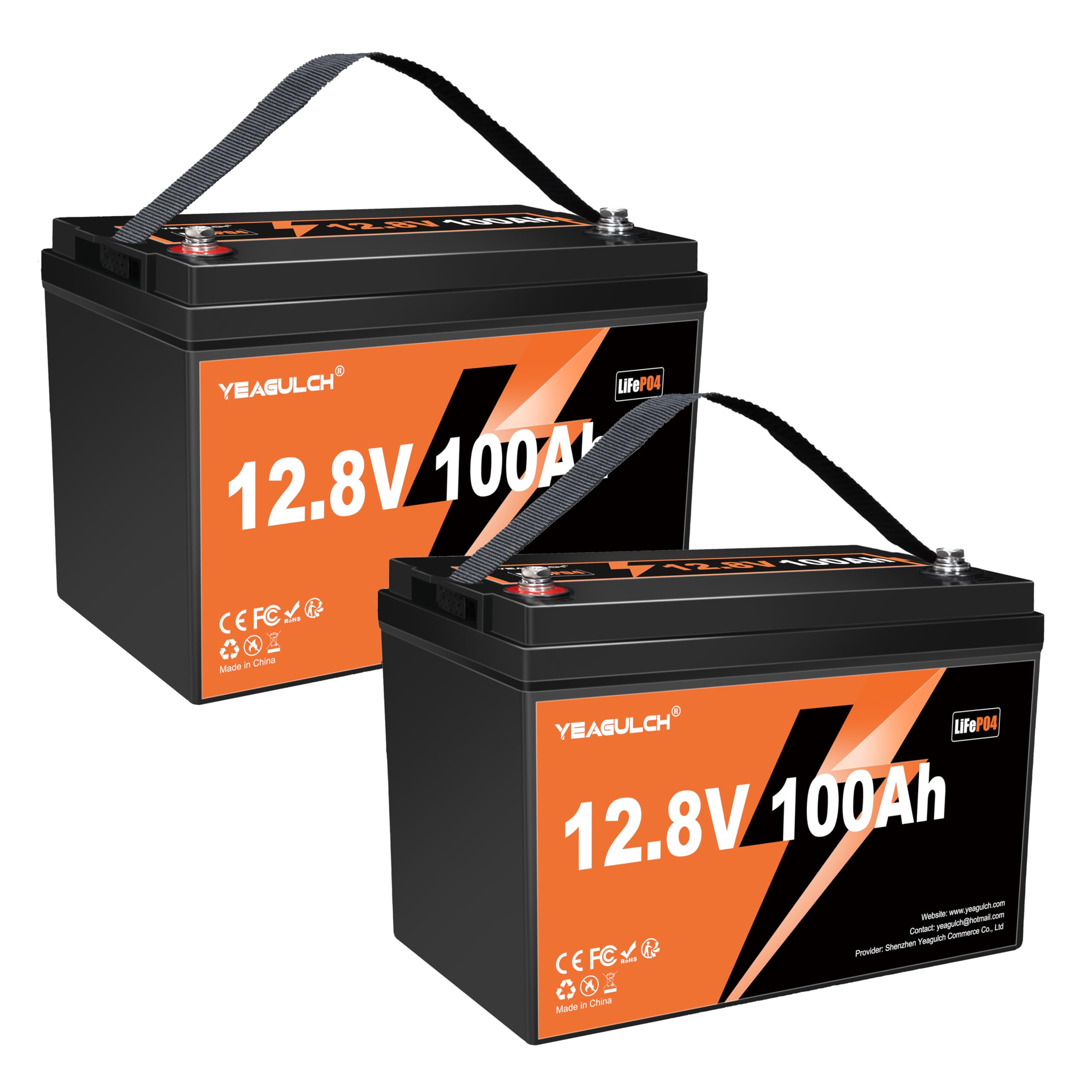
The Yeagulch 2-pack bundles two 12V 100Ah LiFePO4 batteries with 100A BMS each, offering a straightforward way to build a 24V 100Ah system (2 in series) or parallel for 12V 200Ah. The cells are rated for 6,000 cycles at 80% depth of discharge, which is competitive with mid-tier brands. Each battery weighs 22.04 pounds, roughly one-third the weight of a comparable lead-acid battery.
Real-world tests show these batteries powering 80-lb trolling motors on a 10-foot pontoon for four outings without recharging. Owners note a 10% speed boost from the higher voltage of LiFePO4 versus lead-acid. However, some capacity tests revealed one battery arrived at 13.6V and the other at 13.2V — close but not perfectly matched. Users recommend topping both to full charge and verifying balance before wiring in series for a 48V golf cart bank.
One complaint is the lack of Bluetooth BMS, which means you won’t get phone-based monitoring. The glossy finish looks premium but shows scratches easily. A small number of negative reviews mention units failing in parallel setups, though those instances may stem from loose terminals or improperly sized wiring. For the price, you get two functional batteries with decent cycle life, but the smart features are absent.
Why it’s great
- 2-pack saves cost versus buying singles
- 6000 cycles at 80% DOD provides solid longevity
- Lightweight (22 lbs each) simplifies handling
- Works with 80-lb trolling motors for marine applications
Good to know
- No Bluetooth BMS — no phone monitoring
- Arriving voltages can differ between units
- Some parallel failures reported due to loose connections
5. Dumfume 12V 150Ah LiFePO4 Deep Cycle Battery
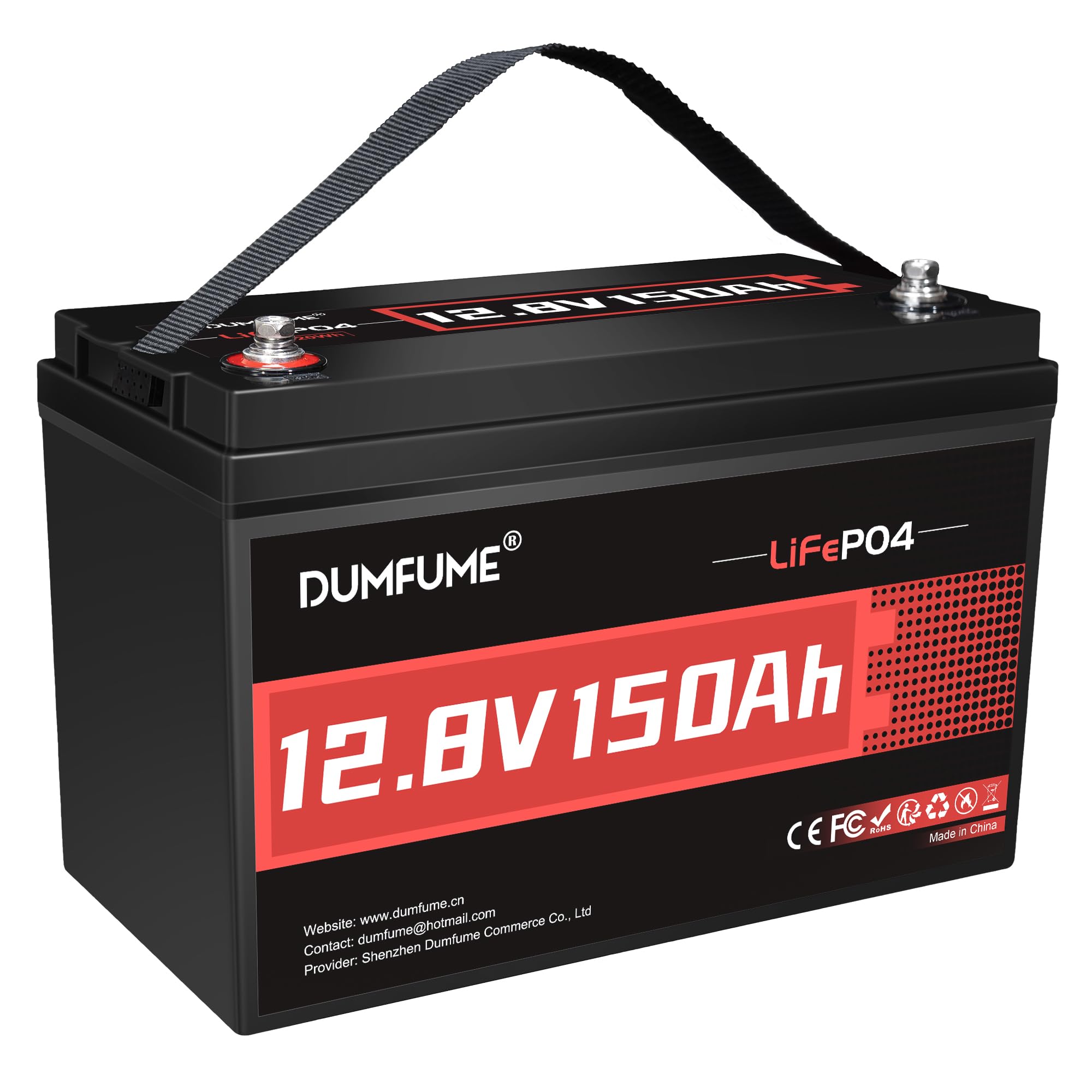
The 100A BMS provides standard protections (overcharge, over-discharge, short circuit, overheating) and low-temperature charging cutoff. Weight is just 22.05 pounds, incredibly light for a 150Ah unit, which translates to significant weight savings compared to a bank of four lead-acid Group 31 batteries.
Owners report that four 150Ah units in a 48V configuration power a cart with noticeably better range than 100Ah packs, and on solar setups these batteries exceed rated capacity by about 7Ah per unit. One hobbyist who upgraded a golf cart caught a BMS cutout during the first startup due to a capacitor spike, but resolved it by preconditioning the battery with a slow charge. After that, the batteries powered the cart through hilly terrain without issue.
The Dumfume is a non-smart battery — no Bluetooth, no display. A single negative review documented a unit failing after one year under a 3.5A continuous draw, though the reviewer later noted the 5-year warranty is only valid for direct purchases, not Amazon sales. That warranty caveat is important to verify before buying. For users who want high capacity without smart features, this delivers exceptional energy density per dollar.
Why it’s great
- 150Ah capacity gives 50% more range than 100Ah batteries
- Only 22 lbs — extremely lightweight for 150Ah class
- 4S4P expandable up to 20.48kWh total
- Owners report exceeding rated capacity in real tests
Good to know
- No Bluetooth or smart monitoring
- Warranty may not cover Amazon purchases — verify directly
- Initial BMS cutout possible on high-startup carts
6. ECO-WORTHY 12V 100Ah LiFePO4 with Bluetooth & SOC Display
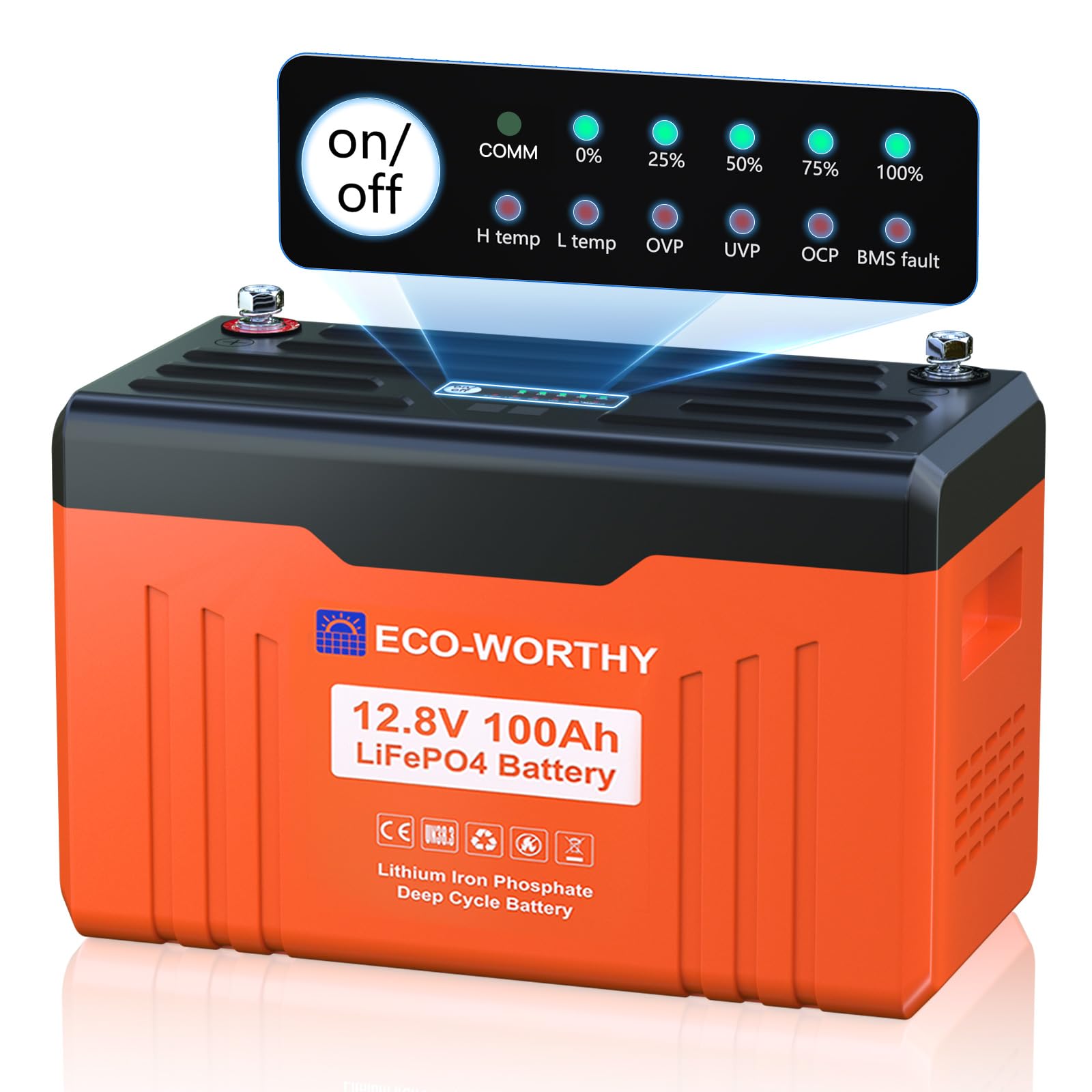
ECO-WORTHY’s upgraded 12V 100Ah battery adds both a built-in Bluetooth module and a front-facing LED panel that displays state of charge (SOC) without needing an app. The metal fixture securing the cells prevents cell expansion, a common failure mode in cheaper prismatic-cell packs. The 100A BMS includes low-temperature protection and a buzzer that alerts you to faults, adding an extra safety layer in enclosed battery compartments.
In a 48V golf cart configuration, four units in series deliver 51.2V 100Ah with 5.12kWh. Owners running four in parallel reported powering RV lights, appliances, and a water pump continuously for six days with no performance drop. The Bluetooth app is functional, but one user noted the LED display overestimates charge — showing 50% when the true SOC was closer to 30% based on charge time. The app data appears more accurate.
A drawback is the lack of a carry strap; at 25 pounds, side handholds make two-handed transport necessary. The Group 27 form factor is slightly larger than Group 24, so check your battery tray dimensions before buying. For the price, the dual monitoring (Bluetooth + LED) and structural cell fixture make it a well-rounded choice for users who want visible SOC at a glance without pulling out a phone.
Why it’s great
- Bluetooth app + LED SOC display for dual monitoring
- Metal cell fixture prevents swelling and extends life
- Buzzer alerts for BMS faults
- Supports 4P2S expansion to 10.24kWh
Good to know
- LED display may overestimate SOC — app is more reliable
- No carry strap, side handholds only
- Group 27 size may not fit smaller battery trays
7. Dyness 12V 100Ah LiFePO4 with Bluetooth
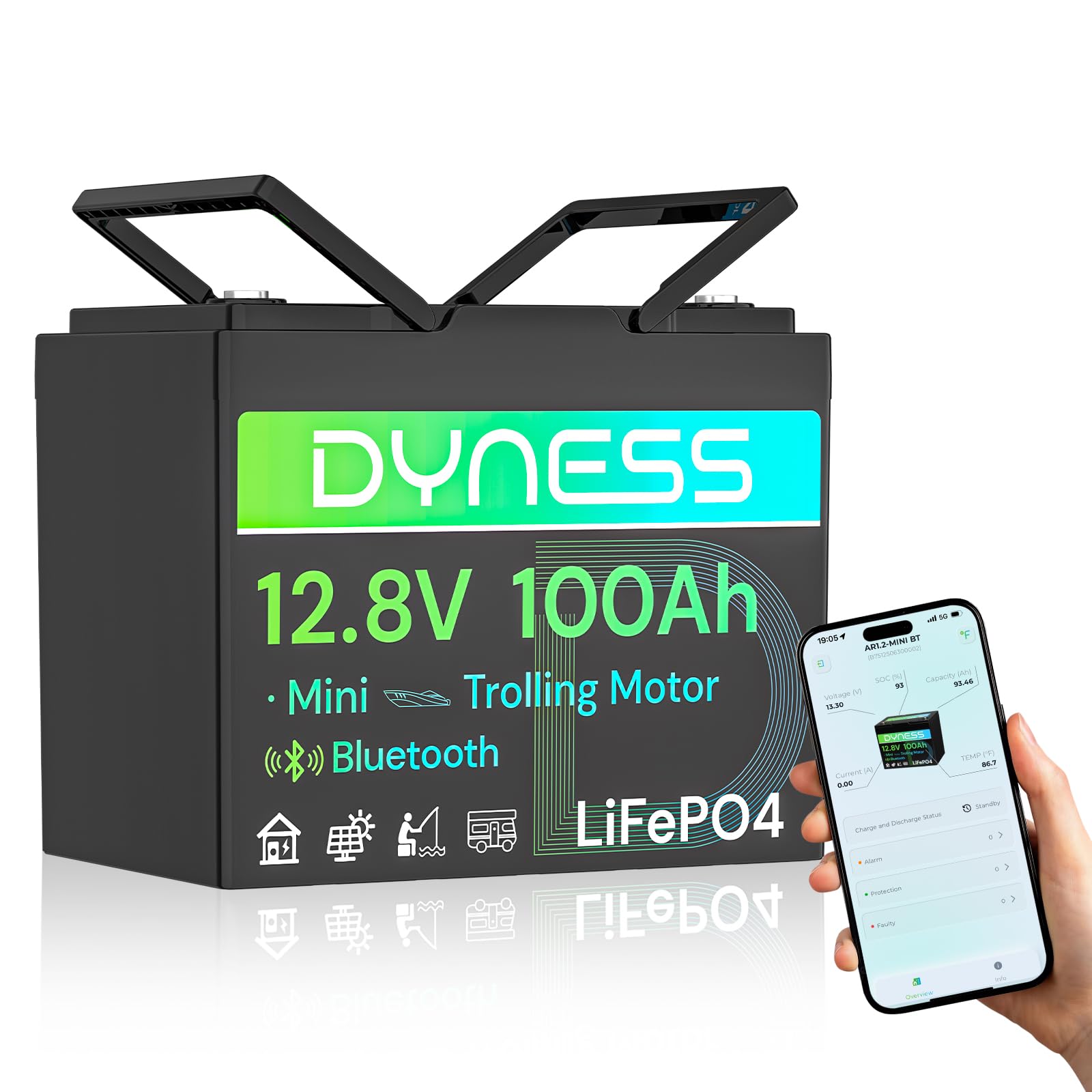
Dyness’s Group 24 LiFePO4 battery prioritizes marine-grade durability with an IP65 waterproof rating and an intelligent chip that cuts off current at five distinct thresholds (120A/60s, 200A/10s, 300A/5s, 500A/1s). This graduated overcurrent protection is unique in this price range and prevents nuisance trips on trolling motors during sudden acceleration. The Bluetooth 5.0 module communicates with the Dyness app for real-time voltage, current, capacity, and temperature monitoring.
Weighing 20.9 pounds, it’s one of the lightest 100Ah batteries here. The BMS includes low-temperature protection that stops charging below 32°F and discharging below -4°F, ideal for cold-climate storage. One review mentions a phantom drain overnight from 80% to zero, likely due to an inverter issue rather than the battery itself. Another reviewer praised it for powering a telescope tracking system and computer without issue.
For a 48V golf cart bank, four units in series connect seamlessly. The app’s industrial-style interface is functional but lacks historical graphing. A geopolitical note: one user highlighted that the battery’s remote shutdown feature could theoretically be triggered by a third party, though this is an edge case that most buyers won’t encounter. Overall, the IP65 rating and graduated overcurrent cutoffs make it a solid choice for carts that face wet conditions.
Why it’s great
- IP65 waterproof — tolerates rain and marine spray
- Graduated overcurrent protection (120A to 500A thresholds)
- Lightest 100Ah option at 20.9 lbs
- Low-temp charging cutoff for cold storage
Good to know
- Bluetooth app lacks history/graph features
- One report of phantom overnight drain (possible inverter issue)
- Remote shutdown feature is a privacy concern for some
8. GrenerPower 12V 100Ah LiFePO4 Battery
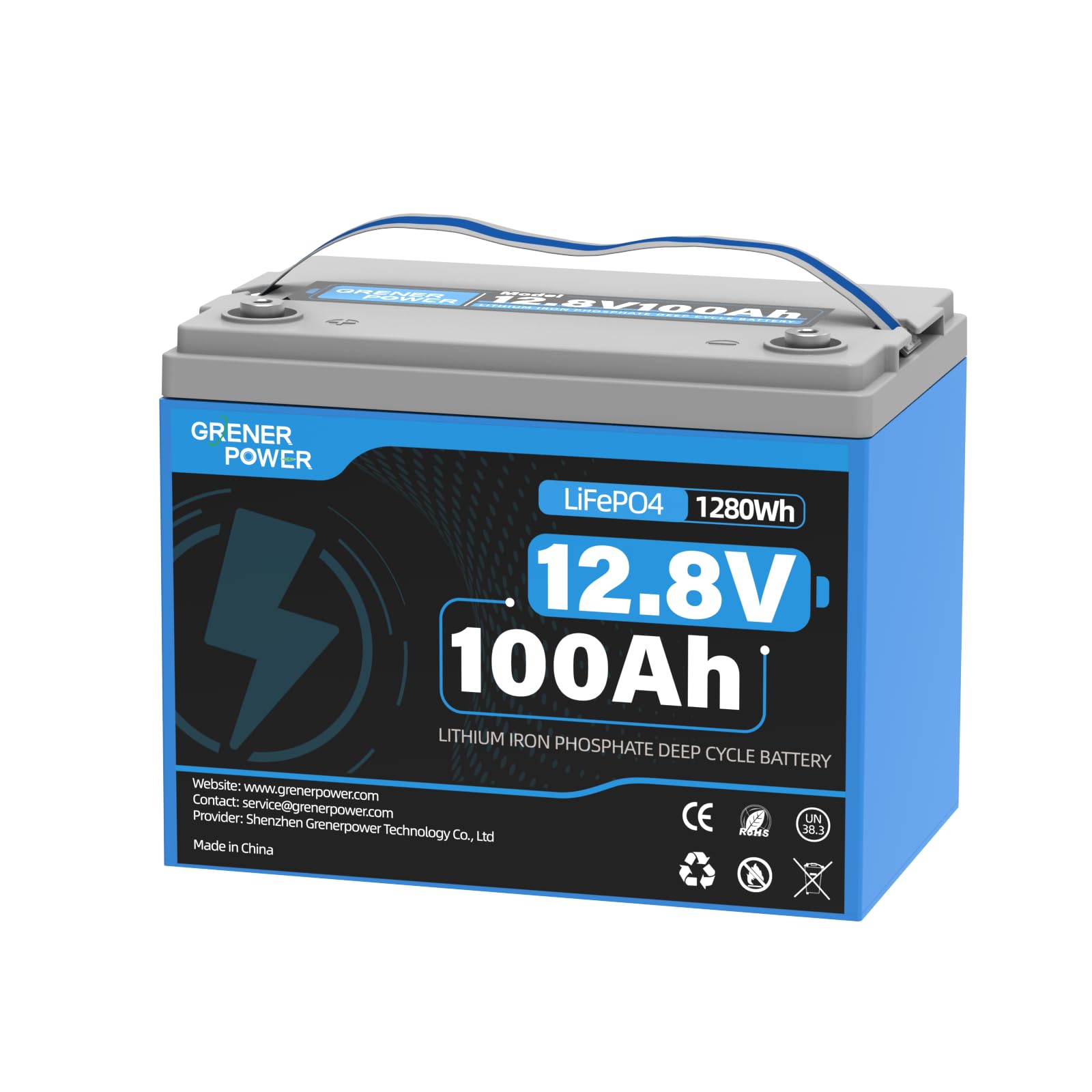
GrenerPower claims 15,000 deep cycles — an extraordinary figure that edges out virtually every competitor in this list, though real-world cycle life depends on depth of discharge and charging habits. The battery uses Grade A+ cylindrical cells, which inherently provide better thermal management and longer calendar life than the prismatic cells found in most budget packs. The 100A BMS offers five-layer protection: overcharge, over-discharge, short-circuit, overcurrent, and overheat.
At 22.6 pounds and Group 24 dimensions (10.23 x 6.61 x 8.3 inches), it fits standard golf cart trays without modification. Owners who tested capacity confirmed 100Ah+ performance, with one user discharging at 60Ah for 90 minutes to 12.8V (roughly 10% SOC) with no voltage sag. Three units wired in parallel for a 36V trolling motor setup saved over 60 pounds compared to a flooded 4D battery.
A notable caveat: the manufacturer explicitly states this battery is designed for energy storage, not for golf cart starting or high-cranking applications. This is a deep-cycle battery — fine for a 48V series bank that powers the cart’s motor, but not suitable as a starting battery in a gas cart. The 5-year warranty provides adequate coverage, and customer support promptness is generally positive. For users who plan to cycle daily, the 15,000-cycle rating offers serious long-term value.
Why it’s great
- 15,000 cycles is industry-leading for deep-cycle LiFePO4
- Grade A+ cylindrical cells for better thermal performance
- Compact Group 24 size fits standard trays
- Real-world capacity tests confirm 100Ah+
Good to know
- Not for golf cart starting/engine cranking
- No Bluetooth — no smart monitoring
- One report of initial cell imbalance requiring top charging
9. FLLYROWER 12V 100Ah LiFePO4 Battery

FLLYROWER’s 12V 100Ah battery claims 16,500 cycles (best on spec sheet) and includes a 7A AC charger in the box — a rare inclusion that saves roughly -60 on ancillary gear. The Grade A cells and 100A BMS with low-temp protection bring it in line with mid-range competitors, but the charger inclusion makes this the most affordable entry point for someone building their first lithium bank. Real-world capacity testing confirmed 103Ah, exceeding the rated spec.
Light at 22 pounds, the battery is equipped with a molded handle for easy transport. Owners using it with Minn Kota trolling motors report all-day coastal fishing with huge weight savings over lead-acid. One user paired it with a 2000W inverter to power a fridge, computers, and modem during outages, confirming its suitability as a dual-purpose battery for cart and backup use. The included charger works at 7A, but a full charge from empty takes roughly 14.3 hours; a faster charger is advisable for daily cycling.
There is no Bluetooth connectivity or app — you cannot monitor SOC from your phone. The USB-A ports on the unit are a nice bonus for charging phones but won’t replace a proper monitoring system. The battery supports up to 5S series connection (60V max) and unlimited parallels, which gives flexibility for 36V or 48V builds. For the price, the included charger and decent build quality make it the most budget-friendly path into lithium, but you sacrifice smart features and warranty depth (manufacturer specified only on order channels).
Why it’s great
- Includes 7A AC charger — saves -60
- 16500 cycle claim is highest on paper
- Lightweight (22 lbs) with handle for easy carry
- Exceeds rated capacity in real tests (103Ah)
Good to know
- No Bluetooth — no phone monitoring
- Slow full charge (~14h) with included 7A charger
- No carry strap, side handholds only
FAQ
Can I use a 12V LiFePO4 battery to replace a single 12V lead-acid in my golf cart?
What is the difference between lithium cranking vs deep-cycle for a golf cart?
Do I need a special charger for LiFePO4 golf cart batteries?
How many 12V 100Ah batteries do I need for a 48V golf cart?
What does BMS low-temperature protection mean for winter storage?
Final Thoughts: The Verdict
For most users, the golf cart batteries 12v winner is the TEMGO 48V 100Ah Kit because it bundles everything you need — charger, LCD, retention strap, and a 200A BMS — into a single drop-in unit that saves 200+ pounds and delivers 40+ miles per charge. If you prefer the flexibility of wiring four separate batteries, the Litime 12V 100Ah 2-Pack offers Bluetooth monitoring and IP65 waterproofing for peace of mind. And for the budget-conscious builder, the FLLYROWER 12V 100Ah includes a charger and proven capacity that makes the jump to lithium affordable.