
That sharp, nagging pain on the inside of your elbow after every round isn’t just a nuisance — it’s medial epicondylitis signaling that your forearm tendons are under siege. A properly fitted counterforce strap can offload that stress instantly, letting you swing through the bag without wincing.
I’m Mohammad Maruf — the founder and writer behind Drink4Good. I’ve spent weeks dissecting the compression profiles, pad geometries, and material science that separate an effective brace from one that just slides around your arm.
Whether you’re dealing with lingering soreness from last season or a fresh flare-up, the right golf elbow brace applies focused pressure exactly where the extensor tendons attach, reducing microtrauma with every repetition.
How To Choose The Best Golf Elbow Brace
Picking the right brace for medial epicondylitis comes down to three critical factors: compression method, pad design, and arm circumference coverage. A strap that pinches or slips won’t deliver the targeted relief you need during a full round.
Compression Type: Counterforce Strap vs. Sleeve
Counterforce straps — the narrow bands you wear an inch or two below the elbow — work by creating a secondary anchor point that absorbs shock before it reaches the damaged tendon. Full sleeves spread pressure over a larger area but can restrict blood flow and movement during a golf swing. For golfers, the counterforce design is almost always the better fit because it allows full pronation and supination while still protecting the medial epicondyle.
Pad Material: Gel, Rigid Ridge, or Standard Foam
The pad is the business end of the brace. Dual gel packs conform to the arm’s curve and localize pressure precisely over the affected muscle belly. Rigid ridge bars — often made from molded plastic — offer a firmer, more concentrated point of contact that some users prefer for severe tendinopathy. Standard foam pads are softer and more forgiving but may not deliver enough focused compression for chronic cases.
Fit Adjustability and Arm Circumference
Most braces use hook-and-loop straps for adjustment, but micro-adjust dials are becoming popular for fine-tuning tension to the exact millimeter. Measure your forearm circumference about 1–2 inches below the elbow crease. If you fall between sizes (common around 11 inches), choose the smaller size for a snug fit or look for a model with labeled regular and plus options to avoid slipping mid-swing.
Quick Comparison
On smaller screens, swipe sideways to see the full table.
| Model | Category | Best For | Key Spec | Amazon |
|---|---|---|---|---|
| Med Spec EpiGel | Premium | Precise gel-pad isolation | Dual gel pads, 8″–14″ circumference | Amazon |
| PressureFlex Ridge Bar | Premium | Firm ridge-bar compression | U‑shaped pressure ridge, Lycra spandex | Amazon |
| bracemundo Knob-Adjust | Mid-Range | Dial-in tension control | Knob adjustment, 9″–14″ circumference | Amazon |
| Cho-Pat Mayo Clinic Design | Mid-Range | Clinic-backed reliability | Uniform foream strap, medium size | Amazon |
| Sleeve Stars Counterforce | Budget | Value with multi-strap sizing | 3 strap lengths, 9″–23″ circumference | Amazon |
In‑Depth Reviews
1. Med Spec EpiGel Tennis Elbow Brace
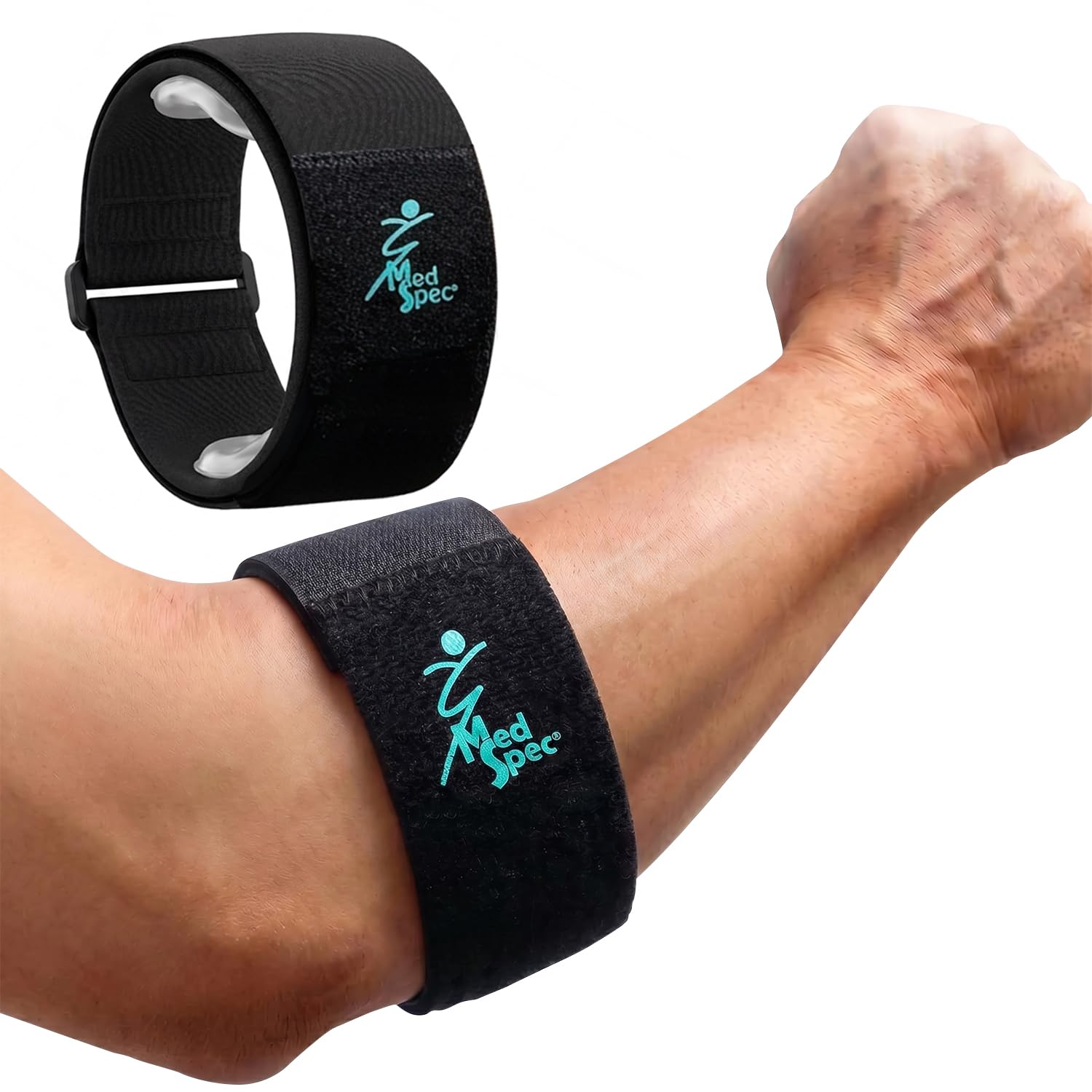
The Med Spec EpiGel stands apart because of its two independent gel pads that you can slide along the strap to target the exact tender spot on your medial epicondyle. Reviewers report pain relief within two to three days, with the gel packs absorbing vibration during impact sports better than any foam-based alternative. The low-profile shape fits easily under a performance polo or long-sleeve base layer without creating a visible bulge at the elbow.
Its universal fit accommodates arms from 8 to 14 inches, which covers nearly all adult sizes. The hook-and-loop closure holds firm through a full 18 holes, though some users note that the gel can cause a mild rash if worn for 10+ hours straight — solved by placing a thin cotton pad between the gel and skin. The strap stays put during heavy lifting, yard work, and repetitive typing, making it a versatile option beyond the course.
Customers specifically treating golfer’s elbow mention that the dual-pad design isolates the inner forearm tendon without squeezing the entire arm like a tourniquet. The EpiGel does not claim to cure tendinopathy, but as a counterforce tool it consistently delivers the most immediate symptom reduction in this lineup. For anyone seeking a brace that combines clinical-grade adjustability with all-day wear comfort, this is the top performer.
Why it’s great
- Movable dual gel pads isolate tendon pressure with precision
- Universal 8–14 inch fit works for most adults
- Low-profile design slips under sleeves without bulk
Good to know
- Gel can cause skin irritation during extended all-day wear
- Not a sleeve-style brace; covers only a 2-inch band
2. PressureFlex Tennis Elbow Brace with Ridge Bar
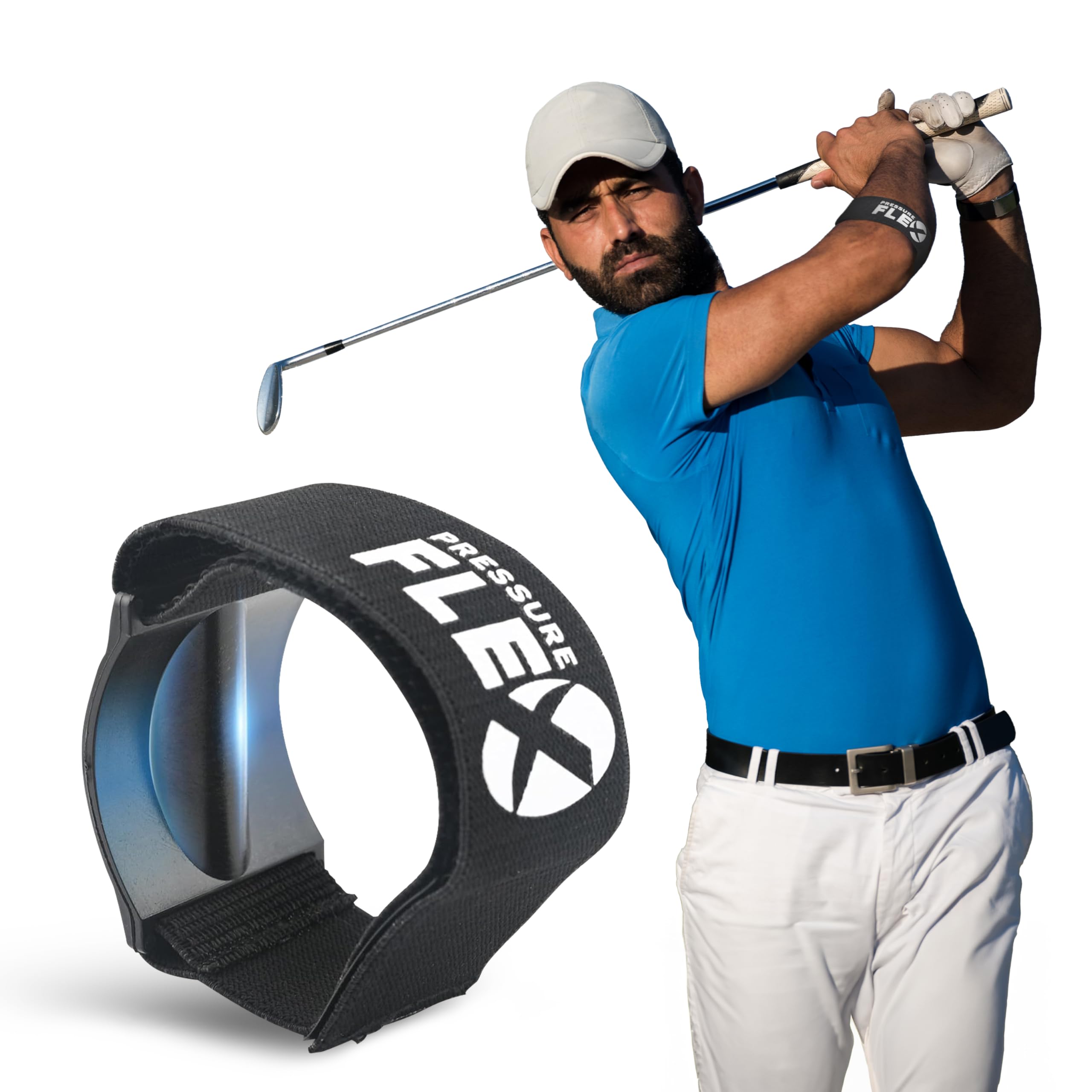
The PressureFlex introduces a patent-pending U‑shaped pressure ridge — a rigid plastic bar embedded in the strap that concentrates force on the forearm muscles far more aggressively than a standard foam bump. Multiple customers who tried softer pads without success found that this firm ridge finally delivered enough focused compression to let them lift, swing, and throw again. The 360-degree adjustable strap lets you dial in exactly how hard that ridge presses.
Built from a nylon and Lycra spandex blend, the band stretches with your arm during a full shoulder turn without bunching or cutting off circulation. It is also FSA and HSA eligible, which lowers the effective out-of-pocket cost for anyone with a benefits card. The low-profile width is slightly narrower than the EpiGel, which helps it disappear under a golf glove gauntlet or a compression sleeve.
A few users found the ridge too uncomfortable for 10-plus hour work shifts, though they still preferred the pain relief over the discomfort. If your golfer’s elbow is particularly stubborn and you need a more assertive pressure point than what foam or gel pads offer, this ridge bar design is the most aggressive option in this comparison. Just be prepared for a break-in period as your arm adjusts to the firmer contact.
Why it’s great
- Rigid U‑shaped ridge provides intense, targeted compression
- FSA/HSA eligible for lower effective cost
- Stretchy Lycra spandex moves with the swing
Good to know
- Firm ridge can feel uncomfortable during very long shifts
- May require a few wears to adjust to the pressure point
3. bracemundo Knob-Adjust Tennis Elbow Brace
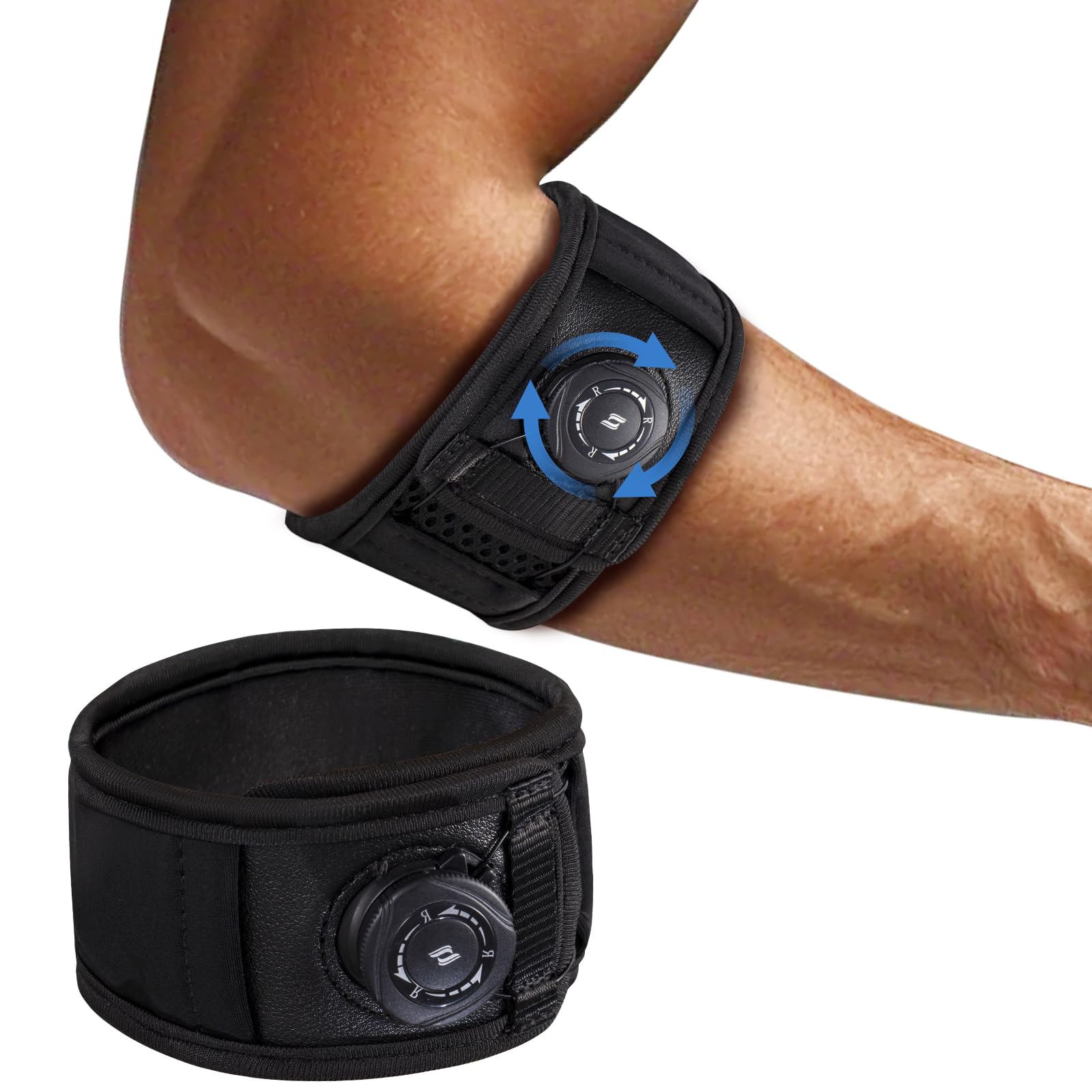
What sets the bracemundo apart is its knurled adjustment dial — a ratcheting mechanism that lets you fine-tune compression in tiny increments rather than relying on the broad velcro zones found on most straps. This is especially useful mid-round when your forearm swells slightly and you need a half-turn tighter to restore the same pressure. The polyester fabric is breathable and the pad uses a soft foam that sits against the skin without the tackiness of gel.
It comes in three defined sizes (Small, M/L, XL) rather than a single one-size band, which reduces the chance of slipping for people with unusually narrow or thick forearms. The M/L fits elbows 9–11.5 inches and the XL covers 11–14 inches, so measure carefully. Several users who bought it for golfer’s elbow reported that the even pressure distribution outperformed expensive branded alternatives they had tried previously.
One recurring critique involves the instructions: the directions don’t clearly explain how tight the dial should be set. The bracemundo is an excellent middle-ground choice if you want the precision of a micro-adjust system without paying premium-tier pricing. It is less bulky than the EpiGel but lacks the movable pad positioning that makes the Med Spec so customizable.
Why it’s great
- Ratchet dial provides micro-adjustable tension control
- Three discrete sizes reduce slipping for non-average arms
- Breathable polyester fabric stays cool during active play
Good to know
- Adjustment instructions are vague
- Fixed foam pad lacks the movement freedom of gel pads
4. Cho-Pat Golfer’s Elbow Support Strap

The Cho-Pat strap carries the distinction of being designed in cooperation with Mayo Clinic, which gives it a level of clinical credibility that over-the-counter braces seldom match. Its design philosophy is minimalism: a single wide band of non-stretch webbing with a small foam pressure pad sewn into the underside. It applies uniform compression across the entire forearm cross-section rather than spot-treating a single point, which some users prefer for generalized muscle strain.
Made in the USA from durable materials, the strap holds up season after season without the velcro losing grip or the webbing fraying. The sizing runs large — several reviewers with arm circumferences near the upper end of a size range advised choosing the smaller size to prevent slipping. It works well for golfers, weightlifters, and anyone doing repetitive yard work, but the fixed pad position means you cannot fine-tune where the pressure lands relative to your pain point.
While the Cho-Pat’s straightforward construction is reliable, it lacks the adjustability and pad sophistication of the EpiGel or PressureFlex. If you value USA-made manufacturing, clinical association, and a no-frills approach, this strap is a solid mid-range option. Just verify your arm measurement before ordering to avoid the reported sizing issues.
Why it’s great
- Developed in collaboration with Mayo Clinic
- Made in the USA with rugged webbing
- Consistent uniform compression for generalized strains
Good to know
- Fixed pad cannot be repositioned for specific tendon spots
- Sizing runs large — buy one size smaller than you think
5. Sleeve Stars Counterforce Elbow Brace

Coming in at the budget-friendly end of the spectrum, the Sleeve Stars brace compensates for its low entry price by including three separate strap lengths in the package — short, medium, and long — so you can choose the one that fits your arm circumference most precisely. That’s a clever workaround for the one-size-fits-most problem, and it’s backed by real customer reports of significant pain reduction during golf and daily physical work.
The counterforce pad uses a dense foam rather than gel or a rigid bar, delivering moderate compression that suits mild to moderate golfer’s elbow. The strap material is breathable and lightweight, making it one of the cooler options to wear during summer rounds. However, the velcro attachment points where the strap loops back on itself can feel bulky under a long-sleeve shirt, and users noted that fabric bunching occurs when worn over a sleeve rather than directly on bare skin.
For first-time buyers or those who aren’t sure whether a counterforce strap will solve their elbow pain, the Sleeve Stars brace offers a risk-free starting point. The quality is decent for the tier, but the foam pad will compress over time faster than the gel or ridge-bar alternatives. Replace it after a season of heavy use to maintain the same level of support.
Why it’s great
- Includes three strap lengths for a custom-like fit
- Lightweight and breathable for hot-weather play
- Low cost makes it an easy entry-level trial
Good to know
- Foam pad loses compression stiffness over time
- Bulkier under long sleeves compared to gel-pad models
FAQ
Should I wear a golf elbow brace during the entire round or only when I feel pain?
How tight should a counterforce strap be for golfer’s elbow?
Can I wear a golf elbow brace on my left arm if I’m right-handed?
Final Thoughts: The Verdict
For most users, the golf elbow brace winner is the Med Spec EpiGel because its movable dual gel pads let you pinpoint the exact tender spot on the medial epicondyle while keeping the profile low enough to wear under a polo. If you want a firmer, more aggressive pressure point that rivals the intensity of a professional kinesiology tape, grab the PressureFlex Ridge Bar. And for an entry-level trial without committing to premium pricing, nothing beats the Sleeve Stars Counterforce with its three strap lengths.