
Knowing your true carry distance and club head speed is the fastest shortcut to lower scores, but the cost of high-end tour-level launch monitors has kept this data out of reach for most amateurs. The gap between guessing your yardage and knowing it is now bridged by a new wave of portable, radar-based devices that deliver actionable metrics without requiring a second mortgage.
I’m Mohammad Maruf — the founder and writer behind Drink4Good. I’ve spent years analyzing the hardware specs, doppler radar accuracy, and app ecosystem integration of the golf training market to separate the reliable tools from the gimmicks.
After reviewing dozens of options across the price spectrum, the following nine models represent the strongest contenders for a golf launch monitor under $500, ranked by real-world accuracy, feature depth, and build quality.
How To Choose The Best Golf Launch Monitor Under $500
Choosing the right monitor in this price band means prioritizing the metrics you actually use. High-end units track spin axis and club face angle, but most sub-$500 devices focus on club speed, ball speed, smash factor, and carry distance. The trade-off is between raw metric depth and ecosystem features like simulator integration or video swing capture.
Radar Type and Space Requirements
Every unit here uses doppler radar, but minimum indoor space varies dramatically. Some require 15 feet of total ball flight to lock onto the ball, while others can track a swing without a ball at all. Measure your available practice area before buying, especially if you plan to use it with a net at home.
Metric Priority and App Integration
If you only need club head speed and smash factor for speed training, a simpler device suffices. If you want spin rate, attack angle, and 3D trajectory visualization, look for a unit with environmental sensors and a mature companion app. Subscription-free apps save money long-term, while models with premium simulator subscriptions add recurring cost.
Build Quality and Portability
Plastic bodies keep weight and cost down, but metal housing and tripod compatibility improve durability and alignment consistency. Rechargeable lithium batteries are preferable over disposable AAs for long-term use, especially if you practice multiple times per week.
Quick Comparison
On smaller screens, swipe sideways to see the full table.
| Model | Category | Best For | Key Spec | Amazon |
|---|---|---|---|---|
| Garmin Approach R10 (PlayBetter Bundle) | Premium Portable | Full simulation & video analysis | 10hr battery, 43k+ courses | Amazon |
| Garmin Approach R10 (Standard Bundle) | Premium Portable | Indoor simulator & course play | Alignment stand accuracy | Amazon |
| Swinora GX-03 | Mid-Range + Metal | 13-metric depth, zero subscription | Metal body, OLED display | Amazon |
| Garmin Approach G80 (Renewed) | Premium GPS Combo | On-course GPS + launch monitor | 15hr GPS battery, touchscreen | Amazon |
| TheStack Radar | Speed-Focused | Speed training & wedge gamming | 0.12 kg, Bluetooth to app | Amazon |
| TAG ONE Sports Radar | Multi-Sport Radar | Baseball & golf speed tracking | ±1 MPH, 225 MPH max | Amazon |
| Voice Caddie SC200Plus | Mid-Range Portable | Voice feedback & ball-less drills | 8 oz, lithium battery | Amazon |
| Arccos Smart Laser Rangefinder | AI Rangefinder | Plays-like distances with wind | 1000 yd range, slope toggle | Amazon |
| Izzo Golf Swami Launch Master | Entry-Level Radar | Budget-friendly basic metrics | LCD display, AA battery | Amazon |
In‑Depth Reviews
8. PlayBetter Garmin Approach R10 Bundle
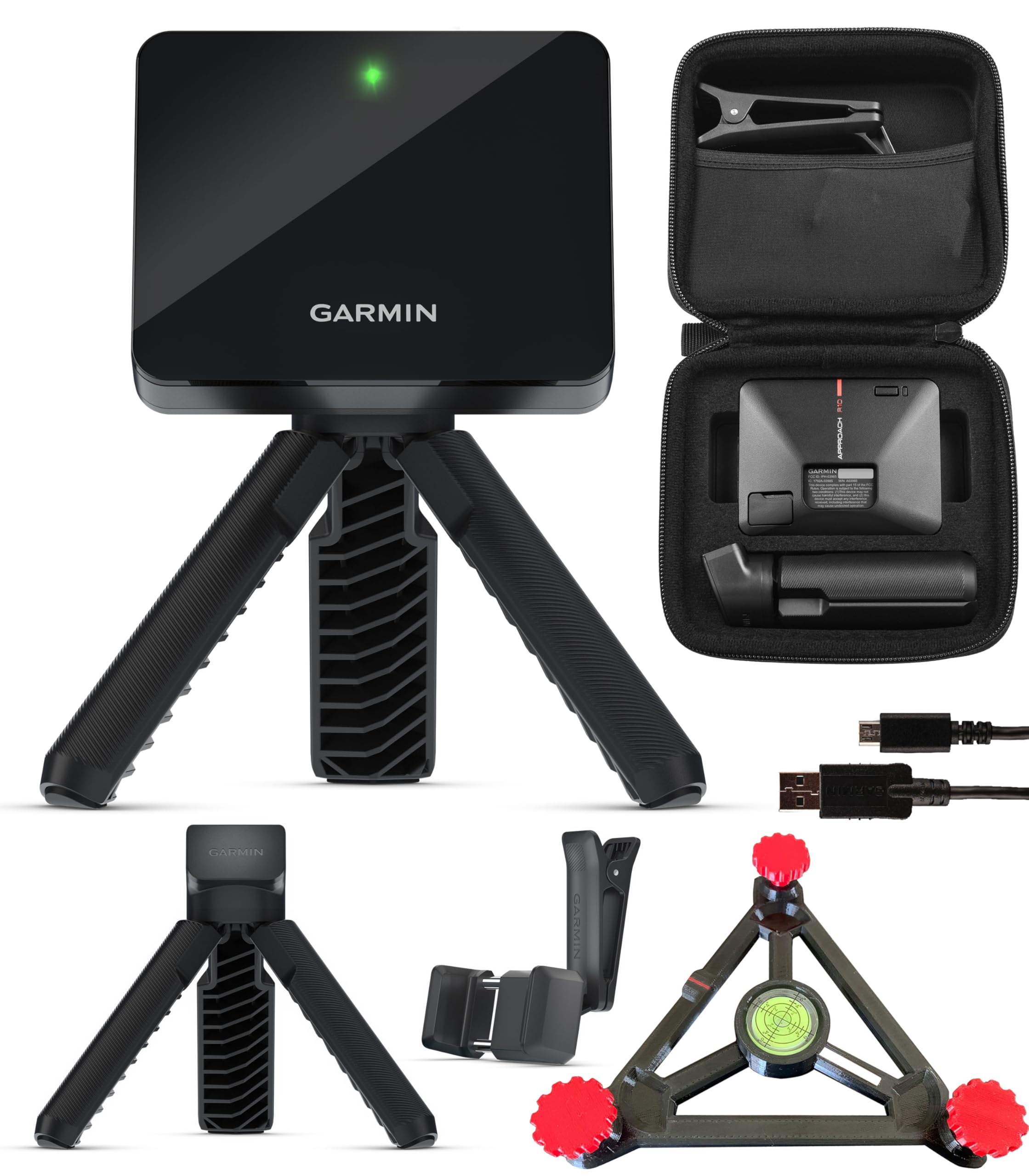
The Garmin Approach R10 remains the gold standard for portable launch monitors under $500, and this PlayBetter bundle elevates it with an alignment stand that physically locks the unit into the correct plane and angle. The alignment accessory alone can improve accuracy on spin axis and launch direction versus setting the R10 on the ground by eye. The bundle also includes a tripod, phone mount, and carry case, making it a true out-of-the-box simulator solution.
On the range or at home with a net, the R10 measures club head speed, ball speed, smash factor, swing tempo, launch angle, and spin rate. Paired with the Garmin Golf app, you get video swing capture synced to each shot and access to the Home Tee Hero simulator with over 43,000 virtual courses. The battery life hits 10 hours, which comfortably covers two range sessions or a full day of simulator play.
Some users report carry distance being 10-30 yards short on longer clubs depending on the environment and altitude settings, so cross-checking with a rangefinder on the course is wise. Subscription costs for premium simulator features add a recurring fee, but the free range app provides ample shot data for most amateurs.
Why it’s great
- Alignment stand improves spin axis accuracy
- 10-hour battery covers multiple sessions
- Full simulator access with 43k+ courses
Good to know
- Can read short on driver distances by 20+ yards
- Premium simulator features require subscription
7. Swinora GX-03 Launch Monitor
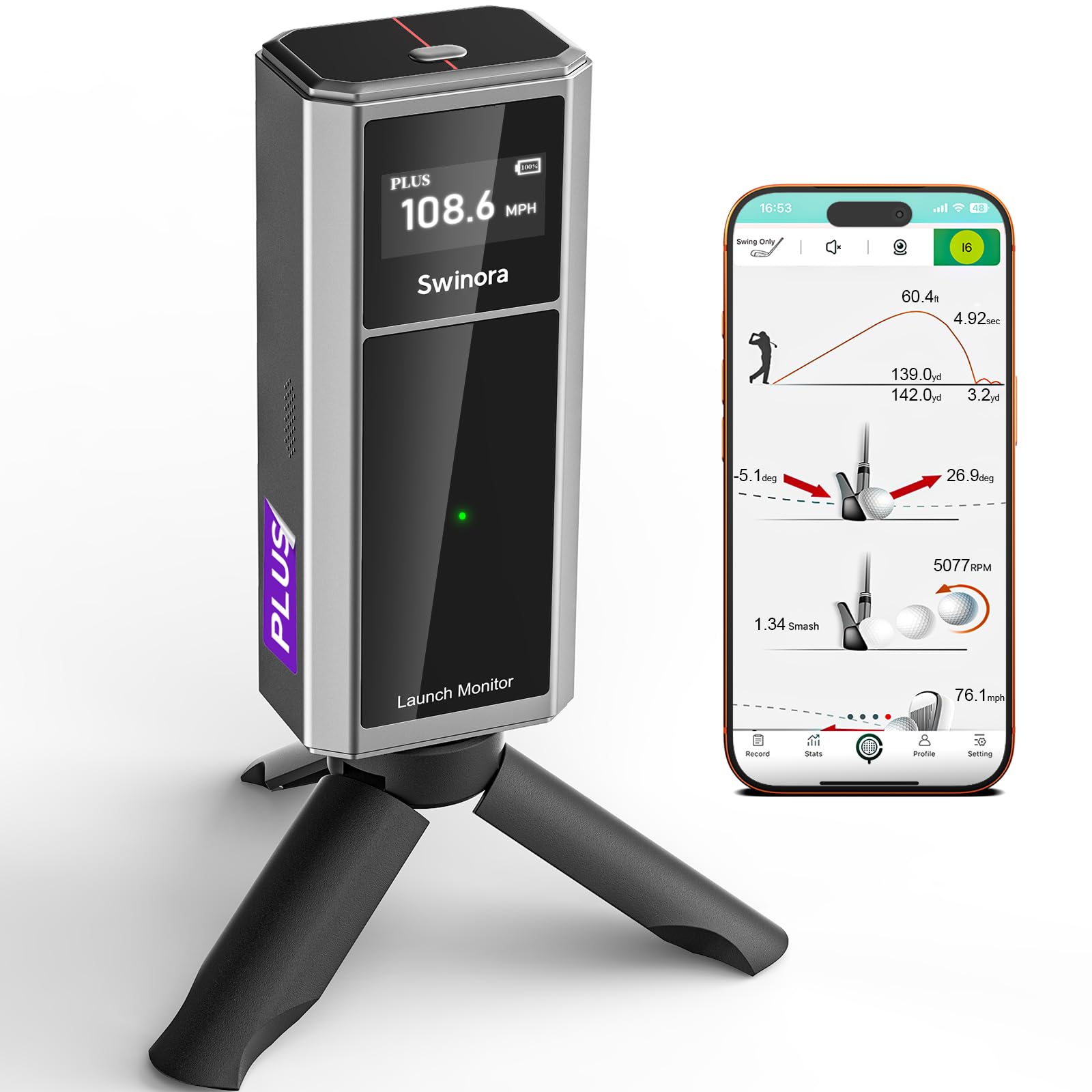
The Swinora GX-03 stands out for its 13-metric depth including attack angle, launch angle, spin rate, and vertical clubface data, all delivered through a premium metal housing with an OLED display. Unlike many competitors, it uses built-in temperature, humidity, and barometric pressure sensors to adjust shot data to real-time conditions, which directly improves carry distance accuracy across different weather.
Its companion app offers a 3D virtual driving range with 45 and 90-degree viewing angles and zero annual fees — a one-time download grants lifetime access to all features. Indoor use requires a 15-foot total space (5 feet behind the ball, 10 feet of ball flight), which is standard for doppler radar in this class. The distance compensation function lets you adjust yardage from 80% to 120% per club, helping calibrate for indoor nets versus outdoor range conditions.
Bluetooth connectivity is reliable, but the app can occasionally freeze or disconnect mid-session, requiring a restart. The metal body adds weight and durability, though some early units showed inconsistent ball speed readings compared to higher-end reference units. For sub-$500, the metric depth is unmatched if your environment allows consistent 15-foot use.
Why it’s great
- 13 metrics including spin rate and attack angle
- No subscription fees for full app access
- Environmental sensors auto-calibrate for weather
Good to know
- Requires 15ft total space for indoor radar lock
- App stability can vary across sessions
9. Garmin Approach R10 Standard Bundle

The standard Garmin Approach R10 bundle from PlayBetter delivers the same core radar hardware as the alignment-stand version but substitutes the stand for a portable charger, making it ideal for golfers who already own a tripod or plan to use the unit primarily with a hitting net at home. The R10 itself tracks all the essential metrics: club head speed, ball speed, smash factor, swing tempo, launch angle, and spin rate.
The key advantage of this bundle is the included 5000mAh PlayBetter power bank, which extends field life beyond the internal 10-hour battery. This matters for long range sessions or indoor simulator days where the unit stays on for hours. The bundled carry case and phone mount round out a clean package that requires no additional purchases to start training immediately.
Distance accuracy on the R10 is generally reliable for mid and long irons, though some users note woods and drivers can read short by 10-30 yards depending on ball quality and altitude compensation settings. The Home Tee Hero subscription adds /month for premium simulation, but the free Garmin Golf app with shot dispersion charts and club statistics covers the basics well.
Why it’s great
- Includes 5000mAh power bank for extended use
- Tracks swing tempo, smash factor, and spin rate
- Lightweight and portable with carry case
Good to know
- May under-report driver carry by 20+ yards
- Premium simulation requires monthly fee
6. Garmin Approach G80 (Renewed)

The Garmin Approach G80 is the only device on this list that combines a full GPS handheld with an integrated launch monitor, making it uniquely suited for on-course practice. The 3.5-inch sunlight-readable touchscreen displays both course maps and live radar data, so you can check your distance to the front of the green, then swing a club and see your carry distance immediately.
Its radar captures club head speed, ball speed, smash factor, swing tempo, and estimated distance. In practice mode, you can work on specific clubs and store data for later review. The G80 is preloaded with over 41,000 course maps worldwide and offers a 15-hour battery life in GPS mode, which means it lasts through multiple rounds without charging.
As a renewed product, the G80 can be a gamble — some units arrive in excellent condition while others show cosmetic wear or functional issues. It lacks spin rate capture and club face angle data, so serious swing analysts may outgrow it quickly. The G80 is best for golfers who want a single device for both on-course navigation and practice range feedback without managing two gadgets.
Why it’s great
- Combines GPS course maps with launch monitor
- Sunlight-readable 3.5-inch touchscreen
- 15-hour battery in GPS mode
Good to know
- Renewed condition varies per unit
- No spin rate or club face data
4. TheStack Radar
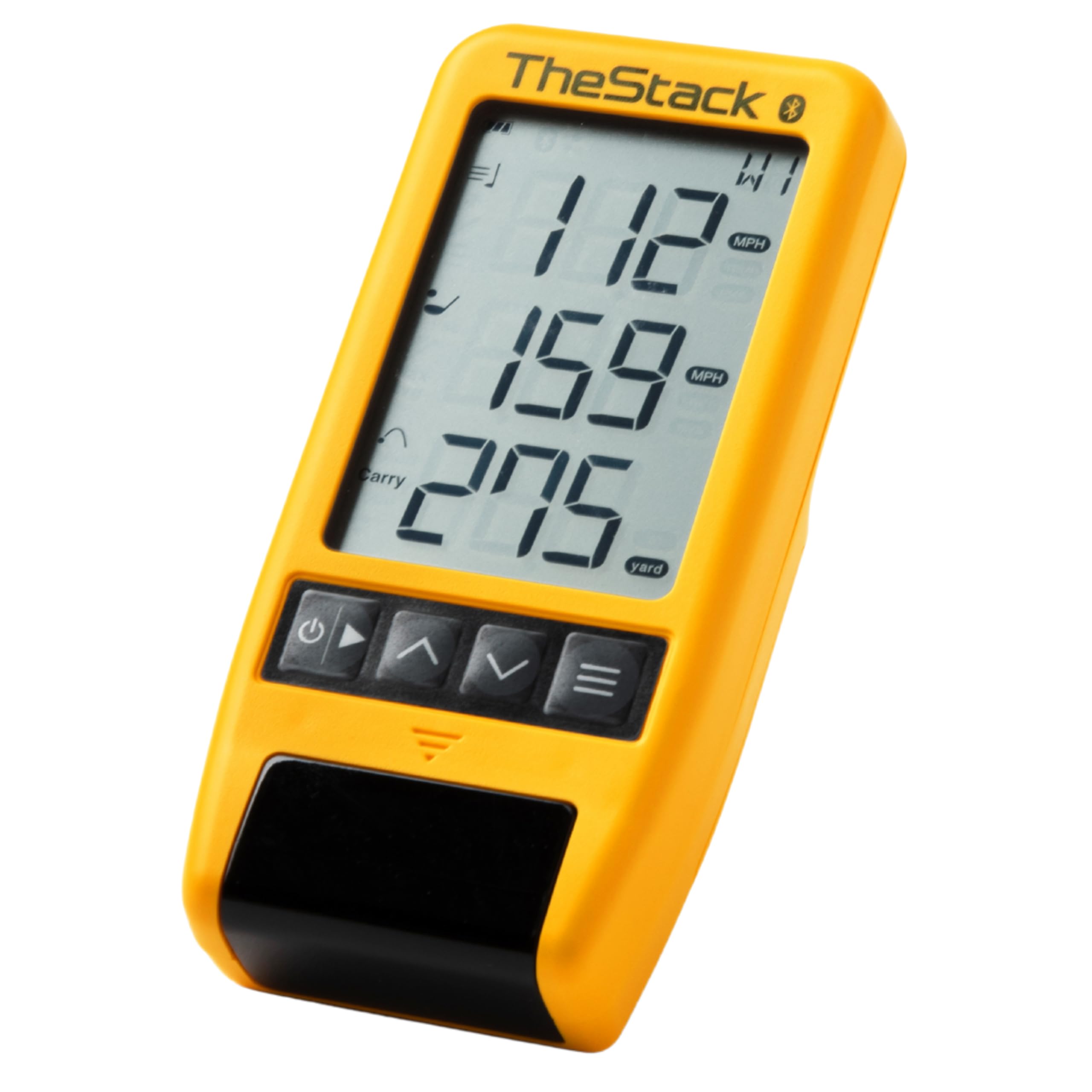
TheStack Radar was purpose-built for speed training within TheStack ecosystem, and it excels at one thing: measuring club head speed and ball speed with precision. At just 0.12 kg, it’s the lightest doppler radar on this list and clips onto a bag or tripod without adding bulk. It calculates estimated carry distance and smash factor, feeding all data directly to TheStack App via Bluetooth.
The true differentiator is the bundled Stack Wedging app, which gamifies wedge distance control with skill-specific practice sessions. This feature is exclusive to TheStack Radar and currently iOS-only, but it turns an otherwise dry range session into a structured game. The Stack Putting bonus app adds guided putting practice insights as well. For golfers already using the Stack System for speed training, this radar is the logical upgrade.
Battery life runs on a pair of AAA batteries rather than a rechargeable cell, which is a minor inconvenience for frequent users. It also struggles to read driver pop-ups accurately, occasionally reporting only ball speed with an incorrect club head speed. For wedge and iron work, it shines — for full driver swings, expect some anomalies.
Why it’s great
- Ultra-light at 0.12 kg for bag portability
- Gamified wedge training app included
- Seamless Bluetooth to TheStack app
Good to know
- AAA batteries instead of rechargeable
- Pop-up driver shots cause data errors
5. TAG ONE Sports Radar
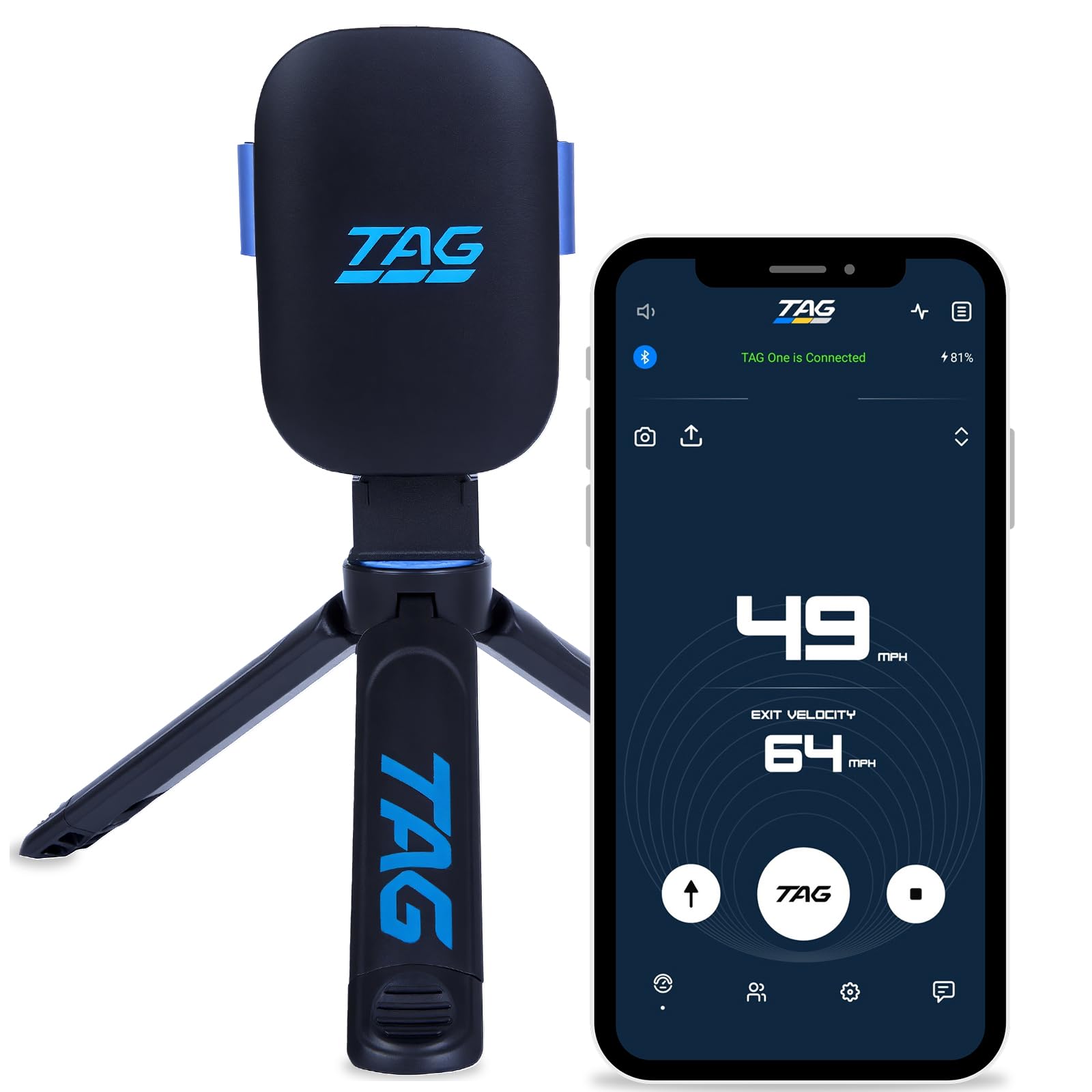
The TAG ONE Sports Radar is a credit-card-sized doppler radar that measures pitch speed, exit velocity, and golf ball speed across a range of 20 to 225 MPH with ±1 MPH accuracy. Its multi-sport nature makes it a smart choice for households with both baseball and golf players, as it seamlessly switches between modes via the TAG Sports app. The included mini tripod, bracket, and drawstring bag make it ready for the field or range out of the box.
The AI-powered smart coach within the app — AiCE — analyzes your session data and provides coaching feedback, which is rare at this price point. The rechargeable lithium-ion battery lasts over 6 hours of continuous use, and the magnetic back allows for quick mounting on metal surfaces. Bluetooth pairing to the app is reliable, and historical data is stored per user profile for tracking progress over weeks and months.
Radar lock can struggle through chain-link fences or window screens, so positioning in front of the hitting area is critical. It also occasionally misses a hit on partial swings or when the ball is struck off-center. For dedicated golf-only use, the metric depth is limited compared to purpose-built launch monitors, but for speed measurement and multi-sport versatility, it punches well above its weight.
Why it’s great
- Measures baseball AND golf speeds accurately
- AI-powered coaching within the app
- 6-hour rechargeable battery with magnetic mount
Good to know
- Struggles to read through chain-link or screens
- Limited metric depth for golf-only analysis
2. Voice Caddie SC200Plus

The Voice Caddie SC200Plus has been a staple in the sub-$500 launch monitor segment for years, and for good reason: it delivers reliable doppler radar in a compact 8-ounce package with both LCD display and audible voice output. The voice readout calls your carry distance after each shot, which is excellent for range sessions where looking down at a screen breaks your rhythm. The all-new swing speed mode allows ball-less practice indoors, perfect for tempo work when you can’t get to the range.
Doppler radar technology with atmospheric pressure calibration keeps data consistent across weather conditions, and adjustable loft angles let you customize the device per club for better accuracy. The SC200Plus stores shot data for each club, so you can pull up average distances across sessions without needing a phone app. The rechargeable lithium-ion battery lasts through multiple practice sessions, though some users report the battery isn’t replaceable.
Accuracy on wedge shots (less than 50 yards) can be inconsistent, with the radar sometimes reading too high or too low depending on ball position. The unit also lacks spin rate data and club face metrics, so it’s best suited for golfers focused on carry distance and swing speed rather than advanced shot shaping analysis. For pure distance feedback with voice integration, it remains a solid mid-range choice.
Why it’s great
- Voice output announces distance automatically
- Ball-less swing speed mode for indoor practice
- Compact 8-ounce design fits in any bag pocket
Good to know
- Wedge accuracy can be inconsistent
- No spin rate or club face data
3. Arccos Smart Laser Rangefinder
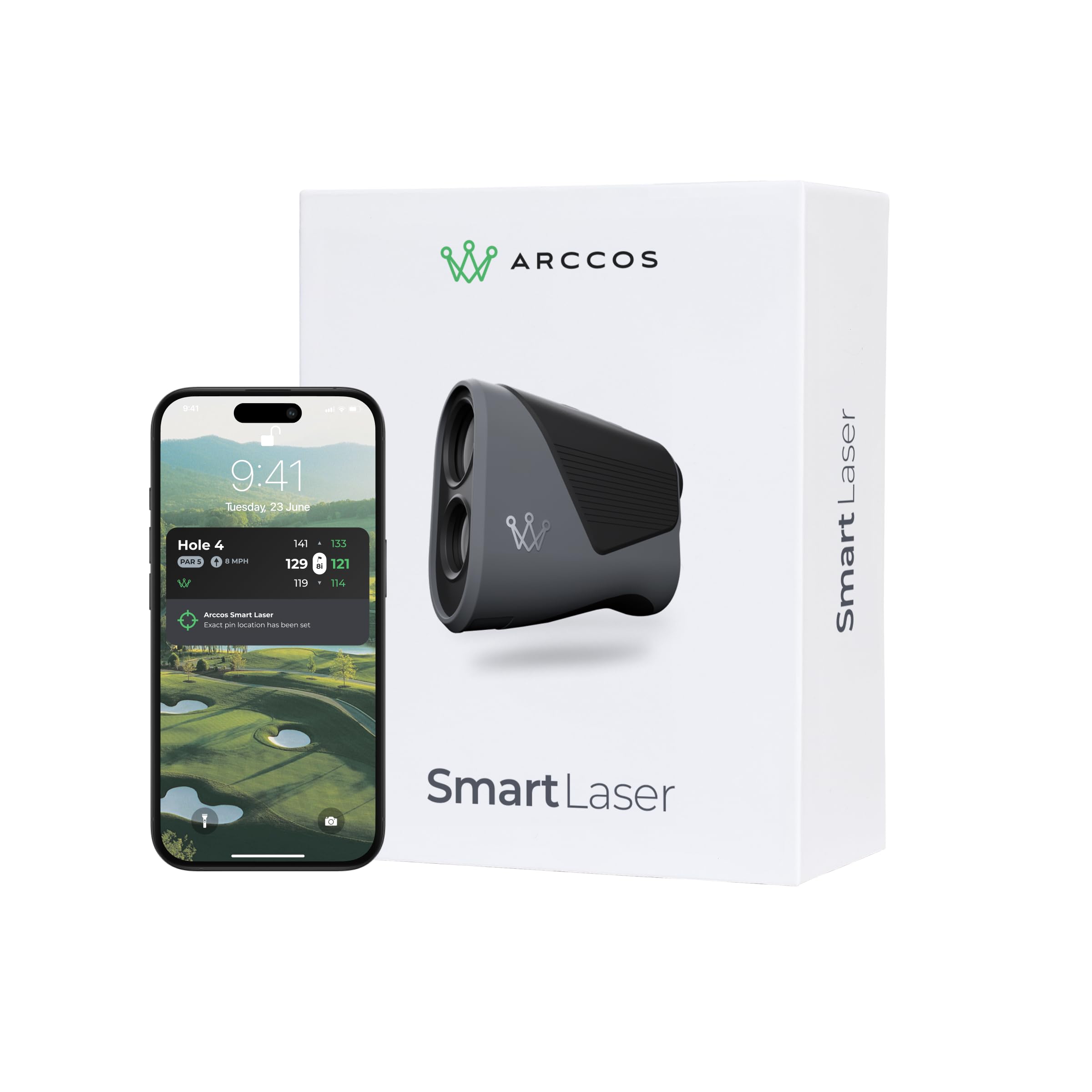
The Arccos Smart Laser Rangefinder is a unique entry in this guide because it is not a doppler radar launch monitor — it is a laser rangefinder enhanced with AI that factors in slope, wind, altitude, and temperature to calculate a “Plays Like” distance. While it doesn’t measure club head speed or ball speed, it replaces the need for a separate launch monitor if your primary goal is on-course yardage accuracy rather than swing analysis.
The 6.1x optical zoom and vibration pin lock deliver fast target acquisition out to 1000 yards with ±1 yard accuracy. The tournament-legal slope toggle lets you disable adjustments for competition. Built on 1.5 billion shots of Arccos data and developed with pro Edoardo Molinari, the AI Strategy and Green Maps feature provides optimal targets on each hole, which goes beyond simple distance to real course management advice.
The device requires the Arccos app to function fully, and the free first-year membership renews at /year. This recurring cost can catch buyers off guard if they expect a one-time purchase. The rangefinder also cannot be loaned to a friend easily since all smart features depend on the paired phone. For Arccos ecosystem users, it’s transformative — for standalone use, it’s less practical than a traditional laser or radar monitor.
Why it’s great
- “Plays Like” distances account for wind and altitude
- AI strategy with 1.5B shot database
- Tournament-legal slope toggle
Good to know
- Requires phone app for all smart features
- Subscription renews at /year after first year
1. Izzo Golf Swami Launch Master

The Izzo Golf Swami Launch Master is the most budget-friendly entry in this guide, designed for golfers who want basic metrics — club head speed, ball speed, smash factor, and carry distance — without a steep learning curve. It uses doppler radar to capture data and displays it on an easy-to-read LCD screen, with an audible readout option that calls your distance after each shot. Powered by 4 AA batteries that are included, plus a hard carry case, it’s truly ready to use out of the box.
Measuring adaptability is a standout feature at this price: you can enter your own club lofts for more accurate personal results, which is rare on entry-level units. The compact form factor (4 x 3 x 5 inches) fits easily in a golf bag side pocket, and the 454-gram weight feels substantial without being heavy. For range sessions focused on distance gapping between clubs, it provides enough data to be genuinely useful.
Accuracy is the most common point of contention among users. Some find the numbers reliable for mid-iron distances, while others report seemingly random readings, especially on mishits or wedges where the radar struggles to lock cleanly. The plastic build feels less durable than metal competitors, and the lack of Bluetooth or app integration means no data storage or shot history. It’s a functional starting point, but serious players will quickly outgrow it.
Why it’s great
- Includes 4 AA batteries and carry case
- Customizable club loft entries for better accuracy
- Audible readout calls distance after each shot
Good to know
- Accuracy can be inconsistent on mishits
- No Bluetooth or app for data tracking
FAQ
How much space do I need to use a doppler launch monitor indoors?
Can I use a golf launch monitor without a smartphone or tablet?
What is the difference between a launch monitor and a golf simulator?
Final Thoughts: The Verdict
For most users, the golf launch monitor under $500 winner is the PlayBetter Garmin Approach R10 Bundle because it delivers the best balance of metric depth, simulator quality, and long battery life with the alignment stand improving shot data accuracy. If you want zero recurring fees and deeper metric analysis, grab the Swinora GX-03. And for golfers who need a single device for both on-course GPS and range practice, the Garmin Approach G80 is the unique hybrid solution that nothing else in this price range matches.