
Thin mats hide a dirty secret: they transmit shock straight into your wrists and elbows, turning practice into a pain-management session. A quality golf practice mat does the opposite—absorbing impact while giving you honest feedback on fat shots so you actually improve instead of embedding bad habits.
I’m Mohammad Maruf — the founder and writer behind Drink4Good. I’ve spent years analyzing the construction layers, turf density ratings, and EVA foam specs that separate joint-friendly mats from concrete-in-disguise landing pads.
Whether you’re outfitting a garage simulator or building a backyard short-game station, the best golf practice mat will protect your clubs and your body while delivering the tactile feedback that makes at-home training actually translate to lower scores.
How To Choose The Best Golf Practice Mat
Not every mat labeled “heavy-duty” protects your joints, and not every thick mat delivers honest feedback. The key is understanding the construction layers and how they interact with your swing speed and club type.
Turf Density and Material
Polypropylene turf is common at entry-level price points, but premium nylon fibers resist flattening and fraying far longer—especially important for iron-heavy practice. The fiber pile height also matters: shorter piles (around 10-16mm) mimic fairway lies, while taller piles simulate first cut rough. Look for commercial-grade nylon if you plan to take more than 500 swings per week.
Base Padding and Shock Absorption
The foam backing is the real joint-saver. High-elasticity EVA foam in the 20mm to 30mm range absorbs roughly 80-90% of ground impact, reducing the jolt that travels up through the shaft. Watch out for mats that use only thin rubber or felt—they feel firm initially but transmit shock directly into your wrists and elbows after extended sessions.
Size and Tee Compatibility
A 5×4 foot mat provides enough room for a full stance with a driver, while 12×17 inch options are strictly for chipping practice. Tee hole count and placement matter too—six tee holes arranged for both lefty and righty stances give you rotation options to spread wear evenly across the surface.
Quick Comparison
On smaller screens, swipe sideways to see the full table.
| Model | Category | Best For | Key Spec | Amazon |
|---|---|---|---|---|
| Dura-Pro Premium Turf | Premium Nylon | High swing speed golfers, long-term durability | 30mm total thickness, 100% nylon fiber | Amazon |
| Bltend 5x4ft Heavy-Duty | Ultra-Thick EVA | Joint protection, simulator setups | 36mm thickness (16mm turf + 20mm EVA) | Amazon |
| Ponsonbay Integrated Ball Tray | All-in-One Design | Garage simulators, convenience | 0.63 inch turf, built-in ball tray | Amazon |
| Ywitio Premium Dual-Turf | Large Dual Surface | Full-swing practice, all skill levels | 45mm max EVA base thickness | Amazon |
| Golfguru 5x4ft Elite | Entry-Level Simulator | Budget indoor setups, beginners | 21mm total thickness (16mm turf + 5mm EVA) | Amazon |
| CHAMPKEY Tri-Turf | Compact Multi-Turf | Portable practice, chipping drills | 16×24 inch foldable design | Amazon |
| FODESAN Precision Hitting Mat | Compact Swing Trainer | Impact feedback, beginner training | Dual replaceable turf pads, 13×17 inch | Amazon |
In‑Depth Reviews
1. Dura-Pro Premium Turf Indoor/Outdoor Golf Mat
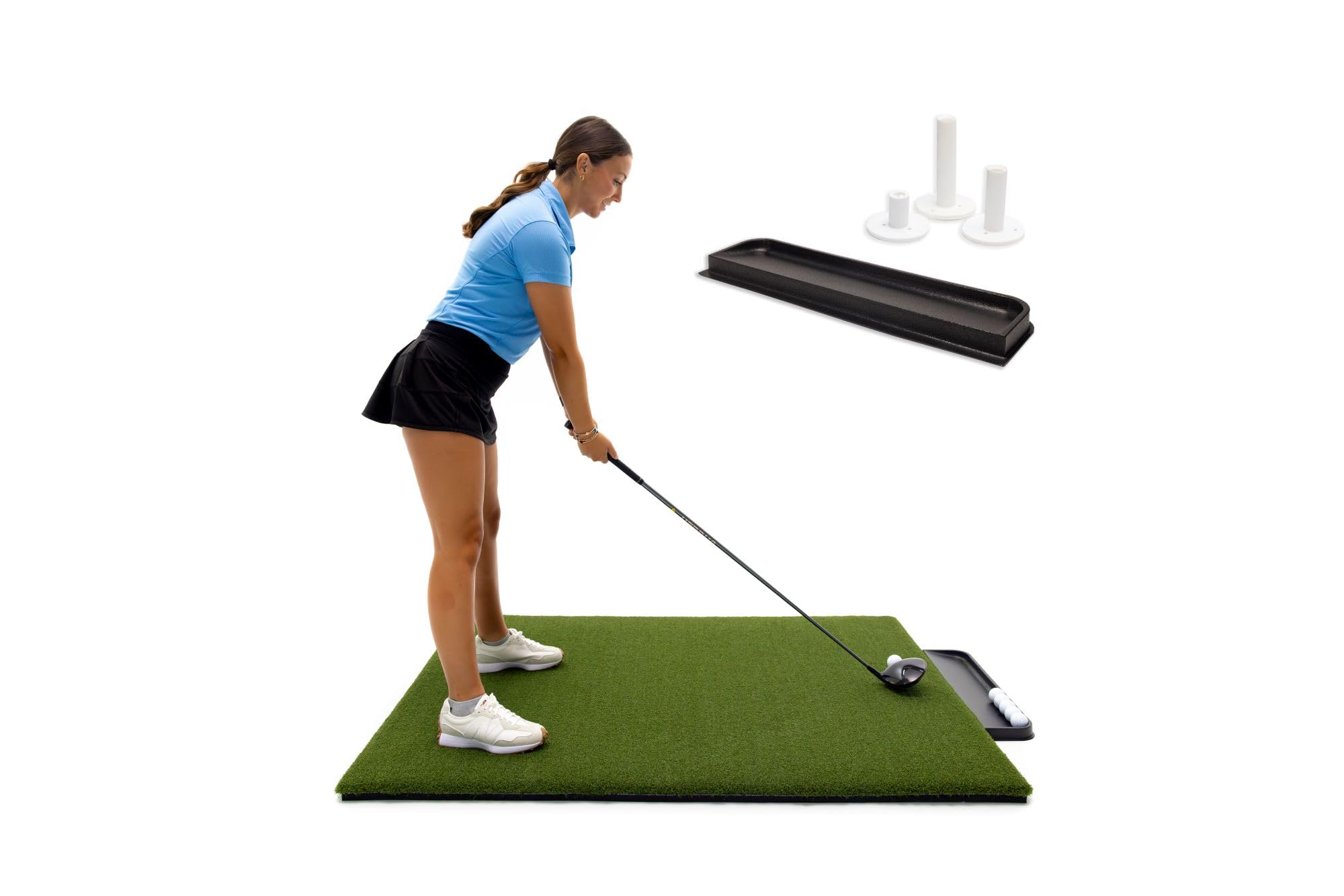
This is the mat low-handicap players and high-swing-speed golfers gravitate toward. The 100% nylon fiber pile stands up to driver-speed impacts without flattening—a common failure point in polypropylene mats. At 30mm total thickness, the rubber-and-foam base provides enough cushioning to protect elbows during long iron sessions, though serious grinders note it feels slightly firmer than a pro-range mat.
The 5×4 foot surface includes two tee holes, which some users find limiting for rotating wear across the mat. The stabilizing foam padding grips concrete well, with minimal shifting even during full-power drives. The included ball tray feels utilitarian, but the mat itself is the real value—customers report zero visible wear after 3,000 swings over a full year of daily use.
For golfers who want a permanent garage or simulator foundation, the Dura-Pro justifies its premium tier through material quality alone. The nylon fiber handles steep impact angles better than any polypropylene mat in this roundup, and the 8-year warranty backs up the commercial-grade claim. Just note you’ll want to add a few extra tee holes yourself if you rotate frequently.
Why it’s great
- Premium nylon fiber resists fraying and flattening far longer than polypropylene
- Heavy non-slip foam base stays planted during full driver swings
- 8-year warranty signals commercial-grade confidence
Good to know
- Only two tee holes limit rotation options for even wear distribution
- Cushioning is firm—not plush—which may feel harsh to steep swingers
2. Bltend 5x4ft Heavy-Duty Golf Mat

The standout spec here is the 20mm high-elasticity EVA pad paired with a 16mm dense turf layer, giving a combined 36mm system that absorbs over 90% of ground impact. That’s noticeably plusher than the 30mm Dura-Pro, and users with wrist or elbow sensitivity report it feels far more forgiving over 200-ball sessions. The turf itself is commercial-grade synthetic with an anti-tearing layer sandwiched between the pile and foam base—a construction detail that prevents the turf from separating from the backing under heavy use.
Six tee holes accommodate both left and right-handed stances, allowing you to rotate the mat across three positions to extend its lifespan. The 5×4 foot footprint gives you room for a full driver stance without stepping off the edge. Some customers noted the actual dimensions run slightly shorter than advertised, arriving roughly an inch short of 5 feet, which matters less for swing space than it does for simulator floor coverage.
The included bundle—9 practice balls and 8 tees—adds genuine value for someone building a first-time setup. After months of daily use, the turf shows wear marks from fat shots but no tearing or delamination. For the balance of impact absorption, surface area, and included accessories, this mat is the strongest mid-range contender for simulator or backyard users.
Why it’s great
- 20mm EVA pad delivers exceptional joint protection for high-volume practice
- Six tee holes allow rotation to spread wear evenly across the surface
- Includes practice balls and tees, ideal for a complete starter kit
Good to know
- Actual dimensions are slightly smaller than advertised
- Early units showed minor edge tearing after heavy simulator use
3. Ponsonbay Integrated Golf Hitting Mat

The integrated ball tray is the headline feature here, saving you from buying a separate bucket or picking up scattered balls after each swing. The 5×4 foot mat uses upgraded artificial turf measuring 0.63 inch thick with an anti-tear layer bonded between the pile and the 0.39 inch EVA rubber base. That anti-tear mesh is a smart engineering choice—it prevents the turf from delaminating when you take deep divots, which is the most common failure mode in mats at this price point.
Three rubber tee holders (2.36, 2.75, and 3.15 inches) give you height adjustability for wedges, irons, and drivers. The mat rolls up easily for storage, though it needs a day to flatten after unrolling. On concrete, the EVA base grips well; on grass or dirt, a few users reported sliding during full swings, so you may want to place it on a rubber underlayment for outdoor use.
The ball tray itself is functional but feels less durable than the mat—it’s a plastic add-on that could crack if stepped on. After 2,000 impact shots, the turf shows strike marks but no structural failure. For garage simulators or driveway practice, the integrated tray is a genuine convenience upgrade that justifies the premium over simpler mat-only options.
Why it’s great
- Built-in ball tray eliminates the hassle of separate ball collection
- Anti-tear layer between turf and foam prevents common delamination failure
- Three adjustable tee heights cover wedge through driver practice
Good to know
- Plastic ball tray feels less durable than the mat itself
- Slides on grass or dirt surfaces if not paired with a rubber underlayment
4. Ywitio Premium Dual-Turf Golf Mat

The dual-turf layout gives you both a rough-grass strip and a fairway-grass surface on a single 5×4 foot mat, letting you practice punch-outs from the first cut and clean iron strikes in the same session. The high-elasticity EVA base tapers from 21mm at the edges to 45mm in the center hitting zone—a variable-thickness approach that concentrates cushioning exactly where you need it most. That tapered design also helps the mat lie flat on uneven surfaces.
High-density polypropylene turf resists fraying well, though it doesn’t match the longevity of nylon found on the Dura-Pro. The mat includes three colored tees and three rubber tees, giving you height options without an extra purchase. After thousands of swings over several months, the center hitting zone shows visible wear—an expected trade-off given the softness of the EVA pad.
Ywitio backs the mat with a two-year after-sale service, which is longer than the typical one-year warranty on most mats in this tier. The dual-surface design is a real training advantage for golfers who want to simulate different lies without buying multiple mats. It rolls up for storage, though the 5.99kg weight makes it less portable than compact options.
Why it’s great
- Dual rough and fairway turf surfaces for varied lie practice
- Tapered EVA base provides extra cushioning in the center hitting zone
- Two-year after-sale service exceeds industry-standard coverage
Good to know
- Polypropylene turf shows visible wear in the center after heavy use
- Heavier than compact mats, which reduces portability for range trips
5. Golfguru 5x4ft Elite Golf Mat

The Golfguru mat hits a price point that appeals to first-time simulator builders, pairing a 5×4 foot surface with 21mm total thickness (16mm turf plus 5mm EVA pad). The 5mm EVA layer is noticeably thinner than the 20mm pad on the Bltend, which means joint protection is adequate for shorter practice sessions but may feel jarring after 100+ swings with irons. The turf itself uses commercial-grade material with an integrated anti-tearing layer to prevent separation from the foam base—a smart inclusion at this tier.
Six tee holes are arranged for both left and right-handed golfers, and the kit includes ten PU golf balls, four standard tees, three step-down tees, and two rubber tees. That’s a generous accessory bundle for anyone starting from zero. The non-slip PVC foam base grips hard surfaces well, though some users noted the mat curled at the edges when first unrolled and required a few days to flatten completely.
After four months of daily simulator use, one customer reported corner separation—the foam backing began peeling from the turf at the edges. This isn’t universal, but it suggests the anti-tear layer protects the hitting zone better than the perimeter. For budget-conscious golfers who want a full-size surface without a premium investment, this mat works well for casual practice with reasonable expectations about long-term wear.
Why it’s great
- Full 5×4 foot hitting surface at an entry-friendly price point
- Generous accessory bundle includes balls, tees, and rubber tee holders
- Six tee holes accommodate both left and right-handed stances
Good to know
- Thin 5mm EVA pad offers less joint protection for high-volume practice
- Edge curling reported on initial unboxing in some units
6. CHAMPKEY Professional Tri-Turf Golf Hitting Mat

The CHAMPKEY mat is built around three distinct turf sections: rough, fairway, and tee turf, giving you surface variety in a compact 16×24 inch footprint. That’s small enough to stash in a car trunk or carry to the office for lunch-break chipping practice. The heavy rubber backing keeps the mat from sliding on concrete, though some users reported slight movement during full-power swings—easily fixed with double-sided tape for permanent placement.
The solid adhesive base is a new construction method designed to prevent the turf from separating from the rubber backing, a problem common in earlier CHAMPKEY models. After a year of use, one reviewer confirmed the mat still held together without delamination, which is a solid durability signal for a mat in this size and tier. The foldable design reduces the storage footprint to roughly 16×8.75 inches when collapsed.
There’s a practical limitation: the 16×24 inch surface is too small for full driver swings. You’ll want this mat primarily for iron impact drills, chipping practice, and swing path work. The tee holder works well with rubber tees but can break wooden tees if inserted at an angle. For golfers who need a portable training surface for short-game refinement, this tri-turf option delivers genuine value.
Why it’s great
- Three distinct turf surfaces simulate rough, fairway, and tee lies
- Foldable design compacts to roughly half its size for storage
- Solid adhesive construction resists delamination over long-term use
Good to know
- Compact size unsuitable for full driver or wood swings
- Tee holder can break wooden tees if not aligned correctly
7. FODESAN High-Precision Golf Hitting Mat
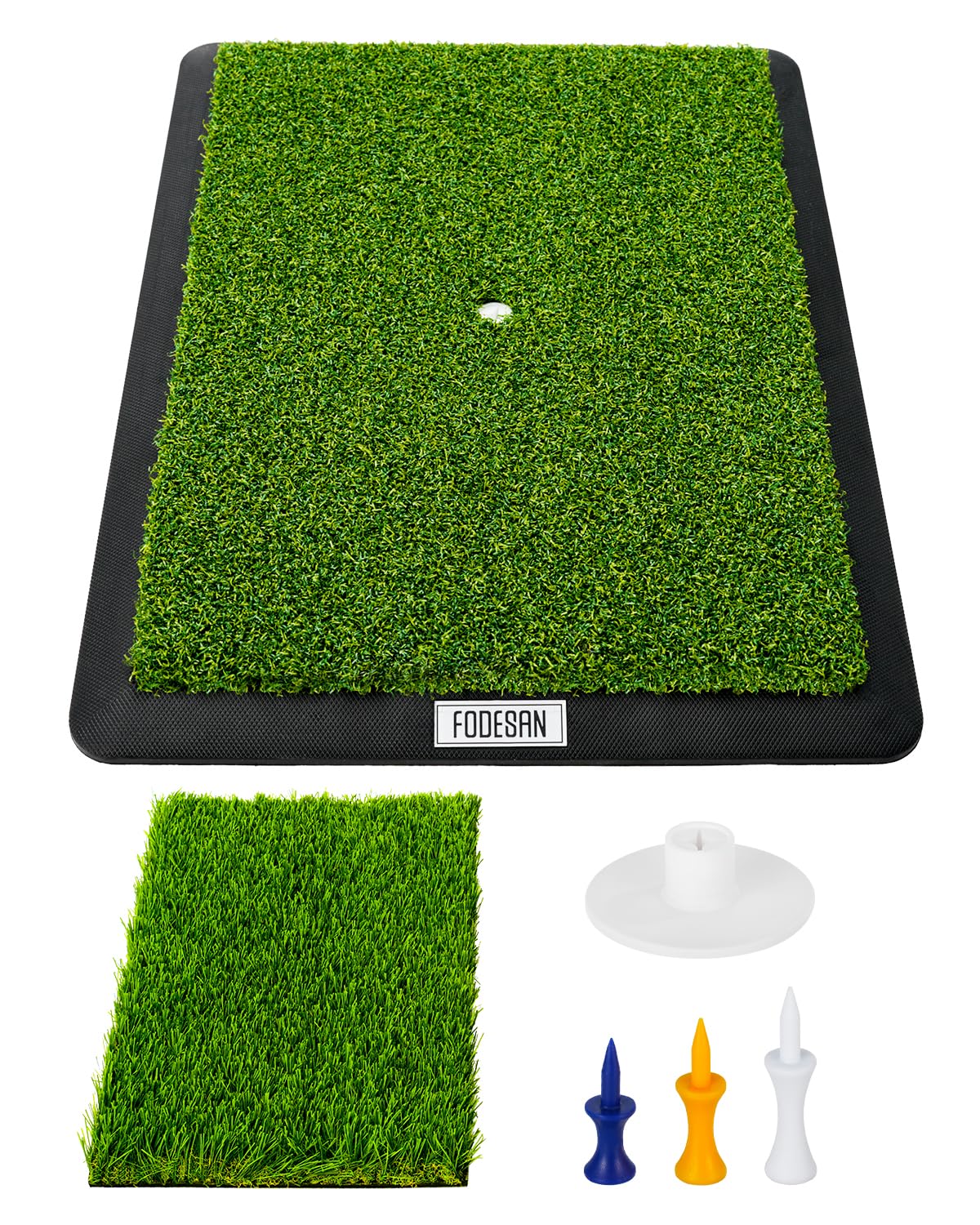
The FODESAN mat stands out for its dual replaceable turf pads—a feature usually reserved for mats costing three times as much. When the primary hitting surface wears down, you simply swap in the second pad instead of replacing the entire mat. That extends usable life dramatically, especially for golfers who practice chipping and iron strikes in tight spaces. The 13×17 inch footprint is purpose-built for chipping, putting, and swing-path drills, not for full swings.
Three adjustable rubber tees (37mm, 42mm, 51mm) let you vary the ball height between wedge, iron, and driver practice. The heavy rubber base stays put on tile, carpet, or concrete—critical for a small mat that could easily slide during impact. Some users noted the mat felt relatively light compared to larger models, and one reviewer described it as “flimsy” for aggressive swingers, though most agreed the feedback on fat vs. clean strikes was clear and helpful.
A two-month durability test showed zero visible wear on the turf fibers, suggesting the material holds up well for chipping-focused training. For golfers who want a portable mat they can keep in a truck bed for lunch-break practice or use in a small apartment, the replaceable turf pads make this one of the smartest value plays in the compact category. It’s not a full-range mat, but it excels at its intended use.
Why it’s great
- Dual replaceable turf pads dramatically extend usable mat lifespan
- Three adjustable tee heights accommodate wedge through driver practice
- Heavy rubber base grips well on multiple indoor surfaces
Good to know
- Compact 13×17 inch size limits practice to chipping and swing-path drills
- Lightweight construction may feel unstable for aggressive full-swing practice
FAQ
Will a thick golf mat damage my clubs or wrists?
How often should I replace the hitting zone on a golf practice mat?
Can I use a golf mat outdoors in direct sunlight?
Final Thoughts: The Verdict
For most users, the best golf practice mat winner is the Bltend 5x4ft Heavy-Duty Mat because its 36mm total thickness with 20mm EVA padding offers the best balance of joint protection, turf feedback, and surface area for the investment. If you want the longest-lasting nylon fiber and have a higher budget, grab the Dura-Pro Premium Turf Mat. And for portable short-game practice on a budget, nothing beats the FODESAN Precision Mat with its replaceable turf pads.