
Forgetting to factor in the morning fog or the subtle drop behind a bunker turns a well-struck iron into a frustrating chip. A reliable distance tool removes that guesswork, letting you commit to a club with real data instead of hope.
I’m Mohammad Maruf — the founder and writer behind Drink4Good. I’ve spent the last several seasons breaking down laser and GPS hardware, from slope algorithms to display refresh rates, to find which units justify their place in the bag.
Every shot deserves a number you can trust, and choosing the right unit means balancing speed, accuracy, and course coverage. This guide cuts through the noise to help you find the best golf rangefinder gps for your style of play.
How To Choose The Best Golf Rangefinder GPS
Whether you are choosing a pure GPS unit that gives you front, center, and back numbers in seconds, or a laser that requires a steady hand to lock onto a flag, the decision comes down to how you play and where you play. A GPS unit shines on the course with auto‑advancing holes and hazard overlays, while a laser gives you precise yardage to any object you can spot through the lens. Understanding the trade-offs between these two technologies is the first step.
Laser vs. GPS: Which Workflow Fits Your Round?
A laser rangefinder demands aim and a moment of stillness to get a reading. It gives you exact yardage to the pin, a tree, or a bunker edge, but you need a direct line of sight. A GPS unit, on the other hand, uses pre‑loaded course data to show distances without needing to see the flag. The trade-off is that GPS accuracy depends on the course map being updated and cannot give you a precise pin location on a blind shot. Many players now carry a hybrid approach—using GPS for quick green yardages and a laser when the pin is tucked behind a hazard.
Slope Compensation and Tournament Legality
Slope technology adjusts distance based on elevation change. Most premium and mid‑range lasers let you toggle this feature on and off, making the unit legal for tournament play. GPS units like the Bushnell Phantom 3 Slope integrate this adjustment into their yardage readout. If you compete in USGA or local league events, ensure the slope function can be disabled or the unit carries a tournament‑legal badge.
Battery Life and Power Source
Lasers typically run on a single CR2 lithium battery that can last a full season of regular play, while GPS units with full‑color screens need rechargeable lithium‑ion cells and offer between 14 and 18 hours of runtime. Some new hybrid‑charging lasers, like the ACEGMET PFS5, include both a USB‑C rechargeable battery and a CR2 backup, ensuring you never get stranded mid‑round.
Display Readability and Magnification
A laser with 6x or 7x magnification helps you lock onto a flag 200 yards out, but the quality of the optics and the brightness of the LCD matter just as much. Look for red/black dual‑display options if you play in varying light. GPS units rely on a clear touchscreen or dedicated front/center/back readout that must be readable in direct sunlight without glare.
Quick Comparison
On smaller screens, swipe sideways to see the full table.
| Model | Category | Best For | Key Spec | Amazon |
|---|---|---|---|---|
| Garmin Approach Z30 | Laser | Garmin ecosystem users | 400 yard range; 6X mag | Amazon |
| Garmin Approach Z82 | Laser + GPS | Pinpoint accuracy with course maps | 10 inch flag accuracy | Amazon |
| Bushnell Golf Tour V5 | Laser | Tour-level reliability | 1300 yard max; JOLT tech | Amazon |
| Bushnell Phantom 3 Slope | GPS | Quick green yardages | 38K+ courses; 14h battery | Amazon |
| REDTIGER GolfVue Series 2 | Laser | Adaptive display clarity | 1200 yard range; ±0.5 yard | Amazon |
| ACEGMET PFS5 | Laser | Dual power and Coach Mode | 450mAh USB-C + CR2 backup | Amazon |
| REDTIGER GolfVue Series 1 pro | Laser | Six measurement modes | 1200 yard max; 0.5 yard acc | Amazon |
| Gogogo Sport Vpro GS03 | Laser | Budget laser with slope switch | 1000 yard range; 6X mag | Amazon |
| Swami KISS 2.0 | GPS | Entry-level GPS with i-Caddie | 38K course maps; magnetic | Amazon |
In‑Depth Reviews
1. Garmin Approach Z30

The Garmin Z30 hits a 400‑yard max range with 6x magnification, but its real magic is the Range Relay feature. Once you lock the pin, the distance automatically pushes to a paired Garmin watch or the Garmin Golf app, so you never have to look away from your target to memorize the number.
The PlaysLike Distance function accounts for elevation change, and an external indicator light tells everyone on the tee that the unit is in tournament‑legal mode. The magnetic cart mount keeps it secure, and the IPX7 waterproof rating means it shrugs off a sudden downpour. The CR2 battery lasts up to a year with typical use.
If you already wear a Garmin watch or use club sensors, the Z30 is the clear premium choice. Without that ecosystem, you are still getting a fast, accurate laser with excellent edge‑to‑edge clarity, though the price is higher than comparable standalone options.
Why it’s great
- Seamless Range Relay to compatible devices
- Tournament‑legal mode with external indicator
- IPX7 waterproof rating
Good to know
- Requires Garmin ecosystem for full features
- Not a hybrid GPS unit
2. Garmin Approach Z82

The Z82 is the most accurate laser rangefinder on the consumer market, claiming ±10 inches of the actual flag position. It combines a full‑color 2D CourseView map from over 41,000 courses directly in the viewfinder, so you see bunker and hazard positions overlaid on your target.
Image stabilization steadies the reticle, making it easier to lock a flag at 450 yards. The Laser Range Arc draws a line on the course map at the ranging distance, helping you see every hazard at that same yardage. The IPX7 water protection is the same level as the Z30, and the battery typically lasts two rounds before needing a charge.
The biggest trade-offs are price and a slightly slower wake‑up time than some competitors. The unit also lacks a built‑in magnet, though a third‑party mount can solve that. For players who want both GPS context and laser precision in one device, the Z82 is unmatched.
Why it’s great
- Sub‑10 inch flag accuracy
- 2D CourseView overlay in viewfinder
- Image stabilization for steady target lock
Good to know
- No built‑in magnetic mount
- Battery lasts about 2 rounds
3. Bushnell Golf Tour V5

The Tour V5 is the unit most frequently seen on professional bags, with a 1,300‑yard max range and Pinseeker technology that uses both a vibrating pulse and a flashing red ring—what Bushnell calls Visual JOLT—to confirm the pin lock. It runs on a standard CR2 battery and measures 6 inches in length, fitting comfortably in most rangefinder slots.
Optics are excellent with true‑color clarity, and the BITE magnetic mount holds firm on cart bars even over bumpy terrain. The slope version allows you to toggle the function off for tournament play. Build quality is robust, though some users note that reflective tape on pins can improve lock consistency in certain lighting.
At this price point, you are paying for proven durability and tour trust. The main downsides are that the CR2 battery is not rechargeable and the warranty is only one year. For a mid‑handicap player who wants the same tool the pros use, the Tour V5 is a solid anchor choice.
Why it’s great
- Trusted by 99% of PGA Tour pros
- Visual and vibrating JOLT confirmation
- Strong BITE magnetic mount
Good to know
- CR2 battery is not rechargeable
- Limited 12-month warranty
4. Bushnell Phantom 3 Slope
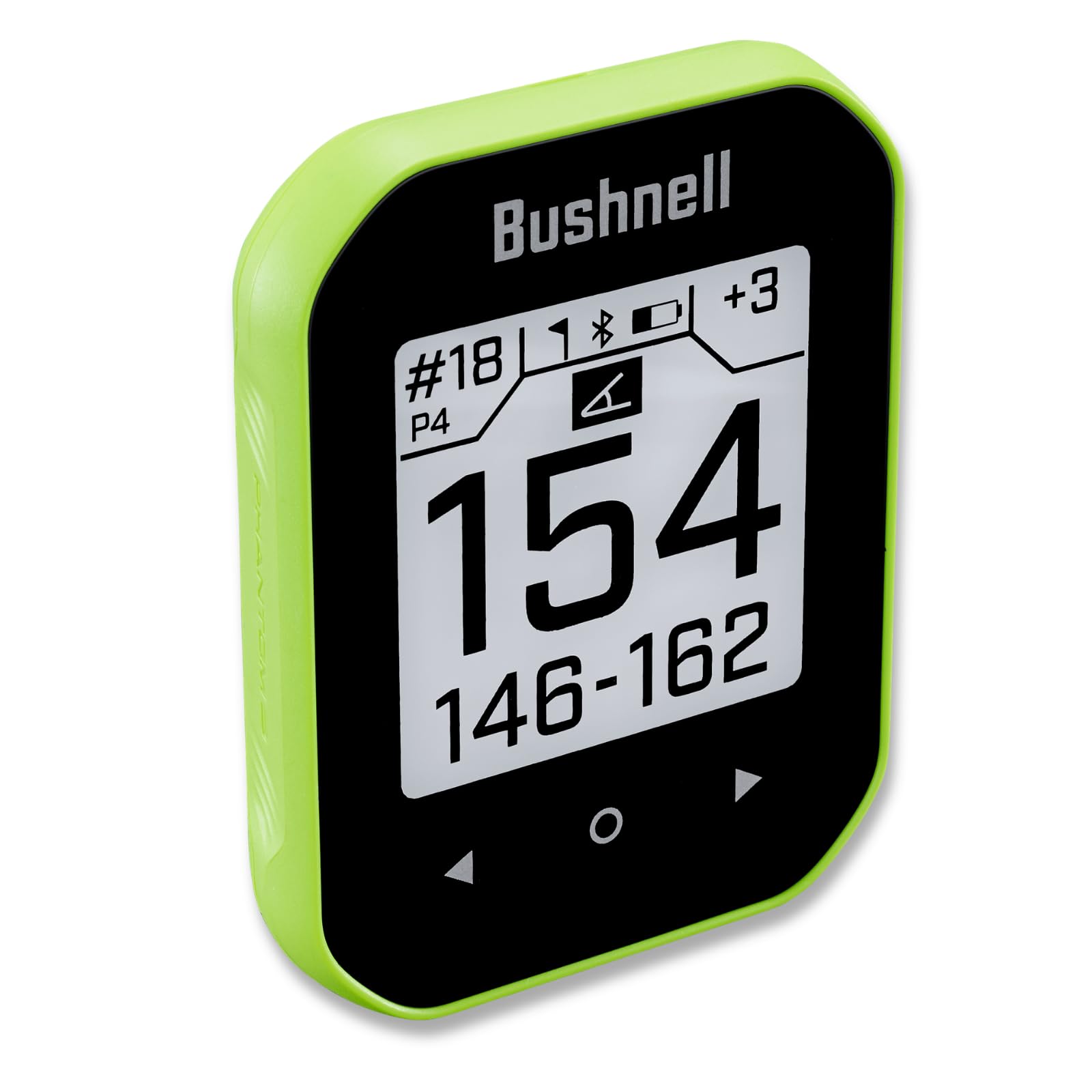
The Phantom 3 Slope is a pure GPS unit that gives you front, center, and back distances instantly without needing to aim a laser. It comes preloaded with over 38,000 courses and uses Bushnell Slope Technology to adjust yardages for uphill and downhill lies. The 2.99‑inch touchscreen is easy to navigate, though gloved swiping can be slightly finicky.
Auto course and hole recognition means you never have to fiddle with settings once you start your round. The 14‑hour battery life covers about four rounds, and the built‑in BITE magnet attaches to the cart or a push cart handle. It also syncs with the Bushnell Golf App via Bluetooth for hazard distances and shot tracking.
The Phantom 3 is ideal for players who want instant green distances without lifting the device to their eye. It will not give you exact distance to a specific tree or pin location, but for most approach shots, the front/center/back data is fast and reliable. The neon green color makes it easy to spot if left on the cart.
Why it’s great
- Instant front/center/back yardages
- Slope‑adjusted distances built in
- 14‑18 hour battery life
Good to know
- Touchscreen less responsive with gloves
- No laser ranging
5. REDTIGER GolfVue Series 2

The GolfVue Series 2 sets itself apart with a light‑adaptive display that automatically switches the reticle from black to red in low light, maintaining clarity whether you are playing a twilight nine or a midday round. It ranges 5 to 1,200 yards with ±0.5 yard accuracy and offers 7x magnification.
The slope switch is easy to toggle for tournament compliance, and the unit includes speed measurement, continuous scan mode, and flag lock with vibration feedback. The 1,000mAh USB-C rechargeable battery provides about 10 hours of continuous use, and the IP54 rating handles rain and dust without issue. A strong magnetic strip attaches the unit securely to the cart frame.
Some users report minor discrepancies on extreme slopes, but for general course play the accuracy tracks well with more expensive names. The aluminum‑finished body feels premium, and the included magnetic belt clip adds another carrying option. This is a strong contender for anyone who plays in changing light conditions and wants a laser with a long runtime.
Why it’s great
- Automatic reticle color adjustment for low light
- High‑capacity 1000mAh rechargeable battery
- ±0.5 yard accuracy
Good to know
- Slight accuracy drift on extreme slopes
- IP54 rating is splash resistant, not submersible
6. ACEGMET PFS5
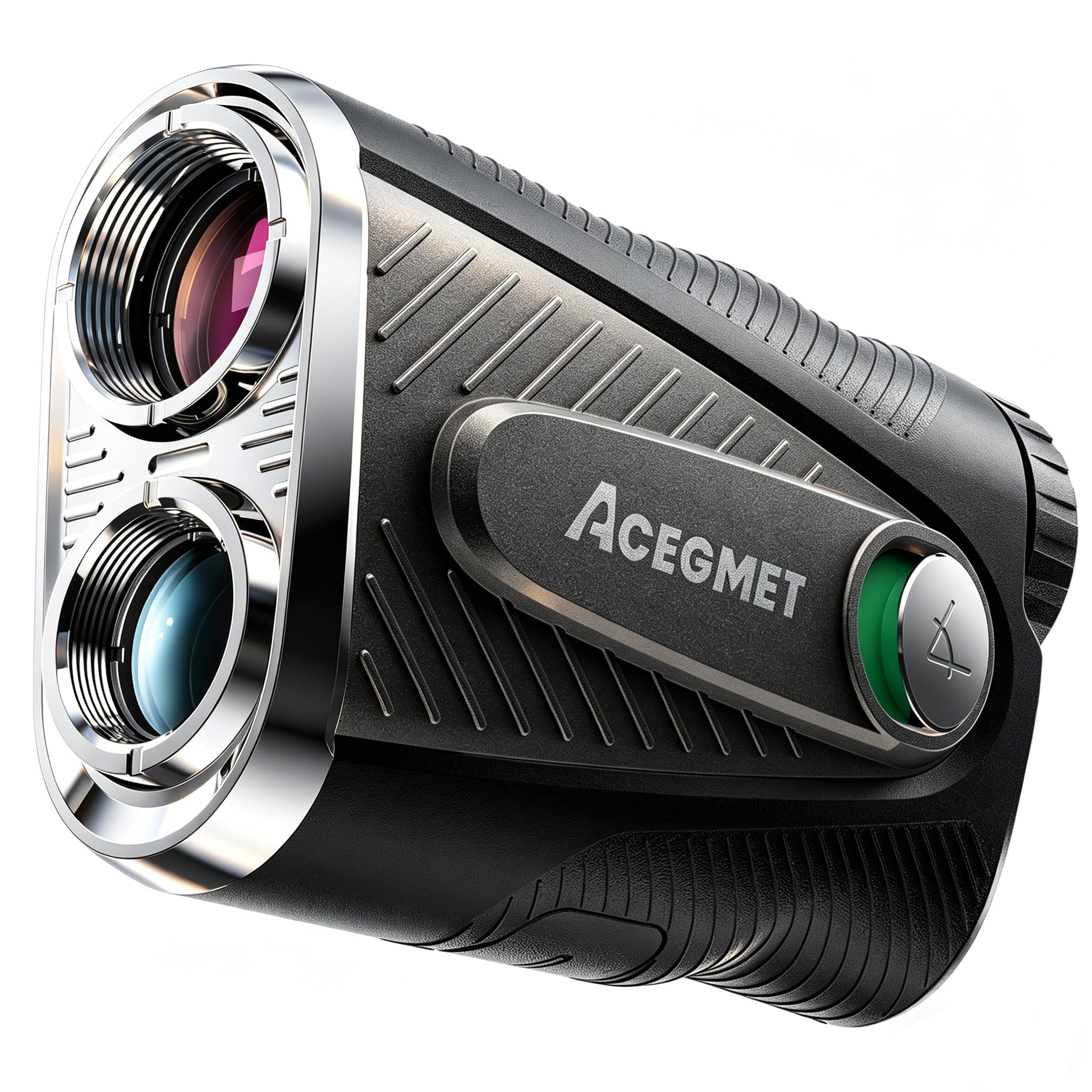
The PFS5 introduces a Coach Mode that measures the ball‑to‑pin distance without requiring you to stand next to your ball—using on‑course triangulation technology. It also features a patented EnviroSlope tech that considers temperature, humidity, and atmospheric pressure, not just elevation, to adjust yardages. The 7x magnification and dual red/black display keep information legible in any light.
The dual power supply is a standout feature: a 450mAh USB-C rechargeable battery that handles over 40,000 measurements per full charge, plus a CR2 backup battery that saves the round if the rechargeable runs dry. The unit ranges up to 1,300 yards and locks onto flags within 450 yards in about 0.1 seconds, with vibration and a red flash as confirmation.
Build quality feels premium for the price, with a non‑slip diamond‑textured grip and a 5,500 Gauss magnetic strip. The instructions are clear, but the Coach Mode requires a brief learning curve. For golfers who play varied courses with unpredictable elevation and weather, the PFS5 offers environmental compensation you rarely see at this tier.
Why it’s great
- Coach Mode triangulates distance from the cart
- Dual USB-C and CR2 power backup
- EnviroSlope accounts for humidity and pressure
Good to know
- Coach Mode has a learning curve
- Flag lock can be inconsistent on uphill targets
7. REDTIGER GolfVue Series 1 pro

The Series 1 pro from REDTIGER packs six measurement modes—slope compensation, golf flag locking, horizontal distance, height ranging, speed measurement, and continuous scan—all accessible with a single button press. It ranges 5 to 1,200 yards and claims ±0.5 yard accuracy with a transflective LCD that stays readable in bright sun.
The built-in magnetic stripe and included magnetic belt clip ensure you never have to dig through your bag for the unit. USB-C charging with a battery level indicator is included, and the IP54 waterproof rating covers unexpected rain. The 7x magnification is crisp for a unit in this range, and the flag lock vibration gives immediate feedback.
Some users note that readings can vary by 2–3 yards between shots, requiring a second or third sample for confidence. The build feels sturdy with an ABS and plastic exterior, and the 2‑year unconditional warranty provides peace of mind. This is a versatile option for players who want multiple measurement modes without jumping to a premium price.
Why it’s great
- Six measurement modes in one device
- USB-C rechargeable with level indicator
- 2‑year unconditional warranty
Good to know
- Readings can vary by 2–3 yards
- Transflective LCD can be dim in low light
8. Gogogo Sport Vpro GS03

It uses a standard CR2 battery that is replaceable on the course, and the slope function can be turned off for tournament play. The 6x magnification is sufficient for most approach shots, and the built‑in magnet attaches securely to cart frames.
Users report the laser matches distances from Bushnell and Sky Caddy units within a yard. The IP54 rating means it handles light rain, and the included carrying case and cleaning cloth give you a complete package out of the box. The manual focus ring takes a few adjustments per round, but the clarity is solid for the price.
The GS03 is a reliable entry point for golfers who are not sure they want to commit to a high‑end laser. The biggest trade-offs are the lack of a rechargeable battery and the need to adjust the diopter ring multiple times per round. For the price, however, it offers the core essentials of a good golf laser without the premium markup.
Why it’s great
- Replaceable CR2 battery
- Slope switch for tournament compliance
- Matches premium laser accuracy
Good to know
- Manual focus ring needs several adjustments
- No rechargeable battery
9. Swami KISS 2.0

The Swami KISS 2.0 is a dedicated GPS unit that comes preloaded with over 38,000 course maps and uses i-Caddie technology to offer personalized club suggestions based on your distance to the target. It weighs only 0.25 pounds, making it one of the lightest options available, with a powerful rear magnet that sticks firmly to cart frames.
The display offers two readout modes: a standard front/center/back view or a simplified mode that shows the center of the green with distances to front and back on the next screen. The device is water and fog resistant, and it charges via a universal micro USB port. The scorecard tracker records GIR and PPR stats as you play.
The main limitation is that it only recognizes 9 holes at a time, requiring a manual reset when you turn to the back nine. The auto‑advance between holes works well, and the large numbers on the display are easy to read without reading glasses. This is a great entry‑level GPS for casual golfers who want quick distances without learning a complex interface.
Why it’s great
- Ultra‑light at 0.25 pounds
- 38K course maps preloaded
- i-Caddie club suggestions
Good to know
- Only recognizes 9 holes at a time
- Micro USB charging (not USB-C)
FAQ
Can I use a rangefinder with slope in tournament play?
How does a GPS unit work without a line of sight to the flag?
Final Thoughts: The Verdict
For most users, the golf rangefinder gps winner is the Bushnell Phantom 3 Slope because it delivers instant front/center/back distances with slope adjustment and a 14‑hour battery life, making it the fastest option for green yardages without sacrificing accuracy. If you want the ecosystem integration of laser ranging with your watch, grab the Garmin Approach Z30. And for a feature‑packed laser with dual power backup and environmental slope compensation, nothing beats the ACEGMET PFS5.