
Converting a cold, unfinished basement into a dedicated indoor golf bay is one of the most rewarding upgrades a golfer can make. But building that space requires more than just a hitting net—it demands a careful balance of accurate launch data, a durable enclosure, and a projector-ready impact screen that doesn’t tear after a few hundred swings.
I’m Mohammad Maruf — the founder and writer behind Drink4Good. I analyze months of market data, customer durability reports, and hardware specifications to identify which products deliver the most reliable performance per dollar in this specialized category.
After researching dozens of models, these are the setups that actually hold up to real ball speeds, tight ceilings, and consistent indoor practice. Keep scrolling for a detailed breakdown of every golf simulator for basement that earned a spot on this list.
How To Choose The Best Golf Simulator For Basement
Building a basement simulator is different from setting one up in a garage or spare room. Ceiling height, ambient light, and ball-containment safety are all non-negotiable considerations. Here are the three specifications that separate a frustrated setup from a long-term training space.
Ceiling Clearance and Swing Arc
Most basement ceilings sit at eight or nine feet. A standard driver swing requires a minimum of nine feet of clearance, while irons and wedges can work with as little as eight. Before buying any enclosure, measure from the floor to the lowest obstruction—ductwork, light fixtures, or piping. Launch monitors that measure club path and attack angle become far more valuable in a space where you cannot see the ball flight.
Screen Durability and Bounce-Back
In a confined basement, a screen that allows significant bounce-back is dangerous and frustrating. Look for dual-layer or triple-layer impact screens made from woven polyester with a smooth projector-facing surface. Enclosures that tension the screen separately from the safety netting reduce rebound energy by as much as 50 percent, which protects both your drywall and your backswing.
Launch Monitor Accuracy in Low Light
Basement setups often have inconsistent lighting. Doppler radar units and photometric camera systems each behave differently in dim conditions. If you plan to practice after dark, choose a monitor with an internal barometer or one that uses reflective markers to maintain spin-rate accuracy even when ambient light drops. A unit that requires direct sunlight to function will disappoint in a basement.
Quick Comparison
On smaller screens, swipe sideways to see the full table.
| Model | Category | Best For | Key Spec | Amazon |
|---|---|---|---|---|
| Garmin Approach R50 | Launch Monitor | Premium accuracy & built-in screen | 3-camera optical system | Amazon |
| GoSports Sim Bay Enclosure | Enclosure Kit | True blackout & low rebound | 10×8 ft commercial frame | Amazon |
| GoSports Range Cage Elite | Enclosure Kit | Value cage with offset screen | 8×8 ft woven polyester screen | Amazon |
| Rapsodo MLM2PRO | Launch Monitor | 13 metrics on a mid-range budget | Spin axis & club path data | Amazon |
| ZEALFEEL 11×8 Enclosure | Enclosure Kit | Large hitting area & side nets | 118×88 inch 4:3 dual-layer screen | Amazon |
| Net Return Home/Pro Series | Practice Net | Quick setup & auto ball return | S-shape return, 240 mph rated | Amazon |
| Diandian 10×8 Enclosure | Enclosure Kit | 4K-ready screen & full blackout | 600D Oxford double-layer screen | Amazon |
| ANYTHING SPORTS 11×8 Enclosure | Enclosure Kit | Complete kit with projector mount | 4K-ready impact screen included | Amazon |
| Durbles 10×8 Enclosure | Enclosure Kit | Triple-layer screen & heavy padding | 3-layer commercial impact screen | Amazon |
| YUNIC Golf Driving Cage | Driving Cage | Budget cage with hitting mat | 8x8x5 ft alloy steel frame | Amazon |
| Izzo Swami Launch Pro | Launch Monitor | Entry-level doppler radar unit | 30–420 yard measuring range | Amazon |
In‑Depth Reviews
1. Garmin Approach R50

The Garmin Approach R50 sits at the top of the launch-monitor food chain for a basement setup. Its three-camera optical system captures face-to-path data, spin axis, and club delivery without requiring reflective stickers on the ball (though a club-face sticker is needed for face-to-path). The built-in 10-inch touchscreen eliminates the need for a separate tablet or phone, which is a huge space-saver when your hitting bay is tight.
With 43,000 courses available through Home Tee Hero and a training mode that tracks club-by-club dispersion, this unit handles both simulation and practice equally well. The internal barometer adjusts carry distance for your specific altitude, and the HDMI output connects directly to a projector for a full-wall display. Battery life hits four hours, so you can pack it to the range when weather cooperates.
Left-handed users may find the side-mounted camera position slightly awkward, and the premium price reflects commercial-grade hardware. But for a basement simulator where accuracy and an all-in-one design matter most, the R50 delivers the most polished experience available.
Why it’s great
- Built-in screen means no phone or tablet required during practice sessions.
- Camera-based spin readings remain accurate in low basement light.
- HDMI-out lets you project directly onto an impact screen without adapters.
Good to know
- Side camera placement creates a less natural setup for left-handed golfers.
- Golf membership subscription required for full course simulation access.
2. GoSports Golf Simulator Enclosure (Sim Bay)

The GoSports Sim Bay enclosure is engineered for golfers who want a true blackout environment in a basement. The enclosure panels undergo a specialized dyeing process that blocks nearly all outside light, which dramatically improves the contrast of any projector image. The commercial-grade heavy-duty impact screen uses a multi-layer construction that reduces rebound while providing a smooth surface for launch monitor projection.
Assembly is remarkably straightforward thanks to numbered poles and a quick-install hardware system—most users report a one-hour build time from unboxing to first swing. The frame itself feels slightly flexible before the cover and screen are installed, but once tensioned, the entire structure becomes rock-solid. The minimized rebounding feature is a genuine safety upgrade, especially when your basement walls are close to the hitting area.
Some users note that the included padding around the frame could be thicker—mishits near the edges can still ricochet. Replacement screens are available separately, but the stock screen holds up well against thousands of hits from drivers and irons alike.
Why it’s great
- True blackout dye process eliminates light bleed for superior projector clarity.
- Multi-layer screen reduces dangerous bounce-back in confined spaces.
- Numbered pole system makes tool-free assembly quick and frustration-free.
Good to know
- Frame feels flimsy until the cover and screen are fully tensioned.
- Side shank nets are not included and must be purchased separately.
3. GoSports Range Cage Elite
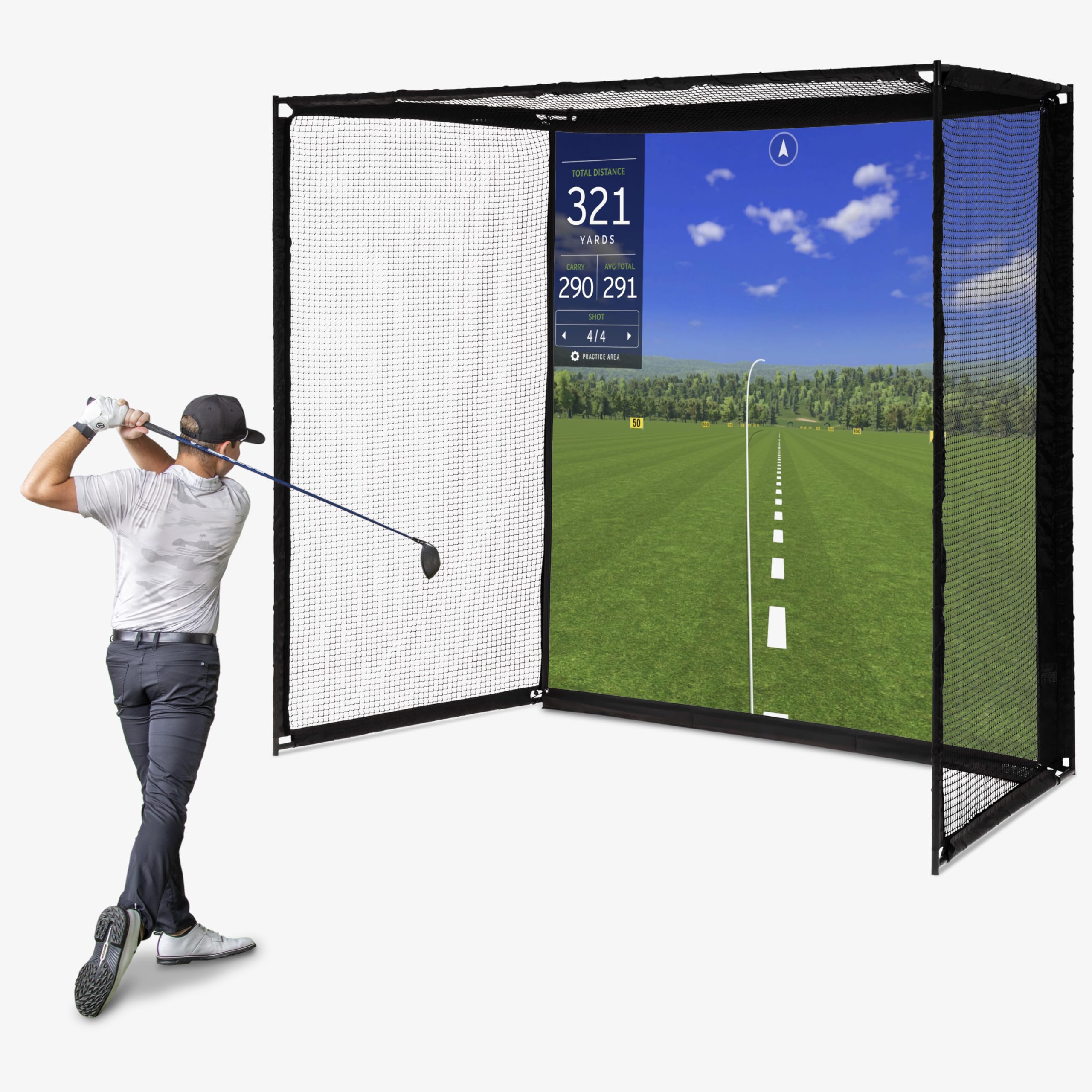
The Range Cage Elite takes a different approach to containment: instead of mounting the impact screen directly on the frame, it attaches the screen in front of the netting. This offset design minimizes ricochet because the screen absorbs the initial impact while the netting catches any balls that punch through. The 8-by-8-foot screen area fits comfortably in most basements with a nine-foot ceiling.
The frame itself is built from powder-coated steel and took most users about 30 minutes to assemble alone. The HD woven polyester screen provides a clean image for projectors, and the cage enclosure prevents shanks and sky-balls from reaching your basement walls. It works with all major launch monitors, including the Rapsodo MLM2PRO and Garmin R10.
A few customers reported screen tearing near the bottom after several hundred hits, particularly from wedge shots. The six-month warranty covers defects, but heavy users may want to budget for a replacement screen down the line.
Why it’s great
- Offset screen separates impact surface from netting to reduce bounce-back.
- Powder-coated steel frame provides a stable, permanent setup solution.
- Under one-hour solo assembly with clear instructions.
Good to know
- Some users experienced screen tearing at the bottom after heavy wedge use.
- Warranty covers only six months from the date of delivery.
4. Rapsodo MLM2PRO
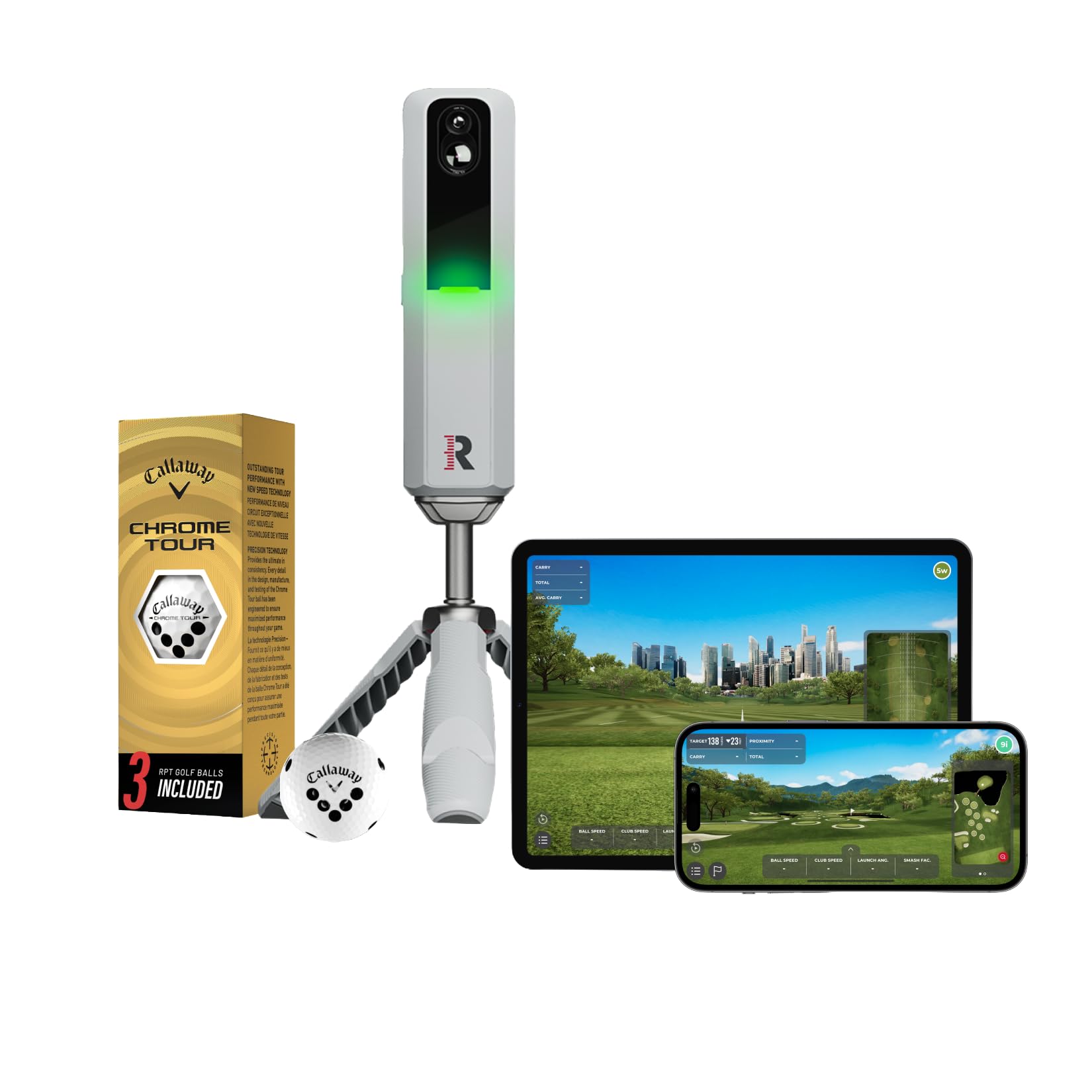
The Rapsodo MLM2PRO bridges the gap between affordable launch monitors and pro-level units by measuring 13 core metrics, including spin axis and club speed. It uses a combination of Doppler radar and camera-based tracking, which means it requires the included Callaway RPT marked balls for spin readings. In a basement environment, the MLM2PRO pairs with Awesome Golf or E6 Connect to deliver full simulation through a smartphone or tablet.
Users consistently report that the data aligns within two to three percent of a TrackMan when the unit is properly leveled and aligned. The built-in slow-motion impact video provides immediate visual feedback on strike location and face angle—a feature that is rare at this price point. The carrying case and tripod make it easy to store when not in use.
Connectivity can be finicky: the unit requires a direct WiFi connection to the device, and some users experience session-ending drops. Short chips under six feet are not reliably read, and the subscription model (including an optional lifetime membership) adds recurring cost.
Why it’s great
- Thirteen data points including spin axis and face-to-path at a mid-range price.
- Impact video feature helps diagnose strike location and club delivery.
- Portable design stores easily when the basement needs to serve other purposes.
Good to know
- Requires specific marked balls for accurate spin measurements.
- WiFi connection drops can interrupt a virtual round mid-swing.
5. ZEALFEEL 11×8 Enclosure
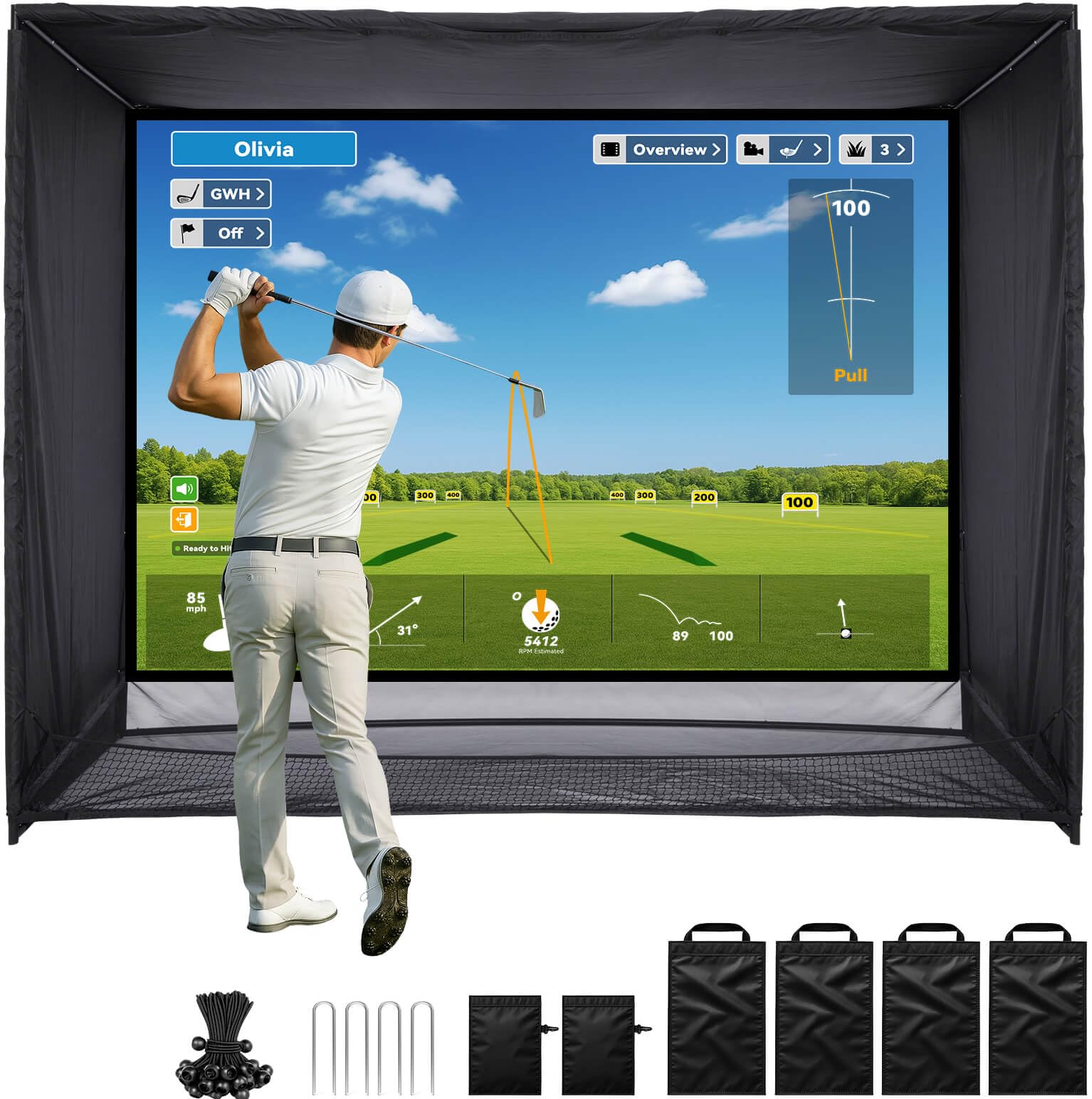
The ZEALFEEL enclosure offers an 11-by-8-foot impact screen with a 4:3 aspect ratio that works perfectly with most golf simulation software. The dual-layer screen combines a smooth projector surface with a rear impact-absorbing layer to reduce noise and bounce-back. Side barriers and ground nets catch errant shots that miss the screen entirely, which is critical when your basement doubles as a family room.
One standout feature is the sloped bottom design that automatically rolls balls back toward the hitting area. This reduces the number of times you must walk to the screen to retrieve a ball, keeping practice sessions more fluid. The kit includes sandbags and ground stakes for stability, plus bungee cords that tension the screen evenly across the frame.
Build quality is mixed: the frame uses powder-coated steel that feels sturdy, but some users report that the side netting can tear if catch a mis-hit at an awkward angle. The impact screen itself holds up well to driver-speed shots, but wedge balls with high spin can leave visible marks that require occasional cleaning.
Why it’s great
- Sloped bottom returns balls automatically without reaching into the net.
- Large 11×8 screen fills most basement walls for an immersive experience.
- Side barriers capture shanks and protect walls and furniture.
Good to know
- Side netting can tear if mis-hits catch the mesh at high speed.
- Outdoor use requires caution—frame brackets can bend in strong wind.
6. Net Return Home/Pro Series

The Net Return is the most established name in hitting nets, and the Home/Pro Series justifies its reputation with an S-shape return system that delivers the ball back to your feet on nearly every center strike. The aircraft-grade aluminum frame is surprisingly lightweight yet rated to handle ball speeds exceeding 240 mph—enough for tour-level swing speeds. Assembly takes five minutes with the color-coded push-button system and requires zero tools.
This net excels in a basement where you want the flexibility to break down and store the setup between sessions. The quiet impact absorption is noticeably better than cheaper nets, and the UV-shielded netting resists degradation even if your basement has windows. Pairing it with a launch monitor is straightforward; many users combine this net with a Rapsodo or Garmin unit for a complete simulator.
The 7-by-7-foot hitting area is smaller than a full enclosure, so wedge shots need to be aimed carefully to stay on the net. The frame can dent if struck directly, though it continues to function without issue. This is a premium practice net, not a full simulator enclosure, so it lacks side barriers and a projector screen.
Why it’s great
- Industry-leading 250,000-shot guarantee and three-year warranty.
- Five-minute tool-free assembly with a color-coded connection system.
- Auto ball return keeps practice sessions fluid without constant retrieval.
Good to know
- Seven-foot hitting area requires accurate aim, especially with wedges.
- Frame can dent if the ball strikes the metal instead of the netting.
7. Diandian 10×8 Enclosure
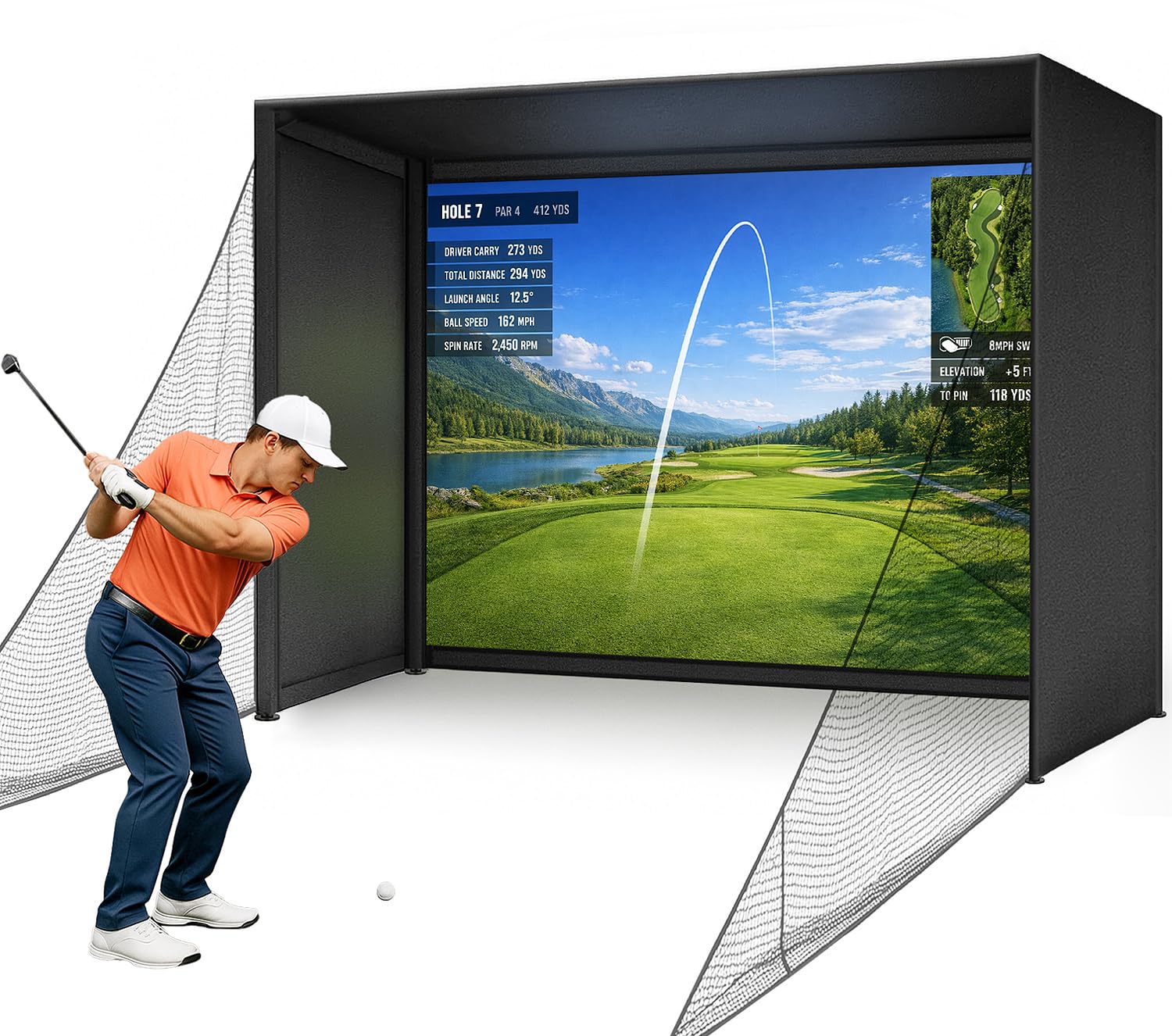
The Diandian enclosure punches above its price point with a 600D Oxford blackout cover that wraps fully around the top, sides, and back of the frame. This complete enclosure blocks ambient light more effectively than many competitors that leave the back exposed. The dual-layer 4K-ready impact screen delivers crisp visuals with a matte finish that minimizes projector glare, and the easy-to-clean surface resists ball marks better than standard polyester screens.
Assembly requires no tools—the click-lock frame design and push-pin connections allow a solo user to complete the build in around 30 minutes. The foam edge padding is thicker than what comes with most kits in this range, and it significantly reduces the noise of a ball hitting the frame. Multiple users note that the screen produces noticeably less bounce-back than the GoSports Elite, making it a safer choice for tight basements.
Long-term durability is the primary concern: a few customers report that the bottom stitching of the screen tore after several weeks of use. The one-year manufacturer warranty provides some coverage, but replacement screens require a separate purchase.
Why it’s great
- Full 600D Oxford blackout cover eliminates ambient light for projector clarity.
- Dual-layer 4K-ready screen delivers crisp visuals with minimal bounce-back.
- Tool-free click-lock assembly takes about 30 minutes solo.
Good to know
- Screen stitching can fail at the bottom after several hundred swings.
- Projector, launch monitor, and hitting mat must be purchased separately.
8. ANYTHING SPORTS 11×8 Enclosure
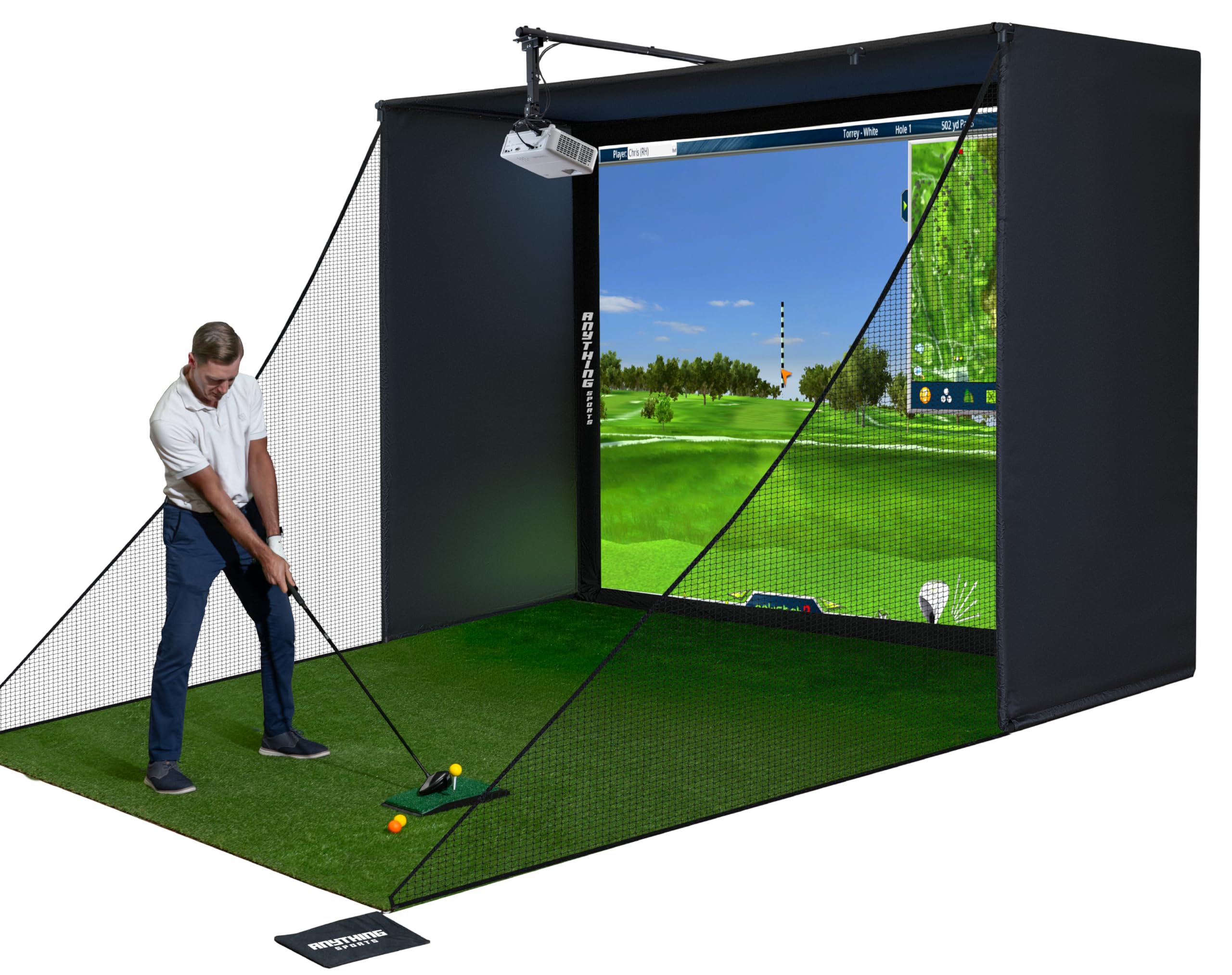
The ANYTHING SPORTS enclosure stands out because it includes a projector mount in the box, saving buyers the hassle of sourcing a separate ceiling mount that fits their frame. The 11-by-8-foot 4K-ready impact screen is precision-sized to fit just one inch smaller than the frame, which minimizes light bleed around the edges. The screen uses a rubbery, soft material that absorbs impact quietly and shows minimal sagging over time.
The frame is built from sturdy metal poles that lock together without tools, though the included instructions are sparse and rely heavily on pictures. Side barrier nets with weighted bags are included, and a black tarp behind the screen reduces light bleed from any room lights behind the enclosure. The 12-month no-questions-asked warranty adds confidence for a purchase in this price tier.
Some users report that the bungee cords are difficult to tension evenly, and the screen can produce significant bounce-back during the first few sessions until it stretches slightly. The projector mount extends about 12 inches, which works well for most short-throw projectors but may not reach for standard throw models.
Why it’s great
- Includes a projector mount, saving cost and installation guesswork.
- Screen is precision-sized to the frame, minimizing light bleed around edges.
- 12-month no-questions-asked warranty from a U.S.-based company.
Good to know
- Assembly instructions are picture-only and may be confusing the first time.
- Bounce-back is noticeable initially until the screen material settles.
9. Durbles 10×8 Enclosure
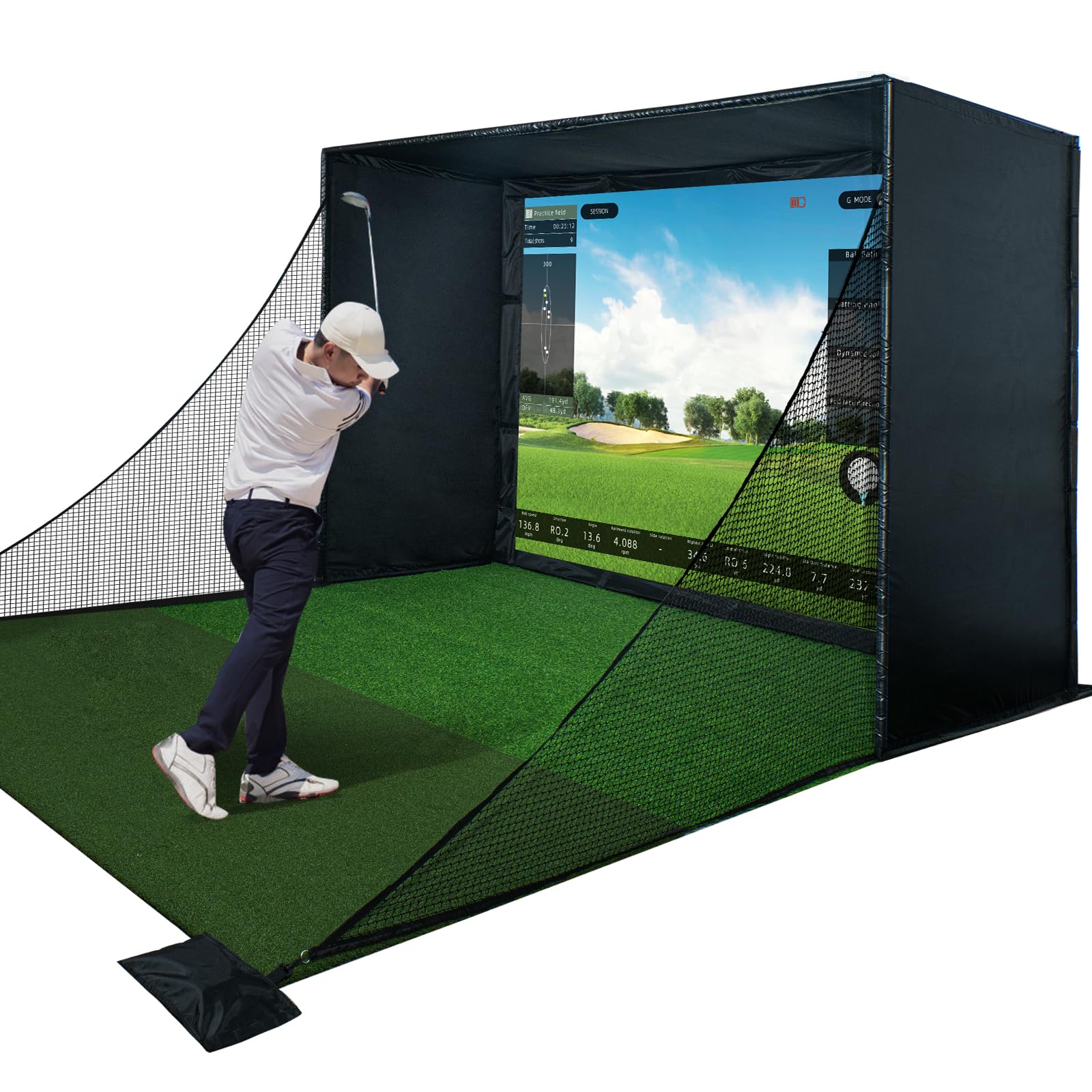
Durbles takes screen durability seriously with a triple-layer commercial-grade impact screen that absorbs shock and reduces sound more effectively than single or dual-layer alternatives. The screen material is noticeably thicker than what comes with most kits at this price, and it holds up to fast ball speeds without sagging or tearing. The full-coverage foam padding around the frame reduces ricochets by a claimed 50 percent, which is a real safety feature in a confined basement.
The enclosure includes a heavy blackout curtain that wraps the entire frame, blocking ambient light for a more immersive projection experience. Setup is tool-free, and the steel frame is powder-coated to resist rust and scratches. The kit works with most launch monitors and projectors on the market, making it a flexible foundation for a custom build.
A few users note that some pipe ends were not flared enough, making frame assembly slightly more difficult than expected. The bounce-back off the triple-layer screen is less than most competitors, but not eliminated entirely—wedge shots still rebound a foot or two.
Why it’s great
- Triple-layer construction dramatically reduces sound and screen wear over time.
- Thick foam padding around the frame minimizes dangerous ricochets.
- Full blackout curtain blocks ambient light for a clear projection image.
Good to know
- Some pipe ends fit tightly and require extra force to connect during assembly.
- Wedge shots still produce moderate bounce-back despite the padding.
10. YUNIC Golf Driving Cage
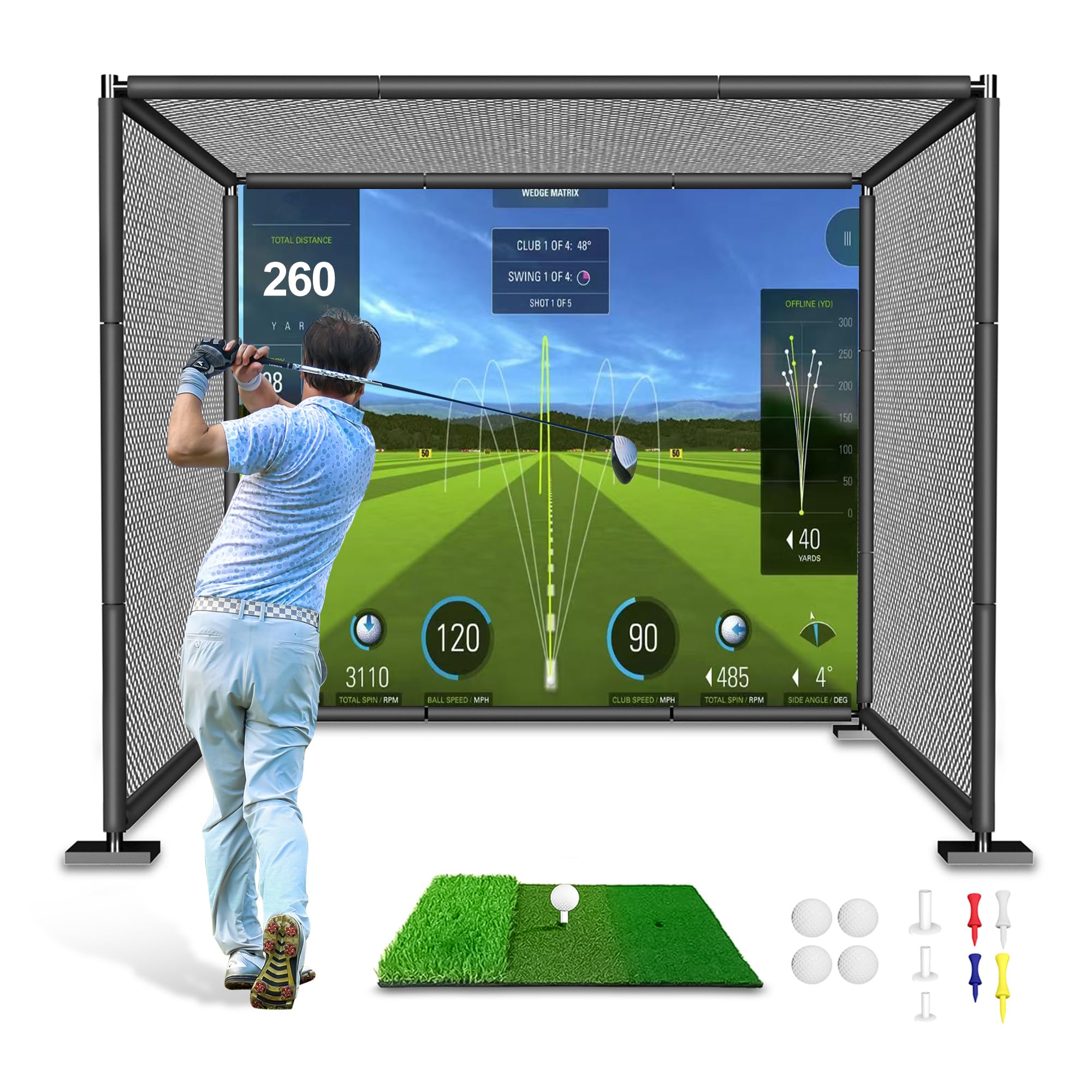
The YUNIC cage offers an entry point into basement golf practice without a four-figure investment. The 8-by-8-by-5-foot alloy steel frame is foam-padded to protect both the structure and any stray balls, and the three-layer netting system (outer net, inner net, and target cloth) ensures that no ball escapes. The kit includes a tri-turf hitting mat and rubber tees, which saves the cost of buying these separately.
Assembly is straightforward but the instructions are sparse—the unlabeled pipes require a bit of trial and error to sort. Once together, the cage feels sturdy and the foam padding absorbs impact well. Customers consistently praise the included accessories, noting that the hitting mat alone justifies a portion of the cost.
This is a cage, not a full simulator enclosure, so there is no projector screen. You can add a DIY impact screen and use it with a launch monitor, but the netting does not double as a projection surface. The frame is rated for permanent indoor use, but some users have modified it with custom canvas and a separate projector screen for a more complete setup.
Why it’s great
- Includes a tri-turf hitting mat, rubber tees, and practice balls out of the box.
- Three-layer netting system provides excellent ball containment and safety.
- Foam padding on the steel frame protects clubs and walls from impacts.
Good to know
- Assembly instructions are unclear due to unlabeled frame pipes.
- Netting is not a projection surface—a separate screen is needed for simulation.
11. Izzo Swami Launch Pro

The Izzo Swami Launch Pro brings Doppler radar tracking to a budget-friendly form factor, measuring total distance, carry, swing speed, ball speed, smash factor, launch angle, attack angle, spin rate, and apex. The measuring range of 30 to 420 yards covers everything from a chip shot to a driver, and the integrated weather sensors automatically adjust for temperature, humidity, and altitude.
Setup is genuinely plug-and-play: place the unit six to eight feet behind the ball, align it with your target, and start swinging. The voice readout provides immediate feedback on each shot without needing to glance at a phone screen. The slim 10.5-by-9-inch profile takes up minimal floor space in a basement corner.
Accuracy is the trade-off. Multiple users report that distance readings are off by about ten yards compared to range-based launch monitors, and the unit tends to read five to ten yards longer than a TopTracer system. It lacks data recording and longer club name customization, so it is better suited for real-time feedback than detailed session analysis.
Why it’s great
- Measures nine key metrics including attack angle and smash factor at a low cost.
- Integrated weather sensors adjust for temperature and altitude automatically.
- Voice readout provides immediate feedback without checking a screen.
Good to know
- Distance readings can be off by 10 yards compared to more expensive units.
- No on-board data recording or detailed session log for long-term analysis.
FAQ
What ceiling height do I need for a driver swing in a basement simulator?
Do I need a dedicated projector or can I use a regular TV for basement simulation?
How much space do I need behind the hitting area for a launch monitor?
Final Thoughts: The Verdict
For most users, the golf simulator for basement winner is the Garmin Approach R50 because it combines a built-in display, three-camera precision, and HDMI output into a single unit that does not require a phone or tablet to operate. If you want a true blackout enclosure with commercial-grade durability, grab the GoSports Sim Bay Enclosure. And for a budget-friendly entry point that still delivers nine data metrics and voice feedback, nothing beats the Izzo Swami Launch Pro.