
Dialing in a golf swing from a living room or backyard demands more than over-the-counter help — the feedback needs to be immediate and mechanically honest. You need training aids that cut through the noise, exposing a flippy release or an open face before those bad habits cement themselves on the course.
I’m Mohammad Maruf — the founder and writer behind Drink4Good. I spend my time parsing through hundreds of user-testing logs and spec sheets every season to isolate which golf training aids actually deliver transferable results rather than gimmicky promises.
A well-chosen set of training tools can bridge the gap between the range and the first tee box, and this curated selection of the best golf training aids focuses on those that provide actionable feedback on face angle, swing tempo, and alignment without requiring a coach at your side.
How To Choose The Best Golf Training Aids
The golf training aid market is flooded with gadgets that promise a single-digit handicap in a week. The real winners are those that give you honest data — whether that data is a swing speed number, a misaligned shoulder reflection, or a ball that veers offline because your face was two degrees open.
Prioritize Immediate Feedback Over Flashy Design
A training aid must tell you instantly whether you did something right or wrong. The PuttOUT Devil Ball works because it makes a bad putt roll drastically offline — you feel the miss. The Voice Caddie launch monitor speaks a swing speed number aloud the second you swing, even without a ball. Avoid aids that require a second device or a video replay to understand the result.
Match the Aid to Your Weakest Area
If three-putts are destroying your score, invest in a putting mirror or gate system like the EyeLine Golf Mirror or the WHYGOLF Putting System — these fix setup and stroke path. If you lose distance or struggle with tempo, a weighted swing stick like the Callaway Lag Trainer or the Amazon Basics Swing Trainer builds muscle memory for a proper release. A launch monitor such as the Voice Caddie SC200 Plus is best for verifying carry distances and club gapping.
Check Portability and Storage Requirements
Some aids, like the YOUCZON Putting Green, are excellent for home practice but require floor space for a 10-foot mat. Others, like the PuttOUT Devil Ball or the Callaway Swing Stick, slip into a golf bag pocket and go to the practice green or range with you. Know where you’ll be training most — a compact aid you actually use is better than a simulator you have to unpack each session.
Quick Comparison
On smaller screens, swipe sideways to see the full table.
| Model | Category | Best For | Key Spec | Amazon |
|---|---|---|---|---|
| Voice Caddie SC200 Plus | Launch Monitor | Real-time swing speed & distance | Doppler radar; 20hr battery | Amazon |
| WHYGOLF Putting System | Putting Trainer | Putter face & ball path alignment | Adjustable gates; 1/16″ thick | Amazon |
| EyeLine Golf Alignment Mirror | Putting Mirror | Setup & shoulder alignment | Dual mirrors; 23.25″ length | Amazon |
| YOUCZON Putting Green Mat | Putting Mat | Indoor home practice with return | 10ft crystal velvet; auto return | Amazon |
| Callaway Swing Stick Lag Trainer | Swing Trainer | Lag, tempo & warm-up | 37.5″ length; weighted flex | Amazon |
| PuttOUT Devil Ball | Putting Feedback | Face angle control at impact | 3 difficulty levels; flat edge | Amazon |
| Amazon Basics Swing Trainer | Swing Trainer | Warm-up & tempo on a budget | 48″ length; 0.5lb weighted head | Amazon |
In‑Depth Reviews
1. Voice Caddie SC200 Plus Launch Monitor

The Voice Caddie SC200 Plus uses Doppler radar technology to measure swing speed and ball speed, then estimates carry distance based on your selected club loft. You can swing without a ball using the Swing Speed mode, making it one of the few mid-range launch monitors that works on a mat in your garage. The LCD display and voice output give you spoken feedback instantly — no app or phone pairing required.
It stores shot data and average distances for each club, which is useful for tracking gapping over several practice sessions. The battery lasts up to 20 hours per charge, so you won’t be hunting for a cable mid-session. The unit is lightweight at 8 ounces and fits into most golf bags, though it lacks a protective case. Loft angle adjustments are available for simulating different clubs, and you can even use the approach mode for short-game work.
Some users report accuracy issues with wedge distances, and a rare defective unit may produce inconsistent readings. But for a consumer-level monitor, the consistency across driver through 7-iron is strong enough to guide club selection. It works indoors and outdoors, and the lack of subscription fees makes it a premium but one-time investment for serious swing analysis.
Why it’s great
- Instant voice feedback and bright display
- Ball-less swing speed mode for tempo work
- Compact design fits in a golf bag
Good to know
- No rechargeable battery included
- Short wedge distances can read a few yards off
2. WHYGOLF Putting System
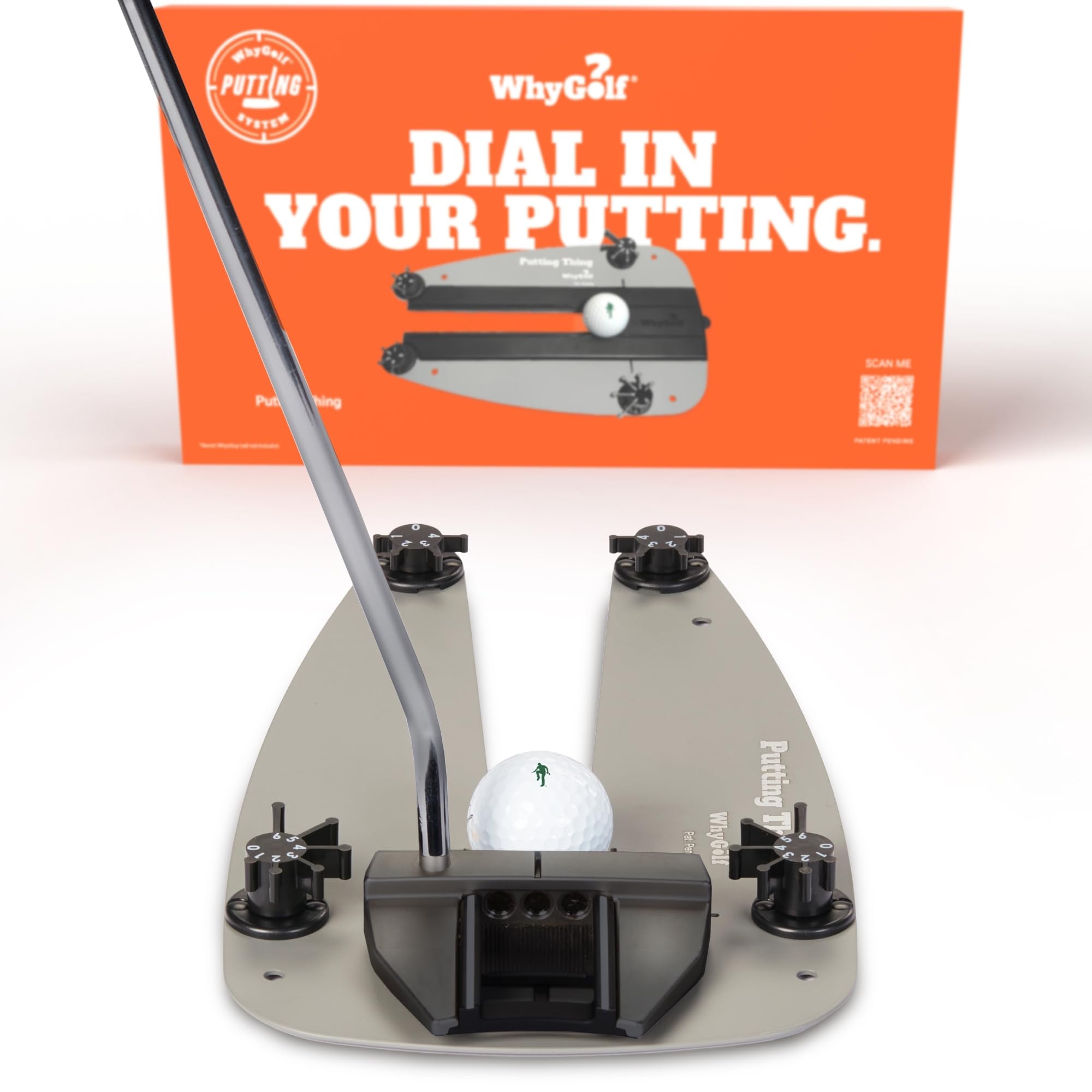
The WHYGOLF Putting System combines a putting mirror, adjustable putter gates, and a ball gate into a single aluminum alloy frame that measures just 1/16 inch thick. The putter gate forces you to deliver a square face through impact — if your putter head twists or cuts across the ball, the gate rattles or catches the hosel. The ball gate ensures the ball starts on your target line rather than leaking right or pulling left.
It comes with an alignment rail that helps you set up parallel to your target, and the entire system folds flat into a zippered travel bag. It works on carpet, real greens, and indoor putting mats because of its low profile. WhyGolf also provides training video access through their storefront, which explains how to progress from the widest gate settings down to the tightest for advanced practice.
Some users found the rear putter guides restrictive and removed them for a freer stroke, and the tightest gate settings may not accommodate all putter head shapes — especially oversized mallets. But for a compact, carry-anywhere tool that gives you both setup and stroke feedback, it earns a spot in any practice session.
Why it’s great
- Combines mirror, gate, and alignment in one unit
- Ultra-thin frame works on any surface
- Includes carrying case and video training
Good to know
- Rear putter guides may need removal for some strokes
- Oversized mallet putters may not fit tightest gate
3. EyeLine Golf Alignment Putting Mirror
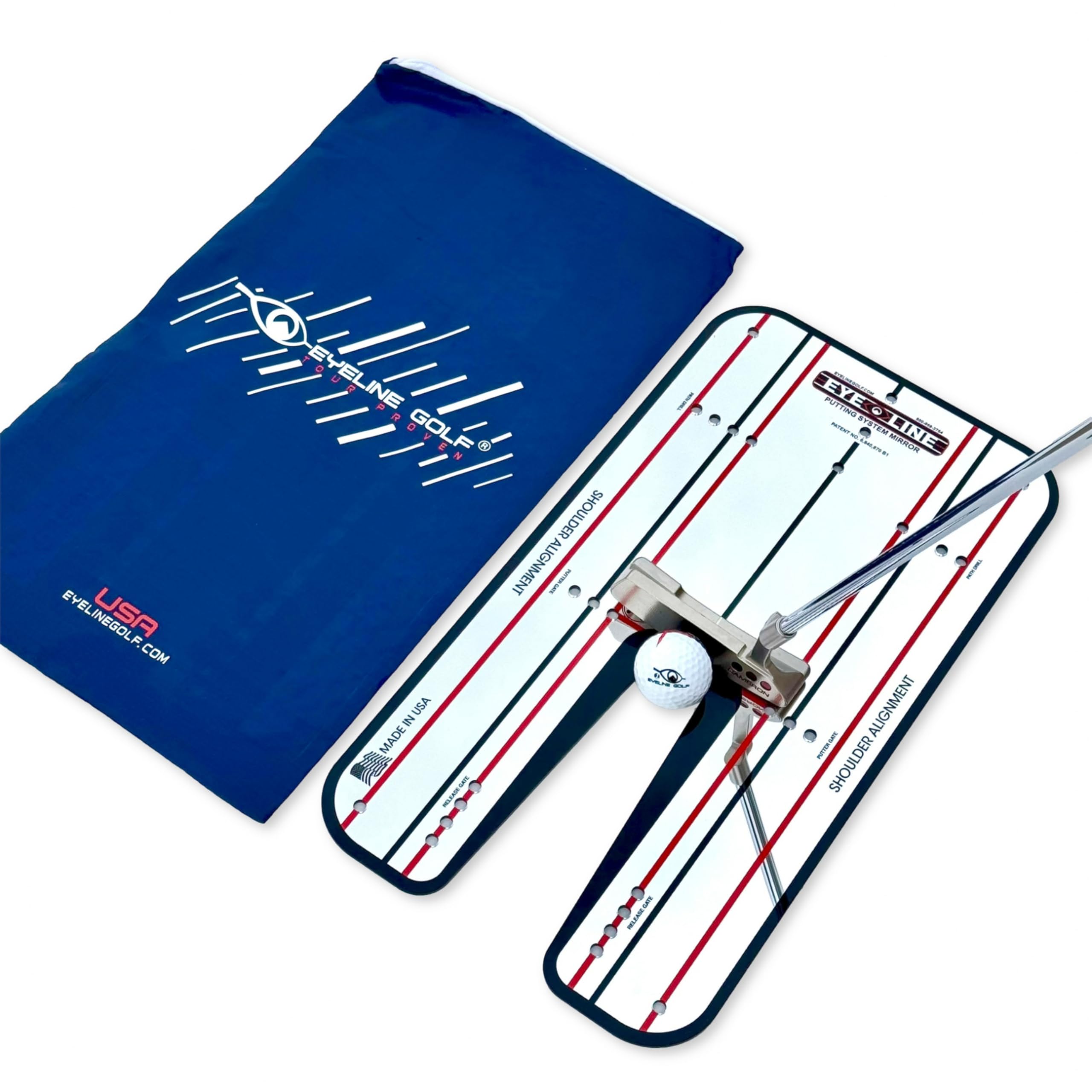
EyeLine Golf’s Classic Putting Alignment Mirror is an acrylic mirror with a printed stroke arc and a secondary mirror positioned behind the ball. The primary mirror shows whether your eyes are over the ball — a common cause of missed putts — while the rear mirror reflects your shoulder line, letting you see if you’re aiming left or right of the target. The arc is built into the mat surface, so you can practice an arc stroke path without guesswork.
It measures 23.25 inches by 7 inches and includes multiple grommet holes on the stroke path for tee gates. You start by putting without tees, then add them at different widths to challenge your path. The mat is thin enough to lay flat on most indoor surfaces and real greens. It comes with a protective sleeve, and the acrylic is scratch-resistant for normal use.
Several reviewers reported immediate improvement in setup after seeing how far off their shoulder alignment actually was. The only compromise is that you need a flat surface for the mirror to be effective — thick carpet can cause the mat to rock slightly. For golfers who miss putts because of alignment rather than speed control, this mirror is one of the most efficient fixes available.
Why it’s great
- Two mirrors for eyes and shoulder alignment
- Adjustable tee gate system for stroke path
- Thin and lightweight for travel
Good to know
- Requires a flat, stable surface
- Not designed for severe undulations
4. YOUCZON Putting Green Indoor Mat

This 10-foot putting mat uses a crystal velvet surface that rolls the ball consistently and returns it automatically through a magnetic wooden track. It has two practice holes at 2.5 and 3.5 inches, so you can vary the target size. The mat is backed with wood strips that stiffen the base, and the ball storage box collects the returned ball after your putt drops into the hole track.
Setup is straightforward: unfold the mat, attach the magnetic track, and place the baffle at the end. The velvet material is quiet and works on both carpet and tile floors. The package includes one practice ball, but you can use any standard size golf ball. It rolls up easily for storage under a bed or in a closet, making it a good option for apartment dwellers.
Some users noted small humps or wrinkles in the mat that didn’t fully flatten even after being weighted down overnight. The ball return is effective but occasionally catches on the track joint if not perfectly aligned. Despite these minor convenience issues, the mat provides a dedicated practice station that keeps you putting without chasing balls around the living room.
Why it’s great
- Auto ball return saves time on each stroke
- Two hole sizes for progressive difficulty
- Velvet surface rolls true and quiet
Good to know
- Some mats may have minor wrinkles
- Track alignment requires occasional adjustment
5. Callaway Golf Swing Stick Lag Trainer

Measuring the same length as a standard 6-iron at 37.5 inches, the Callaway Lag Trainer uses a weighted, flexible shaft to train sequencing and wrist hinge. When you swing correctly, the shaft loads and unloads at the right time — swing with your arms only and the head lags too late, producing a sluggish feel. It helps you feel the difference between a body-driven swing and an arms-only fling.
The rubber grip is comfortable and fits both left- and right-handed players. The plastic head is durable enough for driveway swings and indoor practice. It fits into any standard golf bag alongside your irons, so you can bring it to the range for warm-up stretches before hitting balls. The flexibility also allows you to use it for shoulder mobility exercises outside of golf.
Some users found the grip size to be slightly smaller than a standard midsize grip, but it’s still usable as-is. The flex rating is medium, so very strong swings may bottom out the shaft on aggressive transition. For golfers looking to groove a one-piece takeaway and improve wrist set, this stick provides immediate tactile feedback without needing a launch monitor.
Why it’s great
- 6-iron length for realistic swing feel
- Weighted head promotes lag and tempo
- Fits in a golf bag for on-course warm-up
Good to know
- Grip may feel too slim for some players
- Not ideal for high-speed swing training
6. PuttOUT Devil Ball Face Angle Trainer

The PuttOUT Devil Ball uses a flat, angled edge to exaggerate the effect of a misaligned putter face at impact. The design has three built-in difficulty levels: you rotate the ball to hit a rounder section (easier) or a flatter section (harder). On the hardest setting, holing a 3-foot putt is about twice as difficult as with a regular ball.
It comes as a two-pack with an alignment marker and a travel pouch. The marker lets you draw a line on the ball to see if it tumbles end-over-end or shows wobble after impact. The firm plastic material doesn’t replicate the sound or soft feel of a real ball, but the feedback is honest: a square strike rolls true, while any face angle error sends the ball offline.
Some users noted that the lack of real ball feel makes it hard to judge distance control, and the effect diminishes on putts longer than 6 to 8 feet where gravity and break overwhelm the face angle deviation. But for grooving a square impact on short putts — the ones that keep scorecards clean — it’s one of the most effective and affordable tools available.
Why it’s great
- Exaggerates face angle error for clear feedback
- Three difficulty settings for progression
- Compact and portable with travel pouch
Good to know
- Does not feel like a real golf ball
- Best for putts under 6 feet
7. Amazon Basics Golf Swing Trainer Aid

The Amazon Basics swing trainer is a 48-inch weighted training stick with a flexible fiberglass shaft and a 0.5-pound head. It’s designed to promote a full-body swing by forcing you to rotate rather than using your hands — if you swing with your arms only, the flexible shaft doesn’t load, and you get no resistance. The elastic rod springs back to shape after each swing, making it safe for indoor use.
It comes with a comfortable non-slip rubber grip, though some users found the grip to be unusually slim and replaced it with a standard golf grip. The length is similar to a driver, which helps with one-plane swing feel. Many buyers use it for pre-round warm-ups on the first tee, as it loosens the back and shoulders while reinforcing tempo.
The main long-term concern is durability: the flexible rod can snap if you hit the ground or a wall during a practice swing. The grip also sits on a non-standard 0.400-inch shaft, so regripping requires some modification. But at a fraction of the cost of branded swing trainers, it delivers the same weighted-feedback concept for budget-conscious golfers who want a consistent warm-up tool.
Why it’s great
- Very affordable alternative to premium swing sticks
- Flexible shaft provides immediate tempo feedback
- Good length for warm-up and shoulder mobility
Good to know
- Slim grip may need replacement for comfort
- Fragile if struck against ground or furniture
FAQ
What is the most effective golf training aid for fixing a slice?
How does a putting mirror help with alignment errors?
Can launch monitors be used indoors without a net?
How tight should I set the gates on a putting trainer?
Final Thoughts: The Verdict
For most users, the best golf training aids winner is the Voice Caddie SC200 Plus because it combines swing speed measurement, ball data, and voice feedback into a single portable unit that works with or without a ball. If you want a tool that fixes your setup before each putt, grab the EyeLine Golf Alignment Mirror. And for groove-level feedback on your putting impact, nothing beats the PuttOUT Devil Ball — it exposes face angle errors that a regular ball simply hides.