
Camping pushes you beyond cell towers, into places where a dead phone battery or a lost signal isn’t just an inconvenience—it’s a genuine risk. The right GPS unit does more than show a map; it becomes your tether to civilization, tracking your steps, marking your camp, and, in a worst-case scenario, calling for help when no one else can hear you.
I’m Mohammad Maruf — the founder and writer behind Drink4Good. My research focuses on the intersection of rugged hardware reliability and real-world field performance, dissecting satellite reception sensitivity, battery endurance under load, and the durability of buttons and seals that matter when you’re miles from the trailhead.
Whether you’re navigating a dense forest or marking a dispersed campsite, the best gps for campers provides a reliable lifeline when your smartphone fails.
How To Choose The Best GPS For Campers
Choosing the right GPS for camping is less about the number of features and more about matching the device’s core capabilities to your specific camping style. A weekend car camper has very different needs than a solo backpacker heading into the backcountry for a week. Here’s what matters most.
Mapping and Navigation: From Simple Waypoints to Topo Maps
The most fundamental split in this category is between units that only capture and navigate to waypoints (distance and bearing to your truck or camp) and those that display full topographic maps with routable trails and roads. Waypoint-only devices are lighter, simpler, and more affordable. Mapping units like the Garmin GPSMAP 66i or the NiesahYan with USA Topo maps let you see and plan your route directly on the screen, which is invaluable for off-trail exploration or navigating complex trail networks.
Satellite Connectivity: Two-Way Messaging and SOS
If you venture beyond cell service, a satellite communicator is the single most important safety tool you can carry. Devices like the Spot Gen4 and Garmin GPSMAP 66i allow you to send and receive text messages, share your GPS location with loved ones, and trigger an SOS alert that reaches a 24/7 search-and-rescue monitoring center. This is not a luxury—it’s a life-saving line of communication when everything else fails.
Multi-GNSS Support and Antenna Quality
Not all GPS reception is equal. A device that only uses the US GPS satellite network will struggle in deep canyons or under a thick forest canopy. Look for models that support multiple satellite constellations—GPS + GLONASS (Russian) + Galileo (European) + QZSS (Japanese). The Garmin GPSMAP 64sx takes it a step further with a quad-helix antenna, providing superior signal locking in challenging environments. This directly translates to less time waiting for a fix and more accurate position data.
Battery Life and Power Management
Battery life is a direct constraint on your trip duration. A device promising 35 hours in standard mode might be sufficient for a long weekend, but a multi-day expedition often requires a power bank. Some units, like the Garmin Rino 700, use standard AA batteries, allowing you to carry spares. Others use internal rechargeable lithium-ion batteries. The gold standard for extended trips is the Garmin Instinct 2X Solar, which uses solar charging to potentially extend battery life indefinitely in smartwatch mode, provided you get enough direct sunlight.
Ruggedness and Screen Readability
Your GPS will get bumped, wet, and possibly dropped. Look for an IPX7 or IP66 water resistance rating, which means it can survive rain, splashes, and even brief submersion. The screen must be sunlight-readable (often a high-contrast, transflective memory-in-pixel display) and large enough to be useful with gloved hands. Button-operated units are often preferable to touchscreens in wet or cold conditions, as they remain fully functional regardless of moisture or touch sensitivity.
Quick Comparison
On smaller screens, swipe sideways to see the full table.
| Model | Category | Best For | Key Spec | Amazon |
|---|---|---|---|---|
| Garmin Instinct 2X Solar | GPS Smartwatch | Lightweight hiking & everyday carry | Infinite battery via solar | Amazon |
| Garmin GPSMAP 66i | GPS + Sat Com | Backcountry navigation & safety | SOS via Iridium satellite | Amazon |
| Garmin GPSMAP 64sx | Handheld GPS | Off-trail hiking with topo maps | Quad-helix antenna + multi-GNSS | Amazon |
| NiesahYan A6 | Handheld GPS | Budget-friendly track recording | 20-hour battery life | Amazon |
| Bushnell BackTrack Mini | Waypoint GPS | Simple return-to-truck navigation | 35-hour battery life | Amazon |
| NiesahYan with USA Topo | Handheld GPS | Map-based exploration on a budget | 36-hour battery + preloaded topo | Amazon |
| Spot Gen 4 | Satellite Messenger | Emergency SOS & check-in messaging | Globalstar satellite coverage | Amazon |
| ZL180 Land Survey | Survey GPS | Large area distance/area measurement | 0.003 acre measurement accuracy | Amazon |
| Garmin RV 895 | RV Navigator | Road navigation for large RVs | Custom RV routing by size/weight | Amazon |
In‑Depth Reviews
1. Garmin Instinct 2X Solar – Tactical Edition

The Garmin Instinct 2X Solar isn’t just a GPS watch—it’s a rugged, military-standard wearable that redefines battery expectations for backcountry trips. Its 50mm fiber-reinforced polymer case is built to withstand thermal shock, water immersion, and the kind of daily abuse that would destroy a standard smartwatch. The solar-charging Power Glass lens is the headline feature: in smartwatch mode, it can sip enough energy from direct sunlight to achieve effectively infinite battery life, eliminating the need to carry a charging cable for weeks at a time. For campers who move fast and light, this is a paradigm shift in power management.
The built-in LED flashlight with variable intensities and an SOS strobe is surprisingly practical—it illuminates a tent interior, finds a dropped carabiner at midnight, and signals for help without fumbling for a separate headlamp. Multi-band GPS reception ensures accurate tracking even when you’re weaving through dense forest or deep ravines. The health suite (heart rate, Pulse Ox, sleep monitoring) doubles as an excellent daily driver for fitness and wellness tracking, making it a true all-in-one device for the outdoor enthusiast.
Navigation is handled through Garmin’s robust ecosystem, though the small 1.3-inch display can feel cramped for complex map reading. The watch excels at breadcrumb navigation and route following, but it’s not a replacement for a dedicated handheld with a 3-inch topo map screen. Pairing it with the Garmin Explore app is essential for trip planning and reviewing data. The Tactical Edition adds a ballistics calculator and jumpmaster mode, which is overkill for most campers, but the core navigation and battery features are universally excellent.
Why it’s great
- Unmatched battery endurance via solar charging
- Military-grade durability (shock, thermal, water)
- Built-in LED flashlight is genuinely useful at camp
- Multi-band GPS for accurate tracking under cover
Good to know
- Screen is small for detailed topo map navigation
- Tactical features are unnecessary for standard camping
- Setting up custom data screens requires some initial learning
2. Garmin GPSMAP 66i

The Garmin GPSMAP 66i is the gold standard for campers who demand both comprehensive navigation and life-saving satellite communication in a single, rugged handheld. Its 3-inch sunlight-readable color display is just large enough to read preloaded TopoActive maps without being cumbersome. The device supports multiple GNSS constellations (GPS + Galileo) and includes a barometric altimeter and 3-axis compass, providing all the sensor data a serious hiker needs to stay oriented in featureless terrain. The 200-hour expedition mode with 30-minute tracking intervals is ideal for multi-week trips where power is at a premium.
The integrated inReach satellite technology is its killer feature. Using the 100% global Iridium satellite network, you can send and receive two-way text messages, share your GPS location with anyone, and trigger an interactive SOS that connects you directly to a 24/7 GEOS search-and-rescue monitoring center. This isn’t a theoretical option—customer reviews confirm the SOS function has coordinated real rescues. For family peace of mind, the regular check-in messages are invaluable, letting loved ones know you’re safe when you’re out of cell range for days.
Preloaded Birdseye satellite imagery can be downloaded directly to the device, providing a photorealistic view of your surroundings that aids in off-trail route-finding. The user interface is Garmin’s typical multi-menu system, which has a steep learning curve, but the device is fully functional out of the box for basic navigation. The internal lithium-ion battery provides up to 35 hours of battery life in 10-minute tracking mode. It’s a premium investment, but for anyone who travels deep into the backcountry, the safety and navigation value is unmatched.
Why it’s great
- Integrated satellite SOS and two-way messaging
- Large, sunlight-readable topo map display
- Birdseye satellite imagery preloaded
- Global Iridium satellite coverage
Good to know
- Requires a monthly satellite subscription
- User interface has a significant learning curve
- Battery life is shorter than some competitors
3. Garmin GPSMAP 64sx

The Garmin GPSMAP 64sx is a purpose-built handheld GPS that prioritizes signal reception and map detail above all else. Its quad-helix antenna, combined with multi-GNSS support (GPS, GLONASS, Galileo), provides exceptional satellite locking capability, even under heavy tree cover or in steep canyons where other devices struggle to maintain a fix. The 2.6-inch sunlight-readable color display is sharp and high-contrast, making it easy to read preloaded TopoActive maps that include routable roads and trails for both cycling and hiking. The ABC sensors (altimeter, barometer, compass) are calibrated and accurate for real-time environmental feedback.
Wireless connectivity via Bluetooth and ANT+ allows the 64sx to pair with a smartphone for smart notifications and sharing data. This is a dedicated navigation tool, not a smartwatch, so the battery life is a solid 16 hours using two standard AA batteries. The ability to swap in fresh batteries when the power runs low is a significant advantage for extended trips where recharging isn’t an option. The device is rugged and water-resistant, built to withstand the elements and the bumps of a pack pocket. It also supports microSD cards for additional map storage, allowing you to load custom topo maps or satellite imagery.
Customers consistently praise its reliable performance in extreme conditions, from the Grand Canyon to desert off-roading. The learning curve for Garmin’s operating system is moderate, but the payoff is a highly capable navigator that will guide you off-trail with confidence. The absence of a satellite communicator or SOS function means it’s best used in conjunction with a separate messenger device for full safety coverage. It’s a classic, durable workhorse that delivers exactly what it promises: precise navigation in the toughest environments.
Why it’s great
- Superior GNSS reception with quad-helix antenna
- Preloaded TopoActive maps
- Uses standard AA batteries for easy re-supply
- ABC sensors for comprehensive environmental data
Good to know
- No satellite SOS or messaging built-in
- Battery life (16 hours) is lower than some rivals
- Needs a microSD card for large map libraries
4. NiesahYan Handheld GPS with USA Topo
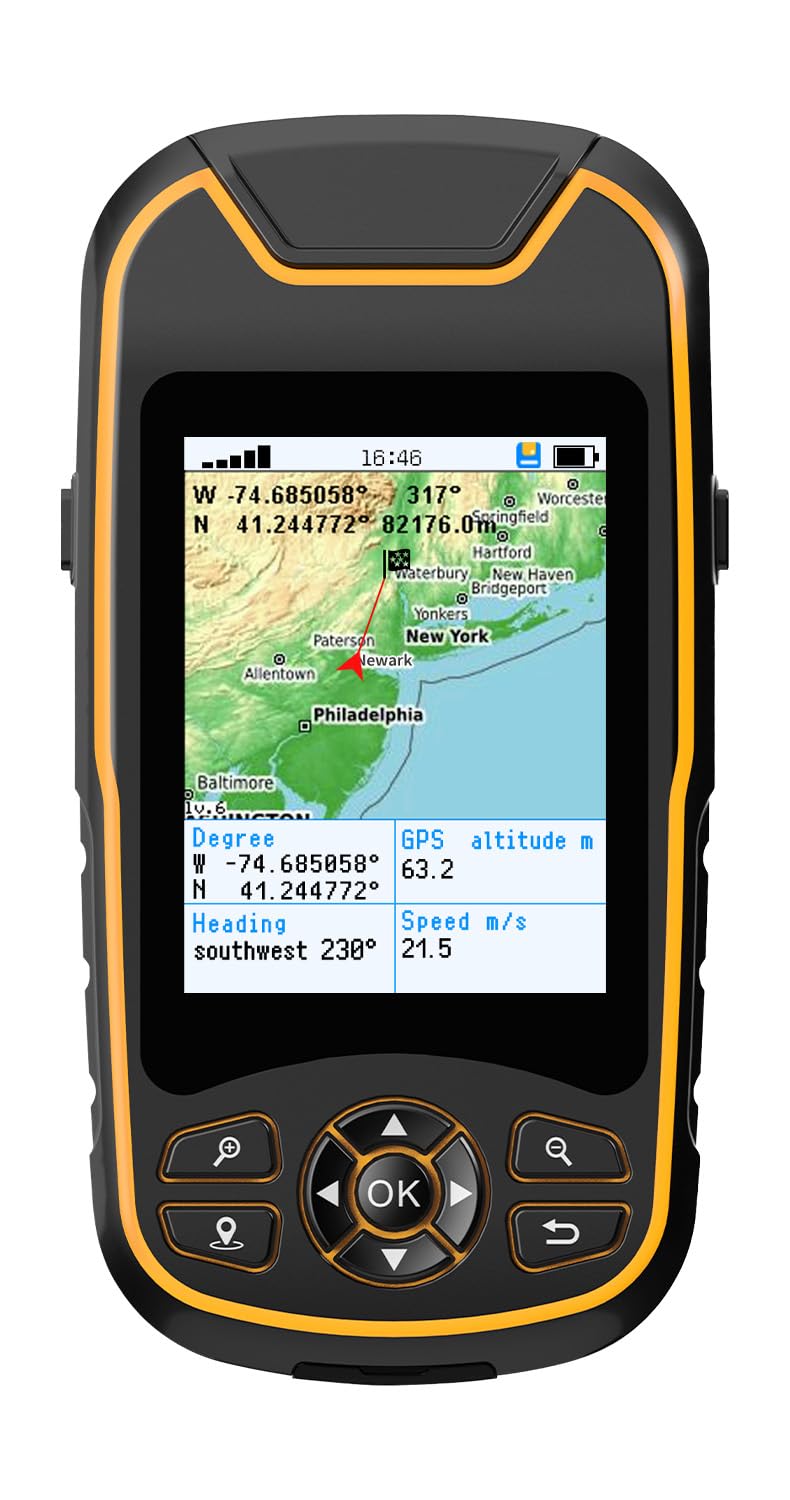
This NiesahYan handheld GPS disrupts the market by offering a 3.2-inch sunlight-readable color display with preloaded USA Topo maps at a mid-range price point. It supports four GNSS constellations (GPS, Galileo, BeiDou, QZSS) for excellent positional accuracy, typically within 6 feet. The 36-hour battery life is a major asset for multi-day camping trips, and the IP66 water-resistant rating ensures it can handle rain and splashes without issue. The 3-axis compass and barometric altimeter work well for maintaining situational awareness, even when stationary.
The 32 GB of internal memory provides ample space for downloading additional topo maps or satellite imagery, making it a very capable platform for route planning. The physical button controls are responsive and easy to use with gloves, which is crucial in cold or wet conditions. For the price, you get a feature set that was previously only available from Garmin, though the user interface feels less polished and the included instructions are notably sparse, requiring some trial-and-error learning. The “save my spot” feature allows you to mark your camp or a point of interest with ease.
Customer reports indicate that the unit can suffer from initial calibration issues and, in some cases, complete failure after the first field test. The GPX file import is reportedly primitive and may not work seamlessly with all third-party routing software. While it offers incredible value on paper, the build quality and software stability are not yet on par with Garmin’s established reputation. It is best suited for campers comfortable with technology and willing to work through potential bugs for the price savings.
Why it’s great
- Large 3.2-inch sunlight-readable screen with topo maps
- 36-hour battery life for extended trips
- Excellent price-to-feature ratio
- Multi-GNSS support for accurate positioning
Good to know
- Software and firmware can be unstable
- Documentation is poor and difficult to follow
- GPX file import is very primitive
5. Garmin RV 895

The Garmin RV 895 is designed specifically for large RVs and travel trailers, solving the unique navigation challenges that car GPS units or smartphone apps cannot handle. Its bright 8-inch LED touchscreen is large enough to read clearly at a glance, and it can be viewed in both landscape and portrait orientations. The killer feature is custom routing: you input your RV’s exact height, weight, length, and width, and the device plans routes that avoid low bridges, sharp curves, steep grades, and weight-restricted roads. This is not a token feature—it is the primary reason to buy this device over a standard car navigator.
The preloaded directory of RV parks, services, and points of interest is extensive, including TripAdvisor ratings, KOA, and Ultimate Public Campgrounds. The high-resolution Birdseye satellite imagery provides a vivid aerial view of your destination, helping you identify a large enough pull-through spot before you arrive. The mount is a combination of suction cup and magnetic plate, which secures the device firmly to the windshield. The interface is motion-locked by default for safety, which limits passenger use unless you navigate to the settings menu.
While the routing algorithm is vastly better than consumer GPS units, it is not perfect. A handful of customer reports note instances where the device routed onto roads that still felt unsafe for a large rig, and the “no idea if safe” icon can appear frequently on non-freeway roads, forcing you to use your own judgment. The Bluetooth connectivity for traffic and weather can be finicky, and the device needs its own power source for Wi-Fi updates. It’s an excellent road companion, but not a substitute for physical map verification of critical low-clearance or narrow routes.
Why it’s great
- Custom routing for your RV’s specific dimensions
- Large 8-inch high-resolution touchscreen
- Extensive database of RV parks and services
- High-resolution satellite imagery for final approach
Good to know
- Routing algorithm can still make questionable choices
- Bluetooth and Wi-Fi connectivity can be unreliable
- Interface is motion-locked and needs manual unlock
6. Spot Gen 4 Satellite GPS Messenger

The Spot Gen 4 is a pure satellite messenger, purpose-built for one critical task: providing a reliable line of communication when you’re beyond cell coverage. It does not have a map screen or full GPS navigation; instead, it focuses on transmitting your GPS location via the Globalstar satellite network. The SOS button is physically integrated and magnetic, making it easy to find and activate in an emergency. It will send your exact coordinates to a 24/7 emergency response center. The custom messaging feature allows you to send a pre-written “I’m OK” message to a list of contacts, giving loved ones automatic check-ins.
The tracking feature is excellent for family reassurance. You can set it to update your position at intervals (typically 10 minutes) and the device will transmit your location to a map that your contacts can view online. The device itself is fairly simple: a plastic case with a carabiner and a small screen that shows signal strength and message status. The battery life is strong, often lasting for weeks in tracking mode. The subscription plans (Flex and Basic) are more affordable than Garmin’s inReach options, making it an attractive entry point into satellite safety.
The Gen 4 introduced magnetic SOS and HELP buttons, which are an improvement over older models. However, there are significant downsides. The device cannot be powered via USB; it uses internal batteries that require removing four screws to replace. The included weather seal can easily fall out, making the waterproof seal unreliable over time. More concerning, some users have reported that check-in messages have shown as “sent” but were never delivered, which fundamentally undermines the device’s primary purpose. It is a solid choice for basic safety, but its reliability is not as rock-solid as Garmin’s inReach units.
Why it’s great
- Affordable satellite messaging and SOS capability
- Excellent check-in tracking for family reassurance
- Magnetic SOS button is intuitive in an emergency
- Good battery life in standard tracking mode
Good to know
- No map display or GPS navigation features
- Battery replacement requires tools and can compromise the seal
- Some users report undelivered check-in messages
7. Bushnell BackTrack Mini GPS

The Bushnell BackTrack Mini is a compact, water-resistant device designed for a single, straightforward purpose: helping you find your way back to your starting point. It captures your current location as a waypoint (your truck, your camp, the trailhead) and then provides you with a heading and distance to that point, regardless of whether you’ve wandered off-trail or through a dense forest without a visible path. It does not show a topographic map or aerial imagery, relying instead on a simple LCD interface with large, glove-friendly buttons. The 35-hour battery life is generous for weekend trips, and it charges via a standard micro-USB cable.
The device also logs your trip’s elevation gain and loss, barometric pressure, and sunrise/sunset times. Bluetooth connectivity allows you to sync your waypoints and tracked routes to the Bushnell Connect smartphone app, where you can review your path. For many car campers and day hikers, this is exactly enough functionality: it’s an affordable, low-fuss insurance policy against getting turned around. Customers who use it for trail running and simple hikes consistently report it works well for its intended, narrow purpose. It’s an excellent backup navigator or a device for someone who doesn’t want to learn complex mapping systems.
The critical weakness is the Bushnell Connect app. Multiple customer reviews indicate the app is currently displaying an “unexpected error” and is effectively non-functional for syncing data, with little evidence of developer support. This means the device is essentially used alone, which is fine for basic navigation but eliminates the benefit of reviewing your trips on a larger screen. The buttons are also reported to be stiff, making one-handed operation difficult. The price point is competitive, but the app dependency for any advanced features is a notable risk. It’s a good tool for the solo camper who just needs a reliable compass and back-to-truck direction.
Why it’s great
- Simple, intuitive waypoint return navigation
- 35-hour battery life
- Compact and water-resistant design
- Logs elevation, barometric pressure, and sunset times
Good to know
- No topographic map display
- Bushnell Connect app is currently non-functional
- Buttons are stiff and hard to press
8. NiesahYan A6 Handheld GPS
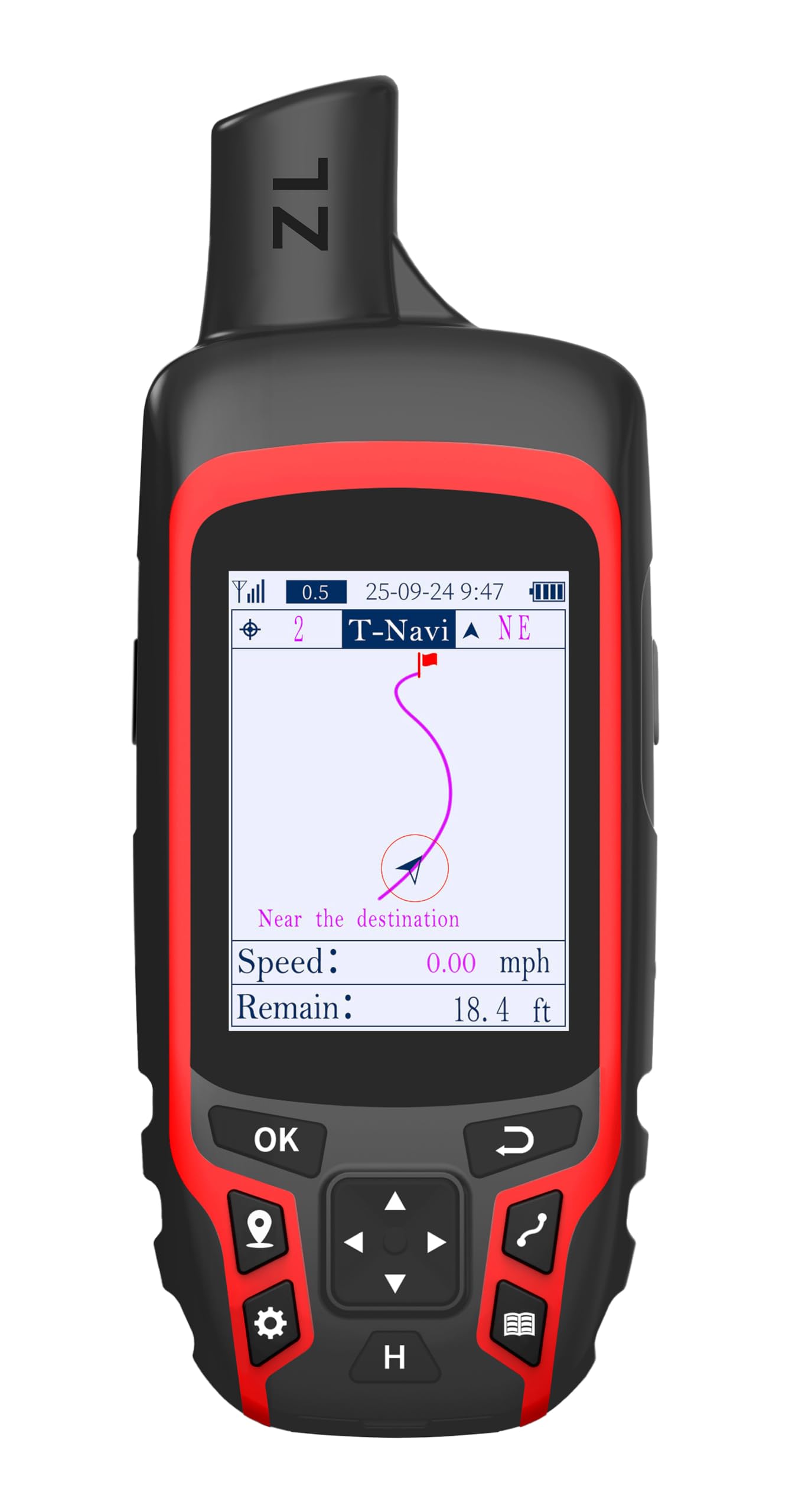
The NiesahYan A6 is a compact, budget-friendly handheld GPS navigator designed for hikers and campers who want a lightweight backup to their smartphone. It features a 2.4-inch sunlight-readable color screen and supports four satellite constellations (GPS, Galileo, BeiDou, QZSS) for robust positional accuracy. The 20-hour battery life via USB-C charging is adequate for long day hikes or a weekend trip, and the device includes a built-in GPS compass, barometric altimeter, and sunrise/sunset times. The core function is recording a track before you hike and then using that track to navigate back to your starting point, which is a reliable way to avoid getting lost.
The unit is rugged and compact, with a durable case and a lanyard for easy carrying. It is critically important to note that this GPS does not have built-in maps. It displays your coordinates and a compass heading, but the screen will not show a visual map of the terrain or trails. This makes it more of a coordinate tracker than a proper navigation device. It is excellent for recording a route and retracing it, but it will not help you plan a new route or identify nearby landmarks. This is a different beast from a Garmin GPSMAP and is best used as a simple, reliable path recorder.
Customer feedback is mixed. Users who understand its limitations (no maps, no routing) find it a good value for basic track recording. Others who expected a full mapping GPS are disappointed. The initial GPS lock is described as quick, and the screen is bright and legible. The menu system has a moderate learning curve but is manageable. For a camper who knows their trail and just wants a confirmation of their route, the A6 is a solid, cheap piece of gear. It’s not for off-trail exploration or complex navigation needs.
Why it’s great
- Very affordable entry into GPS navigation
- Multi-GNSS support for reliable signal locking
- Lightweight and compact for easy packing
- USB-C charging is convenient
Good to know
- No built-in maps or topo overlays
- Limited to track recording and waypoint navigation
- Menu system requires some learning
9. ZL180 Handheld GPS for Surveying

The ZL180 is not a general-purpose hiking GPS; it is a specialized area measurement tool designed for surveying land, such as ranches, gardens, farmland, and parking areas. It uses high-sensitivity GPS and GLONASS satellites to calculate area with a stated error margin of 0.003 acres, and distance measurement with an error of under 0.01%. The large 2.4-inch LCD backlit display shows measurement results directly. It offers four measurement modes: two for area (useful for irregularly shaped parcels) and two for distance (straight line and curved line).
The device is compact (about 6.3 oz) with a grooved design that makes it easy to hold while walking the perimeter of a property. It is important to note that the ZL180 is not a navigational device. It cannot save waypoints for later routing, and it cannot be used to navigate back to a specific point. Its sole purpose is to measure the size and distance of a given area. It is not intended for trail hiking or backcountry use. The instructions explicitly state it is recommended for measuring areas above 0.16 acres and distances above 328 feet, as accuracy degrades significantly on smaller scales.
Customer reviews are polarized. Users who need a quick, ballpark measurement of their property or campsite find it works well enough for the price. Others who expected a true precision surveying tool or a navigational GPS have been deeply disappointed, with one calling it “absolute junk.” The device requires a clear view of the sky and about a minute to lock onto satellites before use. It’s a niche product for a very specific camping or property task, not a general-purpose navigation tool. If you need to measure a large campsite or plot of land, this is an inexpensive solution.
Why it’s great
- Designed specifically for area and distance measurement
- Fast satellite lock with GPS and GLONASS
- Compact and easy to carry
- Four measurement modes for versatility
Good to know
- Cannot be used for navigation or waypoint saving
- Accuracy degrades on small areas (<0.16 acres)
- Not a substitute for a hiking GPS
FAQ
Do I need a satellite subscription for a GPS for camping?
Can I use my smartphone as a GPS for camping?
What is the difference between GPS and GLONASS?
Final Thoughts: The Verdict
For most campers, the best gps for campers winner is the Garmin Instinct 2X Solar because its solar-charging battery eliminates the most fundamental trip constraint, while its GPS smartwatch form factor integrates seamlessly into daily life and hiking. If you need a dedicated navigation device with full topo maps and satellite SOS capability for deep backcountry exploration, grab the Garmin GPSMAP 66i. And for the simplest, most affordable way to never get lost on a day hike, nothing beats the Bushnell BackTrack Mini.