
When your trail map is on your phone and the bars vanish a mile past the trailhead, you face a choice: turn back or trust a dedicated device that doesn’t depend on cell towers. A purpose-built navigator brings peace of mind with satellite connectivity, rugged weatherproofing, and battery life measured in days, not hours.
I’m Mohammad Maruf — the founder and writer behind Drink4Good. I’ve spent years analyzing the hardware specifications and real-world performance data of outdoor navigation gear to help hikers find the right balance of durability, accuracy, and battery endurance.
Whether you need basic waypoint tracking or full topo mapping with SOS capabilities, this guide breaks down the top options for finding the best gps for hiking that matches your terrain, skill level, and how far off-grid you plan to go.
How To Choose The Best GPS For Hiking
Dedicated hiking GPS units differ from everyday smartphones in three critical ways: they use satellite networks that work far from cell towers, they’re built to survive drops and downpours, and they conserve power for multi-day trips. Before you buy, match the device to how you actually hike.
Mapping Capabilities: Coordinates vs. Topo
Entry-level units display latitude/longitude coordinates and a compass heading — fine for marking a camp or retracing a simple out-and-back. If you explore unfamiliar terrain or plan multi-day routes, choose a model with preloaded topo maps. These show contour lines, trails, water sources, and landmarks, letting you navigate without a separate paper map.
Satellite System Support
GPS alone works almost anywhere, but adding GLONASS, Galileo, or BeiDou boosts accuracy in deep valleys or under dense canopy. Devices with multi-GNSS receivers lock onto satellites faster and maintain a fix when the sky view is narrow. For serious off-trail hiking, look for at least dual-frequency support or SatIQ technology that automatically optimizes positioning and battery use.
Battery Life and Power Source
Battery life varies dramatically between models — from 16 hours to over 240 hours. Rechargeable lithium-ion packs are convenient, but replaceable AA batteries let you carry spares for week-long treks. Always check the manufacturer’s rating in standard GPS mode (not battery-save or expedition mode) for a realistic baseline.
Durability and Waterproofing
A hiking GPS should survive a drop onto granite and a sudden thunderstorm. Look for an IP66 or IP67 rating for dust and water resistance, a rubberized armor layer, and a screen that remains readable in direct sunlight. Physical buttons are a major advantage when you’re wearing gloves or the screen is wet.
Safety and Connectivity
If you hike alone or in areas without any cell signal, consider a satellite messenger with SOS capability. Models like the Spot X let you send and receive texts via the Globalstar network and trigger search-and-rescue with confirmation. Bluetooth syncing to a phone app is useful for trip planning, but the device should function fully as a standalone unit.
Quick Comparison
On smaller screens, swipe sideways to see the full table.
| Model | Category | Best For | Key Spec | Amazon |
|---|---|---|---|---|
| Garmin Instinct 3 45mm Solar | Smartwatch | All-day wear with GPS | Unlimited battery with solar | Amazon |
| Garmin fēnix 8 47mm AMOLED | Smartwatch | Premium multisport hiking | 47-hour GPS battery life | Amazon |
| Garmin GPSMAP 64sx | Handheld | Off-trail navigation | Quad helix antenna | Amazon |
| Garmin eTrex 32x | Handheld | Reliable basic wayfinding | 25-hour battery (2 AA) | Amazon |
| Spot X with Bluetooth | Satellite Messenger | Two-way texting and SOS | 240-hour standby time | Amazon |
| NiesahYan A6 | Handheld | Budget-friendly tracking | 20-hour rechargeable battery | Amazon |
| Bushnell BackTrack Mini | Handheld | Simple point-to-point return | 35-hour battery life | Amazon |
| NiesahYan 3.2″ Topo Navigator | Handheld | USA topo mapping on a budget | 36-hour battery / 32 GB memory | Amazon |
| BEVA NB88 Survey GPS | Survey Tool | Land area measurement | ±0.002 acre accuracy | Amazon |
In‑Depth Reviews
1. Garmin Instinct 3 45mm Solar

The Garmin Instinct 3 bridges the gap between a rugged handheld and a daily-wear smartwatch. Its 45mm fiber-reinforced polymer case with a metal-reinforced bezel meets MIL-STD-810 for thermal and shock resistance, and the 10 ATM water rating handles river crossings and heavy rain without a second thought. The 0.9-inch MIP display with a solar charging lens offers unlimited battery life under typical outdoor wear — you can leave the charger at home for multi-week trips.
Navigation hardware includes a 3-axis compass, barometric altimeter, and multi-band GPS with SatIQ technology. SatIQ automatically switches between GPS modes to balance accuracy and battery draw, so you get a tight fix under canopy without draining the cell when you’re on an open ridge. Health monitoring — wrist-based heart rate, Pulse Ox, advanced sleep — rounds out the package, making it a capable fitness tracker that never compromises on positioning.
The built-in LED flashlight with variable intensities and strobe modes is unexpectedly useful for trail navigation after dusk. Smart notifications and Garmin Pay work when paired with a phone, but the watch functions fully as a standalone navigator. For a hiker who wants one device for daily life and off-grid weekends, this is the most versatile option available.
Why it’s great
- Solar charging extends battery indefinitely for most users
- Multi-band GPS with SatIQ for precise tracking in varied terrain
- Rugged MIL-STD-810 build with 10 ATM water resistance
- Integrated flashlight adds real utility on the trail
Good to know
- No preloaded topo maps for on-wrist navigation
- Requires Garmin Connect app for detailed route planning
- Silicone band can trap moisture during long hikes
2. Garmin fēnix 8 47mm AMOLED

For hikers who demand the absolute best, the fēnix 8 delivers a bright 1.4-inch AMOLED panel that makes trail maps and data fields pop even in direct sunlight. The stainless steel bezel and leakproof metal buttons survive scuba diving to 40 meters, so you can pair this with water-based adventures without worry. Battery life reaches 16 days in smartwatch mode and 47 hours in GPS mode — enough for a week-long thru-hike between charges.
Navigation is the strongest suit: multi-band GPS with SatIQ, a gyroscope, 3-axis compass, and barometric altimeter work together to maintain a rock-solid fix in canyons and under dense forest cover. Dynamic round-trip routing lets you set a target distance and get turn-by-turn directions back to your start, which is invaluable when you’re exploring unfamiliar networks of trails. The built-in speaker and mic support phone calls and voice assistant commands even when your phone is stowed.
Training features are deep — real-time stamina tracking, sport-specific workouts, and a training readiness score based on sleep and recovery. The ECG app can check for signs of atrial fibrillation (not available in all regions). All that power comes in a 47mm case that fits wrists 125-208 mm. If your budget allows one device for hiking, running, swimming, and daily wear, this is it.
Why it’s great
- Stunning AMOLED display with excellent sunlight readability
- Multi-band GPS with SatIQ for superior positioning accuracy
- Dive-rated to 40 meters for water sports and kayaking
- Built-in flashlight and voice assistant support
Good to know
- Premium price reflects the top-tier feature set
- AMOLED display can be distracting for some users in low light
- No onboard topo map storage without smartphone sync
3. Garmin GPSMAP 64sx

The GPSMAP 64sx is the handheld purist’s tool. Its high-sensitivity receiver with a quad helix antenna provides superior signal locking in challenging environments — think slot canyons, steep valley walls, and under dense rain forest canopy. Multi-GNSS support (GPS, GLONASS, Galileo) ensures you maintain a fix even when fewer satellites are overhead. The 2.6-inch sunlight-readable color display is crisp, and the button-only interface works flawlessly with wet hands or gloves.
Preloaded TopoActive maps for the US and Australia show routable roads and trails, making route planning and on-the-fly rerouting straightforward. The 3-axis compass and barometric altimeter give you ABC (altimeter, barometer, compass) data without relying on movement — your bearing stays accurate even when you’re standing still. Wireless connectivity via Bluetooth and ANT+ lets you sync with a phone for notifications or upload tracks to Garmin Connect.
Battery life is rated at 16 hours in GPS mode using two AA batteries. That’s shorter than some competitors, but the freedom to swap batteries instantly on a multi-week expedition is a real advantage. The rugged, water-resistant design has been field-tested by hunters, geocachers, and serious backpackers for years. If you want a dedicated navigator without touchscreen fragility, this is a proven workhorse.
Why it’s great
- Quad helix antenna provides exceptional signal sensitivity
- Preloaded TopoActive maps for US and Australia
- AA batteries allow easy field swapping
- Button operation works with gloves or in rain
Good to know
- 16-hour battery life is shorter than many competitors
- No microSD card included for map expansion
- Interface can feel dated compared to newer models
4. Garmin eTrex 32x

The eTrex 32x is a compact, reliable handheld that focuses on the essentials without unnecessary complexity. Its 2.2-inch sunlight-readable color display (240 x 320 pixels) is smaller than dedicated topo models, but it’s perfectly legible for waypoint navigation and track review. Preloaded with TopoActive maps featuring routable roads and trails, it covers hiking and cycling routes out of the box.
GPS and GLONASS support provides faster lock times and better tracking in demanding environments than GPS-only models. The 3-axis compass and barometric altimeter — the key upgrade over the standard eTrex 30x — give you accurate heading data even when standing still, plus elevation and barometric pressure trends that help predict weather changes. Eight GB of internal memory is ample for map downloads, and the microSD slot lets you add more.
Battery life is a standout feature: up to 25 hours in GPS mode on two AA batteries. Real-world tests with battery-save mode and WAAS off have pushed that past 50 hours. The physical button layout is intuitive, and the lack of a touchscreen means no accidental taps in rain. For hikers who want a no-frills workhorse with long legs, the eTrex 32x delivers proven Garmin reliability at a reasonable cost.
Why it’s great
- Excellent battery life — up to 25 hours on two AAs
- 3-axis compass and barometric altimeter built in
- Small form factor fits easily in a pack pocket
- Preloaded TopoActive maps for immediate use
Good to know
- Small screen limits map detail at a glance
- Steep learning curve for initial setup and navigation
- OpenStreetMap .img files on SD can cause boot loops
5. Spot X with Bluetooth

The Spot X is a dedicated satellite communicator first and a GPS device second. It connects to the Globalstar satellite network to send and receive text messages, share GPS coordinates, and trigger SOS to a 24/7 search-and-rescue monitoring center — and because it uses a dedicated US mobile number, your contacts don’t need a special app to reply. This makes it ideal for solo hikers, backcountry guides, or anyone who wants a reliable emergency line off the grid.
Standby battery life is listed at 240 hours, which translates to roughly 10 days of moderate use. In practice, with tracking intervals set to 10 minutes, you’ll get closer to 5-7 days before needing a charge. The monochrome display and rubber button interface are utilitarian but functional, even with gloves. Bluetooth pairing lets you use the Spot X as a messaging relay for your phone’s contacts, though the device works fully standalone.
A subscription plan is required — prices start around -30 per month depending on features. The Spot X excels at its core mission: reliable two-way communication and SOS in places where your phone shows “No Service.” It’s not a full-featured navigator with topo maps, so pair it with a handheld GPS or phone for route guidance. For safety-minded hikers, the peace of mind is worth the recurring cost.
Why it’s great
- Two-way satellite messaging and SOS from anywhere
- Dedicated phone number for incoming texts
- Excellent standby battery for multi-day trips
- Bluetooth sync with smartphone for convenience
Good to know
- Requires ongoing subscription service
- No built-in topo maps for navigation
- 5G areas can interfere with message reception
- Charges via Micro USB (not USB-C)
6. NiesahYan A6 Handheld GPS
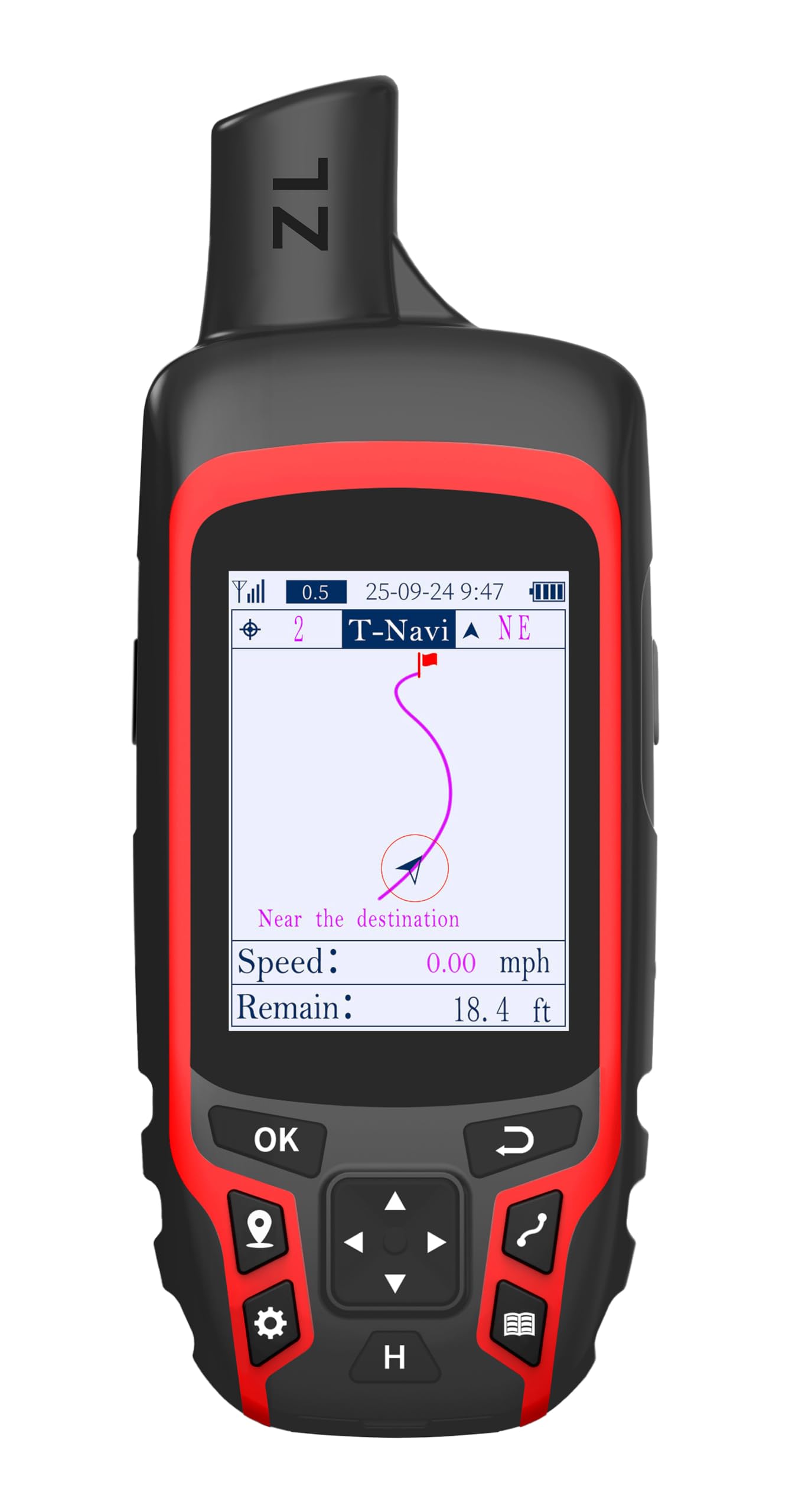
The A6 is a compact, lightweight GPS navigator designed for hikers who want a basic safety net without the complexity or cost of a full topo unit. It supports four satellite constellations (GPS, Galileo, BeiDou, QZSS) for fast acquisition and stable positioning even under moderate tree cover. The 2.4-inch color LCD is sunlight-readable, and the button interface is glove-friendly.
Critical to understand: this unit does not come with preloaded maps. It displays your coordinates, a compass heading, and a track log — so you can record a route and navigate back to your starting point. For hikers who stick to well-marked trails or carry a paper map, this is perfectly adequate. The 20-hour rechargeable battery via USB-C is convenient, and the rugged, waterproof casing survives typical trail conditions.
User reviews highlight fast GPS acquisition and a bright screen, but also note that navigation without maps requires solid map-reading skills. If you need turn-by-turn trail guidance or want to see contour lines, you’ll need to step up to a topo-capable model. For the price, the A6 offers reliable core GPS functionality in a durable package.
Why it’s great
- Four-satellite support for fast, accurate positioning
- 20-hour battery life with USB-C charging
- Compact and lightweight for easy packing
- Rugged, waterproof build at a low cost
Good to know
- No preloaded maps — coordinates and tracking only
- Menu navigation requires study of the manual
- Not designed for off-trail or complex route planning
7. Bushnell BackTrack Mini

The Bushnell BackTrack Mini is built for one specific job: getting you back to where you started. It uses GPS to capture a trip or waypoint, then provides a simple arrow pointing toward that location — no maps, no complex menus, no learning curve. This makes it ideal for day hikers, trail runners, and hunters who just need a reliable electronic breadcrumb trail.
The easy-to-read LCD and large, glove-friendly buttons are a highlight. Battery life is rated up to 35 hours from a rechargeable internal battery, and the rugged, waterproof design handles rain and drops. Bluetooth connectivity lets you sync trips and waypoints to the Bushnell Connect app for sharing or later review. The device also shows elevation gain and loss, barometric pressure, sunrise/sunset, and moonrise/moonset — useful weather awareness tools.
Some users report that the small buttons can be stiff to press, and the app integration has reliability issues. Distance readings can overestimate by up to 60% in some cases, and elevation accuracy is mixed. For the price, the BackTrack Mini is a decent solution for simple return navigation, but serious hikers may outgrow its limited functionality quickly.
Why it’s great
- Extremely simple one-button operation for mark-and-return
- Long battery life for multiple day trips
- Rugged, waterproof design
- Bluetooth app sync for trip storage
Good to know
- No maps — only coordinate and compass guidance
- Small buttons can be difficult to press
- App integration has reliability issues
- Distance and elevation accuracy can be inconsistent
8. NiesahYan 3.2″ Topo Navigator
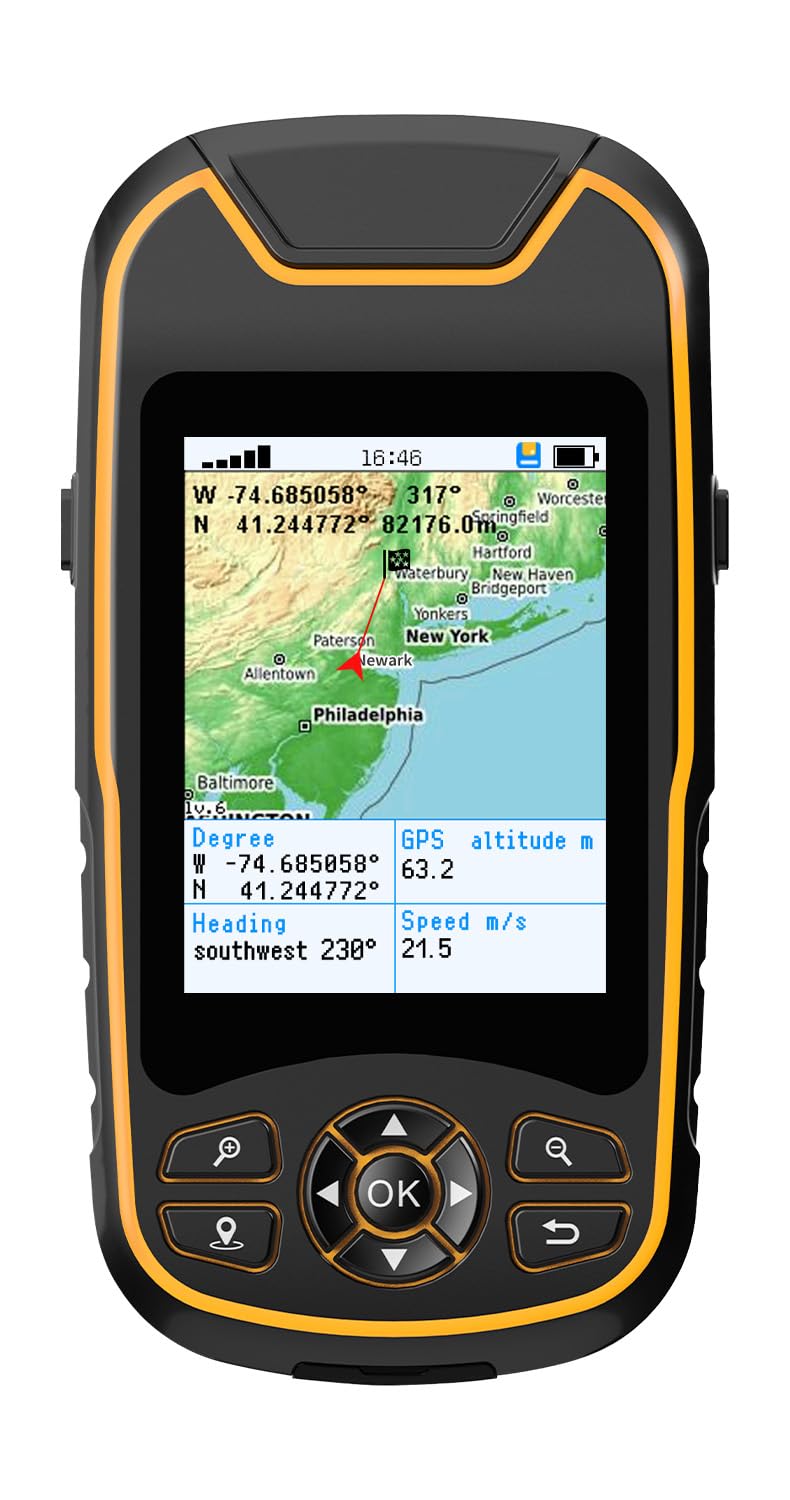
This handheld navigator brings preloaded USA Topo maps to the entry-level price bracket, making it an attractive option for hikers who want on-screen trail guidance without a Garmin price tag. The 3.2-inch sunlight-readable display is generous for the category, and the anti-slip, rubberized case provides a confident grip in wet conditions. Multi-GNSS support (GPS, Galileo, BeiDou, QZSS) delivers location accuracy within roughly 6 feet.
A 3-axis compass and barometric altimeter are included, giving you the ABC sensor suite that outdoor enthusiasts rely on. The IP66 water-resistant rating means it can handle rain and splashes, though it’s not fully submersible. Battery life is rated at 36 hours from a full charge, and the USB-C rechargeable battery eliminates the need for spare cells on shorter trips. The 32 GB of internal memory is generous for map storage.
Some users report software issues, including boot loops after initial use, and the interface can be counterintuitive. The device lacks the polish and reliability of established brands like Garmin, and the included manual is sparse. For the price, you get a capable map-based navigator if it works correctly, but the reliability concerns are worth noting before buying.
Why it’s great
- Preloaded USA Topo maps for on-screen navigation
- Large 3.2-inch sunlight-readable display
- Multi-GNSS support for accurate positioning
- 36-hour battery life with USB-C charging
Good to know
- Some units have reported software boot-loop issues
- Instruction manual is minimal and hard to follow
- Not as durable or reliable as established brands
- IP66 is splashproof but not fully submersible
9. BEVA NB88 Handheld Survey GPS

The BEVA NB88 is designed for land measurement, not traditional hiking navigation. Its primary function is area calculation — it uses four satellite positioning systems (GPS, BeiDou, GLONASS, QZSS) to measure acreage with accuracy down to ±0.002 acres. This makes it a practical tool for hikers who own or manage rural property, farmland, or forest and need to measure trails, clearings, or boundaries.
The 3.2-inch anti-glare TFT display is readable in bright conditions, and the rubberized casing offers a comfortable, secure grip. The device supports multiple measurement modes for different terrain types and can also measure distance and slope. The rechargeable battery keeps it running for a full day of fieldwork, and the IP-rated waterproofing handles rain and mud.
This is not a general-purpose hiking GPS. It lacks preloaded trail maps, turn-by-turn navigation, and compass/altimeter features. Customer feedback notes inconsistent measurements on test courses and a steep learning curve due to sparse instructions. For its intended use — surveying plots of land — it performs adequately at a budget-friendly price, but hikers seeking trail navigation should look elsewhere.
Why it’s great
- Highly accurate acreage measurements for land surveying
- Four satellite systems for reliable positioning
- Rugged, waterproof build suitable for outdoor use
- Large anti-glare display readable in sunlight
Good to know
- No trail maps or hiking navigation features
- Measurement accuracy can be inconsistent
- Steep learning curve with minimal instructions
- Not designed for general-purpose outdoor navigation
FAQ
Can I use my smartphone instead of a dedicated hiking GPS?
What is the difference between a GPS navigator and a satellite messenger?
How often should I update the maps on my GPS for hiking?
Do I need a subscription for a satellite messenger like the Spot X?
Final Thoughts: The Verdict
For most users, the best gps for hiking winner is the Garmin Instinct 3 45mm Solar because it combines reliable multi-band GPS with unlimited battery life through solar charging, all in a rugged package you can wear every day. If you want a dedicated handheld with topo maps and AA battery flexibility, go with the Garmin GPSMAP 64sx. And for those who prioritize safety with two-way satellite messaging, nothing beats the Spot X.