
A dog that bolts after a squirrel, slips a collar, or wanders off-trail in dense woods triggers a specific kind of panic that only a reliable tracker can solve. The difference between a frantic search and a quick retrieval often comes down to how well your chosen device handles coverage gaps, battery endurance, and real-world interference like hills or heavy tree cover.
I’m Mohammad Maruf — the founder and writer behind Drink4Good. I’ve spent thousands of hours dissecting GPS, RF, and cellular-based tracking systems, analyzing their signal acquisition times, update rates, and real-world range performance so you can avoid the models that fail when you need them most.
Whether you hike remote trails, let your dog roam a large property, or just want peace of mind on daily walks, this guide to the best gps tracker for dogs breaks down the specs and trade-offs that separate a reliable safety net from a gadget that leaves you guessing.
How To Choose The Best GPS Tracker For Dogs
GPS trackers for dogs aren’t one-size-fits-all. Some rely on cellular networks that charge monthly fees, while others use radio frequency (RF) technology that works in the most remote areas without a single subscription. Matching the tracker to your lifestyle — backcountry hunts, suburban yards, or daily neighborhood walks — requires understanding the key specs that actually determine performance.
Cellular vs. RF vs. Satellite: Which Network Fits Your Terrain?
Cellular trackers (like most budget-friendly models) use the same towers your phone does. They shine in towns and suburbs but fail completely in valleys or national forests with no signal. RF-based trackers, such as the Marco Polo, need no cell coverage at all and can track a dog up to a mile through dense terrain using radio direction finding. Satellite-linked collars (like the Halo Collar 5) combine GPS with cellular and satellite corrections for the widest coverage, but they often require ongoing subscription fees.
Update Rate and Battery Life: The Two Specs That Actually Matter
An update rate of 2.5 seconds (Garmin Alpha TT 25) or 2 seconds (Dogtra Pathfinder 2) lets you see a moving dog’s exact position in near real time — crucial for hunting or off-leash hikes. Slower updates can leave you staring at a stale dot. Battery life varies massively: some collars last 20+ hours on a charge (Dogtra, Garmin expanded packs), while others need a top-up every day or two (Halo Collar). RF trackers like the Marco Polo can go six weeks per charge on the collar tag because they aren’t constantly pinging satellites.
Collar Weight, Fit, and Durability for Different Breeds
A tracker that’s too heavy causes neck fatigue for a 10-pound terrier but is perfectly fine for a 70-pound Labrador. The Garmin TT 15 Mini is purpose-built for breeds with a neck circumference as small as 9.5 inches, weighing just 7.5 ounces. Most RF and cellular tags are lighter than full GPS training collars. Water resistance matters too — IP67-rated collars (Halo Collar 5) survive full submersion, while some trackers are only splash-resistant. Always check the collar strap width and material for durability against dogs that swim, dig, or roll in mud.
Quick Comparison
On smaller screens, swipe sideways to see the full table.
| Model | Category | Best For | Key Spec | Amazon |
|---|---|---|---|---|
| Dogtra Pathfinder 2 | Hunting / Training | Large-breed hunting dogs, 9-mile range | 2-second GPS update rate | Amazon |
| Garmin Alpha TT 25 | Training Collar | Versatile tracking and e-collar training | 9-mile range, multicolor LED | Amazon |
| Garmin TT 15 Mini | Compact Tracker | Smaller breeds, hunting or hiking | 7.5 oz, 9.5-inch neck minimum | Amazon |
| Halo Collar 5 | Wireless Fence | Suburban containment, GSM + satellite | Dual-frequency GPS, 2-ft accuracy | Amazon |
| Dogtra Pathfinder 2 Mini | Compact Training | Smaller medium dogs, 4-mile range | 22% smaller than standard PF2 | Amazon |
| Marco Polo Pet Monitor | RF Tracker | Remote areas, no cell coverage | 6-week collar battery, no fees | Amazon |
| Moto Watchdog Hardwire | Vehicle Tracker | Tracking dogs in vehicles (fleets) | No subscription, hardwired power | Amazon |
In‑Depth Reviews
1. Dogtra Pathfinder 2

The Dogtra Pathfinder 2 is the rare combination of a serious hunting-range GPS tracker and a fully featured e-collar with 100 levels of nick and constant stimulation. Its 2-second update rate is among the fastest available, rendering a dog’s path as a smooth line rather than a guessing game of dots. The in-app mapping uses MapBox satellite imagery and includes offline mode — critical when you’re miles from cell service. You can also pair it with a smartwatch via Bluetooth, freeing your hands for gear or binoculars.
Battery life hovers around 24 hours of continuous tracking, which covers a full day of hard hunting or hiking. The e-fence (Geo-Fence and Mobile-Fence) sends alerts when your dog crosses a drawn boundary, and the collar light helps spot your dog at dusk. It also supports up to 21 dogs on one system, making it a favorite among guides and multi-dog owners. The collar fits dogs 35 pounds and up, with replaceable nylon straps and contact point extensions available for thick-coated breeds.
Some users report that the app drains phone battery when the tracking line is set to its fastest refresh rate — dropping it to a 10-minute interval solves that for all-day outings. The e-fence must be manually activated each time, which is a minor friction if you use it daily, but the overall reliability and no-subscription pricing put this tracker ahead of most competitors in its class.
Why it’s great
- Real-time tracking with 2-second GPS updates
- No monthly subscription or activation fees
- Smartwatch and smartphone app control
Good to know
- App can drain phone battery on fastest tracking interval
- E-fence must be manually enabled each session
- Best suited for dogs 35+ pounds
2. Garmin Alpha TT 25

The Garmin Alpha TT 25 is a purpose-built dog tracking and training collar that works exclusively with Garmin handheld devices (Alpha or Pro 550 Plus series). It delivers position updates every 2.5 seconds over a 9-mile range, and its dynamic tracking adjusts battery consumption based on the dog’s movement — a standard pack lasts up to 68 hours, and the expanded pack extends that to 136 hours. That’s enough for multi-day backcountry trips without recharging.
Training capabilities include 18 levels of continuous or momentary stimulation, plus vibration and an audible tone. The multicolor LED (seven color options) makes it easy to spot your dog after dark, and the user-replaceable flex band and contact points mean you won’t trash the whole collar when a strap wears out. Wi-Fi connectivity delivers automatic firmware updates when the collar is charging, keeping the GPS logic current without manual effort.
The obvious trade-off is that you need a separate Garmin handheld to use the TT 25 — no smartphone app control here, which is a con if you prefer using your phone for everything. The collar is also physically chunkier than RF-only tags, though most hunting dog owners find the trade-off acceptable given the reliability and battery endurance. Pairing is straightforward, and customer feedback consistently praises the accuracy down to a few feet.
Why it’s great
- Up to 136-hour battery with expanded pack
- 2.5-second position updates at 9-mile range
- Built-in training with stimulation, tone, vibration
Good to know
- Requires a compatible Garmin handheld (sold separately)
- No smartphone app connectivity
- Standard battery pack is adequate but not exceptional
3. Garmin TT 15 Mini

The TT 15 Mini is Garmin’s answer to the problem of fitting a full-featured GPS tracker on a small dog. At 7.5 ounces, it shaves 2.5 ounces off the standard TT 15, and its shorter antenna works well for breeds with a minimum neck circumference of just 9.5 inches — think spaniels, terriers, and small pointers. Inside, it still uses dual GPS/GLONASS satellite reception and offers sleep mode to conserve battery when the dog is crated or resting.
The collar strap is 3/4-inch polyurethane-coated nylon, more durable than the standard TT 15’s strap, and the included short and long stainless steel contact points accommodate different coat thicknesses. It pairs natively with Garmin Alpha and Astro handhelds, offering the same point-and-track interface as the larger units.
The main compromise is range: users report reliable tracking around 1,000 yards in open terrain versus the 9 miles advertised for full-size units. In dense forest or hilly areas, the mini antenna’s signal drops sooner than a whip antenna’s. The GPS track can also show as much as 20 feet of jitter compared to the standard TT 15. For small-breed owners who need a tracker that doesn’t weigh down their dog, this is still the most capable option available — just manage your range expectations in heavy cover.
Why it’s great
- Lightweight design for small breeds
- Sleep mode to save battery life
- More durable collar strap than full-size version
Good to know
- Reduced range in dense forest or hills
- GPS track can show slight jitter
- Requires Garmin handheld (not included)
4. Halo Collar 5

The Halo Collar 5 takes a different approach from traditional tracking collars — its primary function is wireless containment using a virtual fence you draw on your phone, with tracking serving as a secondary safety net. The dual-frequency L1/L5 GPS combined with real-time ground-station corrections delivers accuracy within 2 feet of the dog’s actual location, which is tighter than most consumer GPS collars. The AlwaysOn GPS sends updates 20 times per second, and you get instant alerts when the dog approaches or crosses a boundary.
The training program developed by Cesar Millan uses sound, vibration, and optional static correction to teach the dog to respect the fence. You can store multiple fences and swap them instantly — useful for switching between home, a friend’s yard, or a campsite. The collar fits dogs 10 pounds and up with an adjustable 8–30 inch strap, and the IP67 rating means it’s fully submersible. Battery life lasts a full day between charges, with rapid charging in roughly one hour.
The catch is a required subscription to activate GPS and fence features. Without it, the collar is essentially a dumb strap. Some customers report boundary drift after firmware updates, resulting in false corrections inside the safe zone, and the customer support wait times can be frustrating. The collar also has a tendency to slide down a narrow neck if not cinched tightly. If you need a no-subscription tracker for backcountry use, this isn’t the right pick — but for suburban containment with real-time GPS backups, it’s a strong contender.
Why it’s great
- 2-foot GPS accuracy with dual-frequency L1/L5
- Virtual fence for containment anywhere
- IP67 waterproof, fits dogs 10+ pounds
Good to know
- Requires ongoing subscription for GPS and fence
- Occasional boundary drift after firmware updates
- Customer support can have long wait times
5. Dogtra Pathfinder 2 Mini

The Pathfinder 2 Mini uses the same Gen 2 software and app as its larger sibling but in a package that’s 22 percent smaller. That weight savings makes it a better fit for medium-sized breeds that don’t need the full 9-mile range but still want GPS tracking and e-collar training. The range is capped at 4 miles, which covers most hiking, hunting, and off-leash scenarios without the extra bulk.
It retains the same 2-second GPS update rate and 100 levels of stimulation, plus the new vibration function that wasn’t on the original Pathfinder. The yellow remote transmitter is easier to see in grass or snow, and the smartwatch pairing works the same way — no cellular data needed, just Bluetooth. The e-fence feature lets you set Geo-Fence or Mobile-Fence boundaries from the app and receive alerts when your dog crosses them. Battery life is roughly 24 hours in real-world use, matching the full-size version.
The reduced range is the defining compromise — if you hunt in wide-open country where a dog might range beyond 4 miles, step up to the standard Pathfinder 2. The collar strap and contact points are the same quality, and user reports note that the mini collar still fits dogs 35+ pounds comfortably. The app’s battery drain issue remains, so adjust the tracking interval to 10 minutes for all-day excursions.
Why it’s great
- Lightweight, compact design for medium dogs
- Smartwatch and app control without cellular data
- No subscription fees for tracking or e-fence
Good to know
- 4-mile range may not suit open-country hunters
- App battery drain on fastest tracking interval
- Not recommended for dogs under 35 pounds
6. Marco Polo Pet Monitor

The Marco Polo Pet Monitor stands alone in this list because it uses radio direction finding (RDF) instead of GPS or cellular networks. That means zero subscription fees, zero dependency on cell towers, and the ability to track a dog in places where no phone signal exists — think slot canyons, dense Pacific Northwest forests, or deep national parks. The handheld receiver shows you distance and direction to the collar tag, guiding you on a physical vector rather than a map dot.
The collar tag’s battery lasts up to six weeks while being continuously monitored, which is an order of magnitude better than any GPS collar here. The base unit plugs in at home and stays on, while the receiver runs on rechargeable batteries that last four to six weeks between charges. The system is simple: one button to start searching, then follow the arrow. Users report tracking dogs and cats up to a mile away in hilly, wooded terrain — further than many cellular GPS trackers can manage off-grid.
The downsides are a steeper learning curve (you need to practice interpreting direction and distance without a map), and the range shrinks in areas with metal structures or steep ravines. The collar tag is also larger than a typical GPS module, and the included collar holder is flimsy enough that active dogs can wear through it in a few months. If most of your dog’s adventures happen inside cell coverage, a GPS tracker will be easier to use. But for true remote-area peace of mind, the Marco Polo is the most reliable tool available.
Why it’s great
- Works without GPS or cell networks
- No monthly subscription fees ever
- Collar tag battery lasts up to six weeks
Good to know
- Requires practice to interpret direction/distance
- Range can be affected by metal structures
- Collar holder is not durable for very active dogs
7. Moto Watchdog Hardwire GPS
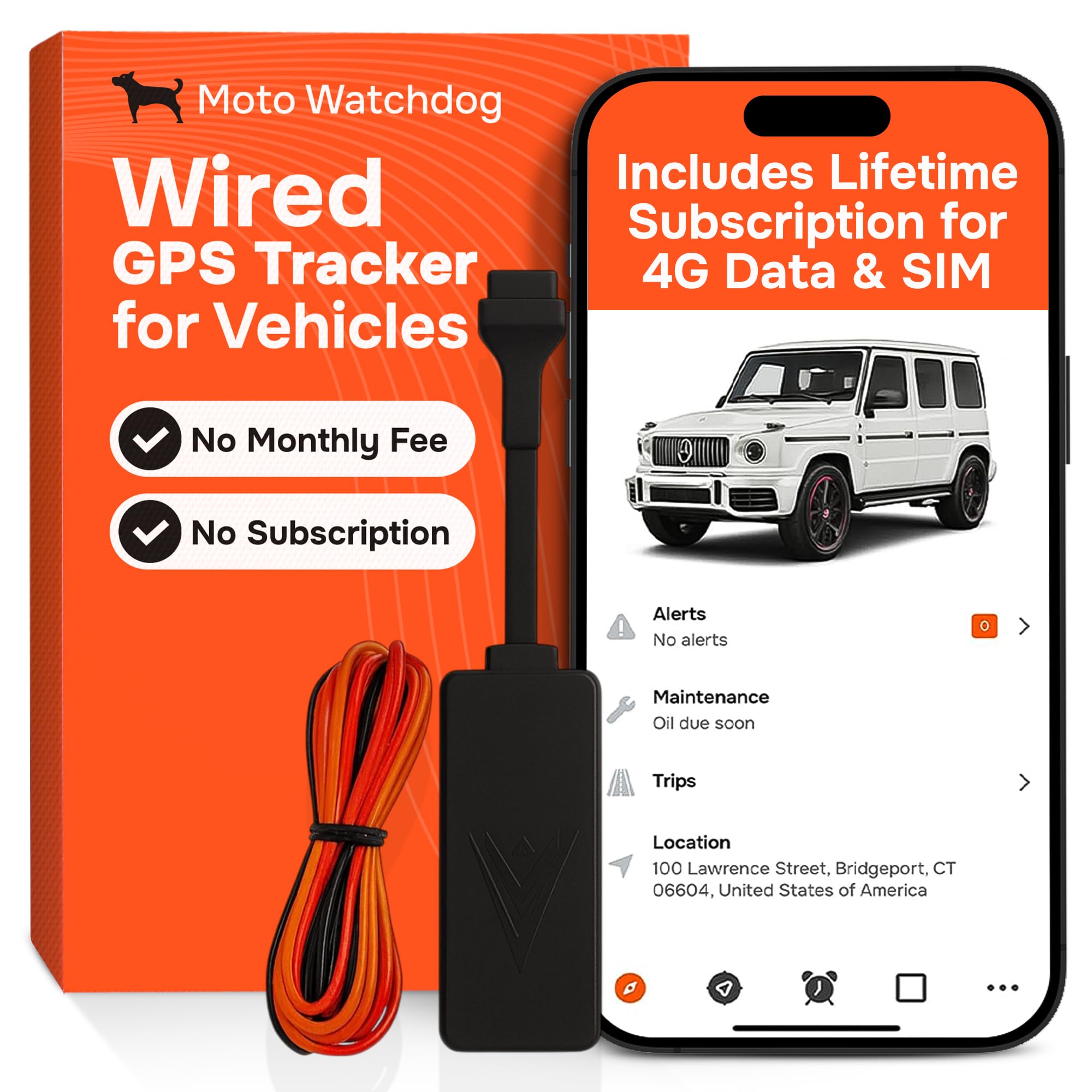
The Moto Watchdog is a hardwired vehicle GPS tracker with zero subscription fees — you pay once for the hardware and get lifetime cellular tracking with no activation or monthly charges. It’s intended for fleet management and monitoring teen drivers, but its use case extends to tracking dogs that ride in vehicles, such as hunting dogs in trucks or service dogs in vans. The unit runs off the vehicle’s 12V power, so there’s no battery to charge, and it goes to sleep minutes after the ignition cuts off to avoid draining the battery.
Setup is a simple two-wire connection (red to positive, black to negative) with an optional orange wire for ignition detection. The app provides real-time location, speed monitoring, route history, geofence alerts, and push notifications. It works in 140+ countries and supports fleet tracking from a single screen. The SIM card is included and the cellular data plan is lifetime — you never add it to your monthly bills.
The obvious limitation for dog owners is that this only tracks the vehicle, not the dog directly. If your dog is inside a kennel crate in the truck bed, you’ll know the truck’s location but not the dog’s if it bolts out during a stop. For tracking hunting dogs that ride in the back of a truck and deploy to the field, pair this with a GPS dog collar for vehicle-level security. The unit is also water-resistant but not fully submersible, so mounting it in a dry engine bay or under-dash location is essential.
Why it’s great
- No subscription fees – lifetime cellular service included
- Hardwired, no battery to recharge
- Real-time location, speed alerts, and geofencing
Good to know
- Tracks the vehicle, not the dog directly
- Requires hardwiring to vehicle power
- Not fully submersible, keep in a dry location
FAQ
Can I use a GPS tracker for a dog that swims or plays in water?
Do all GPS dog trackers require a monthly subscription?
Final Thoughts: The Verdict
For most users, the best gps tracker for dogs winner is the Dogtra Pathfinder 2 because it combines hunting-grade range, no subscription fees, and a 2-second update rate that shows exactly where your dog is in near real time. If you want a dedicated training collar with 136-hour battery life and prefer a handheld remote over a phone app, grab the Garmin Alpha TT 25. And for true remote-area tracking where zero cell service exists and you need a six-week battery on the collar, nothing beats the Marco Polo Pet Monitor.