
A GPS watch for hiking needs to do more than just track a route — it has to survive the elements, hold a charge for multiple days, and lock onto satellites under dense tree canopy or deep in a canyon. The wrong pick leaves you with a dead screen at the trailhead or a washed-out display you can’t read in direct sun.
I’m Mohammad Maruf — the founder and writer behind Drink4Good. I’ve spent years analyzing consumer-grade and expedition-ready wearable hardware, focusing on battery endurance, satellite lock speeds, and display readability under real-world outdoor conditions.
Whether you are planning a weekend day hike or a week-long backcountry traverse, finding the right gps watch for hiking comes down to balancing navigation tools, battery life, and rugged durability without overpaying for features you will never use.
How To Choose The Best GPS Watch For Hiking
Picking a hiking watch is different from picking a running watch. You need reliable navigation when you are miles from a trail marker, a battery that outlasts your trip, and a case that can take a rock scrape without cracking. Here are the core specs to focus on before you buy.
Multi-Band GPS and Satellite Support
Standard single-band GPS struggles in deep forests, narrow valleys, and near cliff faces. Multi-band GPS (L1 + L5) locks onto signals from two frequency bands simultaneously, drastically improving accuracy in challenging terrain. Look for support across GPS, GLONASS, Galileo, and BeiDou for the most reliable positioning.
Battery Life in GPS Mode
A watch that lasts two weeks in smartwatch mode may only hold 10 to 20 hours with continuous GPS tracking. For multi-day hikes, you need a model that offers at least 30 hours of GPS endurance — or solar charging to stretch it further. Check the “GPS mode” battery spec, not the typical-use number.
Display Type: AMOLED vs. MIP
AMOLED screens offer vibrant colors and are easier to read in low light, but they consume more power and can wash out in bright sunlight if the brightness isn’t high enough. MIP (Memory in Pixel) displays reflect ambient light and stay crisp under direct sun with minimal battery draw — a strong choice for backpackers who need always-on readability.
Durability and Water Resistance
A hiking watch should withstand drops, bumps, and weather. Look for MIL-STD-810 certification for thermal and shock resistance, and a water rating of at least 10 ATM (100 meters) if you encounter river crossings or heavy rain. Stainless steel bezels and fiber-reinforced polymer cases offer the best protection without excessive weight.
Quick Comparison
On smaller screens, swipe sideways to see the full table.
| Model | Category | Best For | Key Spec | Amazon |
|---|---|---|---|---|
| Garmin Instinct 3 Solar | Premium Solar | Unlimited battery with solar | Multi-band GPS with SatIQ | Amazon |
| Apple Watch Ultra 3 | Premium Cellular | Satellite SOS and safety | Dual-frequency GPS | Amazon |
| Garmin Instinct 2X Solar Tactical | Tactical Solar | Military-grade endurance | 50mm case, 50% more solar | Amazon |
| COROS NOMAD | Adventure MIP | Voice notes and navigation | 50 hours GPS battery | Amazon |
| Amazfit T-Rex 3 | Rugged AMOLED | Extreme temperature resistance | 180 hours GPS mode | Amazon |
| SUUNTO Run | Lightweight GPS | Ultralight day hikes | 36g with textile strap | Amazon |
| Amazfit Active Max | Value AMOLED | 4GB offline storage | 3000-nit display | Amazon |
| Cubitt Terra Rugged | Budget Dual-Band | Entry-level dual-band GPS | Dual-Band GPS (L1+L5) | Amazon |
| G-Shock Rangeman GPR-H1000 | Hybrid Tough | Classic G-Shock durability | Casio hybrid GPS | Amazon |
In‑Depth Reviews
1. Garmin Instinct 3 45mm Solar

The Garmin Instinct 3 brings together the best of rugged build and solar-powered endurance. Its 45mm fiber-reinforced polymer case and metal-reinforced bezel meet MIL-STD-810 standards for thermal and shock resistance, while the 10 ATM water rating handles river crossings and heavy rain without concern. The built-in LED flashlight with variable intensities and strobe modes is a practical tool for pre-dawn starts and emergency signaling on the trail.
Navigation is powered by multi-band GPS with SatIQ technology, which automatically switches between GPS modes to balance accuracy and battery conservation. The 0.9-inch MIP display remains crisp under direct sunlight, and the solar charging lens extends battery life indefinitely under typical outdoor use — real-world reports show over 38 days of smartwatch use out of the box. Garmin Pay adds convenience for resupply stops without carrying a wallet.
Health monitoring includes wrist-based heart rate, Pulse Ox, advanced sleep tracking, and HRV status derived from Firstbeat Analytics. The Connect IQ Store allows customization with third-party watch faces and data fields tailored to hiking. Some users note the monochrome MIP display lacks the visual punch of AMOLED, but for pure backcountry reliability, this tradeoff is easy to accept.
Why it’s great
- Solar charging delivers effectively unlimited battery life in outdoor use
- Multi-band GPS with SatIQ optimizes accuracy and power draw
- MIL-STD-810 certified and 10 ATM water rated for extreme conditions
- Built-in LED flashlight with SOS strobe adds real trail utility
Good to know
- MIP display is monochrome — no color maps or vibrant graphics
- No onboard music storage or offline map details
- Requires Garmin Connect app running in background for phone sync
2. Apple Watch Ultra 3
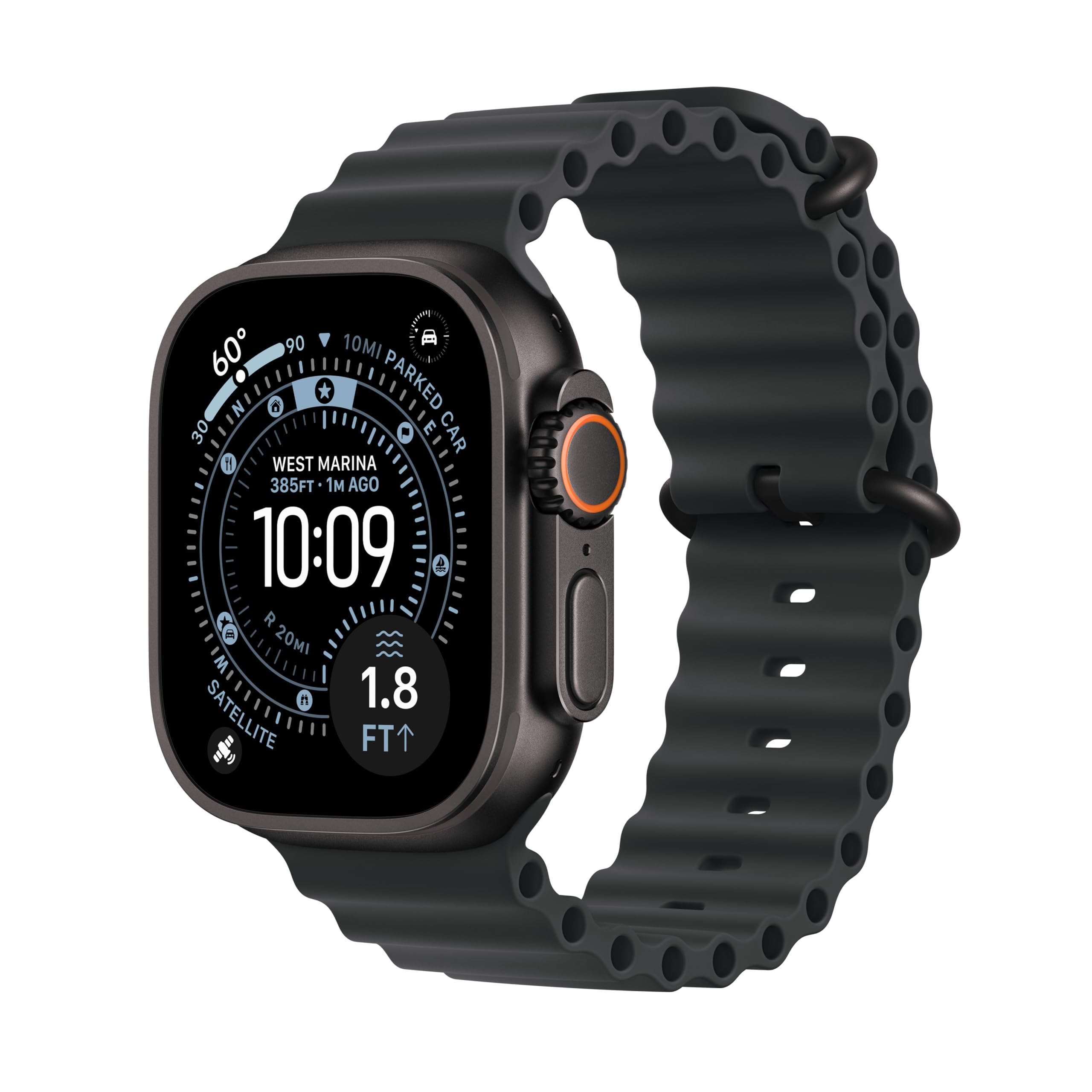
The Apple Watch Ultra 3 is the most feature-dense hiking watch on this list, packing a rugged titanium case, a sapphire crystal display, and 100-meter water resistance into a 49mm package. Its standout feature for backcountry security is satellite communications — when you are out of cellular range, you can text emergency services via satellite directly from your wrist. The dual-frequency GPS delivers precise tracking even in dense forest or urban canyons.
Battery life reaches up to 42 hours of normal use and up to 72 hours in Low Power Mode, with 20 hours of full GPS and heart rate monitoring in Low Power Mode. The customizable Action Button lets you start a hike or mark a waypoint with one press, and the 5G cellular connectivity means you can make calls and stream music without your phone. The 3000-nit display remains readable in direct sunlight, and the built-in speaker is loud enough for trail-side alerts.
Health tracking is comprehensive — sleep apnea detection, irregular rhythm notifications, blood oxygen readings, and the Vitals app for daily health status. The Ultra 3 also includes fall and crash detection, which can automatically alert emergency contacts if you take a hard spill. The main drawbacks are its reliance on an iPhone for full functionality and the premium price point that exceeds most dedicated hiking watches.
Why it’s great
- Satellite SOS and messaging work without any cellular signal
- Dual-frequency GPS with 3000-nit display for all-light readability
- 100m water resistance and titanium case for extreme durability
- Full cellular connectivity for calls and music without a phone
Good to know
- Requires an iPhone for setup and full feature use
- Battery life lags behind dedicated solar-powered hiking watches
- Metal bands can scratch the sapphire crystal — use silicone straps
3. Garmin Instinct 2X Solar – Tactical Edition

The Garmin Instinct 2X Solar Tactical Edition is built for users who need maximum endurance in a MIL-STD-810 certified body. Its 50mm fiber-reinforced polymer case houses a Power Glass solar lens that produces 50% more energy than the standard Instinct 2 Solar — real-world users report over 40 days of battery life in smartwatch mode and enough charge to complete 10-day backpacking trips with daily GPS tracking. The built-in LED flashlight with SOS strobe is a practical feature for night navigation and emergency signaling.
Navigation is handled by multi-band signal reception and a 3-axis compass with barometric altimeter. The Tactical Edition also includes a ballistics calculator and Jumpmaster mode for military applications, but the core hiking features — GPS tracking, waypoint navigation, and breadcrumb trails — are the same as the standard model. The 26mm silicone band fits comfortably despite the large case, and the buttons are operable with gloves on.
Health monitoring covers wrist-based heart rate, Pulse Ox, advanced sleep monitoring, and respiration tracking. HRV status derived from Firstbeat Analytics gives you a clear picture of recovery between long days on the trail. The monochrome MIP display is the tradeoff — it offers excellent sunlight readability but lacks the color detail of AMOLED maps. For pure battery confidence and ruggedness, this watch is hard to beat.
Why it’s great
- Solar charging yields 40+ days of battery in typical use
- Multi-band GPS ensures reliable tracking in heavy cover
- MIL-STD-810 certified with 50mm rugged case
- LED flashlight with SOS strobe for emergency visibility
Good to know
- Monochrome MIP display — no color maps
- Large 50mm case may feel bulky on smaller wrists
- No onboard music or full offline map support
4. COROS NOMAD Outdoor GPS Smartwatch
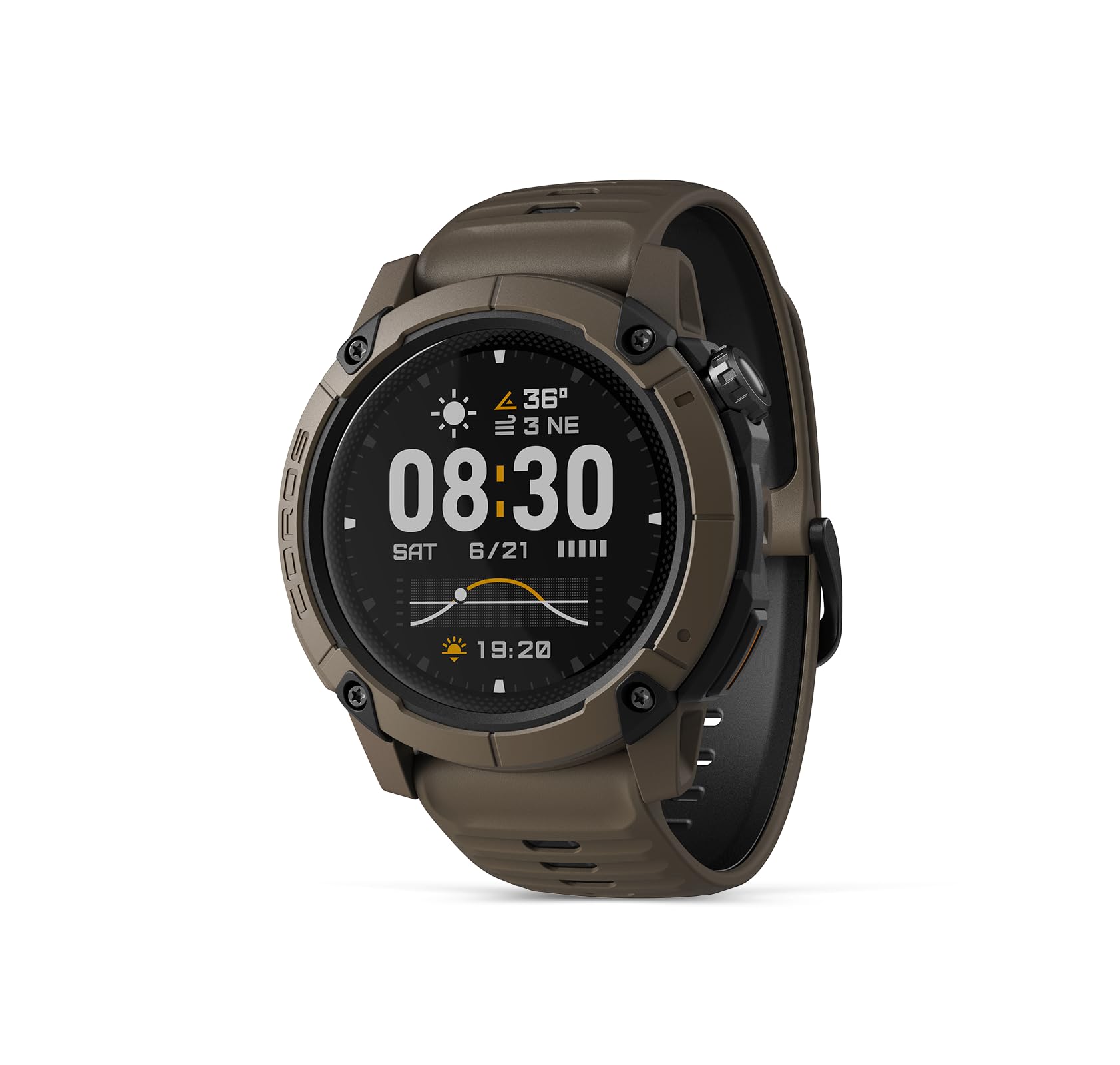
The COROS NOMAD takes a unique approach by combining serious navigation hardware with a built-in Adventure Journal that records voice notes, tags locations, and transcribes voice-to-text memos during activities. The 1.3-inch MIP touchscreen delivers high contrast in direct sunlight and deep color saturation in low light, making it versatile across different lighting conditions. The dual-layer polymer and aluminum alloy bezel keeps weight down while maintaining toughness.
Battery performance is exceptional — 50 hours of continuous GPS tracking and 22 days of daily use. The pre-loaded global maps include street names, and the turn-by-turn navigation works offline without a cellular connection. Additional features include real-time weather data, tide and moon phase information, safety alerts, and a Back-to-Start navigation function that helps you retrace your route if you lose the trail.
The Adventure Journal is genuinely useful — you can record a voice memo at a scenic overlook, tag the GPS coordinates, and later review your journey with photos and notes synced to the app. Some users note the MIP display brightness is moderate compared to high-end AMOLED screens, but the battery savings make it a fair trade for multi-day trips. The COROS app provides detailed activity analysis without a subscription.
Why it’s great
- 50 hours of GPS battery for multi-day backcountry trips
- Adventure Journal with voice memos and GPS tagging
- Free pre-loaded global maps with offline navigation
- Lightweight dual-layer construction with aluminum bezel
Good to know
- MIP display brightness is moderate compared to AMOLED
- No music storage or contactless payment support
- Touchscreen can be less responsive with wet fingers
5. Amazfit T-Rex 3

The Amazfit T-Rex 3 is engineered for extreme environments, with a 316L stainless steel bezel and the ability to operate between -22°F and 158°F. It is water-resistant to 328 feet and certified for freediving to 147 feet, making it one of the most capable water-rated watches in this class. The 1.5-inch AMOLED display peaks at 2,000 nits, ensuring map and workout data remain readable even under harsh midday sun. Glove Mode and Night Mode further enhance usability in varied outdoor conditions.
Battery endurance is a strong point — up to 27 days of typical use and 180 hours in GPS mode. The dual-band positioning supports six satellite systems for fast, accurate GPS lock, and the free global offline maps provide turn-by-turn navigation without a phone connection. The 170+ workout modes cover everything from hiking and trail running to surfing and freediving.
AI-generated training plans adapt to your performance and recovery, and the Zepp app provides detailed workout analysis. The watch is comfortable despite its size, though some users note the charging speed is slower than Garmin’s. The lack of a speaker means no call or voice reply functionality, but for pure navigation and fitness tracking in extreme conditions, the T-Rex 3 delivers exceptional value.
Why it’s great
- Operates reliably from -22°F to 158°F with stainless steel bezel
- 180 hours of GPS battery for extended expeditions
- 2,000-nit AMOLED display readable in direct sunlight
- 328-foot water resistance with freediving certification
Good to know
- No built-in speaker for calls or voice replies
- Charging is slower than competing premium models
- Large case may feel heavy for ultralight backpackers
6. SUUNTO Run Sports Watch
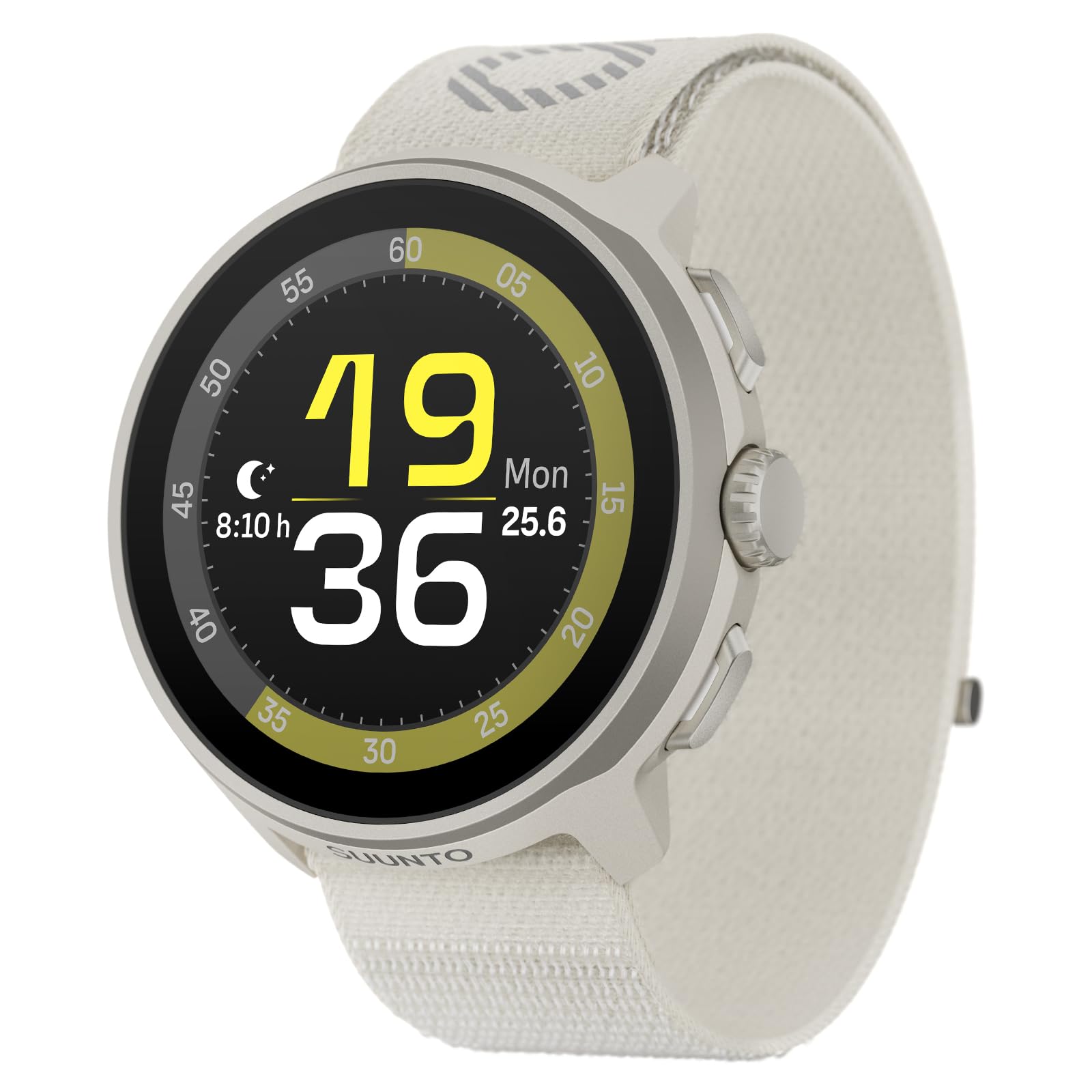
The SUUNTO Run weighs just 36 grams with the textile velcro strap, making it the lightest watch on this list — an important advantage for fast-and-light day hikes and trail running. Despite its low weight, it packs a 1.32-inch AMOLED touchscreen with a crown button and dual-band GPS for accurate tracking in city, countryside, and outdoor environments. The Breadcrumb Trail and navigation features let you retrace your route without getting lost.
Battery life reaches up to 12 days in smartwatch mode and 23 hours in high-precision GPS mode, with fast charging that replenishes the battery in about one hour. The watch tracks training load, post-exercise heart rate, and Training Stress Score (TSS) to help you manage effort on multi-day adventures. Multiple sport modes include hiking, cycling, yoga, tennis, and boxing, making it versatile beyond just hiking.
The SUUNTO App provides detailed performance analysis, and the watch integrates seamlessly with popular fitness platforms. Some users find the app lacks weekly or monthly target customization, and sleep tracking accuracy is described as adequate rather than exceptional. The 4GB offline music storage is a nice bonus for trail listening, but the absence of NFC payments limits its utility for unsupported resupply stops.
Why it’s great
- Ultra-light 36g design ideal for fast day hikes and trail runs
- Dual-band GPS with Breadcrumb Trail for reliable navigation
- Fast charging reaches full in under one hour
- 23 hours of GPS battery covers extended day trips
Good to know
- Sleep tracking accuracy is modest compared to dedicated sleep trackers
- No NFC payments for trail-side purchases
- App lacks customizable weekly or monthly training targets
7. Amazfit Active Max
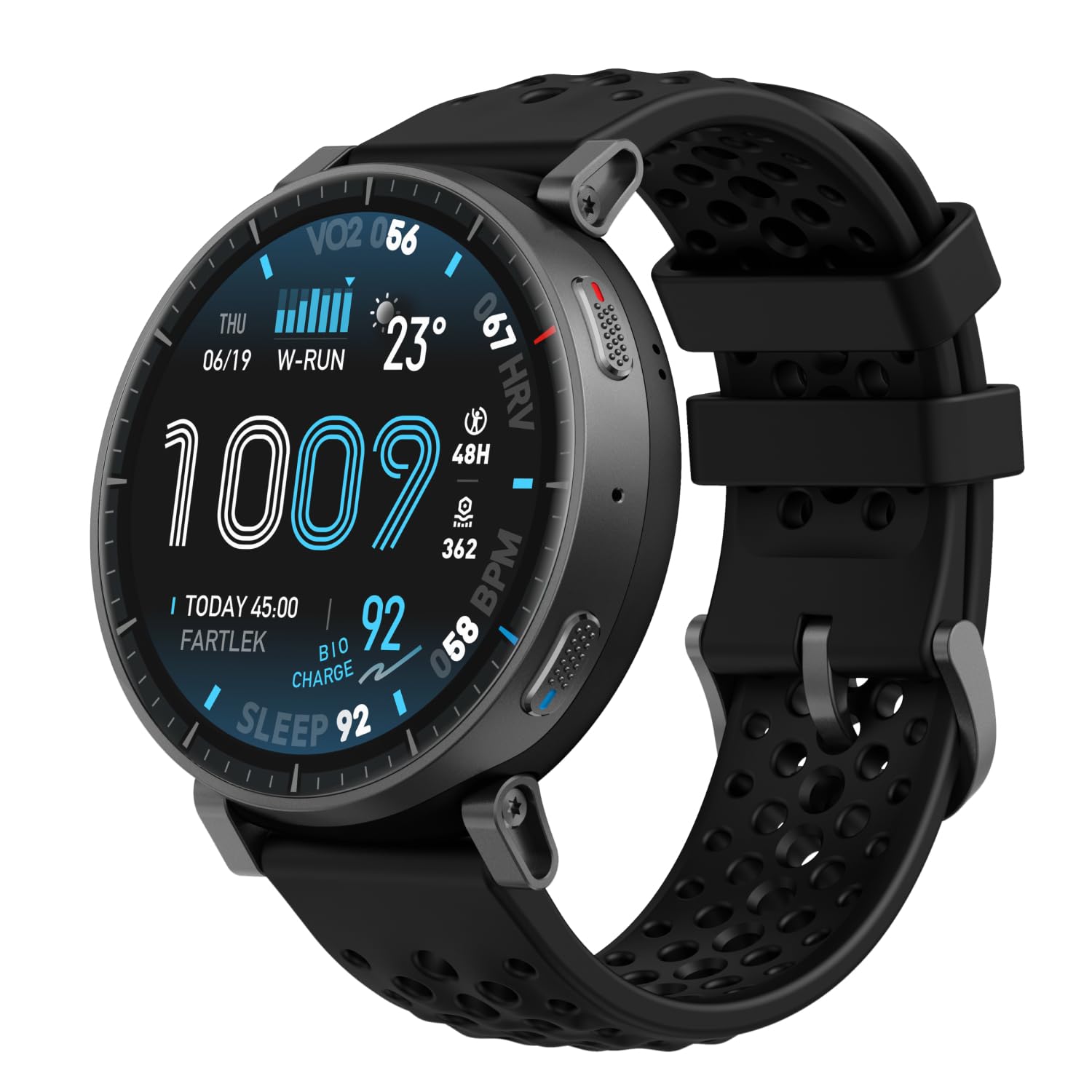
The Amazfit Active Max punches well above its price point with a 1.5-inch AMOLED display that hits an extraordinary 3,000 nits of peak brightness — brighter than most premium smartwatches. This makes it exceptionally easy to read in direct sunlight on the trail. The 4GB of onboard storage lets you load music and download offline maps with turn-by-turn directions, all accessible from your wrist without a phone.
Battery life reaches up to 25 days in typical use, and the BioCharge Energy Monitoring score helps you decide when to push harder and when to rest based on your daily workouts and stress levels. The watch supports 170+ workout modes and integrates with the Zepp Coach for personalized AI-driven training plans. Five satellite positioning systems ensure fast and accurate GPS lock, and the free downloadable terrain and ski maps work offline.
Bluetooth calling and Zepp Flow voice control let you stay connected on the trail, though Android users get richer messaging functionality than iOS users. The 5 ATM water resistance handles rain and stream crossings but is not suitable for scuba diving. Some users note the Zepp app does not sync data to MyFitnessPal, which may be a limitation for those who track nutrition alongside activity.
Why it’s great
- 3,000-nit AMOLED display is the brightest in this class
- 4GB storage for offline music and downloaded maps
- 25-day battery life with fast charging
- AI-driven Zepp Coach for personalized training plans
Good to know
- No MyFitnessPal integration for nutrition tracking
- Messaging features are richer on Android than iOS
- 5 ATM water rating is sufficient but not for diving
8. Cubitt Terra Rugged Smartwatch
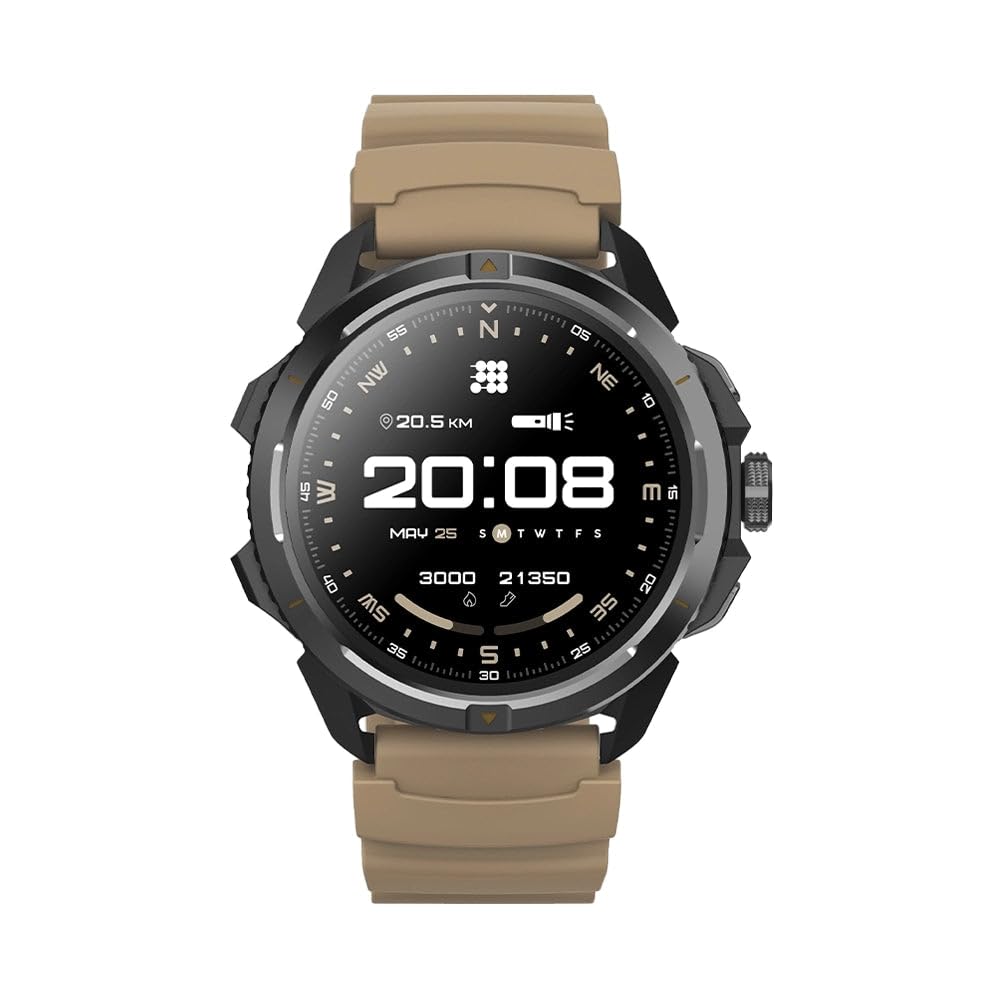
The Cubitt Terra Rugged Smartwatch brings dual-band GPS (L1 + L5) to a budget-friendly price point, supporting five GNSS systems for improved accuracy in remote and urban environments. The 1.48-inch AMOLED display with auto-brightness and 24-bit true color adapts to different lighting conditions, and the rugged case is built to resist heat, cold, shocks, and everyday wear. A built-in flashlight adds practical utility for camping and night navigation.
The 530 mAh battery delivers up to 14 days of typical use or 26 hours with continuous GPS tracking. Advanced health sensors cover 24/7 heart rate, SpO₂, VO₂ Max, body temperature, stress, menstrual cycle, and sleep analysis with Sleep Score. The VITA AI assistant and AI Coach provide voice-guided workout support, and Bluetooth 5.3 enables calling, smart notifications, and offline music playback with direct TWS connection.
User reviews highlight the excellent battery life and clean software interface, though the built-in speaker is described as loud but mediocre for calls. The watch pairs with both Android and iOS devices, and firmware updates have improved performance since launch. Some users note the health data quality is superior to more expensive watches and rings, making this a compelling entry point for hikers who want dual-band GPS without spending at the premium tier.
Why it’s great
- Dual-band GPS at a budget-friendly entry price
- 530 mAh battery provides 14 days of typical use
- VITA AI assistant with voice-controlled workout guidance
- Rugged case resists heat, cold, and shock
Good to know
- Speaker quality is mediocre for phone calls
- GPS battery life is 26 hours — adequate but not exceptional
- Build quality may not match premium-tier rugged watches
9. G-Shock CASIO Rangeman GPR-H1000

The G-Shock Rangeman GPR-H1000 is a hybrid that marries Casio’s legendary G-Shock toughness with modern GPS and heart rate tracking. It is built to survive drops, shocks, and submersion to 150 meters, making it one of the most physically durable watches on this list. The MIP display offers excellent sunlight readability, and the negative display option reduces glare in bright conditions. GPS lock typically takes about 10 seconds, which is competitive with dedicated sports watches.
Battery life with always-on heart rate monitoring and daily workouts ranges from 12 to 15 days. The Casio Watches app transfers workout data, steps, and heart rate to Apple Health and Strava, though the app itself is described as basic but functional. Sleep tracking provides a quality score and ANS strain insight, but results do not sync to Apple Health — a limitation for ecosystem users.
The barometer, compass, and thermometer sensors are present but reviewers note the compass requires frequent recalibration and the tide display is basic. For hikers who prioritize indestructible build quality over advanced software features, the Rangeman delivers Casio’s signature reliability. However, at its premium price, a mid-range Garmin offers more sophisticated navigation tools and a better fitness tracking experience.
Why it’s great
- Legendary G-Shock durability with 150m water resistance
- MIP display is highly readable in direct sunlight
- Integrates with Apple Health and Strava for activity data
- Comfortable negative display with excellent strap quality
Good to know
- Software and app are basic compared to Garmin or COROS
- Compass requires frequent recalibration
- Sleep data does not sync to Apple Health
- Premium price does not include offline maps or advanced navigation
FAQ
Do I need multi-band GPS for day hikes on well-marked trails?
How many hours of GPS battery do I need for a weekend backpacking trip?
Can I use a hiking GPS watch for swimming and water sports?
Final Thoughts: The Verdict
For most users, the gps watch for hiking winner is the Garmin Instinct 3 Solar because it balances unlimited battery via solar charging, multi-band GPS accuracy, and MIL-STD-810 ruggedness at a mid-range price. If you want satellite SOS safety and deep Apple ecosystem integration, grab the Apple Watch Ultra 3. And for extreme temperature endurance with the brightest AMOLED display available, nothing beats the Amazfit T-Rex 3.