
Pairing a GPU with the AMD Ryzen 5 9600X is a balancing act — this processor delivers strong single-threaded gaming performance, but its PCIe 5.0 support and power efficiency mean you can slot in anything from a competent 1080p card to a 4K monster without bottleneck concerns. The challenge is matching the right tier of graphics horsepower to your resolution and frame-rate targets.
I’m Mohammad Maruf — the founder and writer behind Drink4Good. I’ve spent countless hours analyzing GPU benchmarks, power draw data, and real-world gaming results across the latest RTX 50-series and Radeon RX 9000-series to find which cards truly shine alongside the 9600X.
Whether your goal is 1080p esports dominance, maxed-out 1440p AAA gaming, or a future-proof 4K setup, this guide breaks down the nine strongest contenders to help you pick the right gpu for 9600x based on real hardware specifications and validated performance.
How To Choose The Best GPU For 9600X
The 9600X handles high frame-rate gaming without breaking a sweat, but your choice of GPU determines what resolution and visual quality you can realistically expect. Focus on three core factors: VRAM capacity for your target resolution, the upscaling ecosystem (DLSS 4 versus FSR 4), and the physical dimensions of the card to ensure it fits your case.
VRAM: The Resolution Gatekeeper
An 8GB card like the RTX 5060 is adequate for 1080p high-refresh gaming, but textures in modern AAA titles already push past that buffer at 1440p. For 1440p high/ultra settings, 12GB is the practical minimum, while 16GB gives you headroom for 4K textures and future titles. If you plan to keep this pairing for three to five years, prioritize 16GB cards like the RX 9060 XT or RX 9070 XT.
Upscaling Technology: DLSS 4 vs. FSR 4
NVIDIA’s DLSS 4 with Multi Frame Generation smooths 1% lows dramatically on the RTX 50-series, making a 12GB RTX 5070 feel smoother than its raw rasterization suggests. AMD’s FSR 4 on RDNA 4 cards offers improved image quality over FSR 3 but still trails DLSS in temporal stability. If ray tracing matters, DLSS 4 is the clear winner; if pure raster value matters, AMD’s 16GB options dominate the mid-range.
Physical Fit and Power Requirements
High-end cards like the PowerColor Red Devil RX 9070 XT stretch over 340mm and require 900W power supplies. The 9600X itself is power-efficient (65W TDP), so you can pair it with almost any GPU, but triple-fan cards exceeding 2.5 slots may block front-panel USB headers in mATX cases. Always measure your case clearance and confirm your PSU has the appropriate PCIe power connectors.
Quick Comparison
On smaller screens, swipe sideways to see the full table.
| Model | Category | Best For | Key Spec | Amazon |
|---|---|---|---|---|
| ASUS Dual RTX 5060 | Entry-Level | 1080p competitive gaming | 8GB GDDR7, 623 AI TOPS | Amazon |
| XFX Swift RX 9060 XT | Mid-Range | 1080p max settings/1440p high | 16GB GDDR6, 3320 MHz boost | Amazon |
| GIGABYTE RX 9060 XT Gaming OC | Mid-Range | 1440p ultra with quiet cooling | 16GB GDDR6, WINDFORCE fans | Amazon |
| ASUS Prime RX 9060 XT | Mid-Range | Silent 1440p gaming | 16GB GDDR6, Dual BIOS | Amazon |
| PNY RTX 5070 Epic-X ARGB | Upper-Mid | 1440p max with DLSS 4 | 12GB GDDR7, 2685 MHz boost | Amazon |
| GIGABYTE RTX 5070 WINDFORCE | Upper-Mid | 1440p high-refresh, compact build | 12GB GDDR7, SFF-ready | Amazon |
| ASRock Challenger RX 9070 XT | Premium | 1440p ultra/4K entry | 16GB GDDR6, 2970 MHz boost | Amazon |
| Sapphire Nitro+ RX 9070 XT | Premium | 4K gaming with quiet operation | 16GB GDDR6, 3060 MHz boost | Amazon |
| PowerColor Red Devil RX 9070 XT | Enthusiast | Maxed 1440p ultrawide/4K | 16GB GDDR6, three 8-pin power | Amazon |
In‑Depth Reviews
1. PNY NVIDIA GeForce RTX 5070 Epic-X ARGB OC Triple Fan
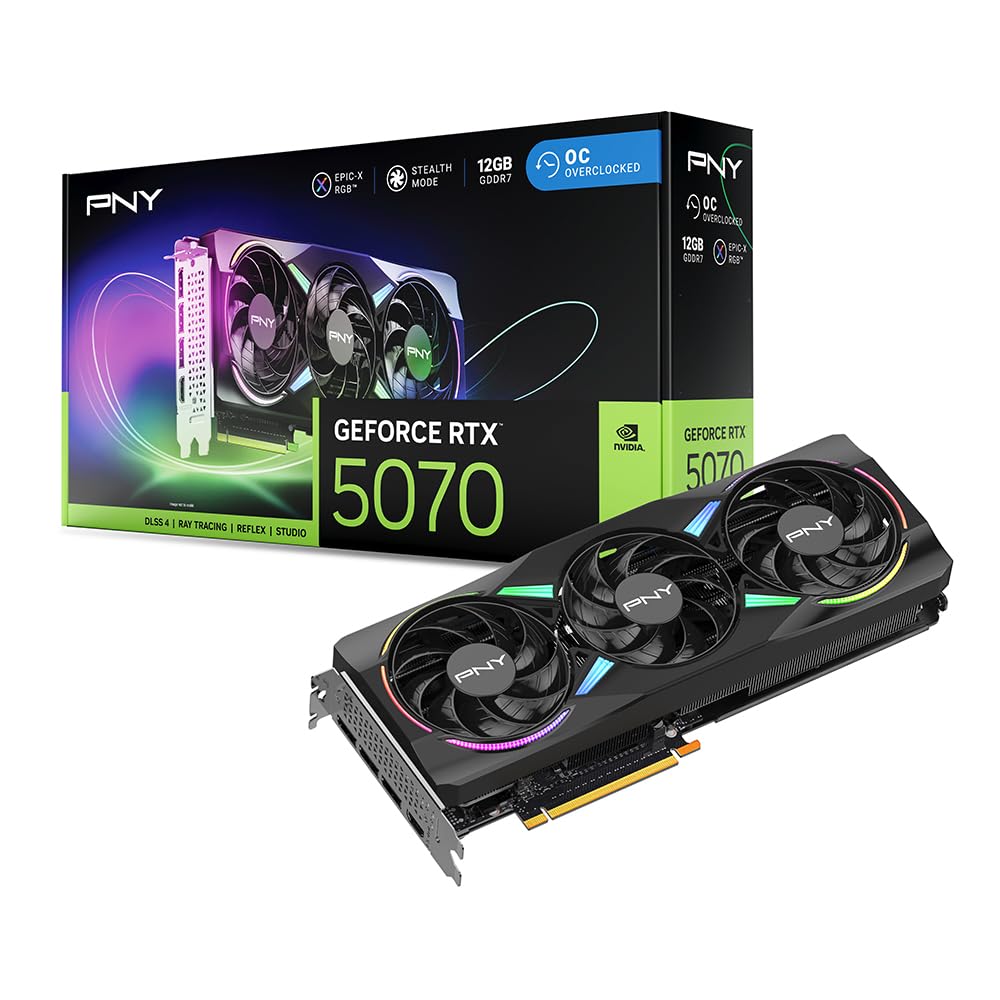
The PNY RTX 5070 Epic-X hits the sweet spot for the 9600X by offering Blackwell architecture, 12GB of GDDR7 memory, and full DLSS 4 support without jumping to flagship pricing. With a boost clock of 2685 MHz and a 192-bit memory bus delivering up to 672 GB/s of bandwidth, this card handles 1440p max settings in titles like Cyberpunk 2077 and Hogwarts Legacy with ease. The triple-fan cooler keeps thermals well under control, and the 2.4-slot profile means it fits in most ATX cases without crowding the front panel.
What sets this card apart for 9600X owners is Multi Frame Generation — DLSS 4 smooths 1% lows dramatically, making even demanding scenes feel fluid. Owners report excellent 1440p performance, quiet operation, and stable overclocking headroom right out of the box. The 8% factory overclock provides tangible gains over reference specs, and the included dual 8-pin to 12-pin adapter ensures compatibility with existing power supplies.
If you are building a balanced 1440p high-refresh system around the 9600X, the PNY RTX 5070 delivers the best combination of raw rasterization, ray tracing capability, and upscaling polish at this tier. The 12GB VRAM buffer is sufficient for current titles at 1440p, though future games may push closer to the limit — still, the performance per watt here is exceptional.
Why it’s great
- DLSS 4 Multi Frame Generation dramatically smooths 1% lows
- Quiet, efficient triple-fan cooler with good thermal headroom
- 8% factory OC provides tangible real-world gains over reference
Good to know
- 12GB VRAM may limit ultra textures in future 1440p titles
- Requires 750W power supply and 12-pin adapter
2. Sapphire 11348-01-20G Nitro+ AMD Radeon RX 9070 XT Gaming OC

The Sapphire Nitro+ RX 9070 XT is a premium interpretation of AMD’s RDNA 4 architecture, delivering a 3060 MHz boost clock and 16GB of GDDR6 on a 256-bit bus. Paired with the 9600X’s PCIe 5.0 support, this card achieves excellent 4K gaming performance at ultra settings, with owners noting zero coil whine and whisper-quiet operation even under extended load. The triple-fan cooler and substantial heatsink keep junction temperatures in check without aggressive fan curves.
Benchmarks show a 60-90% performance uplift over previous-gen cards like the RX 6750 XT, with significantly improved 1% lows thanks to the RDNA 4 architecture and FSR 4 support. The card is large — over 300mm and occupying three slots — so measure your case carefully. The included GPU support bracket is necessary to prevent sag, and a minimum 850W power supply is recommended for stability.
For 1440p high-refresh or 4K gaming, the Nitro+ provides generous VRAM headroom that the RTX 5070’s 12GB buffer cannot match. The trade-off is slightly weaker ray tracing performance compared to NVIDIA’s DLSS 4 ecosystem, but for pure raster value and future-proof memory capacity, this is a top-tier pairing for the 9600X.
Why it’s great
- 16GB VRAM provides substantial headroom for 4K textures
- Quiet, premium cooling with zero coil whine reported
- Excellent 1440p and capable 4K performance with RDNA 4
Good to know
- 3-slot design requires a spacious case and support bracket
- Ray tracing performance trails NVIDIA’s DLSS 4 implementation
3. PowerColor Red Devil AMD Radeon RX 9070 XT 16GB GDDR6

PowerColor’s Red Devil RX 9070 XT is an enthusiast-grade card built for maximum cooling and overclocking headroom. It measures 340mm and requires three 8-pin power connectors, making it the most demanding card on this list in terms of case and PSU requirements. With 16GB of GDDR6 and a robust triple-fan heatsink, it runs exceptionally cool and quiet even during extended gaming sessions at 3440×1440 ultrawide resolution.
Real-world testing shows this card delivering around 200 FPS in Warframe at ultrawide, smooth 1440p performance in Stalker 2 and Cyberpunk 2077 with FSR 4 enabled, and stable temperatures that rarely crest 70°C under load. The included addressable RGB lighting and graphics card holder add to the premium feel, though the card’s size eliminates compatibility with smaller mATX builds and some mid-tower cases.
If your 9600X build lives in a full-tower case with a 900W+ power supply, the Red Devil offers the highest raw performance ceiling among the RX 9070 XT options. The triple 8-pin power delivery ensures stable overclocking, and the 16GB VRAM buffer handles 4K textures with ease. Just ensure your case has sufficient depth — this card extends well past standard ATX dimensions.
Why it’s great
- Excellent cooling keeps temps below 70°C under sustained load
- 16GB VRAM handles 4K textures and ultrawide resolutions
- Includes physical GPU support bracket to prevent sag
Good to know
- 340mm length requires a full-tower case at minimum
- 900W power supply recommended for stable operation
4. ASRock Radeon RX 9070 XT Challenger 16GB OC
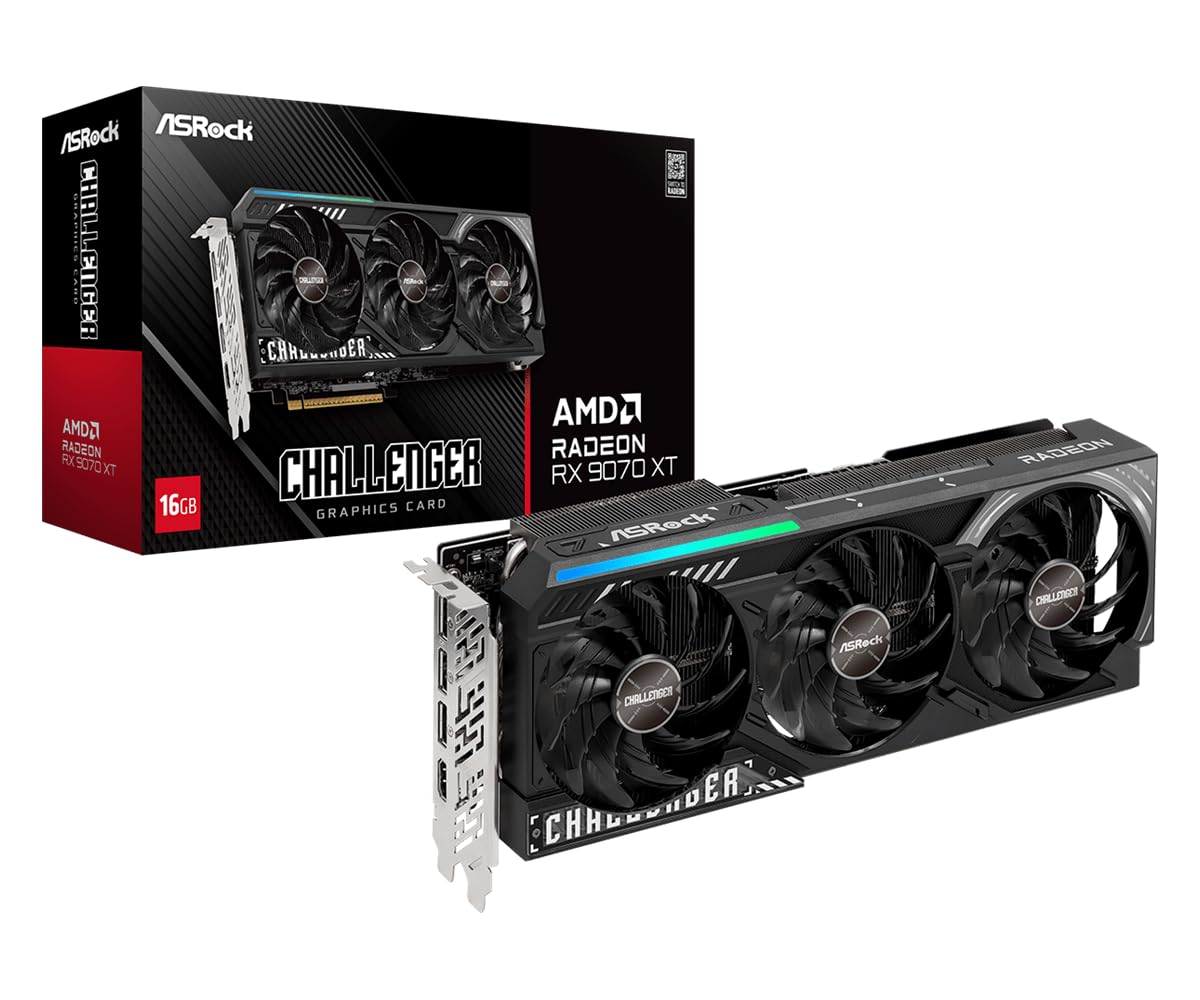
The ASRock Challenger RX 9070 XT offers a more accessible entry point into RDNA 4 performance while still delivering 2970 MHz boost clocks and 16GB of GDDR6. Its triple-fan cooling system with striped axial fan technology and 0dB silent mode means the fans stop completely during low-load scenarios, making it ideal for desktop work and light gaming. The physical LED switch on the card lets you control lighting without proprietary software.
Users pairing this card with a 9600X3D report maxed-out 1440p performance in demanding titles, smooth VR gameplay in No Man’s Sky, and stable operation even after undervolting via Adrenaline software. The card requires a 750W power supply, which aligns well with the 9600X’s 65W TDP. Some owners note the ASRock RGB software can be buggy, but the physical lighting switch mitigates that issue for most users.
For 1440p ultra gaming with an eye toward future 4K experimentation, the Challenger strikes a strong balance between price and performance. The 16GB VRAM buffer gives you texture-quality headroom that the 12GB RTX 5070 cannot match, and the PCIe 5.0 interface ensures no bandwidth bottleneck with the 9600X.
Why it’s great
- 0dB silent cooling stops fans entirely at low loads
- Physical LED switch removes need for software control
- 16GB VRAM provides strong future-proofing for 1440p
Good to know
- ASRock RGB software can lose connection on some systems
- Requires 750W+ power supply for stable operation
5. GIGABYTE GeForce RTX 5070 WINDFORCE OC SFF 12G

GIGABYTE’s RTX 5070 WINDFORCE is the compact option for 9600X builds where case space is limited. At 11.1 inches long and just 4.33 inches wide, it fits comfortably in smaller ATX and larger mATX cases while still housing a triple-fan WINDFORCE cooling system. The 12GB GDDR7 memory on a 192-bit bus provides 28 Gbps memory speed, and the PCIe 5.0 interface ensures full bandwidth utilization with the 9600X.
Owners upgrading from RTX 2080 Super and RTX 3080 cards report significant temperature improvements — one user noted idle temps around 42°C and full-load operation under 75°C on maxed-out 1440p games. The card is SFF-ready by NVIDIA’s standards, meaning it complies with the small form factor guidelines while delivering Blackwell architecture benefits including DLSS 4 and fourth-gen ray tracing cores.
The trade-off for the compact size is a slightly lower factory clock than some larger RTX 5070 variants, but real-world performance still reaches 180Hz monitor refresh limits at 1440p ultra settings in most titles. The clean, professional aesthetic without RGB makes it a good fit for office or understated gaming builds.
Why it’s great
- Compact SFF-ready design fits smaller cases easily
- Runs under 75°C at full 1440p load with quiet fans
- No RGB — clean, professional aesthetic
Good to know
- 12GB VRAM may limit 4K texture quality in demanding titles
- Lower factory clock than larger RTX 5070 variants
6. GIGABYTE Radeon RX 9060 XT Gaming OC 16G

The GIGABYTE RX 9060 XT Gaming OC delivers compelling value by pairing 16GB of GDDR6 with the WINDFORCE cooling system and PCIe 5.0 support at a mid-range price point. The Hawk fans and server-grade thermal conductive gel keep temperatures low while maintaining zero-RPM mode for silent desktop use. With a boost clock reaching 2700 MHz, this card handles 1440p high and ultra settings with ease.
User feedback highlights excellent 1440p performance in Cyberpunk 2077 and Hogwarts Legacy, with smooth frame pacing and no thermal throttling. The dual-slot design is relatively compact at 11.06 inches, fitting most standard cases without issue. The card includes AV1 encoding support and FSR 4 upscaling, making it versatile for both gaming and content creation workloads on the 9600X.
Ray tracing performance is decent but not class-leading — that is the trade-off for the 16GB VRAM buffer and aggressive pricing. For gamers prioritizing high frame rates at 1440p with ultra textures and moderate ray tracing, this is the most cost-effective option on the list. The standard 8-pin power connector also means no adapter hassle with most power supplies.
Why it’s great
- 16GB VRAM at a mid-range price point is excellent value
- Quiet WINDFORCE cooling with zero-RPM mode
- Standard 8-pin power connector — no adapter needed
Good to know
- Ray tracing performance is decent but not class-leading
- Large 11-inch length may be tight in smaller mATX cases
7. ASUS Prime AMD Radeon RX 9060 XT 16GB GDDR6 OC Edition

The ASUS Prime RX 9060 XT stands out for its dual BIOS feature, letting you toggle between Quiet and Performance profiles without software. The axial-tech fans with dual-ball bearings last up to twice as long as conventional sleeve bearings, and the 2.5-slot design improves case compatibility while maintaining cooling performance. With 16GB of GDDR6 and a claimed GPU clock speed of 7000 MHz, this card is built for sustained 1440p gaming workloads.
3DMark Steel Nomad benchmarks show an average score of 3,696 with stable clock speeds and no thermal throttling, translating to smooth 1080p and 1440p gaming. The 0dB technology stops fans during low-load scenarios, making the card effectively silent for desktop productivity work on the 9600X. Owners appreciate the FSR 4 and AV1 encoder support for both gaming and creative applications.
The primary consideration is value — while the card performs well, its pricing sometimes approaches the RX 9070 XT tier, which offers significantly more raster performance. If you find it at its competitive price point, the dual BIOS flexibility and long-lasting fan bearings make it a solid mid-range choice for the 9600X.
Why it’s great
- Dual BIOS switch lets you choose between quiet and performance modes
- Dual-ball fan bearings provide extended longevity
- 0dB technology enables silent desktop operation
Good to know
- Pricing sometimes approaches RX 9070 XT territory
- Ray tracing performance trails NVIDIA equivalents
8. XFX Swift AMD Radeon RX 9060 XT OC Gaming Edition 16GB
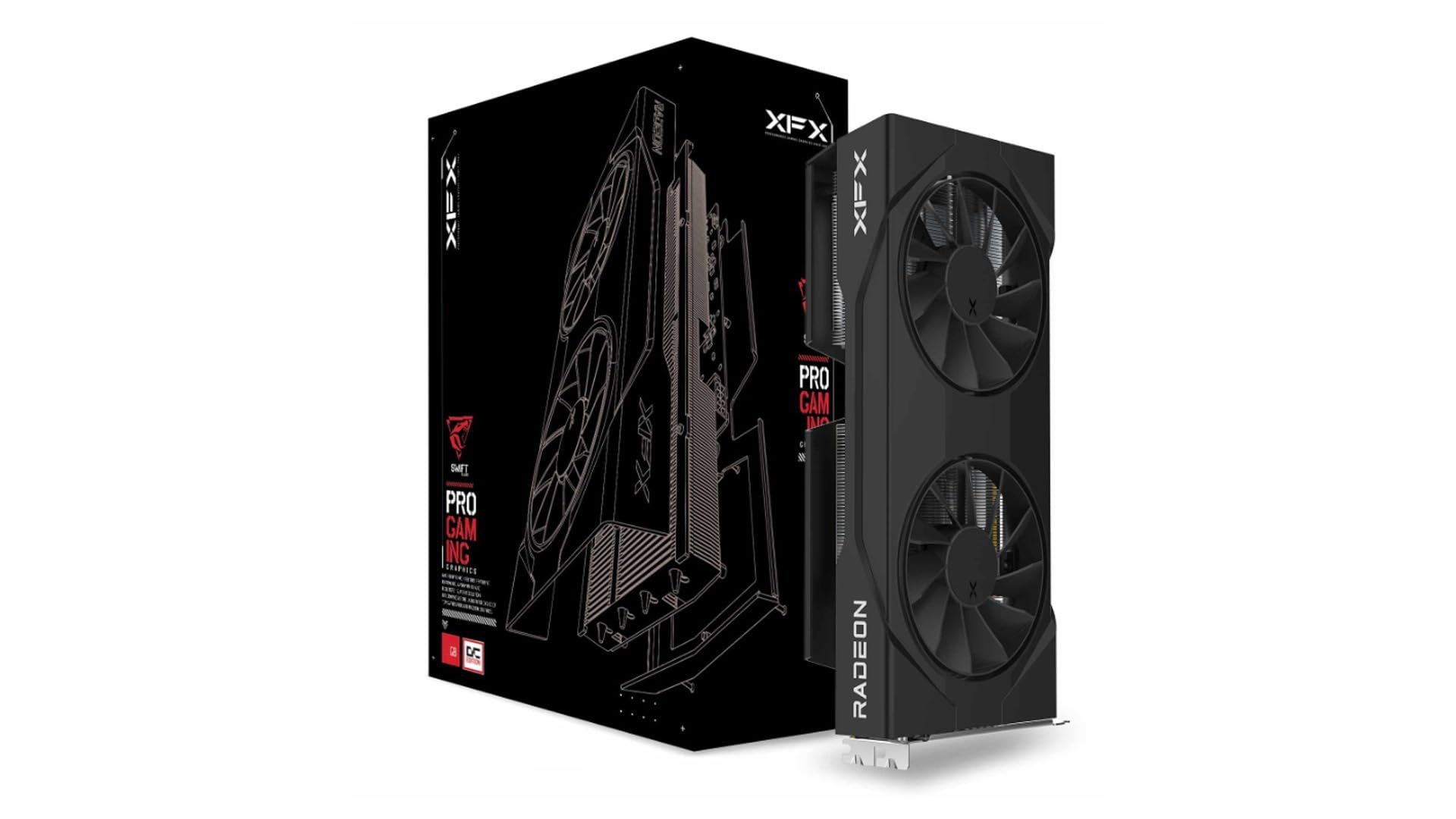
The XFX Swift RX 9060 XT delivers a strong 1080p max-settings experience with enough VRAM headroom to handle 1440p high settings when needed. The SWFT dual-fan cooling solution keeps temperatures around 60°C under load, and the 3320 MHz boost clock provides excellent frequency headroom. At 10.63 inches long, it fits comfortably in most mid-tower cases without the space concerns of larger premium cards.
Owners report Timespy scores around 17,000 and the ability to run 1080p max settings on 95% of modern AAA games, including demanding titles like Crimson Desert. The card is notably power-efficient and super quiet, making it a strong upgrade from previous-generation mid-range cards like the RX 6650 XT. Some users note the display output configuration — 2 DisplayPort and 1 HDMI — may require motherboard HDMI for multi-monitor setups beyond three displays.
For 1080p high-refresh gaming with the 9600X, the XFX Swift provides more VRAM than you strictly need at that resolution, which translates to excellent future-proofing. The 16GB buffer ensures that even when you crank texture quality to ultra, the card handles it without stutter. This makes it a smart pick if you plan to upgrade to a 1440p monitor later.
Why it’s great
- 16GB VRAM provides excellent headroom for ultra textures
- Runs cool at ~60°C with quiet dual-fan cooling
- Strong 1080p max-settings performance across AAA titles
Good to know
- Only 3 display outputs (2 DP + 1 HDMI) limit multi-monitor setups
- Ray tracing performance trails NVIDIA in this price tier
9. ASUS Dual NVIDIA GeForce RTX 5060 8GB GDDR7 OC Edition

The ASUS Dual RTX 5060 is the entry-level option for the 9600X, leveraging the Blackwell architecture with 8GB of GDDR7 memory and a 623 AI TOPS processing capability. Despite the modest VRAM, the GDDR7 memory bandwidth and PCIe 5.0 interface allow this card to punch above its class — TechPowerUp benchmarks show rasterization performance approaching the RTX 2080 Ti and RTX 3070. The 150W TDP makes it highly efficient, and the axial-tech fan design with 0dB technology keeps noise minimal.
This is a dedicated 1080p gaming solution — users report 140 FPS in Fortnite and smooth performance across competitive titles. The SFF-ready design at 9 inches long fits in compact builds, including older 8-year-old prebuilts where users reported seamless compatibility. The 2.5-slot cooler provides adequate thermal management without the bulk of triple-fan designs.
The 8GB VRAM is the clear limitation here — modern AAA titles at 1440p will push past this buffer, causing texture pop-in or forcing medium settings. If your 9600X build is strictly for 1080p competitive gaming or esports titles, the RTX 5060 offers the best bang for your buck. For anyone considering 1440p now or in the future, step up to one of the 16GB cards above.
Why it’s great
- Excellent 1080p competitive gaming performance at low power draw
- GDDR7 memory and PCIe 5.0 provide bandwidth headroom
- SFF-ready compact size fits in older and smaller cases
Good to know
- 8GB VRAM limits texture quality at 1440p in modern titles
- Ray tracing at high settings still penalizes performance heavily
FAQ
Will a 750W power supply handle the RX 9070 XT with a 9600X?
Does the 9600X bottleneck the RTX 5070 at 1440p?
Is 8GB of VRAM enough for a 9600X gaming build?
Final Thoughts: The Verdict
For most users, the gpu for 9600x winner is the PNY RTX 5070 Epic-X because it balances Blackwell architecture, DLSS 4, and 12GB GDDR7 for excellent 1440p performance without the physical footprint of larger premium cards. If you want maximum VRAM capacity and raw raster at 1440p, grab the Sapphire Nitro+ RX 9070 XT. And for budget 1080p gaming, nothing beats the value of the ASUS Dual RTX 5060 with GDDR7 memory.