
Nothing breaks immersion in a VR headset like a frame drop or a stutter that throws off your spatial tracking. You need a graphics card that can deliver consistently high frame rates at the demanding resolutions of modern VR headsets — often above 90 frames per second per eye — without introducing judder or latency. The choice of GPU directly determines whether your virtual experience feels tangible or causes motion sickness.
I’m Mohammad Maruf — the founder and writer behind Drink4Good. I’ve spent hundreds of hours cross-referencing GPU benchmarks, VR-specific compatibility notes, and real-world feedback to identify which graphics cards genuinely deliver on the promise of seamless virtual reality.
This guide breaks down the key specs, compatibility factors, and real-world performance data you actually need to make the right choice for gpu for vr.
How To Choose The Best GPU For VR
Selecting a GPU for virtual reality involves more than just picking the fastest card on a store shelf. VR headsets demand sustained high frame rates at dual high-resolution displays, which places unique stress on a GPU’s rendering pipeline, memory bandwidth, and latency optimization. A card that crushes traditional 4K gaming can still struggle in VR if it lacks the right architectural features.
VRAM Capacity Matters More Than You Think
VR headsets with resolutions above 2160×2160 per eye — like the HP Reverb G2 or Pimax Crystal — can consume over 8 GB of VRAM on heavy titles. Texture streaming at those resolutions fills memory quickly, and once the buffer overflows, stuttering begins. For current-gen headsets, 12 GB is a safe target; 16 GB provides genuine headroom for future titles and higher super-sampling percentages.
Frame Time Consistency Over Peak FPS
In VR, a consistent 90 fps with low frame time variance feels far smoother than a card that spikes to 120 fps but occasionally drops to 72. Look for GPUs that consistently hit frame times under 11 milliseconds. NVIDIA’s Reflex and AMD’s Anti-Lag technologies help reduce render latency, which directly improves the feeling of controller tracking and head movement response inside the headset.
Connection Standards: DisplayPort vs. HDMI
Most PC VR headsets require a DisplayPort 1.4 or HDMI 2.0 connection for full resolution at 90 Hz. Some headsets, like the Valve Index, explicitly need DisplayPort. Ensure your chosen card has at least one DisplayPort 1.4a output and check compatibility with your specific headset’s cable requirements before purchasing.
Quick Comparison
On smaller screens, swipe sideways to see the full table.
| Model | Category | Best For | Key Spec | Amazon |
|---|---|---|---|---|
| ZOTAC RTX 4070 Ti Trinity OC | Premium | High-refresh VR with ray tracing | 12GB GDDR6X / 21 Gbps | Amazon |
| MSI RTX 5070 Ti Gaming Trio OC Plus | Premium | 8K VR and high-super-sampling | 16GB GDDR7 / 28 Gbps | Amazon |
| ASUS RX 9070 XT Prime | Premium | 4K VR with FSR upscaling | 16GB GDDR6 / 4 GHz Boost | Amazon |
| GIGABYTE RX 9070 XT Gaming OC | Premium | 1440p VR with high frame consistency | 16GB GDDR6 / 3060 MHz | Amazon |
| ASUS Prime RTX 5070 | Premium | Small-form-factor VR builds | 12GB GDDR7 / SFF-Ready | Amazon |
| PNY RTX 5070 Epic-X OC | Mid-Range | 1440p VR with DLSS 4 | 12GB GDDR7 / 2685 MHz | Amazon |
| GIGABYTE RTX 5070 Windforce OC | Mid-Range | Quiet VR operation | 12GB GDDR7 / PCIe 5.0 | Amazon |
| XFX Swift RX 9060 XT | Mid-Range | Entry-to-mid-tier VR gaming | 16GB GDDR6 / 3320 MHz | Amazon |
| ASRock RX 7700 XT Challenger | Mid-Range | Silent cooling for VR | 12GB GDDR6 / Dual Fan | Amazon |
| PNY RTX 5060 Epic-X OC | Budget | Entry-level VR with DLSS 4 | 8GB GDDR7 / 2280 MHz | Amazon |
| MSI RTX 2060 Ventus GP OC | Budget | Basic VR with older headsets | 6GB GDDR6 / Turing | Amazon |
In‑Depth Reviews
1. ZOTAC Gaming GeForce RTX 4070 Ti Trinity OC

The RTX 4070 Ti Trinity OC delivers 12 GB of GDDR6X memory at 21 Gbps, providing the bandwidth necessary to handle high-resolution VR headsets without bottlenecking. Its boost clock of 2625 MHz, combined with the Ada Lovelace architecture, ensures frame times stay consistently under 11 milliseconds — a critical threshold for nausea-free VR immersion. The IceStorm 2.0 cooling system with three 90 mm fans keeps thermals under 72°C even during extended VR sessions.
DLSS 3 frame generation proves especially valuable in VR titles that support it, effectively increasing perceived frame rates without adding render latency when Reflex is enabled. The card includes three DisplayPort 1.4a outputs and one HDMI 2.1a, matching the connectivity needs of most modern PC VR headsets. Users report smooth 120 fps performance in sim-heavy VR games like Microsoft Flight Simulator 2020 and Half-Life: Alyx at high settings.
A bundled GPU support stand addresses the card’s significant size, preventing PCB flex and connector stress on the 12VHPWR power interface. The FREEZE Fan Stop mode halts all fan rotation under light loads, so typical desktop work and flat-panel gaming produce no audible noise. VR enthusiasts pairing this with a high-refresh headset like the Valve Index will find the 4070 Ti hits the sweet spot between raw power and power efficiency.
Why it’s great
- Consistent sub-11ms frame times for smooth VR
- Excellent thermal performance under sustained load
- DLSS 3 frame generation boosts VR frame rates
- Quiet fan operation at idle
Good to know
- Requires generous case length for installation
- 12VHPWR connector needs careful cable routing
- Premium pricing in the mid-to-high tier
2. MSI NVIDIA GeForce RTX 5070 Ti 16G Gaming Trio OC Plus

With 16 GB of GDDR7 memory on a 256-bit interface running at 28 Gbps, the MSI RTX 5070 Ti delivers a memory bandwidth of 896 GB/s — enough to handle high-super-sampling ratios on headsets like the Pimax 8K X without texture thrashing. The Blackwell architecture introduces fourth-generation ray tracing cores and DLSS 4, which includes multi-frame generation for supported titles. For VR, the raw rasterization throughput is what matters most, and this card delivers it in spades.
The TRI FROZR 4 cooling system uses three STORMFORCE fans with textured blades and zero RPM mode, keeping the card silent during non-VR workloads. Under load, the nickel-plated copper base and heat pipe arrangement maintain temperatures well below 70°C in most cases. The 2.5-slot design measures 338 mm in length, so case compatibility should be verified before purchase — especially for mid-tower VR rigs.
Real-world feedback confirms that this card handles HEVC video encoding for VR content creation without breaking a sweat, outperforming previous-generation 4070 Ti in professional workflows. The DisplayPort 2.1b outputs support up to 4K at 480 Hz, future-proofing for next-generation VR headsets that may push beyond current resolution standards. For anyone building a VR rig with headroom for the next three to five years, this is the most assertive choice in the list.
Why it’s great
- 16 GB GDDR7 with massive bandwidth for ultra-high-res VR
- DLSS 4 multi-frame generation support
- Excellent thermal management under sustained VR load
- DisplayPort 2.1b ready for next-gen headsets
Good to know
- Long card requiring spacious cases
- 16-pin power connector may need adapter use
- Heavier than most 2.5-slot cards
3. ASUS Prime AMD Radeon RX 9070 XT 16GB OC Edition

AMD’s RDNA 4 architecture powers the RX 9070 XT with 16 GB of GDDR6 memory and a boost clock reaching up to 4 GHz. In VR scenarios, the card consistently stays between 55°C and 65°C under load thanks to the axial-tech fans and phase-change GPU thermal pad. Users report idle temperatures as low as 28°C to 32°C, and the 0 dB technology means the fans stop completely during light usage — a benefit for quiet VR environments.
The 2.5-slot design keeps build compatibility high, though the card measures 12.3 inches in length, requiring careful case measurement. Three PCIe power connectors are needed, which may demand a hefty power supply. For VR gaming, the RX 9070 XT runs Red Dead Redemption 2 at 1440p ultra with 100 to 110 FPS, translating to smooth performance in VR ports of similar graphical intensity.
Linux users report flawless plug-and-play VR performance with this card on Fedora and Xubuntu, including SteamVR compatibility without proprietary driver headaches. While ray tracing performance trails equivalent NVIDIA cards in flat-panel benchmarks, for pure rasterized VR content — which comprises the vast majority of current VR titles — the RX 9070 XT offers exceptional value. The dual bios switch provides flexibility for those who prefer quiet operation over maximum clock speeds.
Why it’s great
- Exceptional temperature management for long VR sessions
- 16 GB VRAM handles high super-sampling ratios
- Linux compatibility for SteamVR without driver issues
- 0 dB fan mode for silent idle operation
Good to know
- Requires three PCIe power connectors
- Ray tracing performance not competitive with NVIDIA
- Large physical footprint
4. GIGABYTE Radeon RX 9070 XT Gaming OC 16G

The GIGABYTE RX 9070 XT Gaming OC employs the WINDFORCE cooling system with Hawk fans and server-grade thermal gel to maintain temperatures under 65°C during VR gaming. With 16 GB of GDDR6 memory and a boost clock up to 3060 MHz, this card handles 1440p VR with super-sampling ratios up to 150% without framerate degradation. FSR 4.1 upscaling provides additional headroom for headsets that support AMD’s temporal upscaling technology.
Users report 500+ FPS in competitive flat-panel titles when paired with a Ryzen 9800X3D, suggesting that the VR performance gap compared to similarly priced NVIDIA cards has narrowed significantly. The card runs quiet even under load, with the Hawk fans producing minimal audible noise. The subtle RGB lighting keeps the aesthetic professional for those who don’t want a glowing display inside their VR room.
One user noted higher-than-expected edge-to-junction temperature deltas compared to other RX 9070 XT models, though undervolting effectively addressed this in warm environments. The 11.34-inch length fits most mid-tower cases without issue, and the dual 8-pin power connectors are standard for this tier. For VR enthusiasts prioritizing price-to-performance ratio over ray tracing features, this card is a compelling contender.
Why it’s great
- Excellent price-to-VR-performance value
- FSR 4.1 support for upscaled VR experiences
- Quiet operation under full load
- Competitive 1440p VR frame times
Good to know
- Runs slightly hotter than competing RX 9070 XT models
- Undervolting recommended for warm environments
- Ray tracing trails NVIDIA equivalents
5. ASUS SFF-Ready Prime NVIDIA GeForce RTX 5070

The ASUS Prime RTX 5070 is built specifically for small-form-factor builds, making it an ideal choice for VR enthusiasts who need a compact rig that travels or fits into a limited desk space. Despite its smaller footprint, it packs 12 GB of GDDR7 memory and the Blackwell architecture with DLSS 4. The axial-tech fans with a smaller hub and longer blades increase downward air pressure, compensating for the tighter case ventilation typical of SFF enclosures.
Thermal performance is impressive for the size class: users report temperatures around 67°C under full load, with the phase-change GPU thermal pad ensuring efficient heat transfer. The dual BIOS system allows switching between performance and quiet modes, the latter being useful for VR sessions where fan noise would otherwise be picked up by headset microphones. Overclocking headroom of roughly +300 MHz core and +1500 MHz VRAM is available for those who want extra VR performance.
At 304 mm in length, this card is physically shorter than many RTX 5070 models, but it still requires a 16-pin connector. Users recommend pairing it with a 7800X3D for optimal VR frame pacing. The clean black aesthetic and lack of aggressive RGB make it a discreet choice for living room VR setups. For compact VR systems, this SFF-ready card punches well above its physical size.
Why it’s great
- Designed specifically for small-form-factor VR builds
- Excellent thermal management in compact enclosures
- Dual BIOS for noise-conscious VR operation
- DLSS 4 support for frame rate enhancement
Good to know
- Thicker card may challenge ultra-compact cases
- 16-pin connector requires appropriate PSU
- 12 GB VRAM may limit future ultra-high-res headsets
6. PNY NVIDIA GeForce RTX 5070 Epic-X ARGB OC Triple Fan
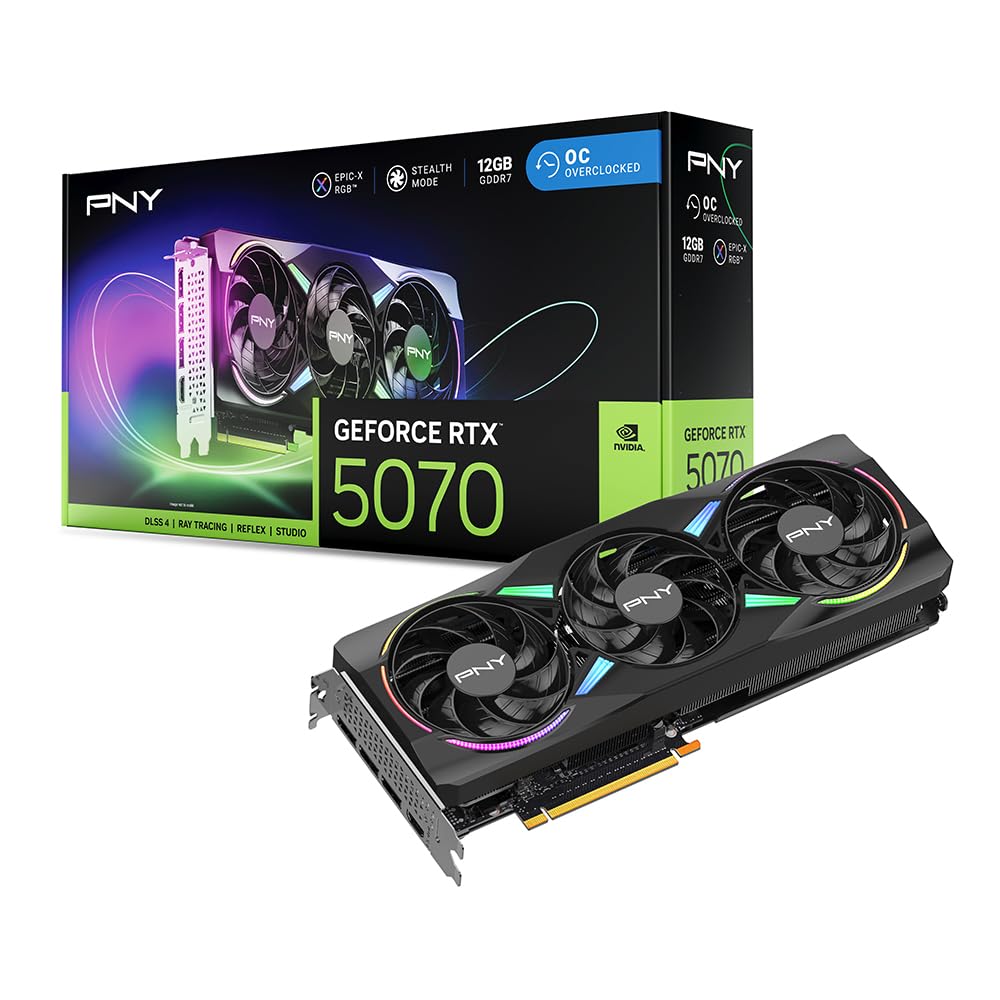
The PNY RTX 5070 Epic-X OC brings the Blackwell architecture and 12 GB of GDDR7 memory to the mid-range tier with a boost clock of 2685 MHz. For VR gaming at 1440p per eye, this card delivers frame times that rival the previous generation’s high-end offerings. The triple-fan cooling system keeps thermals well controlled, with users noting that the card remains quiet even during prolonged VR sessions — an important factor when you’re wearing a headset.
DLSS 4 and the fourth-generation ray tracing cores provide future-proofing for VR titles that may adopt path tracing or neural rendering techniques. The card draws just 250 W, making it compatible with 650 W power supplies that many existing VR rigs already have. Installation is straightforward, with dual 8-pin to 12-pin adapter included in the box.
Benchmarks show this card outperforming the RTX 4070 Super in raw FPS without relying on DLSS or frame generation, which translates to consistent native VR performance. The SFF-ready certification means it fits in mid-tower and compact cases without clearance issues. For users upgrading from 20-series or 30-series cards, the PNY 5070 represents a generational leap in VR performance without the premium of a Ti or Super variant.
Why it’s great
- Outperforms RTX 4070 Super in raw VR performance
- Quiet triple-fan cooling for immersion
- Low power draw at 250 W
- 10% factory overclock with additional headroom
Good to know
- 12 GB VRAM may limit extreme super-sampling
- Adapter cable required for most PSUs
- ARGB lighting may not suit all builds
7. GIGABYTE GeForce RTX 5070 WINDFORCE OC SFF 12G

The GIGABYTE RTX 5070 Windforce OC prioritizes acoustic performance without compromising VR capability. Users upgrading from cards like the RTX 2080 Super report significantly lower noise levels, with the triple-fan system staying quieter than previous-generation dual-fan designs. The card runs at approximately 75°C under max load at 1440p, with idle temperatures settling around 42°C — numbers that indicate efficient heat dissipation for the form factor.
With 12 GB of GDDR7 memory on a 192-bit interface and PCIe 5.0 support, this card handles the Valve Index and HP Reverb G2 without bottlenecking at native resolutions. The compact 4.33-inch width and 11.1-inch length ensure compatibility with standard ATX cases. The professional, non-RGB aesthetic appeals to users who prefer a clean look inside their VR workstation.
Real-world gaming benchmarks show this card achieving 180 Hz at 1440p in many modern titles on max settings, translating to consistent 90 Hz per eye in VR with headroom for super-sampling. The card requires standard PCIe power connections and integrates seamlessly with existing PSUs. For VR users who value silence as much as frame rate — such as those recording VR gameplay or streaming — this Windforce card is a strong mid-range contender.
Why it’s great
- Very quiet operation at all load levels
- Compact dimensions fit most cases
- No RGB for professional builds
- Excellent 1440p VR performance
Good to know
- Not aggressively overclocked out of box
- 12 GB VRAM is adequate but not excessive
- Limited manual overclocking headroom reported
8. XFX Swift AMD Radeon RX 9060 XT OC Gaming Edition
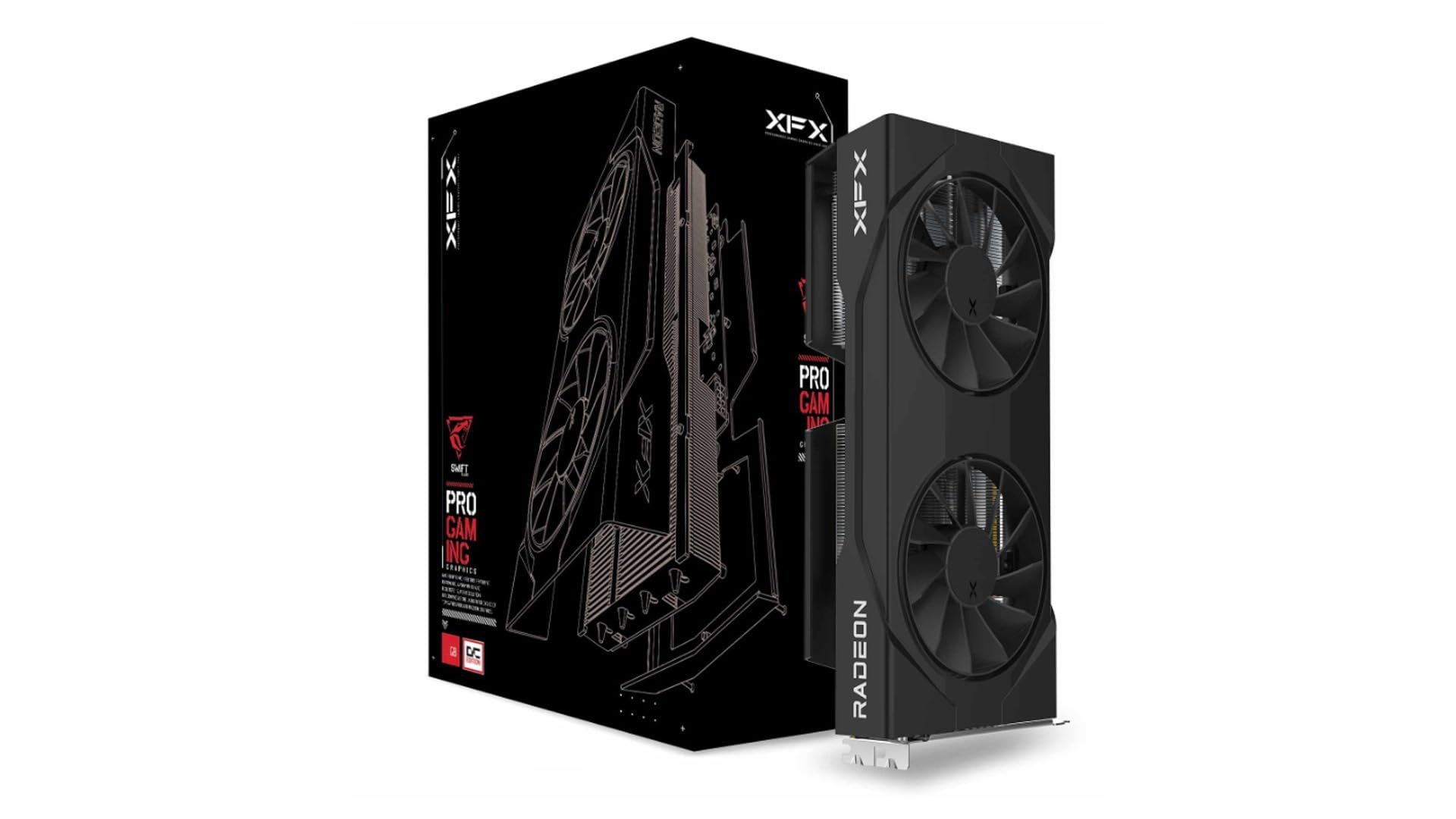
The XFX Swift RX 9060 XT stands out in the budget-adjacent tier by offering 16 GB of GDDR6 memory — more than double what many entry-level VR cards provide. This memory capacity enables smooth texture streaming at high super-sampling ratios that would cause 8 GB cards to stutter. The boost clock of 3320 MHz, combined with RDNA 4 architecture, delivers strong 1080p and 1440p VR performance for the price point.
Thermal performance is a highlight: users report temperatures around 60°C under load, with no overheating observed even after extended VR sessions. The SWFT dual-fan cooling solution maintains these temps quietly, though the 10.63-inch length may be tight in smaller cases. The card offers three output ports — two DisplayPort and one HDMI — which supports most VR headsets but limits multi-monitor setups outside of VR.
For budget-conscious VR builders, this card runs 95% of modern AAA titles at 1080p max settings and handles Crimson Desert without issues. The 16 GB VRAM buffer means upcoming VR titles with higher texture requirements won’t immediately force a compromise. While it lacks the ray tracing horsepower of NVIDIA’s Blackwell cards, for pure rasterized VR content — the current standard — the RX 9060 XT offers exceptional value.
Why it’s great
- 16 GB VRAM at a budget-friendly price point
- Low operating temperatures for sustained VR
- Strong 1080p and 1440p VR performance
- Power-efficient RDNA 4 architecture
Good to know
- Only three display outputs total
- Ray tracing performance limited
- Not compatible with all pre-built systems
9. ASRock AMD Radeon RX 7700 XT Challenger

The ASRock Radeon RX 7700 XT Challenger differentiates itself with a 0dB silent cooling feature that keeps fans completely off during light workloads — a significant advantage for VR users who want silence when browsing or using desktop VR portals. With 12 GB of GDDR6 memory on a 192-bit bus and a boost clock of 2584 MHz, this card delivers competent VR performance for headsets up to 1440p per eye. The dual-fan design with striped ring fans and ultra-fit heatpipe technology provides efficient thermal management when the fans do engage.
Real-world feedback from VR users confirms that this card runs Assetto Corsa VR perfectly and handles GTA V at max settings without issues. The 7,680 x 4,320 digital maximum resolution technically supports high-resolution VR headsets, though performance at extreme super-sampling ratios will be limited by the 12 GB VRAM buffer. The all-metal backplate adds structural rigidity and helps with heat dissipation during extended VR sessions.
Some users report the fans being louder than expected under full load, which may be noticeable in quiet room environments. The white LED indicator is not customizable, which may disappoint users who prefer a specific aesthetic. However, for VR gaming that doesn’t push the absolute highest super-sampling levels, the RX 7700 XT offers a solid experience at a price point below most RTX 4070-class cards.
Why it’s great
- 0dB fan stop for silent desktop use
- 12 GB VRAM handles 1440p VR well
- Metal backplate adds durability
- PCIe 4.0 support for modern motherboards
Good to know
- Fans can become loud under sustained VR load
- White LED lighting is not configurable
- Performance trails similarly priced NVIDIA cards in ray tracing
10. PNY NVIDIA GeForce RTX 5060 Epic-X ARGB OC Triple Fan
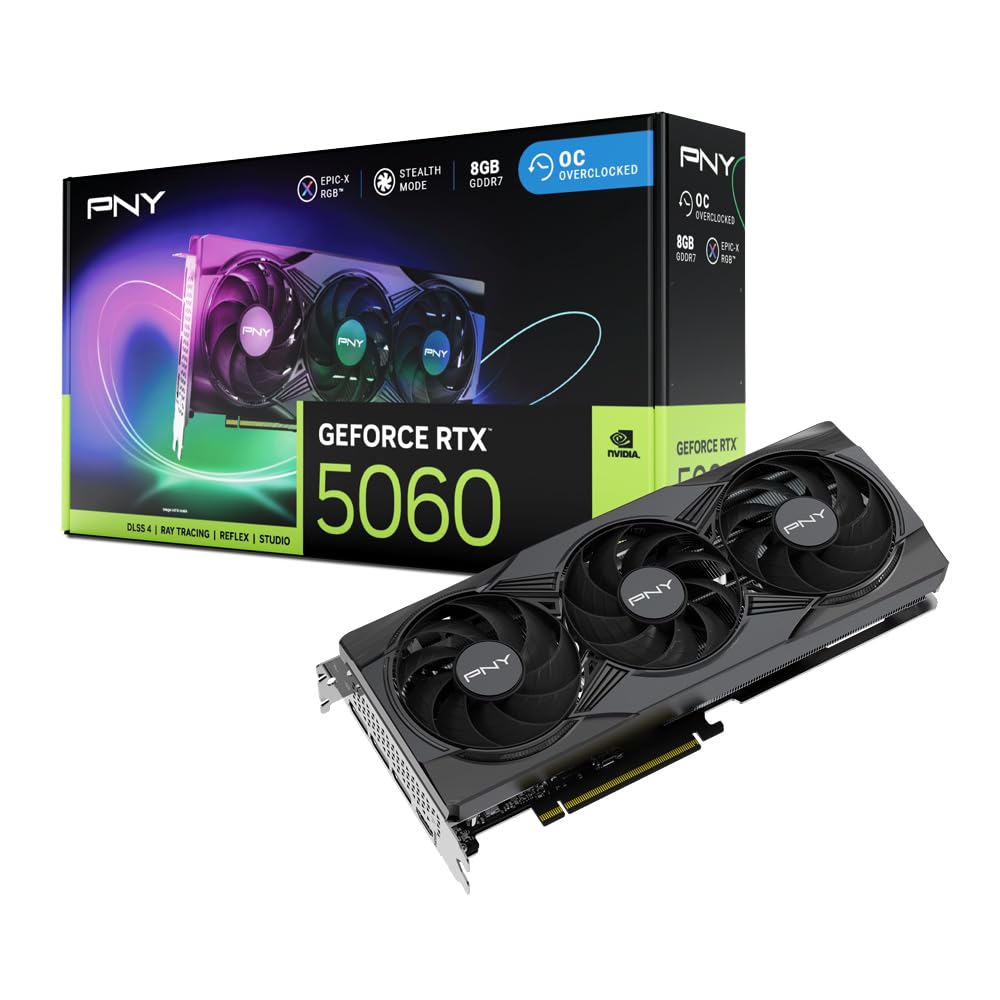
The PNY RTX 5060 Epic-X OC introduces the GDDR7 memory standard at an entry-level price point, with 8 GB of video memory running at 2280 MHz. For VR, the 8 GB buffer is the minimum recommended for current-generation headsets, and the GDDR7 bandwidth helps compensate for the capacity limitation in texture-heavy scenes. The triple-fan cooling system is overkill for the 5060’s thermal output, resulting in exceptionally quiet operation even under load.
DLSS 4 support brings AI-powered frame generation to the budget tier, allowing this card to deliver playable VR frame rates in titles that support upscaling. Users report 74 FPS in PC VR games at medium to high settings, with frame times staying consistent enough for a comfortable experience. The card is small enough for all mid-tower cases and draws minimal power, making it compatible with existing 500 W to 600 W power supplies.
At this price tier, ray tracing performance is limited, but for pure VR gaming at native resolution without heavy super-sampling, the RTX 5060 provides a competent entry point. The PCIe 5.0 interface ensures the card won’t be bandwidth-limited by future motherboard upgrades. For VR newcomers who want to test the waters without a large investment, the PNY 5060 is a sensible starting point that leaves a clear upgrade path.
Why it’s great
- Entry-level VR performance at an accessible price
- GDDR7 memory provides bandwidth efficiency
- DLSS 4 improves frame rates in supported VR titles
- Triple-fan cooling runs very quiet
Good to know
- 8 GB VRAM limits high super-sampling ratios
- Ray tracing performance is minimal
- IO bandwidth limited to PCIe x8
11. MSI Gaming GeForce RTX 2060 6GB Ventus GP OC

The MSI RTX 2060 Ventus GP OC remains a viable entry point for VR despite its age, thanks to its Turing architecture and 6 GB of GDDR6 memory. Users confirm that this card runs VR at 90 FPS when upgraded from a GTX 1050 Ti, achieving consistent frame rates in titles like Cold War at 135 FPS and Apex at 260 FPS on high settings. The 192-bit memory interface provides sufficient bandwidth for 1440p VR headsets at medium settings.
The dual-fan Ventus cooling system runs quietly, with users noting that the fans remain inaudible during regular operation. The single 8-pin power connector and 550 W PSU requirement make it compatible with older systems being retrofitted for VR. Digital maximum resolution support of 7,680 x 4,320 means the card technically connects to high-resolution headsets, though performance will be limited to lower super-sampling levels.
As a budget-tier option, the RTX 2060 lacks the VRAM headroom and architectural efficiency of newer cards. Users who pushed the card in VR-heavy titles eventually upgraded to RTX 4060-class cards for noticeably smoother experiences. For someone building the cheapest possible VR-capable PC using used or deeply discounted components, the RTX 2060 gets the job done with proven reliability — users report these cards running like new after three years of use.
Why it’s great
- Very affordable VR entry point
- Proven reliability with years of user feedback
- Low power draw and simple power requirements
- Runs VR at solid 90 FPS in many titles
Good to know
- 6 GB VRAM limit for higher super-sampling
- No DLSS 3 or higher frame generation
- Requires adequate case airflow for thermal management
FAQ
Can any graphics card with the right connection run VR smoothly?
Is 8 GB of VRAM enough for VR in 2025?
Does ray tracing matter for VR gaming?
Why does my powerful GPU still stutter in VR?
Can I use a laptop GPU for VR?
Final Thoughts: The Verdict
For most users, the gpu for vr winner is the ZOTAC RTX 4070 Ti Trinity OC because it delivers consistent 90 FPS with 12 GB VRAM and DLSS 3 in a well-cooled package that fits standard cases. If you want the highest VRAM capacity and future-proofing for ultra-high resolution headsets, grab the MSI RTX 5070 Ti Gaming Trio OC Plus with 16 GB of GDDR7 memory. And for the best price-to-performance in a compact build, nothing beats the ASUS Prime RTX 5070 — specifically designed for small-form-factor VR rigs without sacrificing Blackwell performance.