
Finding a functional graphics card under means navigating a minefield of driver-crashing clones, power-hungry relics, and low-profile components that barely outperform integrated graphics. The wrong pick leaves you with artifacting screens, unstable frame rates, or a card that fails within 60 days.
I’m Mohammad Maruf — the founder and writer behind Drink4Good. I’ve spent years analyzing hardware specifications, sorting real thermal performance from marketing fluff, and tracking driver stability across budget GPU tiers to separate the daily drivers from the duds.
After digging through decades of customer feedback and technical benchmarks, I’ve assembled the most reliable selection of gpu under 150 that balances VRAM capacity, cooling design, and power draw so you don’t waste money on a card destined for the junk drawer.
How To Choose The Best GPU Under 150
When a low-cost graphics card fails, the culprit is almost never the core chip — it’s a weak power delivery system, mismatched memory type, or a cooler that can’t shed 120W of heat. Focusing on the right specs prevents the “dead after 30 days” reviews that plague this price tier.
VRAM Type and Capacity
GDDR5 memory is standard at this price point, but some cards still ship with GDDR4. GDDR4 cuts memory bandwidth by roughly 30%, which directly affects texture loading in modern games. 8GB of GDDR5 is ideal for 1080p gaming, while 4GB of GDDR5 is sufficient for eSports titles and media PCs. Avoid any card with GDDR4 if you plan to game at 1080p or above.
Bus Width and Memory Interface
Memory bus width (128-bit vs 256-bit) determines how much data moves between the GPU and VRAM per clock cycle. A 256-bit bus paired with 8GB GDDR5 delivers roughly double the bandwidth of a 128-bit card, which matters when playing texture-heavy AAA titles. Budget cards often cut the bus to 64-bit — avoid those for any gaming use.
Power Connector Requirements
Cards like the GT 1030 draw power directly from the PCIe slot (about 30W), making them drop-in upgrades for older office PCs with weak PSUs. RX 580 cards require a 6-pin or 8-pin power connector and draw up to 185W, meaning you need a 450W-750W power supply. Check your existing PSU’s 12V rail rating before buying.
Quick Comparison
On smaller screens, swipe sideways to see the full table.
| Model | Category | Best For | Key Spec | Amazon |
|---|---|---|---|---|
| MAXSUN GT 1030 4GB | Entry-Level | Office PCs / 4K Desktop | 4GB GDDR4 | Amazon |
| MSI GT 1030 4GD4 LP OC | Entry-Level | Low-Profile Builds / Linux | 4GB GDDR4 | Amazon |
| SURALLOW RX 580 8GB | Value Gaming | 1080p Gaming / High Quality | 8GB GDDR5 / 256-bit | Amazon |
| QTHREE RX 560 XT 8GB | Budget Gaming | 1080p Gaming / Office Upgrade | 8GB GDDR5 / 128-bit | Amazon |
| ZER-LON GTX 1050 Ti 4GB | Value Gaming | No-PSU-Upgrade Gaming | 4GB GDDR5 / 75W Draw | Amazon |
| MOUGOL RX 580 8GB | Mid-Range Gaming | 1080p AAA Gaming / Linux | 8GB GDDR5 / 256-bit | Amazon |
| Kelinx AISURIX RX 580 8GB | Value Gaming | 1080p Gaming / Media | 8GB GDDR5 / 256-bit | Amazon |
| MAXSUN RX 580 8GB White | Aesthetic Gaming | White-Themed Builds / 1080p | 8GB GDDR5 / 256-bit | Amazon |
| Sparkle Intel Arc A310 4GB | Media / Transcode | NAS / Jellyfin / SFF Builds | 4GB GDDR6 / 50W TBP | Amazon |
In‑Depth Reviews
1. MOUGOL AMD Radeon RX 580 8GB
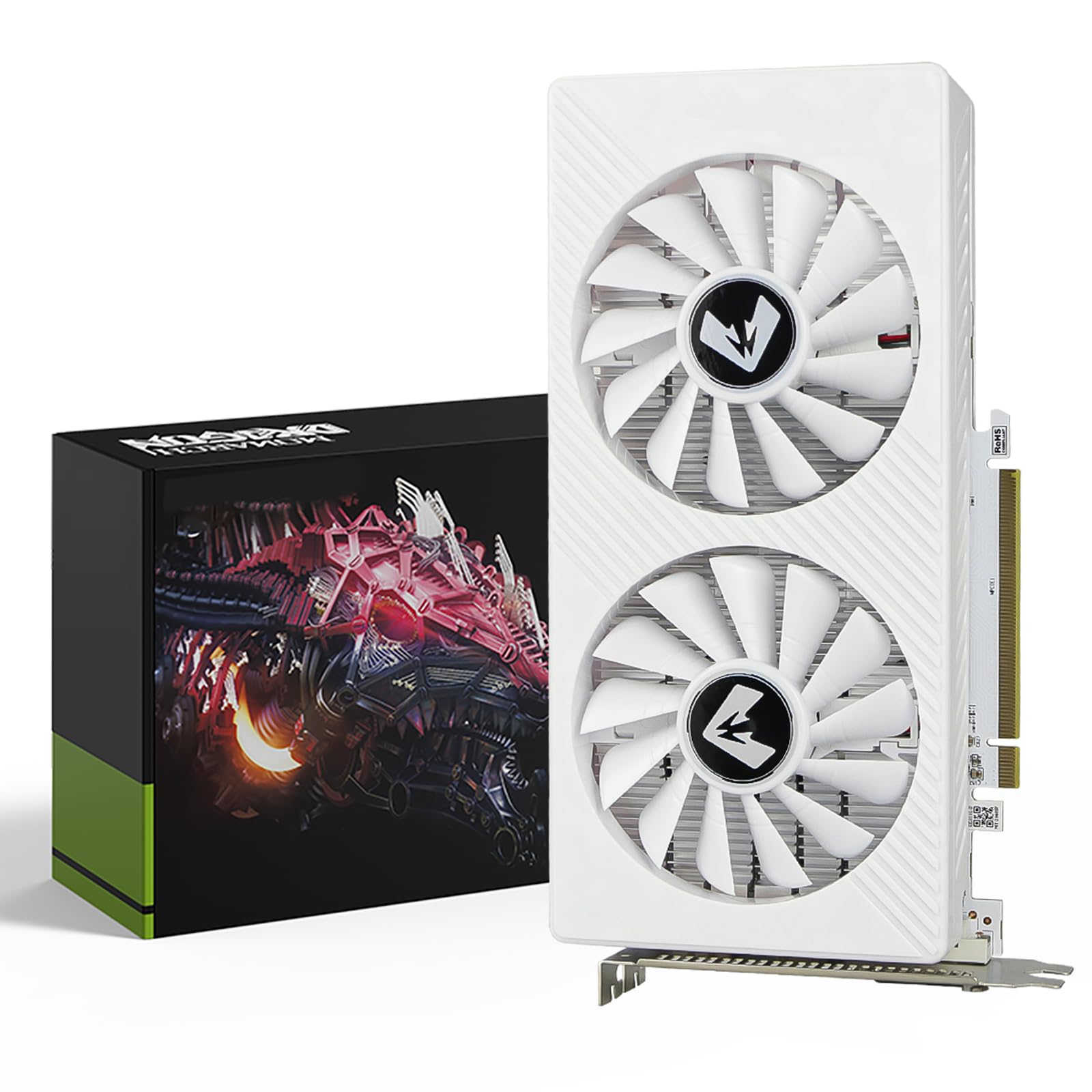
This MOUGOL RX 580 8GB sits at the sweet spot of the budget GPU market, pairing 2048 Stream Processors with Samsung GDDR5 memory across a full 256-bit bus. In practice, that means 1080p gaming at high settings in titles like Fortnite, GTA V, and Valorant without stuttering from memory bandwidth limits. The dual-fan cooling system with intelligent fan control keeps noise down during office work while pushing adequate airflow during extended gaming sessions.
Measuring 9.45 x 5.31 inches, this card fits comfortably in ATX mid-towers and most Micro-ATX cases. The PCIe 3.0 x16 interface requires a 6-pin power connector, so double-check your PSU’s available cables before purchase. AMD Adrenaline software support gives you granular control over fan curves and game profiles, making it easier to dial in performance for older or less demanding titles.
Linux compatibility is a documented strength here — users report it works with Bazzite and drives 3440×1440 OLED monitors without issue. While some units have reported driver instability under heavy synthetic loads, the majority of feedback points to solid day-to-day reliability at this price tier.
Why it’s great
- Full 8GB GDDR5 with 256-bit bus for texture-heavy games
- Quiet dual-fan operation with intelligent temperature-based stopping
- Works reliably under both Windows and Linux distributions
Good to know
- Requires a 6-pin power connector — not a slot-power-only card
- Some units show driver crashes in Furmark or Adrenaline benchmarks
- Limited display outputs may not support 240Hz refresh rates
2. SURALLOW RX 580 8GB 2048SP
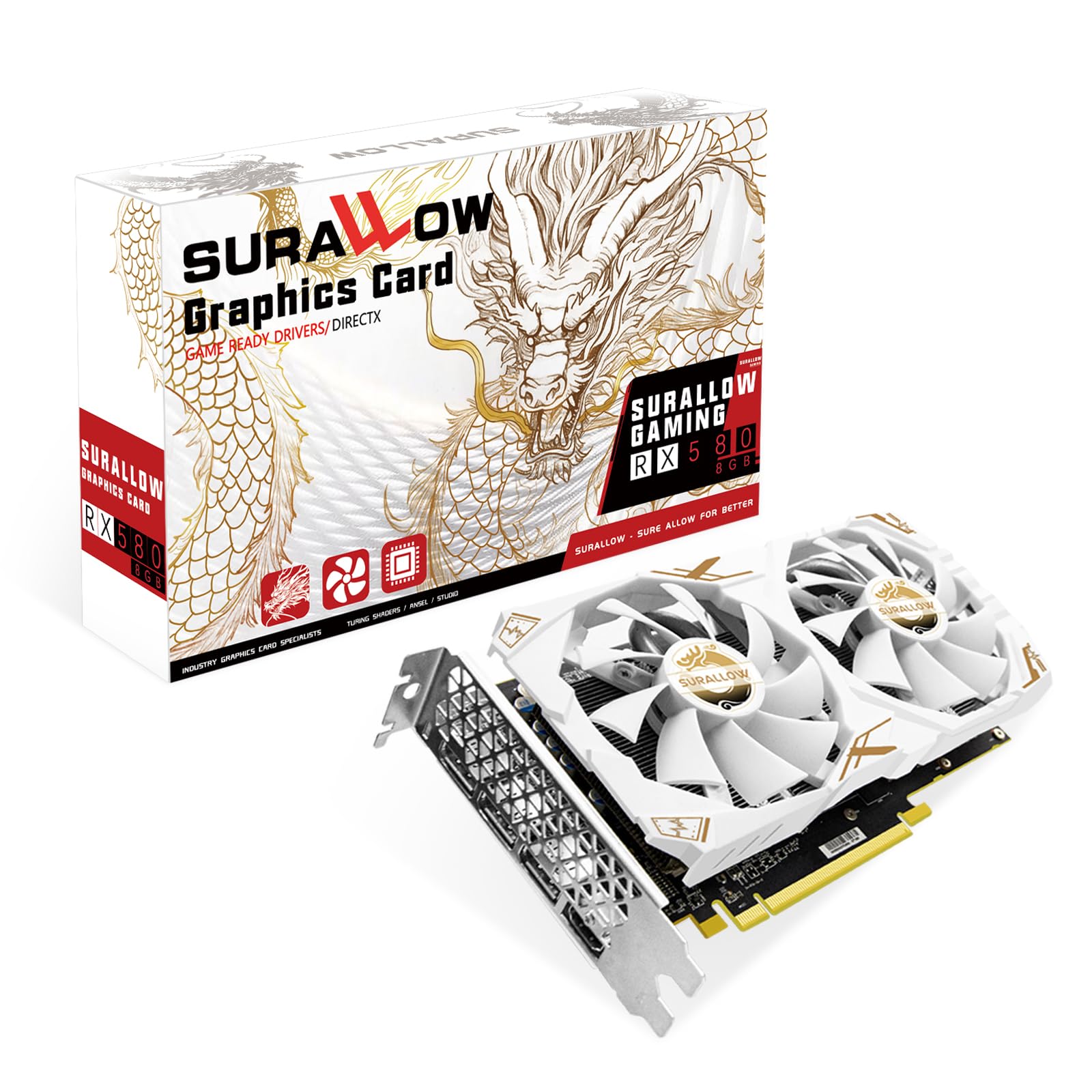
The SURALLOW RX 580 delivers the full 2048SP count at 1286 MHz core clock, backed by 8GB of GDDR5 memory on a 256-bit interface — the same foundation that made the original RX 580 a 1080p gaming staple. The triple-heat dissipation system uses two freeze fans with intelligent start-stop behavior, so the fans stay silent during desktop use and spin up only when GPU load demands active cooling. The copper heat pipes make direct contact with the GPU die for efficient thermal transfer.
Output options include one HDMI 2.0b port, three DisplayPort 1.4a ports, and one DVI port, enabling triple-monitor setups for productivity or sim racing. The 14nm Polaris 20 processor supports DirectX 12 and Vulkan, ensuring compatibility with modern game engines. A 6-pin power connector is required, drawing a maximum of 150W under full load.
Customer experiences split sharply here — while many users report smooth gameplay in Forza Horizon 5 and other modern titles after pairing with 16GB of system RAM, a significant minority report the card failing within 30 days or drivers crashing repeatedly on Windows 10 Pro. The included power cable has been flagged as having incompatible connector ends, potentially requiring a to separate purchase. Budget accordingly for that cable and ensure your PSU can deliver clean 12V power.
Why it’s great
- Full 8GB GDDR5 with 256-bit bus handles AAA 1080p gaming
- Triple DisplayPort 1.4a outputs for multi-monitor setups
- Intelligent fan stop for silent idle operation
Good to know
- Included power cable has incompatible ends for GPU and PSU
- Reports of unit failure within 30 days of use
- Driver stability issues reported on Windows 10 Pro
3. Sparkle Intel Arc A310 ECO 4GB

The Sparkle Intel Arc A310 ECO redefines what a sub- GPU can do for media-focused builds. With a 50W TBP design, it barely sips power compared to the 150W+ drawn by RX 580 cards. The single-slot, low-profile form factor measures just 6.14 x 2.72 inches, making it the most space-efficient option here. It includes both standard and short brackets out of the box, simplifying installation in small-form-factor cases and NAS enclosures.
Intel’s Xe HPG architecture brings hardware-accelerated ray tracing and XeSS upscaling to this price point, though gaming performance is limited to low settings at 1080p for modern titles. Where this card truly excels is video transcoding — the media engine crushes 4K H.264 and H.265 encodes, making it the go-to choice for Jellyfin or Plex servers. The GDDR6 memory running at 15.5 Gbps provides ample bandwidth for high-bitrate streams.
Linux compatibility is excellent, with both i915 and Xe drivers supported for most distributions. The major catch is Resizable BAR support — without ReBAR enabled on your motherboard, expect a 40% performance penalty in games. The single fan produces a droning noise under sustained load, though a firmware update and powertool tuning can mitigate the ramp-up behavior. If gaming is secondary to media serving, this card offers unmatched efficiency at its price point.
Why it’s great
- Ultra-low 50W TBP ideal for NAS and SFF builds
- Best-in-class hardware video transcoding at this price
- Includes low-profile bracket; single-slot design saves space
Good to know
- Requires Resizable BAR support for acceptable gaming performance
- Fan exhibits droning noise under sustained load
- Gaming limited to low settings at 1080p
4. MAXSUN RX 580 8GB 2048SP White

MAXSUN’s white-themed RX 580 is a rare aesthetic find in the budget GPU segment. The Polaris 20 XL variant runs at slightly lower clock speeds than the full RX 580, but still delivers 8GB of GDDR5 memory on a 256-bit bus. Dual-fan cooling keeps temperatures around 65°C under load, and the plastic cooler shroud feels lightweight but functional. This card supports 4K video decode and encode, plus DirectX 12 and Vulkan for modern game compatibility.
Outputs include HDMI, DisplayPort, DVI, and VGA — an unusual but welcome combination that makes this card compatible with older monitors or projectors without needing adapters. At 7.48 inches long, it fits comfortably in smaller cases while still offering the full 8GB memory buffer. The white PCB and fan housing make this a natural fit for white-themed PC builds that would otherwise require paying a premium for matching components.
Real-world gaming experiences report 144 FPS in eSports titles like CS2 and Overwatch, with 60 FPS achievable in AAA games after adjusting settings. Some units shipped without a retail box, which may concern buyers expecting packaging for resale. Additionally, the power port has been noted missing two overclocking pins (only six of the advertised eight pins present), which may affect enthusiast overclocking. For stock operation, however, this card delivers reliable 1080p performance at a competitive price.
Why it’s great
- White PCB and fan housing for themed builds without premium pricing
- Retains VGA output for legacy monitor compatibility
- Short length fits tight cases while offering 8GB VRAM
Good to know
- Power port missing two of eight advertised OC pins
- May ship without box or retail packaging
- Slightly lower clock speeds than standard RX 580 8GB
5. Kelinx AISURIX RX 580 8GB 2048SP

The Kelinx AISURIX RX 580 leverages the Polaris 20 XTX variant, pushing the memory clock to 1750 MHz (8 Gbps effective). With 2048 Stream Processors, 8GB GDDR5, and a 256-bit bus, this card delivers the same baseline silicon as the original RX 580 that dominated the 1080p segment. The semi-automatic intelligent fan system stops the fans entirely when GPU temperature stays low, creating a zero-noise desktop experience during web browsing or office work.
Output options are limited to 2x DisplayPort and 1x HDMI, which supports dual-monitor setups but falls short of the three-display support offered by some competitors. Power delivery requires an 8-pin PCIe connector, and the card has a rated maximum draw of 185W — about 35W higher than the typical RX 580. Ensure your PSU has at least 450W on the 12V rail with a dedicated 8-pin cable.
Customer feedback is mixed but informative. Users report solid performance in Diablo 4 and Battlefront 2 at 1080p, along with crisp color reproduction for photo editing. On the downside, multiple users report fan noise developing after two months, along with random system restarts and screen tearing when pushing above 1080p resolution. This card works best as a 1080p-only solution with moderate gaming demands.
Why it’s great
- Full Polaris 20 XTX with 1750 MHz memory clock
- Zero-noise fan-stop mode for low-load use
- Crisp color reproduction for photo and media work
Good to know
- Fans may develop noise after two months of use
- 185W draw requires substantial PSU with 8-pin cable
- Screen tearing reported above 1080p resolution
6. ZER-LON GeForce GTX 1050 Ti 4GB

The ZER-LON GTX 1050 Ti 4GB is the go-to choice for upgrading prebuilt office PCs with weak power supplies. With a full-load draw of just 75W, this card pulls all its power directly from the PCIe slot and requires no external power cable. The 9cm low-noise fan with nine custom blades, combined with an aluminum fin-stack heatsink, keeps the GPU cool without adding audible stress to an already aging system. The Pascal architecture delivers 768 CUDA cores running up to 1752 MHz boost clock.
Support for NVIDIA G-SYNC, GeForce Experience, and Game Ready Drivers means you get the same software ecosystem as higher-end cards. The HDMI, DisplayPort, and DVI outputs handle up to 7680×4320 resolution for video playback, though gaming at that resolution is not realistic with 4GB of VRAM. The card measures 8.3 x 4.9 inches and fits into most standard cases without clearance issues.
This card proves especially effective in humid or salty environments where original factory GPUs tend to fail — its dual-fan design and larger heatsink improve thermal longevity compared to single-fan OEM cards. However, durability reports are mixed: while some users see immediate improvements in 1080p gaming and video streaming, others report complete failures within 60 days of light use. The lack of a sealed retail box and missing printed instructions may also be off-putting to first-time builders.
Why it’s great
- No external power cable needed — runs on 75W slot power
- Fits older office PCs with 300W PSUs as a drop-in upgrade
- Full NVIDIA software ecosystem with G-Sync support
Good to know
- Some units fail within 60 days of light use
- Retail packaging may arrive unsealed without instructions
- 4GB VRAM limits texture quality in modern AAA titles
7. QTHREE Radeon RX 560 XT 8GB

The QTHREE RX 560 XT is built on the Ellesmere GPU, using a 128-bit memory interface paired with 8GB of GDDR5 memory running at 6000 MHz. The GPU core clocks at 1026 MHz base with boost up to 1206 MHz. The 128-bit bus is the primary bottleneck here compared to the 256-bit cards in this price range, limiting memory bandwidth for texture-heavy workloads. That said, 8GB of VRAM still provides enough buffer for modded games or multiple browser tabs during productivity work.
Output options include HDMI, DisplayPort, and DVI, supporting up to three monitors simultaneously at 4K 60Hz via the DP and HDMI ports. The dual independent cooling fans deliver adequate airflow for the card’s 150W maximum draw, which is fed through a single 8-pin power connector. The card measures as a dual-slot design and fits standard ATX cases without trouble.
User feedback describes this card as a solid replacement for dead OEM GPUs in older HP desktops, with easy installation and stable operation after downloading proper AMD drivers. However, a significant share of reviews describe constant crashing within 30 minutes of gameplay, even at the lowest resolution, and one experienced technician received a DOA unit after storing it for months before installation. The reliability lottery is real here — purchase with a return window in mind.
Why it’s great
- 8GB VRAM provides buffer for mods and multitasking
- Dual-fan cooling with straightforward installation in OEM cases
- Supports triple-monitor 4K 60Hz desktop setups
Good to know
- 128-bit bus limits memory bandwidth for AAA gaming
- Frequent crashing reported during gameplay
- Mixed reliability — DOA units documented in reviews
8. MSI Gaming GeForce GT 1030 4GD4 LP OC

MSI’s GT 1030 is the most reliable entry-level card in this roundup, consistently delivering stable performance for office PC revival projects. The 4GB GDDR4 memory may sound dated, but for desktop productivity tasks, 4K video playback, and legacy OS compatibility, this card gets the job done without requiring a PSU upgrade. Boost clock reaches 1430 MHz, and the single-fan design stays quiet under normal office workloads.
At 9.5 x 6.2 inches, this is a surprisingly long low-profile card, so measure your case clearance before ordering. The DisplayPort 1.4a and HDMI 2.0b outputs support 4K UHD at 3840×2160 resolution. Linux compatibility is excellent — users report solving overscan issues on Panasonic TVs using NVIDIA driver slider adjustments. The 64-bit memory interface is the bottleneck here; this card is not designed for gaming beyond light eSports titles at 720p.
Reports from owners confirm this card gives new life to systems as old as HP Envy 2015 models with 350W PSUs. One user played World of Warcraft and World War Z at playable frame rates, while another upgraded from integrated graphics to experience smooth 2560×1440 desktop operation. Keep expectations in check — this is a modern display adapter first and a gaming card second. For office work, video streaming, and Linux desktop use, it’s the most dependable option under .
Why it’s great
- Class-leading driver stability for Windows 7/10/11 and Linux
- No external power cable needed — runs PCIe slot power only
- Reliable 4K desktop output for office productivity
Good to know
- GDDR4 memory and 64-bit bus limit gaming performance
- Surprisingly long PCB — check case clearance
- Not suitable for modern AAA gaming above 720p
9. MAXSUN GeForce GT 1030 4GB GDDR4

The MAXSUN GT 1030 is the most affordable entry point into dedicated GPU territory, offering 4GB of GDDR4 memory with a silver-plated PCB and all-solid capacitors for improved thermal stability. The single 3.5-inch fan is notably small but keeps noise low while providing adequate airflow for the low-power 30W chip. The ITX form factor at 7.32 x 4.33 inches fits into virtually any case, from compact HTPCs to full towers.
Performance peaks at 4K desktop use and sub-4K video playback. The GPU boost clock tops out at 1380 MHz, and the 64-bit memory interface keeps memory bandwidth low. Users report successful operation with Windows 7 using NVIDIA’s 391.35 driver, which is useful for legacy system owners who can’t upgrade their operating system. The card uses PCI-Express x4 interface physically, not the full x16 bandwidth, though this matters little for the card’s modest performance envelope.
This card excels at a single specific task: reviving an old computer for office use and 4K video streaming. One owner replaced an AMD RX 580 in a Dell T3400 workstation and had Windows 10 auto-update the drivers within five minutes. If you need a display adapter for a home server, a secondary rig, or an aging relative’s PC, this is the most cost-effective path. But if gaming or GPU-accelerated rendering is your goal, look at the RX 580 options above.
Why it’s great
- Smallest form factor — fits any case including ITX
- Silver-plated PCB and solid capacitors for thermal stability
- Driver support for Windows 7 legacy systems
Good to know
- GDDR4 memory hampers gaming and full-screen 4K video
- Cannot handle modern games or GPU-accelerated rendering
- PCIe x4 interface reduces bandwidth compared to x16 slots
FAQ
Can I use an RX 580 card with a 350W power supply?
What is the difference between RX 580 and RX 580 2048SP?
Do I need Resizable BAR for the Intel Arc A310 to work properly?
Why does my GT 1030 perform worse than expected in games?
Final Thoughts: The Verdict
For most users, the gpu under 150 winner is the MOUGOL RX 580 8GB because it delivers the best balance of VRAM capacity, memory bandwidth, and driver stability for 1080p gaming. If you need a slot-powered card for an office PC with a weak PSU, grab the ZER-LON GTX 1050 Ti 4GB. And for a compact media server or NAS with class-leading video transcoding, nothing beats the Sparkle Intel Arc A310 ECO.