
Summer heat stresses cool-season grasses, hardens soil, and activates warm-season weeds. A standard spring feed can scorch turf instead of saving it, turning a green lawn yellow overnight. The right summer fertilizer cools roots, supplies slow-release nitrogen, and strengthens cell walls against drought.
I’m Mohammad Maruf — the founder and writer behind Drink4Good. I’ve spent years analyzing fertilizer N-P-K ratios, slow-release technologies, and iron content to match the exact nutrient profile a lawn needs during the hottest months.
Your goal is to feed the grass without pushing excessive top growth that demands more water. To help you find the right product, I’ve tested and compared seven leading formulas to build this guide to the best grass fertilizer for summer.
How To Choose The Best Grass Fertilizer For Summer
Summer fertilizing is a balancing act: you need nutrients to support photosynthesis and root depth, but applying too much nitrogen or the wrong release type can stress the lawn. Here are the three factors that separate a safe summer feed from a burn risk.
Nitrogen Source: Slow-Release Is Non-Negotiable
Quick-release synthetic nitrogen (ammonium nitrate or urea) spikes leaf growth fast, forcing the lawn to demand more water exactly when you want it to conserve. Look for slow-release sources: sulfur-coated urea (SCU), polymer-coated prills, or natural organics like feather meal. These feed the grass gradually over 6–8 weeks and reduce the risk of burn when soil temps climb above 85°F.
Potassium for Heat and Drought Stress
The third number in the N-P-K ratio is often the most critical for summer. Potassium strengthens cell walls, regulates water uptake, and improves disease resistance. A summer blend with a K value at or above 8 (like 24-0-6 or 7-0-20) helps the lawn survive dry spells and bounce back faster after heat waves.
Iron for Color Without Forcing Growth
When the lawn starts yellowing in July, the temptation is to dump more nitrogen. A smarter approach is iron supplementation. Iron deepens green color by boosting chlorophyll production without stimulating excessive leaf extension. Many premium summer fertilizers include 2–3% iron, and standalone liquid iron products can be rotated between granular applications.
Quick Comparison
On smaller screens, swipe sideways to see the full table.
| Model | Category | Best For | Key Spec | Amazon |
|---|---|---|---|---|
| Yard Mastery 24-0-6 Flagship | Granular | Deep green color | 24‑0‑6 with 3% iron & Bio-Nite | Amazon |
| Andersons PGF 16-0-8 | Granular | Phosphorus‑free feeding | 16‑0‑8 with Humic DG & iron | Amazon |
| Simple Lawn Solutions Bundle | Liquid | Quick green‑up in heat | 16‑4‑8 plus liquid iron | Amazon |
| Espoma Summer Revitalizer | Organic Granular | Organic feeding + iron | 8‑0‑0 with Bio-tone & iron | Amazon |
| Yard Mastery 7-0-20 Stress Blend | Granular | Heat and drought relief | 7‑0‑20 with 3% iron | Amazon |
| Espoma All Season Lawn Food | Organic Granular | Slow organic maintenance | 9‑0‑0 with Bio-tone & iron | Amazon |
| Agriform 20-10-5 Tablets | Slow‑Release Tablet | New trees & shrubs | 20‑10‑5, feeds up to 2 years | Amazon |
In‑Depth Reviews
1. Yard Mastery 24-0-6 Flagship Granular Fertilizer
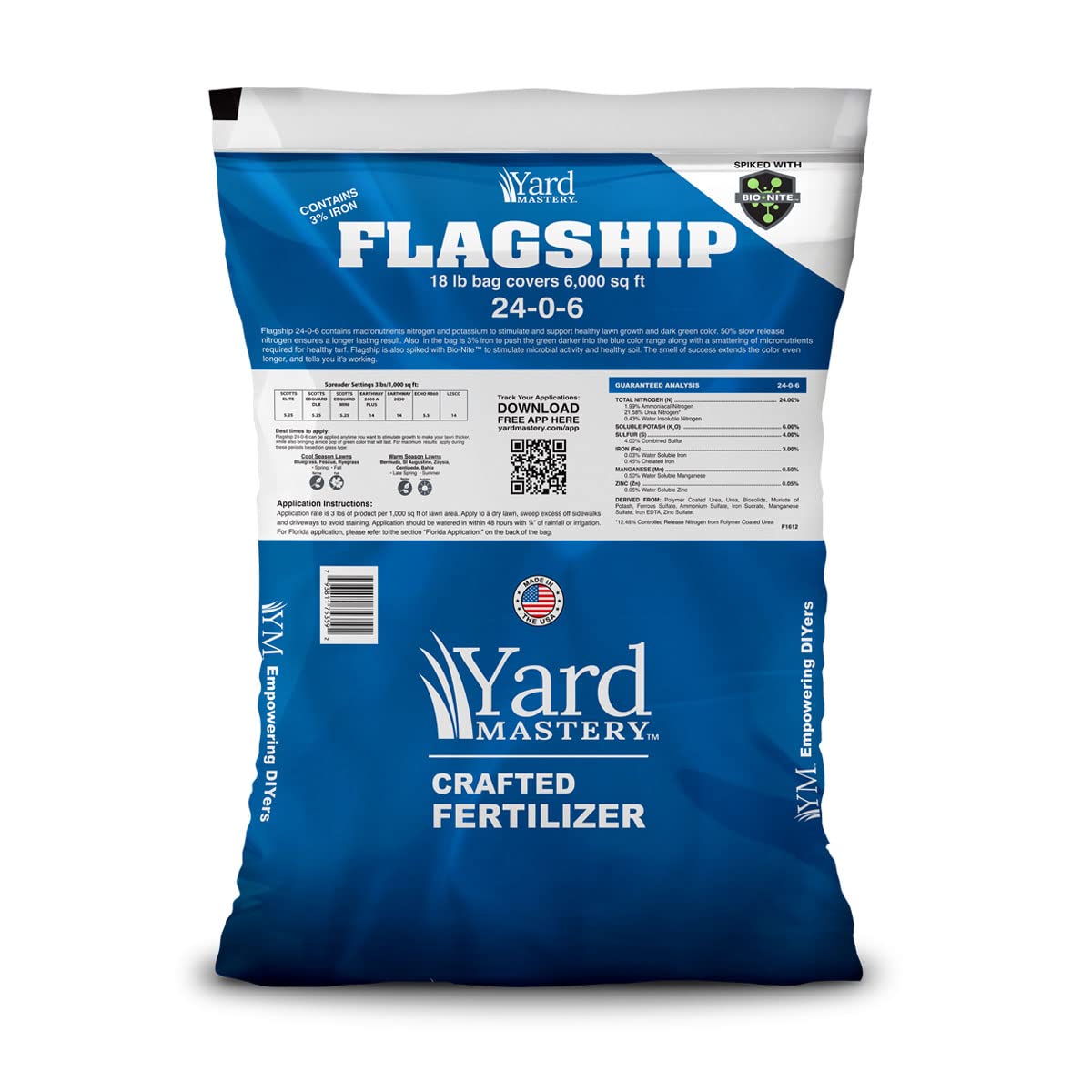
The Yard Mastery 24-0-6 Flagship delivers an aggressive nitrogen load (24%) that is 24% slow-release via Bio-Nite technology, meaning the grass gets steady feeding over 6–8 weeks instead of a single growth spike. The 3% iron content is the highest in this roundup, which explains the deep blue-green color users report within 10–14 days of application. Each 18 lb bag covers 6,000 sq ft, making it a dense, concentrated formula that demands accurate spreader calibration.
Real-world tests show this blend excels on warm-season varieties like Bermuda and Zoysia, where the high potassium (6%) supports root mass and drought resistance. One customer with Bermuda noted the grass thickened enough to choke out weeds after a single bag, outperforming three years of professional lawn service. The micronutrient package (boron, copper, manganese, molybdenum, zinc) addresses trace deficiencies that often appear in summer when soil biology slows down.
Performance under heat is strong, but the high nitrogen means you will be mowing twice a week in peak growth. Apply when temperatures are below 90°F and water in thoroughly within 24 hours to avoid foliar burn. For lawns that need rapid greening without excessive top growth, this is the most balanced high-N summer option available.
Why it’s great
- 24% slow-release nitrogen prevents burn
- 3% iron delivers dramatic greening
- Full micronutrient package for summer stress
Good to know
- High N pushes fast growth — expect more mowing
- Requires accurate broadcast spreader settings
2. The Andersons Professional PGF 16-0-8 with Humic DG
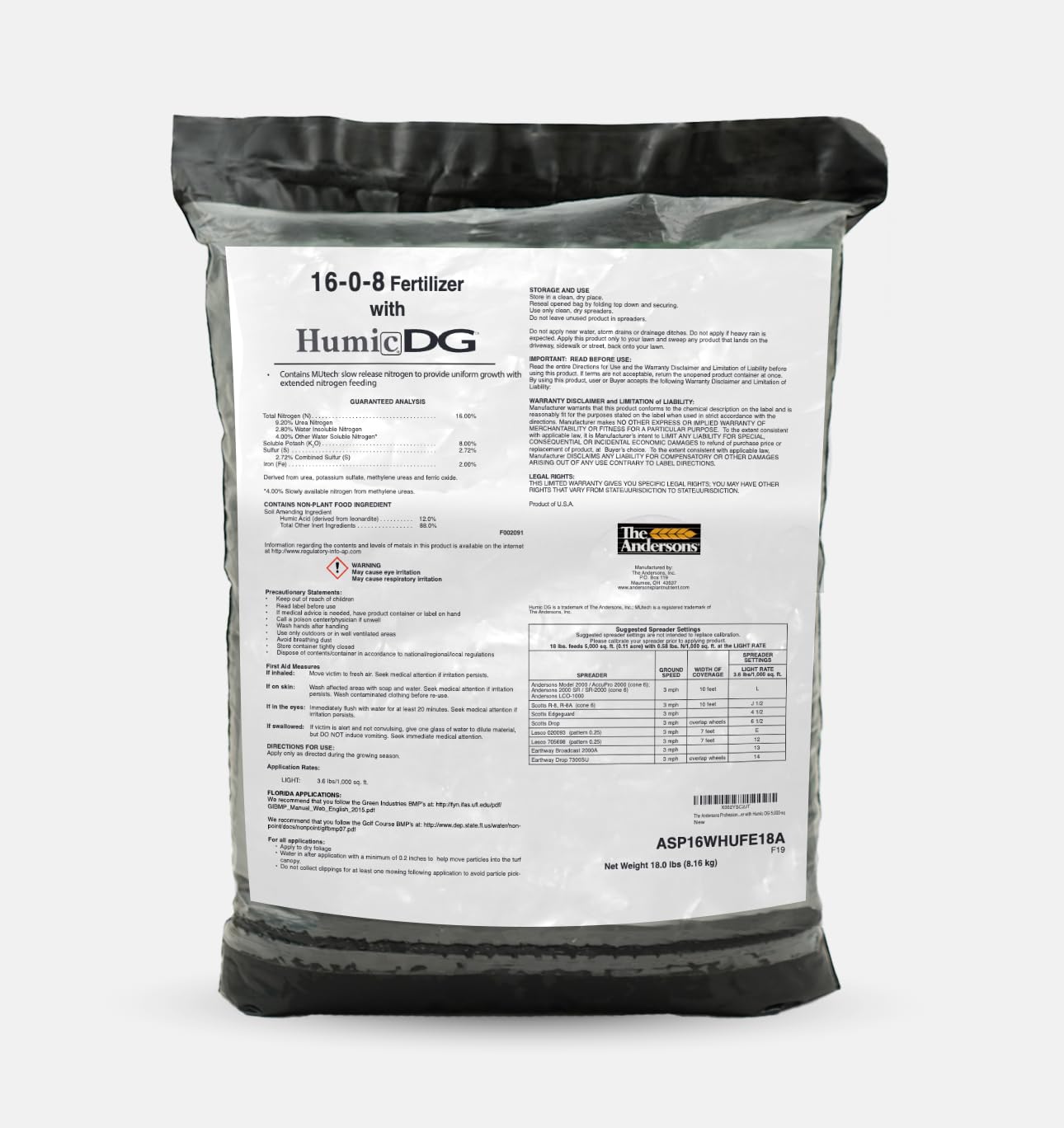
The Andersons PGF 16-0-8 is a phosphorus‑free granular blend designed for lawns where soil tests already show adequate P levels. The 16% nitrogen is split between quick-release (immediate green‑up) and slow-release forms that sustain feeding for up to 8 weeks, perfectly matching the length of a typical summer application window. The 8% potassium is the highest K value among the granular options here, directly supporting heat tolerance and cellular water regulation.
The standout feature is the Humic DG (dispersible granule) technology — each particle breaks down in water and releases humic acids that improve root zone cation exchange and moisture retention. Users describe the granules as “super-fine,” roughly half the diameter of standard prills, which provides twice the number of particles per square foot and eliminates the striped pattern common with cheap spreaders. Coverage is rated at 18 lb per 10,000 sq ft, making this one of the most economical options for larger lawns.
Note that The Andersons is not currently registered for sale in California or Oregon. For southern growers running centipede or Zoysia, the zero‑phosphorus profile avoids triggering broadleaf weed germination while still feeding the turf. The iron and micronutrient package rounds out the offering, though the iron percentage is lower than Yard Mastery’s Flagship blend.
Why it’s great
- 8% potassium supports drought tolerance
- Humic DG improves root‑zone moisture
- Super‑fine granules for even distribution
Good to know
- Not available in California or Oregon
- Lower iron content than some competitors
3. Simple Lawn Solutions 16-4-8 + Liquid Iron Bundle
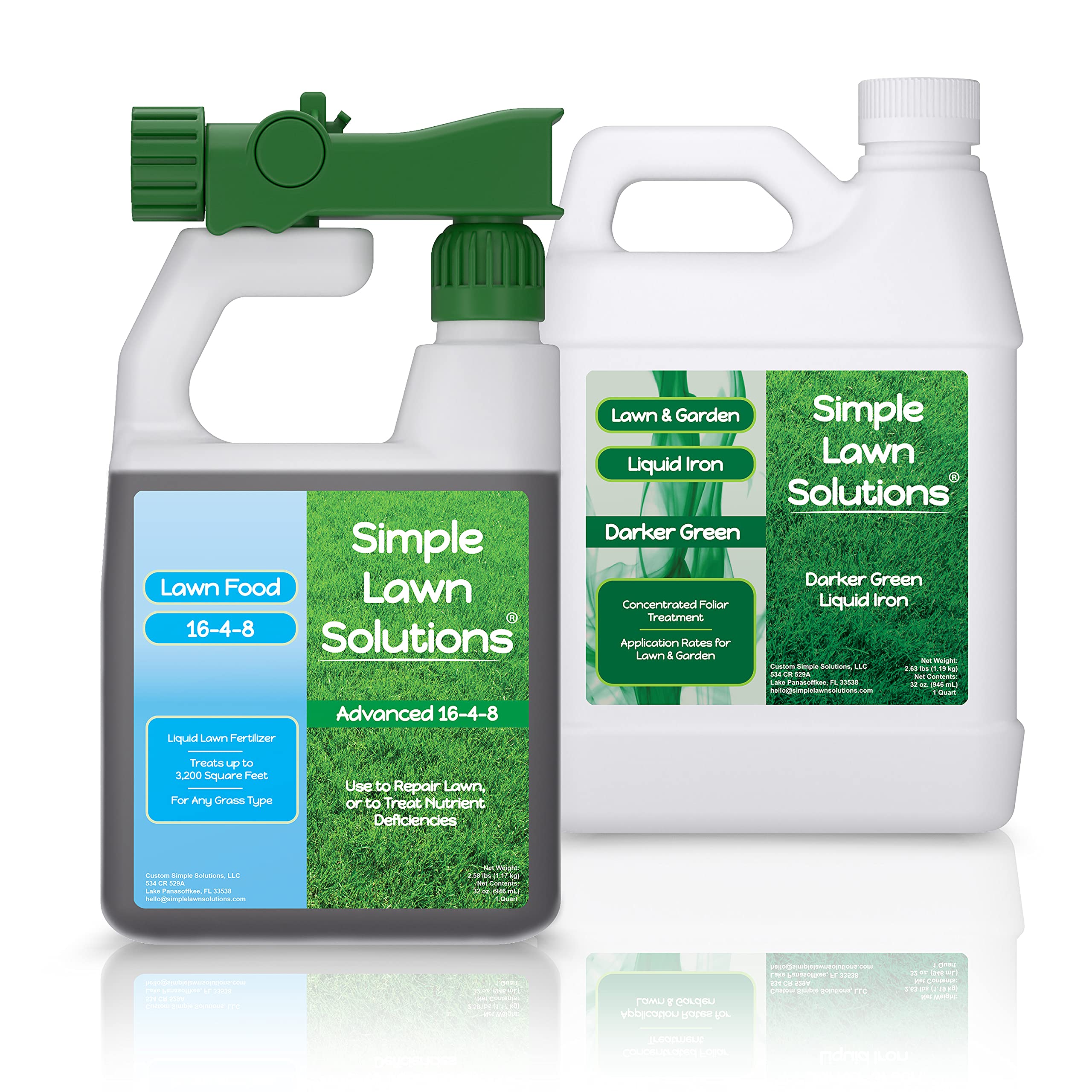
This bundle pairs a 16-4-8 liquid lawn food with a separate 32 oz Dark Green Liquid Iron concentrate, giving you a two‑part system that costs less than most single‑product granular options. The liquid food delivers nitrogen immediately to the leaf blade, which is useful when you need fast recovery from heat stress or yellowing. The 4% phosphorus supports root development, a legitimate benefit for lawns recovering from summer compaction or heavy foot traffic.
The liquid iron is a light formulation (low N) designed to deepen green color without pushing growth, making it safe to apply every 2–3 weeks between granular feeds. Customer reports from hot climates like Texas and Florida show visible darkening within 72 hours. One user noted that adding a teaspoon of dish soap helps the liquid adhere to the grass blades in scorching sun, improving uptake and reducing runoff.
The 64 fluid ounce total coverage treats roughly 3,000 sq ft per bottle, so larger lawns will need multiple bundles. The hose‑end sprayer included with the food bottle is convenient but prone to clogging if the iron concentrate isn’t fully diluted. Consider transferring both products into a backpack sprayer for more consistent coverage on slopes or irregular beds.
Why it’s great
- Two‑product system for the price of one
- Liquid iron greens without excess growth
- Visible results in 3 days
Good to know
- Hose‑end sprayer can clog with iron residue
- Best suited for smaller lawns under 5,000 sq ft
4. Espoma Organic Summer Revitalizer 8-0-0

Espoma’s Summer Revitalizer uses an 8-0-0 analysis with zero phosphorus and zero potassium, which might look low on paper but is intentional for organic summer feeding. The nitrogen comes from feather meal and other natural proteins that break down through soil microbial activity rather than water dissolution, so release slows naturally as soil temperatures rise above 85°F. That built-in microbial brake is exactly what prevents the burst of growth that stresses a lawn during a heat wave.
The Bio-tone formula adds beneficial microbes and mycorrhizal fungi that improve root colonization and water uptake. Users report that the lawn stays green without the “flush and fade” pattern common with synthetic organics. The 30 lb bag covers 5,000 sq ft, and the granules are odor‑free and fine enough to spread evenly through both drop and broadcast spreaders. One user in the Northeast has relied exclusively on Espoma since 2010 and describes the results as “the greenest, fullest, thickest, toughest lawn” of the neighborhood.
The product is OMRI listed for organic production and contains no sludges or toxic ingredients, making it a legitimate choice for families, pets, or edible gardens alongside turf. The main trade‑off is speed: organic feeding takes 2–3 weeks to show visible improvement compared to 3–5 days for a liquid synthetic. If you need a fast fix, pair this with the Simple Lawn Solutions liquid iron between applications.
Why it’s great
- Zero‑burn organic formula safe for pets
- Bio-tone microbes improve root health
- Slow‑release adjusts with soil temperature
Good to know
- Slow to show color change (2–3 weeks)
- Larger granules may clog tight spreader settings
5. Yard Mastery 7-0-20 Stress Blend Granular Fertilizer

Yard Mastery specifically designed the 7-0-20 Stress Blend as an “end‑of‑summer” rescue feed for lawns that have already taken a beating from heat, foot traffic, or drought. The nitrogen is kept low (7%) to avoid pushing growth when the grass is already struggling, while the potassium is the highest in this review at 20% — a ratio that prioritizes stem strength, cellular water retention, and disease resistance over leaf extension. The 3% iron provides a visible color lift without stimulating the top growth that would need even more water.
Real‑world feedback from zone 8B coastal NC shows this product revived centipede grass that was turning yellow and also helped establish newly plugged Zoysia over a single summer. Another user in a southern climate applies the stress blend in late July after a spring routine of monthly chelated iron and reports a lawn that stays green while neighbors’ turf goes dormant. The Bio-Nite technology again provides slow‑release characteristics, though at this low N level the risk of burn is minimal even if you accidentally double‑apply.
Apply when temperatures are below 80°F and water for 3–4 consecutive days after spreading. The 18 lb bag covers 6,000 sq ft, and the granules are uniformly sized for broadcast spreaders. This is not a general‑purpose feed — use it specifically for mid‑ to late‑summer relief when the lawn is showing stress symptoms and you want to strengthen roots for the following spring.
Why it’s great
- 20% potassium targets heat/drought stress
- 3% iron greens without excess growth
- Low N safe for weak summer lawns
Good to know
- You must apply below 80°F for best results
- Not a growth stimulant — use only for stress relief
6. Espoma Organic All Season Lawn Food 9-0-0

Espoma’s All Season Lawn Food (9-0-0) is the organic companion to the Summer Revitalizer but carries a slightly higher nitrogen load and the same Bio‑tone microbial inoculant. The 9% nitrogen is sourced entirely from natural organics, meaning release depends on soil temperature and moisture — slow in early spring, faster by mid‑summer, and tapering off as the soil cools in fall. This pH‑neutral formula won’t acidify the soil like synthetic ammonium‑based fertilizers, which matters for lawns with a history of moss or compaction.
Users who have cycled Espoma for multiple seasons note that the lawn becomes progressively stronger, with deeper root mass and less annual weed pressure, because the organic matter builds soil structure rather than just feeding the blades. One customer reported that after three seasons, the lawn is “thick, lush, and green” with fewer striping issues after mowing, and the organic base means no browning around concrete edges where synthetic salts often accumulate.
The 28 lb bag covers 5,000 sq ft, and the granules are uniform enough for drop spreaders but may require a setting adjustment — the bag’s recommended rate is often a light starting point rather than an exact prescription. Because this is an all‑season formula, it works for early spring through late summer, but you may want to switch to the Stress Blend in August if your region sees sustained 95°F+ temperatures.
Why it’s great
- Soil‑building organic ingredients
- Safe for all grass types year‑round
- No synthetic salts to burn edges
Good to know
- Slow to show visible color change
- Bag weight (28 lb) is heavier than most competitors
7. Agriform 20-10-5 Slow Release Fertilizer Tablets

The Agriform 20-10-5 tablets are a completely different delivery format: 21‑gram compressed tablets that you bury near the root zone of trees, shrubs, and large perennials. The 20% nitrogen feeds the plant for up to 2 years from a single application, making this the longest‑lasting product in the roundup. This is not a product for spreading over a lawn, but it’s a perfect complement if your landscape includes young shade trees or ornamental shrubs that compete with turf for nutrients during summer stress.
The tablets contain minors (secondary nutrients) that are often missing in granular lawn blends, and the slow‑release coating prevents the nitrogen from leaching out during heavy summer rains. Users in Christmas tree farming operations have reported “beautiful” growth after burying tablets around newly planted saplings, and bonsai enthusiasts use them as a controlled‑release capsule for containerized specimens. The 500‑tablet box provides enough material for dozens of trees, so the per‑plant cost is extremely low.
Place the tablets in shallow holes (4–6 inches deep) spaced evenly around the drip line of each plant. The tablets will not work for turfgrass directly, and the 20‑10‑5 ratio is higher in phosphorus than most lawn‑specific summer blends, so keep them separate from your main lawn fertilizing program. For homeowners who want a “set and forget” solution for landscape plants during the hottest months, these tablets deliver reliable results with zero maintenance.
Why it’s great
- Feeds trees and shrubs for up to 2 years
- Zero risk of runoff or leaching
- Low cost per plant with 500‑tablet box
Good to know
- Designed for trees/shrubs, not lawn turf
- Requires burying each tablet individually
FAQ
When should I apply summer fertilizer in the hottest months?
Can I use a regular spring fertilizer in summer?
What does “iron for color” actually mean?
Should I water before or after applying summer fertilizer?
Can I mix different summer fertilizers together?
Final Thoughts: The Verdict
For most users, the best grass fertilizer for summer winner is the Yard Mastery 24-0-6 Flagship because its 24% slow‑release nitrogen, 3% iron, and full micronutrient package deliver deep green color and steady feeding without the burn risk that plagues high‑N synthetics. If you want a phosphorus‑free option with maximum potassium for drought relief, grab the The Andersons PGF 16-0-8. And for organic gardeners or pet owners who need a no‑burn, soil‑building solution, nothing beats the Espoma Organic Summer Revitalizer 8-0-0.