
Finding a solution that nukes that narrow corridor without drifting onto your lawn, garden beds, or the neighbor’s property is the real trick. You need a herbicide with precise application, fast action, and zero residual soil activity that could harm future plantings.
I’m Mohammad Maruf — the founder and writer behind Drink4Good. I’ve analyzed hundreds of herbicide formulas, from concentrated glyphosate to selective grass killers, and focused specifically on how they perform in tight, fenced-in areas where overspray and collateral damage are the biggest risks.
After comparing application methods, active ingredients, and coverage capacities, I’ve narrowed the field to the five most effective options. Here is my analysis of the best grass killer for fence line applications that delivers results without the guesswork.
How To Choose The Best Grass Killer For Fence Line
Your fence line is a unique target: narrow, often shaded, and dangerously close to plants you want to keep. A generic weed killer can nuke the grass but may also sterilize the soil or drift onto your lawn. The key is matching the herbicide type to your specific fence line conditions.
Selective vs. Non-Selective Formulas
A non-selective herbicide like glyphosate kills everything it touches — grass, weeds, flowers, shrubs. This is ideal for bare-ground fence lines where nothing should grow. A selective grass killer (like sethoxydim or fluazifop) targets grassy weeds only, leaving broadleaf plants like your rose bushes or young trees unharmed. If your fence line runs through a garden, selective is safer.
Concentrate vs. Ready-To-Use
For a long fence line, concentrates provide far better value per square foot. A 32-ounce bottle often makes 5 to 10 gallons of spray solution. Ready-to-use (RTU) trigger sprayers are convenient for small areas but run out quickly on 100-foot stretches. If you’re covering more than 200 square feet, a concentrate mixed in a pump sprayer is the practical choice.
Rainfast Window and Speed of Action
Look for a rainfast time of 15 minutes or less. A product that needs 6 hours of dry weather before a rain shower is risky for fence lines exposed to sprinklers or unpredictable weather. Fast-acting formulas show visible wilting within 2 to 6 hours, which helps you confirm coverage before you move on to the next section.
Quick Comparison
On smaller screens, swipe sideways to see the full table.
| Model | Category | Best For | Key Spec | Amazon |
|---|---|---|---|---|
| Ortho GroundClear Super Concentrate | Non-Selective | Fast root kill on tough perennial weeds | 2,240 sq. ft. coverage per 32 oz | Amazon |
| Southern AG Brush Weed Killer | Non-Selective | Dense brush and vine control | 41% triclopyr concentrate | Amazon |
| Roundup Weed & Grass Killer III | Non-Selective | Immediate visible results on spot weeds | Foam technology for drift control | Amazon |
| Control Solutions Eraser Concentrate | Non-Selective | Budget-friendly whole fence line nuking | 41% glyphosate concentrate | Amazon |
| Ferti-lome Over The Top Grass Killer | Selective | Killing grass near ornamentals and gardens | Selective graminicide formula | Amazon |
In-Depth Reviews
1. Ortho GroundClear Weed & Grass Killer Super Concentrate

The Ortho GroundClear Super Concentrate delivers the fastest knockdown of any product here — users report visible wilting within 2 to 48 hours, with complete root kill on tough perennials like silverleaf nightshade and crabgrass. The 32-ounce bottle treats up to 1,120 square feet at standard mix rate, and the formula is rainfast in just 15 minutes, making it reliable even if a quick shower rolls through.
Its active ingredients (2,4-D and dicamba) give it strong systemic action, pulling the herbicide deep into root systems. This is critical for fence lines where rhizomes from Bermuda grass or quackgrass can travel under the fence and resprout. The concentrate format lets you dial the strength up for dense brush or down for maintenance spraying along a wooden privacy fence.
One real concern: dicamba becomes volatile above 80°F and can drift onto nearby ornamentals, causing twisted growth and leaf damage. Apply on calm mornings when temperatures are below 80°F, and use a coarse spray nozzle to minimize aerosolization. For the combination of speed, coverage area, and price per gallon, this is the most versatile option for general fence line cleanup.
Why it’s great
- Fast visible results in 2–48 hours on most weeds
- Super concentrate treats up to 1,120 sq. ft. per bottle
- Rainfast in 15 minutes — low weather dependency
Good to know
- Dicamba can drift and damage plants above 80°F
- Price fluctuates significantly; watch for sales
- Not selective — will kill any plant it contacts
2. Southern AG 01113 Brush Weed Killer

When the grass along your fence line has matured into brush and woody vines, the Southern AG Brush Weed Killer is the specialist you need. Its active ingredient, triclopyr, is formulated specifically for tough woody plants and deep-rooted vines that laugh at glyphosate. One reviewer noted that it killed weeds that had pushed through weed block and rock — a scenario common along fence lines where fabric has been laid but grass still finds a way.
The 32-ounce quart bottle covers 512 to 1,024 square feet per gallon of mixed solution, making it a mid-range volume option. Triclopyr works slower than some alternatives — expect full dieback in one to two weeks — but the root kill is more complete on woody species like poison ivy, wild blackberry, and strangler fig. The formula also prevents sprouting on clean-cut stumps, which is useful if you trim back fence-line brush and want to stop regrowth.
It is a non-selective herbicide, so careful application along a chain-link fence or wooden slats is essential. The concentrated liquid requires mixing in a tank sprayer, which adds a step but gives you precise control over strength. Users consistently report it outperforming big-box store products on the really stubborn stuff that standard weed killers leave alive.
Why it’s great
- High-concentration triclopyr kills woody brush and vines
- Prevents regrowth on cut stumps and roots
- Cost-effective alternative to BioAdvanced at same strength
Good to know
- Slow action — visible dieback takes 1–2 weeks
- Non-selective; requires precise application near desired plants
- 32 oz bottle is small for very long fence lines
3. Roundup Weed & Grass Killer III Ready-to-Use Trigger Spray

The Roundup Weed & Grass Killer III stands out because of its foaming technology, which creates a visible white foam that clings to grass blades. For fence line spot treatments, this is a killer feature — you can see exactly where the herbicide lands, reducing the risk of overspray onto the lawn or garden on the other side of the fence. The formula starts working immediately, with visible results in 6 hours, which is faster than most concentrates.
Despite the Roundup branding, this formula actually uses triclopyr and diquat, not glyphosate as the Amazon listing mistakenly claims. Diquat provides the fast desiccation (leaf burn), while triclopyr attacks the root system. The rainproof window is just 10 minutes, making it one of the most weather-resistant ready-to-use sprays available. It’s ideal for the homeowner who wants to grab a bottle and spot-spray the clumps of grass poking through fence cracks without mixing anything.
The trade-off is volume and cost per square foot. A 30-ounce bottle covers roughly 3,000 square feet, but at this price point, you’ll need multiple bottles for a full fence line. The trigger sprayer also arrived damaged for some customers, so inspect the packaging on delivery. It’s the best pick for quick, visible spot treatment, but not the most economical for a full fence-length assault.
Why it’s great
- Foam technology provides visible spray pattern — no guesswork
- Visible results in 6 hours, rainproof in 10 minutes
- Ready-to-use — no mixing or measuring required
Good to know
- Small bottle; expensive for large fence line areas
- Contains triclopyr + diquat (not glyphosate as listed)
- Trigger sprayer packaging can arrive damaged
4. Control Solutions Eraser & Grass Killer Concentrate
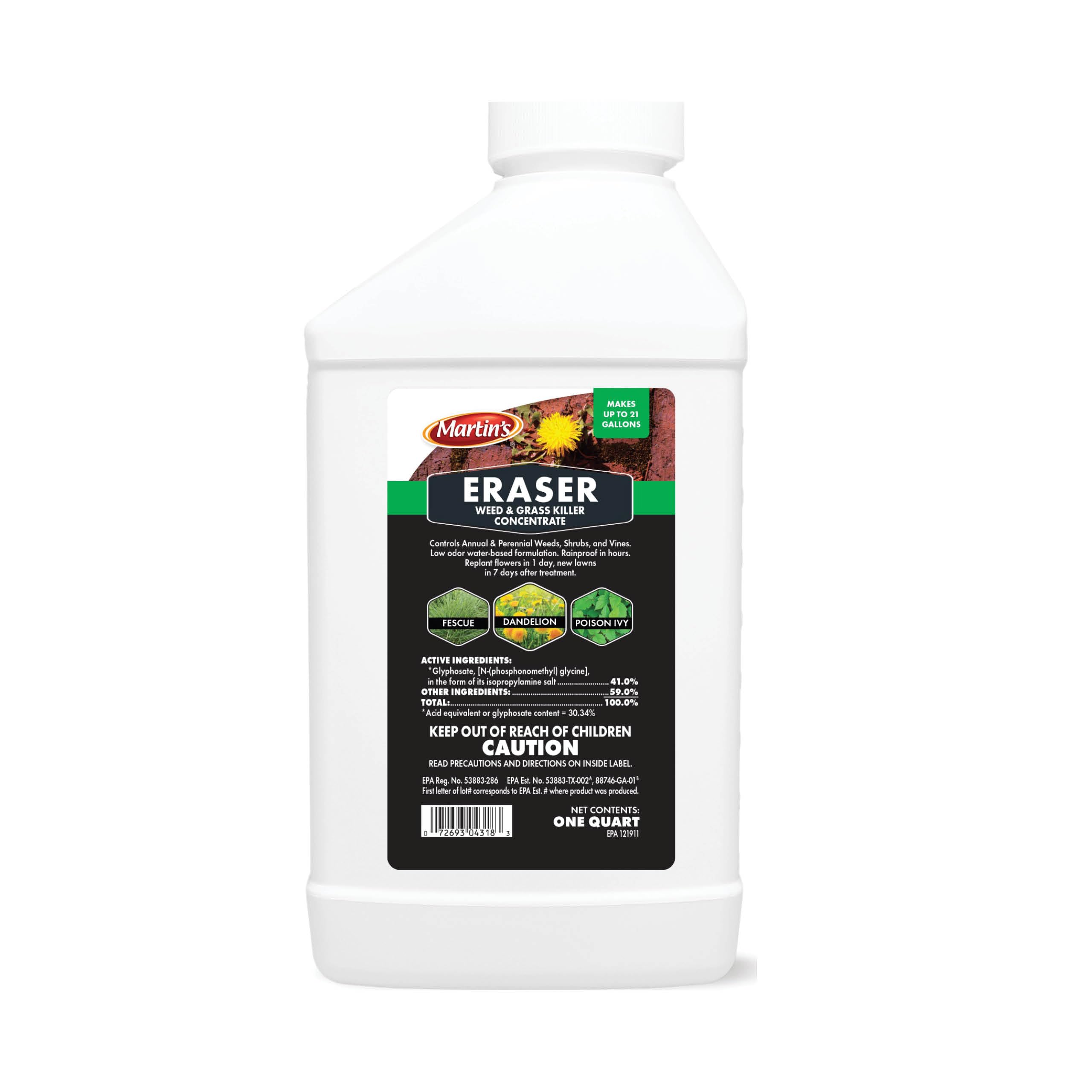
The Control Solutions Eraser Concentrate delivers 41% glyphosate — the same active ingredient found in commercial-grade Roundup — at a fraction of the per-gallon cost. One reviewer calculated that mixing 8 ounces per gallon of water yields a solution that kills everything green (grass, clover, dandelions, flowers) within 7 to 14 days. For a long fence line, this is the most cost-effective way to nuke every plant in a single pass.
The formula is water-based and low-odor, which makes it more pleasant to work with than some petroleum-based concentrates. It has no residual soil activity, meaning you can replant or reseed the fence line area once the weeds have died — critical if you plan to lay new sod or plant a hedge after clearing. Users who switched from consumer-grade Roundup report better results at lower cost, especially when mixed with a non-ionic surfactant (or even a drop of dish soap) to improve leaf adhesion.
Glyphosate works slowly compared to diquat-based products — don’t expect to see results for 4 to 7 days. The instructions on the label are minimal, so new users may need to research proper mixing ratios. Poison ivy and other woody vines may need a follow-up application. For bulk clearing of grass and annual weeds along an entire fence perimeter, this is the smart budget pick.
Why it’s great
- High 41% glyphosate concentration — same as commercial grade
- Much cheaper per gallon than consumer Roundup
- No residual soil activity; safe for replanting
Good to know
- Slow action — full dieback takes 1–2 weeks
- Label instructions are vague; requires some research
- Woody vines and poison ivy may need reapplication
5. Fertilome Over The Top Grass Killer

If your fence line runs through a garden, flower bed, or shrub border, the Fertilome Over The Top Grass Killer is the only choice that won’t turn your ornamental plants into brown skeletons. This is a selective graminicide — it targets grass weeds (Bermuda grass, crabgrass, foxtail) while leaving broadleaf plants like roses, azaleas, and vegetables unharmed. Reviewers report it successfully killed Bermuda grass in flower beds after three weeks without damaging adjacent shrubs.
The 8-ounce concentrate makes 8 gallons of spray solution, covering roughly 2,000 square feet. It stops grass growth within 2 days of application, though full dieback takes patience — plan for 2 to 3 weeks. The formula requires a surfactant (dawn dish soap works) to penetrate the waxy cuticle of grass blades. One critical limitation: it only works effectively on grass shorter than 6 inches. Taller, mature grass clumps will be stunted but not killed outright.
Users report mixed results on very tough perennial grasses — some needed a second application for complete control. It’s also expensive per application compared to non-selective concentrates. But when your fence line is planted with prized perennials or a vegetable garden, the ability to kill grass without killing your plants justifies the premium. It is not a scorched-earth solution; it is a surgical tool for grass-only removal.
Why it’s great
- Selective formula kills grass but not shrubs, flowers, or vegetables
- Effective on tough Bermuda grass and crabgrass
- Makes 8 gallons of spray from one small bottle
Good to know
- Works slowly — full death takes 2–3 weeks
- Ineffective on grass taller than 6 inches
- Requires surfactant for optimal adhesion
FAQ
Can I use a grass killer for fence line near a vegetable garden?
How long does it take for a grass killer to work along a fence line?
Will a grass killer damage my wooden fence or metal fence posts?
How do I apply grass killer along a fence line without killing my lawn?
Final Thoughts: The Verdict
For most users, the grass killer for fence line winner is the Ortho GroundClear Super Concentrate because it combines fast visible results (2–48 hours) with deep root kill and a rainfast window that works with unpredictable weather. If you need to kill brush and woody vines that have overtaken the fence line, grab the Southern AG Brush Weed Killer for its high-concentration triclopyr formula. And for a fence line that runs through a garden or flower bed where you can’t harm ornamentals, nothing beats the Fertilome Over The Top Grass Killer — it’s the only selective option here that spares your cherished plants while erasing the grass.