
Hard-to-grow areas — deep shade from mature trees, compacted clay that bakes in the sun, or slopes that shed water before seeds can root — demand a grass seed blend engineered for the specific stress, not a one-size-fits-all bag from the big-box shelf. The wrong mix germinates poorly, fades by midsummer, or simply refuses to anchor in poor soil, wasting your time and effort. A targeted selection of high-PCF fescue varieties, moisture-retaining seed coatings, and deep-rooting turf types determines whether that patch stays bare or finally fills in.
I’m Mohammad Maruf — the founder and writer behind Drink4Good. I’ve analyzed thousands of customer reports, germination studies, and seed-coating technologies to identify which mixes consistently survive the conditions that kill standard blends.
Whether you are overseeding a spot where sunlight never reaches or starting a lawn on a drought-prone hill, finding the right grass seed for hard-to-grow areas comes down to matching three variables — shade tolerance, drought resistance, and soil adaptability — to your specific microclimate.
How To Choose The Best Grass Seed For Hard-To-Grow Areas
Hard-to-grow areas share one trait: the environment actively works against standard perennial ryegrass or Kentucky bluegrass. You need to identify the primary stress factor — shade, drought, poor soil, or a combination — then pick a seed blend that directly counters that stress with deeper roots, waxy leaf coatings, or shade-adapted fine fescue genetics.
Match the Grass Type to Your Light Conditions
Full sun areas can handle tall fescue or Kentucky bluegrass mixes, but deep shade (less than four hours of direct sun daily) requires fine fescues — creeping red, Chewings, or hard fescue. These varieties photosynthesize efficiently in low light and produce a finer, denser turf that does not stretch thin reaching for sunlight.
Look for Moisture Retention Coatings
Seeds in compacted or sloped soil easily dry out before roots establish. Advanced coatings — like Scotts’ Root-Building Nutrition or Outsidepride’s OptiGrowth — bind water and nutrients directly onto the seed hull, raising germination consistency in non-ideal conditions. Uncoated seed in dry soil can lose 40-60% of its potential germination.
Choose a Blend, Not a Single Variety
Single-variety seed is risky in hard areas because one disease, temperature swing, or pest can wipe out the entire patch. Blends that combine two or three complementary fescue types create redundancy: if one struggles in a wet spring, another thrives. Eretz’s annual ryegrass is a monoculture meant for quick cover, while Outsidepride and Jonathan Green use multi-species blends for long-term resilience.
Quick Comparison
On smaller screens, swipe sideways to see the full table.
| Model | Category | Best For | Key Spec | Amazon |
|---|---|---|---|---|
| Outsidepride Legacy Fine Fescue Mix | Premium Blend | Dense shade & low-maintenance | 3-way fescue blend, 5 lbs | Amazon |
| Jonathan Green Dense Shade | Shade Specialist | Heavy tree canopy | 1,800 sq ft coverage, 3 lbs | Amazon |
| Jonathan Green Black Beauty Heat & Drought | Heat Tolerant | Full sun & high temps | Waxy coating, roots up to 4 ft | Amazon |
| Scotts Turf Builder Sunny Mix | All-in-One | Direct sun & light shade | Seed + fertilizer + soil improver | Amazon |
| Eretz Annual RyeGrass | Budget Quick-Cover | Erosion control & bare spots | Fast germination, 3 lbs | Amazon |
In‑Depth Reviews
1. Outsidepride Legacy Fine Fescue Grass Seed Mix
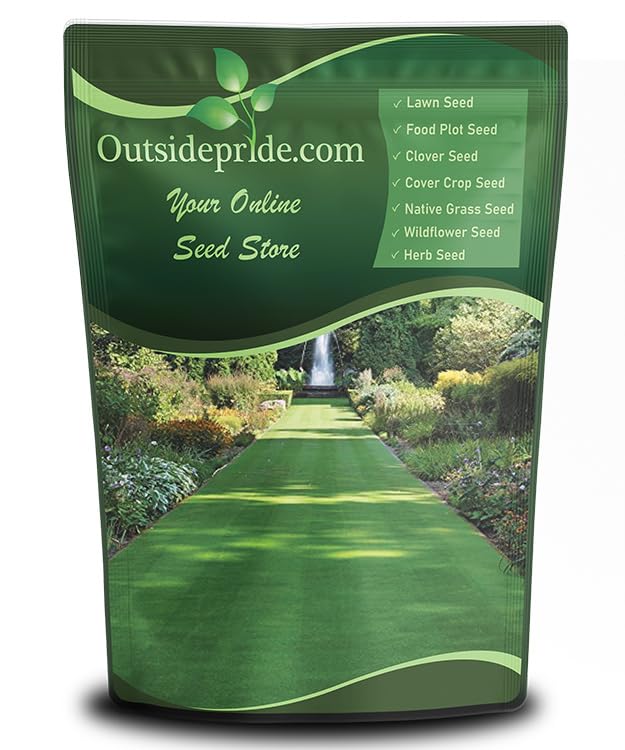
The Outsidepride Legacy mix is the most sophisticated blend in this review, combining 20% Hard Fescue, 40% Chewings Fescue, and 40% Creeping Red Fescue. This three-way composition creates a genetic buffer: if Chewings slows down in a cool spring, Creeping Red fills the gap, and Hard Fescue provides drought resilience. The 5-pound bag offers the bulkiest volume per dollar among the premium options, covering roughly 2,000 square feet for new lawns or up to 4,000 for overseeding.
The OptiGrowth coating binds zinc, phosphorus, nitrogen, and kelp directly to each seed hull, which improves seed-to-soil contact in loose or compacted conditions. Customer reports show germination in 10-14 days in shady areas with minimal yard prep — one reviewer noted thick, dark-green turf in a dense-shade spot with only a compost base and infrequent watering. The fine-textured blades topple gracefully rather than standing stiff, which gives the lawn a manicured golf-course look at low mowing heights.
The trade-off is the maintenance intensity. The blend demands daily watering (ideally twice daily) during establishment, and the fine blades require more frequent mowing than tall fescue. A small minority of buyers reported poor germination (~10%) and an unfavorable refund policy, so sticking to the application directions — topsoil, raking, consistent moisture — is non-negotiable for this blend to perform.
Why it’s great
- Three-way fine fescue blend covers all shade and drought scenarios
- OptiGrowth coating delivers nutrients directly to the seed
- Large 5-lb bag offers the best coverage-to-price ratio
Good to know
- Demanding watering schedule during first 14 days
- Fine blades need more frequent mowing than tall fescue
- Limited germination guarantee; follow prep instructions precisely
2. Jonathan Green Dense Shade Grass Seed
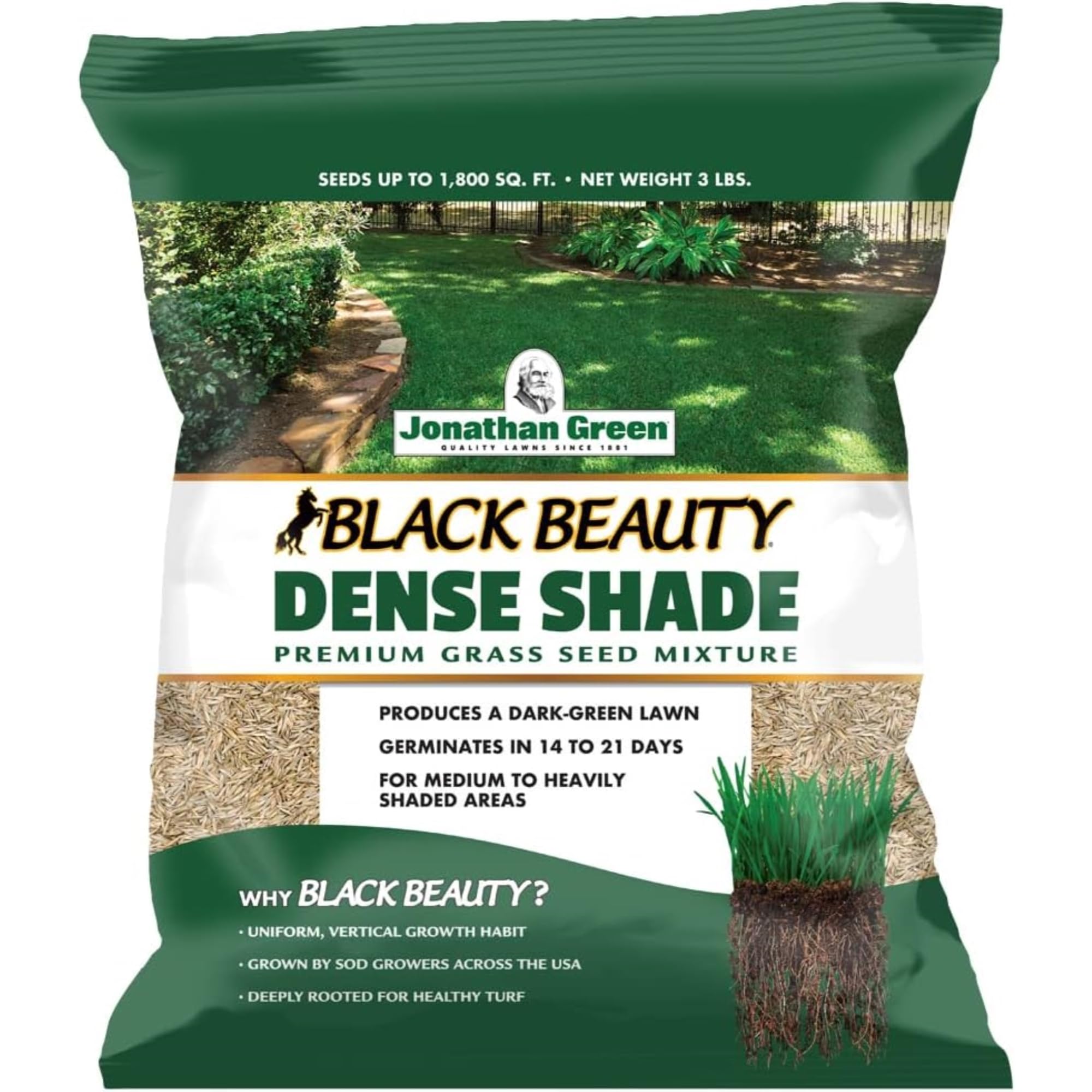
Jonathan Green’s Dense Shade seed is engineered for one specific scenario: areas under a full tree canopy where sunlight hits less than two hours per day. The 3-pound bag claims an aggressive 1,800-square-foot coverage — roughly triple the coverage of similarly sized full-sun mixes — because the fine fescue varieties in this blend require significantly fewer seeds per square foot to establish in low-light conditions.
Reviewers consistently report germination in as little as three days in heavy shade, with grass reaching 4-5 inches under large oak and maple trees. The blades produce a dense, dark-green turf that holds up well against foot traffic and does not thin out when leaves fall and block whatever weak light remains. One verified buyer whose front yard had been bare for years under dense shade called it the first product that “actually works.”
The limitation is heat sensitivity. Several customers noted the grass deteriorated once summer temperatures hit the 80s-90s°F range, even with consistent watering. This is a cool-season blend best suited to spring and fall seeding in northern climates or shaded properties in transition zones. Late-summer buyers in hotter regions may see die-off before the grass fully matures.
Why it’s great
- Germinates in 3 days under dense tree shade
- Massive 1,800 sq ft coverage from a 3-lb bag
- Proven results in bare yards with no prior grass growth
Good to know
- Heat intolerant above 85°F even with regular watering
- Not designed for full-sun or partial-sun areas
- Some batches show poor germination; inconsistent quality control
3. Jonathan Green Black Beauty Heat & Drought Resistant Grass Seed

The Black Beauty Heat & Drought mix takes the opposite approach from the Dense Shade blend: it is optimized for full sun and high temperatures. The primary species are Black Beauty turf-type tall fescues blended with Texas bluegrass, a combination that develops roots up to four feet deep. That root depth is the critical spec — deep roots tap moisture layers that surface-evaporated water never reaches, allowing the grass to stay green when annual ryegrass has already browned out.
The waxy leaf coating, described by Jonathan Green as similar to the skin of an apple, limits evaporation from the leaf surface. Customer reports from transition-zone climates show the seed producing Kentucky Bluegrass-level density in under two weeks with proper soil prep — aeration, 0.5-inch of potting soil, and daily watering. The 3-pound bag covers 750 square feet for new lawns and up to 1,500 for overseeding, with germination listed at 14-21 days.
Not every buyer gets consistent results. A significant minority reported zero germination or slow establishment, particularly when sown in mid-summer heat without adequate irrigation. The label shows more weed content than some competing blends, and the bag is relatively small for the coverage claim — overseeding 1,500 square feet with a 3-pound bag requires a very thin, even spread that is difficult to achieve without a calibrated broadcast spreader.
Why it’s great
- Roots up to 4 feet deep for drought survival
- Waxy leaf coating reduces moisture loss
- Tolerates heat up to 100°F in full sun
Good to know
- Inconsistent germination without meticulous soil prep
- Bag is small for claimed coverage area
- Higher weed seed content than premium fescue blends
4. Scotts Turf Builder Grass Seed Sunny Mix
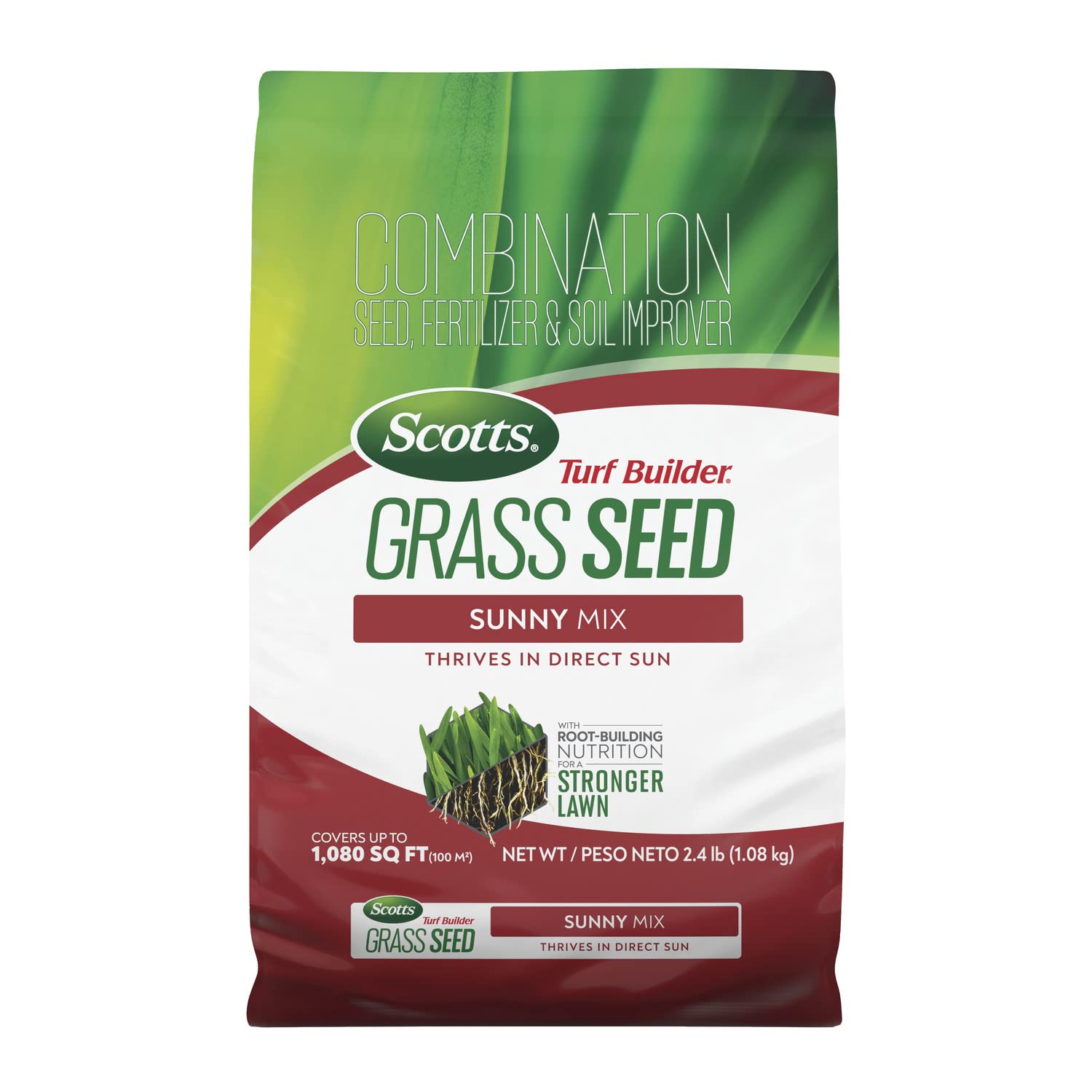
Scotts redesigned its Turf Builder Sunny Mix to combine seed, starter fertilizer, and a soil improver in one bag, which removes the guesswork of separate applications. The Root-Building Nutrition formula provides a controlled-release nitrogen dose that feeds the seedling for roughly six weeks without burning, an advantage in poor soil where nutrients leach quickly. The mix is designed for full sun and light shade, with medium-to-high drought resistance and medium-to-high durability ratings.
The 2.4-pound bag covers 360 square feet for new lawns and 1,080 square feet for overseeding. Customers consistently note fast germination — visible sprouts within 5-7 days in warm soil — and good heat tolerance. One buyer converted a pavement area to dirt and saw the grass spread to the yard before the target area was fully filled, indicating strong rhizome activity typical of the Kentucky bluegrass component in the blend.
The all-in-one convenience comes with a coverage penalty. At 2.4 pounds, this bag covers significantly less area per pound than the Jonathan Green or Outsidepride options, making it more expensive per square foot for large lawns. The fertilizer coating also means the seed loses viability faster if stored, and the mix is not optimized for deep shade — reviewers in under-tree areas saw patchy results compared to the fine fescue specialist blends.
Why it’s great
- All-in-one seed, fertilizer, and soil improver reduces prep steps
- Controlled-release nitrogen feeds seedlings for 6 weeks
- Fast germination in 5-7 days with consistent watering
Good to know
- Very low coverage: 360 sq ft per 2.4-lb bag
- Not suitable for dense shade under tree canopies
- Fertilizer coating shortens shelf life if stored improperly
5. Eretz Annual RyeGrass Seed
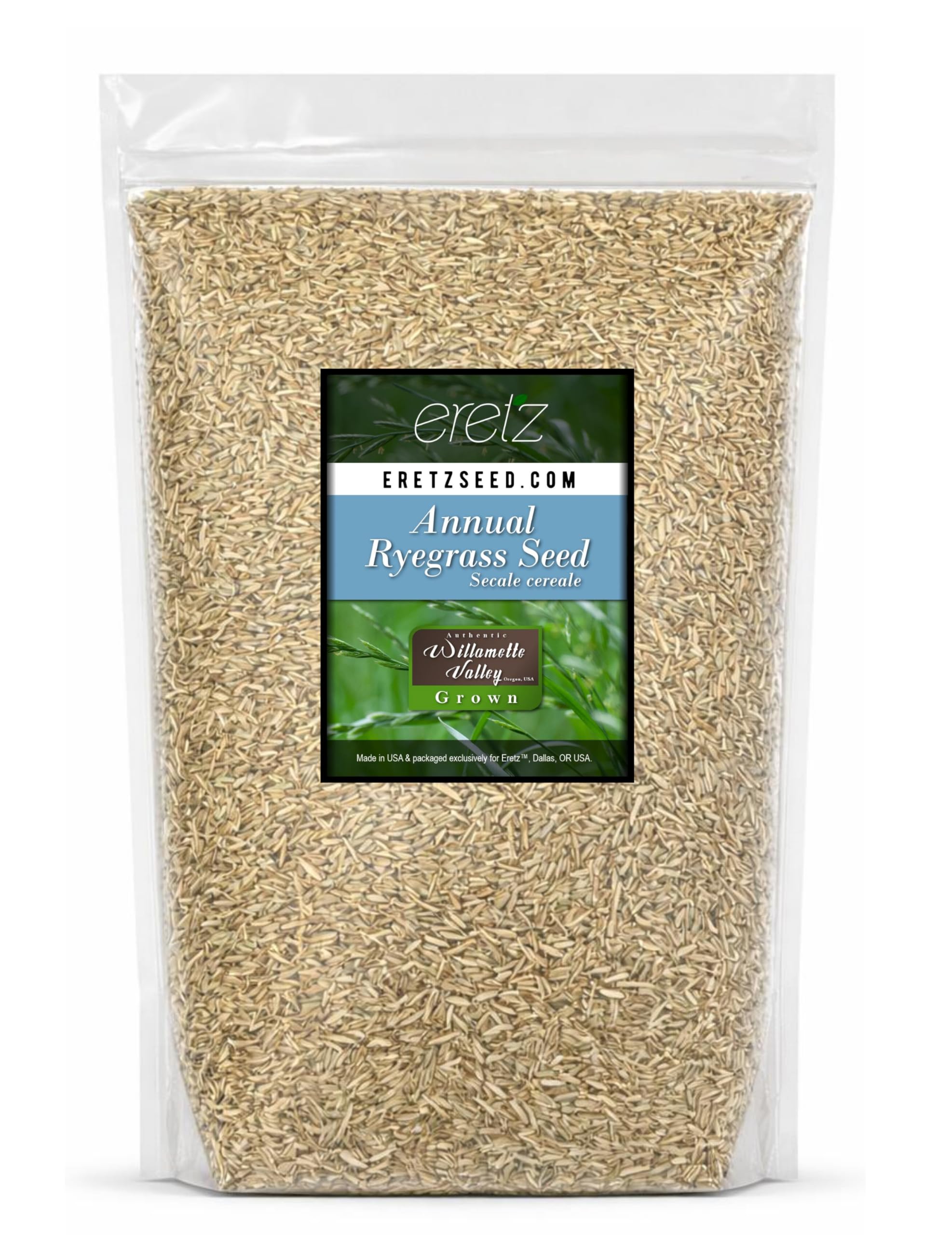
Eretz’s Annual RyeGrass is a monoculture — 100% annual ryegrass, no fillers — sourced from the Willamette Valley in Oregon, a region known for producing some of the cleanest, weed-free grass seed in the world. Annual ryegrass germinates faster than any cool-season perennial, often showing green within 4-7 days, making it the ideal choice for erosion control on slopes, quick beautification of bare patches, or as a temporary nurse crop while slower-establishing fescues take hold.
The 3-pound bag (48 ounces) provides moderate coverage: roughly 500-600 square feet for a new lawn, or up to 1,200 square feet for overseeding. Customers consistently praise its performance in poor soil — one reviewer noted the seed sprouted “in no time” through drought and snow, while another reported a 2/3 germination rate in dry East Texas winter conditions with minimal watering. The fine texture creates a lush, verdant look that rivals more expensive perennial blends in the first two months.
The critical limitation is that annual ryegrass dies after one growing season. It will not return next spring without reseeding, and in warm climates it often burns out by mid-summer. It is also less shade-tolerant than fine fescues and will thin significantly under heavy canopy. This is not a permanent lawn solution — it is a fast, budget-friendly bandage for hard-to-grow spots while you plan a perennial overseeding in the next season.
Why it’s great
- Germinates in 4-7 days — fastest in this review
- Clean, weed-free seed from Oregon’s Willamette Valley
- Survives drought, cold, and poor soil better than most annuals
Good to know
- Annual grass dies after one season; must be reseeded
- Thins in deep shade and high summer heat
- Not a permanent solution for long-term lawn repair
FAQ
What is the difference between fine fescue and tall fescue for shade?
How deep should I prepare the soil before seeding a hard-to-grow area?
Can I mix annual ryegrass with perennial fescue for faster coverage?
Final Thoughts: The Verdict
For most users, the grass seed for hard-to-grow areas winner is the Outsidepride Legacy Fine Fescue Mix because its three-way fescue blend with OptiGrowth coating provides the highest germination consistency across shade, drought, and poor-soil conditions in a single 5-pound bag. If you need a pure shade specialist for a deep-tree-canopy area, grab the Jonathan Green Dense Shade. And for a fast, budget-friendly cover on bare spots while you plan a permanent seeding, nothing beats the Eretz Annual RyeGrass.