
Watching a healthy garden get skeletonized by hungry nymphs in a single afternoon is a specific kind of frustration unique to grasshopper season. These chewing insects move in waves, and once they reach a certain population density, a gentle soap spray won’t cut it—you need a targeted defense that works at the correct life stage.
I’m Mohammad Maruf — the founder and writer behind Drink4Good. I’ve spent years analyzing pest control product formulations, parsing through field-level test data, and matching active ingredients to specific insect deterrent scenarios so you can make a confident, science-backed purchase.
Whether you need a granular bait that protects fruiting crops, a contact-killing powder for structural perimeters, or a concentrated chemical spray for a severe infestation, knowing which best grasshopper killer suits your environment comes down to understanding application method, residual duration, and safety around edible plants.
How To Choose The Best Grasshopper Killer
Grasshoppers are among the hardest garden pests to control because they are mobile, numerous, and have a hard exoskeleton that resists many soft-bodied insect sprays. Your success depends on matching the delivery system to the infestation stage.
Active Ingredient Strategy
Carbaryl (found in Sevin products) provides rapid knock-down through contact and ingestion, making it ideal for heavy outbreaks. Iron phosphate and Spinosad work as stomach poisons that stop feeding within hours and kill within days while remaining safe for organic gardens. Diatomaceous earth (DE) desiccates the insect’s waxy cuticle through physical abrasion, a slower but non-chemical method that grasshoppers cannot build immunity to. Malathion is a potent organophosphate best reserved for persistent infestations where other options have failed.
Application Form and Coverage
Granular baits are the most targeted approach—grasshoppers eat the poisoned pellets and die, minimizing drift onto non-target plants. Powders (DE) must remain dry to work, so they suit indoor perimeters, greenhouses, and covered patios better than open gardens. Liquid sprays offer full coverage on foliage, but they require correct timing: apply when grasshoppers are in the nymph stage for maximum impact, and reapply after rain.
Crop and Pet Safety Window
If you are treating a vegetable or herb garden, prioritise formulations with OMRI-listed ingredients (iron phosphate, Spinosad, food-grade DE). Conventional chemicals like carbaryl and malathion require strict pre-harvest intervals—check the product label for days-to-harvest restrictions, and keep pets and children away from treated areas until the spray has completely dried.
Quick Comparison
On smaller screens, swipe sideways to see the full table.
| Model | Category | Best For | Key Spec | Amazon |
|---|---|---|---|---|
| Sevin Trigger Spray | Contact Spray | Rapid foliage protection | Carbaryl 22.5% concentrate | Amazon |
| Bonide Bug & Slug Bait | Granular Bait | Organic vegetable gardens | Iron phosphate & Spinosad | Amazon |
| Bonide DE Crawling Insect Killer | Desiccant Powder | Indoor and dry perimeter use | 5 lb food-grade DE | Amazon |
| RobiGuard DE & Peppermint | Scented Powder | General household crawling pests | DE + peppermint oil blend | Amazon |
| Hi-Yield Malathion Spray | Concentrate | Stubborn infestations | 55% Malathion concentrate | Amazon |
In‑Depth Reviews
1. Bonide Bug & Slug Bait

This granular bait uses a dual natural active ingredient combination—iron phosphate and Spinosad—that targets grasshoppers through ingestion rather than contact. When grasshoppers consume the pellets, feeding stops within hours, and the pest dies within days, which makes this an excellent match for organic vegetable gardens and fruit tree zones where chemical residue is a concern.
The 1.5-pound bag covers up to 3,000 square feet at the recommended application rate of half to one pound per 1,000 square feet, and a single broadcast lasts up to four weeks under normal conditions. Users report that it stops nightly seedling destruction effectively, though reapplication is necessary after heavy rain—this is expected for any granular bait that relies on the insects actively eating the product.
Because the bait targets earwigs, cutworms, pillbugs, crickets, slugs, and snails in addition to grasshoppers, it functions as a broad-spectrum solution for anyone managing multiple soil-level pests. The OMRI-compatible ingredients allow people and pets to re-enter the area immediately after application, provided the granules are not consumed directly.
Why it’s great
- Certified organic ingredients protect edible crops
- Wide coverage per pound reduces treatment frequency
- Low toxicity to non-target soil organisms
Good to know
- Effectiveness drops after heavy rainfall; must be reapplied
- Not a rapid contact killer—death takes 24 to 72 hours
- Bag seal is not resealable; transfer to a container
2. Sevin Trigger Spray

Sevin is the most widely recognized name in home garden insect control, and this ready-to-use trigger spray delivers carbaryl at 22.5% concentration—enough to kill grasshoppers on contact within minutes. The formula kills over 100 listed insect species, including Japanese beetles, squash bugs, and stink bugs, which makes it the best choice if you face a multi-pest crisis and need immediate visible results.
The 32-ounce bottle covers foliage without requiring any mixing, measuring, or hose attachment assembly. Because carbaryl is a potent carbamate, users report significant reduction in grasshopper populations after a single thorough application on the upper and lower leaf surfaces, particularly effective against the nymph stage before the insects develop strong wings.
There are trade-offs: carbaryl is moderately toxic to bees while wet, so application should happen at dawn or dusk when pollinators are inactive, and the spray should not be used on edible crops within a certain pre-harvest interval detailed on the label. For ornamental borders, flower beds, and non-bearing fruit trees, this is the fastest way to stop a grasshopper invasion cold.
Why it’s great
- Kills grasshoppers on contact in under an hour
- Ready-to-use trigger makes spot treatment simple
- Broad label covers over 100 pest species
Good to know
- Toxic to bees until spray dries completely
- Not suitable for organic gardening protocols
- Requires strict adherence to pre-harvest waiting period
3. Bonide Diatomaceous Earth Crawling Insect Killer

Diatomaceous earth is one of the few physical-mechanism insecticides that grasshoppers cannot develop resistance to. The microscopic razor-sharp silica particles pierce the waxy cuticle of the insect, causing fatal dehydration within 48 hours of contact. This 5-pound bulk bag provides enough food-grade DE to treat large areas—greenhouses, barn stalls, garden perimeters—for a full season or longer.
The powder can be applied as a dry dust using a hand duster or mixed with water into a slurry for spray application on foliage and soil. Users note that direct dusting on grasshoppers yields faster results than residual barriers, because the insect must physically walk through the powder for the desiccation process to begin. Stored properly in a dry environment, DE remains effective indefinitely with no expiration date.
Because it is food-grade and USDA-specified, this DE is safe to apply around livestock, stored grain, and active crops without any withdrawal period. The main limitation is moisture—once DE gets wet, its abrasive action stops until the powder dries out again, which means it works best under covered structures or during dry weather cycles.
Why it’s great
- Non-chemical desiccant action prevents resistance buildup
- Enormous 5-pound supply lasts multiple seasons
- Safe for use around animals and edible plants
Good to know
- Loses efficacy when exposed to rain or heavy dew
- Dust requires mask during application to avoid lung irritation
- Slower acting than synthetic contact sprays
4. RobiGuard Diatomaceous Earth & Peppermint Powder

RobiGuard combines food-grade diatomaceous earth with peppermint oil, adding a natural repellent layer to the mechanical kill action. The peppermint scent masks the attractant cues that grasshoppers use to locate plants, while the DE still desiccates any insect that crosses a treated line. This dual-action approach works well for homeowners who want a chemical-free option that also leaves a pleasant scent behind.
The 16-ounce resealable pouch is sized for indoor perimeter treatment and small outdoor patios rather than large acreage. Users report success sprinkling the powder along baseboards, under refrigerators, around potted plants, and near entry points where grasshoppers and other crawling insects travel. The peppermint oil also provides some deterrent effect against ants and spiders in the same treated zone.
Because the peppermint oil component is volatile, the repellent scent fades after a few days and must be refreshed more frequently than plain DE. Nevertheless, for households with children and pets where synthetic pesticides are not an option, this product offers a gentle but functional barrier that keeps grasshoppers from establishing indoor strongholds.
Why it’s great
- Kid- and pet-safe formula with no synthetic chemicals
- Pleasant peppermint scent masks garden odors
- Resealable pouch simplifies storage and reuse
Good to know
- Smaller quantity limits use to smaller treatment areas
- Peppermint scent requires reapplication every few days
- Powder can be dusty during application; use a mask
5. Hi-Yield 55% Malathion Spray
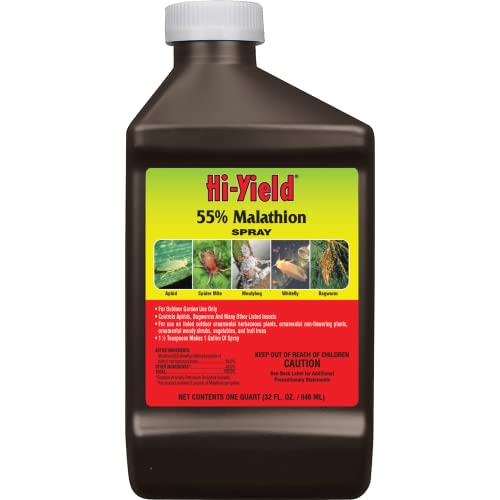
Hi-Yield’s 55% Malathion concentrate is a heavy-duty organophosphate insecticide designed for situations where biological and gentler chemical options have failed. Malathion works by inhibiting acetylcholinesterase in the insect’s nervous system, causing rapid paralysis and death. This is the go-to choice for severe grasshopper outbreaks on ornamentals, non-bearing fruit trees, and shrubs.
The 32-ounce bottle is a concentrate that must be mixed with water and applied via a hose-end or tank sprayer, giving you the ability to treat very large volumes of foliage at a relatively low cost per gallon of mixed solution. Users mention that it eliminates spider mites, scale, and mosquitoes alongside grasshoppers, which makes it effective for comprehensive perimeter management.
Because Malathion is a known suspected carcinogen with moderate environmental persistence, this product should be used sparingly and strictly according to the label. Full protective gear—gloves, long sleeves, goggles, and a respirator—is mandatory during mixing and application, and the spray should never be applied to crops with an active pre-harvest interval. Reserve this for situations where every other method has been exhausted.
Why it’s great
- Highest knockdown power against resistant grasshopper populations
- Concentrate offers excellent per-gallon value for large properties
- Controls a very broad range of sucking and chewing insects
Good to know
- Requires full personal protective equipment during use
- Strong chemical odor and environmental persistence concerns
- Absolutely prohibited on edible crops within harvest window
FAQ
Will diatomaceous earth kill grasshoppers or just repel them?
Can I use granular grasshopper bait around my vegetable garden?
Final Thoughts: The Verdict
For most users, the best grasshopper killer winner is the Bonide Bug & Slug Bait because its dual organic active ingredients provide effective suppression in vegetable gardens without harmful chemical residues. If you need immediate knockdown on ornamental plants, grab the Sevin Trigger Spray. And for a persistent, non-chemical approach around barns, greenhouses, and structural perimeters, nothing beats the bulk Bonide Diatomaceous Earth.