
Nothing ruins a smooth brake job faster than a seized caliper pin that causes uneven pad wear and vibrations through the steering wheel. The thin film of lubricant between your caliper bracket and those sliding pins is the only thing preventing metal-on-metal binding, yet many drivers grab the nearest chassis grease and watch their new pads fail prematurely. Getting this chemistry right means understanding temperature tolerances, rubber compatibility, and the real-world difference between silicone, ceramic, and synthetic formulations.
I’m Mohammad Maruf — the founder and writer behind Drink4Good. I’ve spent years analyzing chemical lubrication specs across automotive subcategories, comparing flash points, thermal stability curves, and material compatibility charts to separate the formulas that hold up from those that wash out after one rainy season.
The right lubricant keeps caliper hardware moving freely and braking consistent for tens of thousands of miles, which is why I track every thermal, dielectric, and corrosion-resistance spec when ranking the best grease for brake caliper pins on the market.
How To Choose The Best Grease For Brake Caliper Pins
Brake caliper pins live in a harsh environment — they see road spray, salt, extreme heat from the rotor, and occasional water immersion. The grease you choose must handle all of it without washing out, melting away, or attacking the rubber dust boots that keep debris out of the pin bore. Three factors determine whether a lubricant will last or lead to a second repair.
Silicone vs. Ceramic vs. Synthetic Base
Silicone-based greases are the safest bet because they remain inert against EPDM rubber boots and won’t swell or harden seals over time. Ceramic-infused formulas, typically blending synthetic MCA oil with ceramic powder, offer extreme heat resistance — some rated beyond 2000°F — making them ideal for high-friction sliding pins that see radiant rotor heat. Straight synthetic formulations balance cost and performance but require checking that they’re safe for the specific rubber compound used in your caliper boots.
Flash Point and Thermal Stability
A grease’s flash point tells you the temperature at which its volatile components ignite, but for brake pin applications, thermal stability matters more — the grease must stay thick enough to cling to the pin surface without melting into a thin oil that runs out. Look for flash points above 400°F; premium ceramic and synthetic blends reach 500°F or higher, ensuring the lubricant remains in place during repeated hard stops.
Rubber Compatibility and Corrosion Protection
Petroleum-based greases will dissolve many common rubber dust boot materials, causing them to swell, split, or lose their seal — once dirt enters the pin bore, binding is inevitable. High-quality brake greases explicitly state compatibility with EPDM, neoprene, or natural rubber. Beyond that, a good formulation resists salt spray and moisture entry, preventing galvanic corrosion between the steel pin and aluminum caliper bracket.
Quick Comparison
On smaller screens, swipe sideways to see the full table.
| Model | Category | Best For | Key Spec | Amazon |
|---|---|---|---|---|
| Keze High Temp Ceramic | Ceramic/Synthetic Blend | Extreme heat resistance | Flash point 3000°F | Amazon |
| Super Lube 97008 Silicone | Silicone with PTFE | Multi-surface and rubber safety | Dielectric strength 400 V/mil | Amazon |
| Motorcraft XG-3-A | OEM Silicone | OE-spec replacement | EPDM rubber compatible | Amazon |
| Versachem 26080 Synthetic | Synthetic | Budget-friendly brake maintenance | Temp range -5°F to 400°F | Amazon |
| CRC Sta-Lube SL3303 | Synthetic Blend | Bulk value for multiple jobs | 12 oz synthetic grease | Amazon |
In‑Depth Reviews
1. Keze High Temp Ceramic Brake Caliper Grease
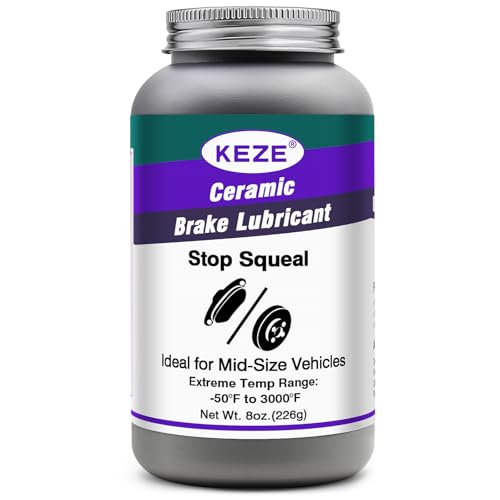
Keze combines synthetic MCA oil with ceramic powder to create a purple grease that stays put at temperatures that would vaporize conventional lubricants — the 3000°F flash point isn’t just a marketing number, it reflects the non-melting ceramic filler that maintains film thickness on sliding pins even after repeated track-day braking. The thick formula clings aggressively to vertical pin surfaces without dripping, which is critical for calipers where gravity would pull a thin oil away from the bushing area.
Users report immediate elimination of sticky caliper movement and uneven pad wear patterns after switching to this blend. The brush-top can applies a controlled bead directly onto the pin, reducing mess compared to squeeze tubes, and the 8 oz container covers multiple brake jobs with plenty left over for shims and pad abutment clips. The purple dye provides visual confirmation that you’ve fully covered the pin surface without gaps.
Customer feedback across several months of use shows no signs of washout or hardening, and the ceramic particles appear to reduce squeal by dampening micro-vibrations between the pad backing plate and the caliper fingers. For a mid-range price point, this delivers the highest thermal ceiling in the test pool.
Why it’s great
- Extreme 3000°F flash point resists melting under hard braking
- Thick, clingy consistency stays on vertical pin surfaces
- Brush-top applicator keeps the grease off your hands
Good to know
- Slightly more expensive per ounce than simple silicone options
- Ceramic powder can feel gritty if over-applied to tight bores
2. Super Lube 97008 Silicone Brake Grease with PTFE
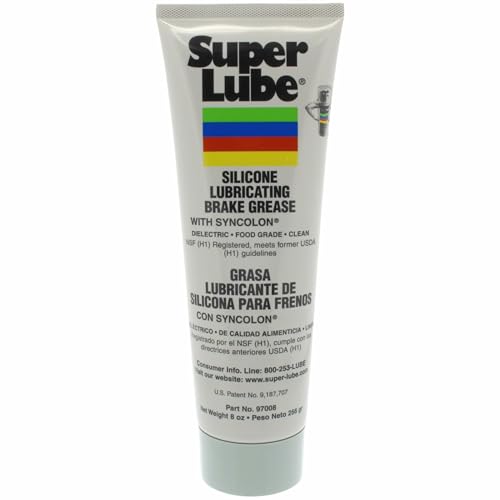
Super Lube’s 97008 leverages a silicone base thickened with PTFE microparticles to create a grease that excels at vibration dampening — the same chemistry that makes it popular on 3D printer lead screws also makes it one of the most effective anti-squeal compounds for brake hardware. The dielectric strength rating of 400 V/mil means it can safely coat electrical connectors without shorting, though its primary role here is keeping caliper pins lubricated and rust-free.
Users appreciate that this formula is completely odorless compared to petroleum-based greases, and the translucent white paste stays where you put it. The 8 oz tube has lasted experienced DIYers through multiple brake jobs on cars and motorcycles, and the silicone base is fully compatible with EPDM rubber boots — no swelling or premature cracking reported even after nearly a year in service.
One minor handling note: the grease separates slightly when stored cap-down in hot garages, requiring a quick stir or shake before first use. That’s a common behavior with silicone compounds that contain PTFE additives, and it doesn’t affect performance once remixed. Given the premium price per ounce, this is best for someone who values rubber safety and multipurpose utility — it also works on plumbing O-rings and pool filter gaskets.
Why it’s great
- Excellent vibration damping reduces brake pad squeal effectively
- Approved for incidental food contact (NSF H1), indicating high purity
- Safe on all common rubber boot materials, no swelling
Good to know
- Consistency is slightly runny compared to ceramic grease
- Premium price per ounce; may separate in hot storage
3. Motorcraft XG-3-A Silicone Brake Caliper Grease

Motorcraft XG-3-A is the factory-fill grease used on millions of Ford and Lincoln vehicles, which gives it immediate credibility for anyone retaining warranty coverage or chasing an OE-specific solution. The silicone-based formula offers high resistance to both water washout and thermal degradation, and it’s explicitly compatible with EPDM rubber — a non-negotiable requirement for long dust boot life. The 3 oz bottle looks small, but a little goes a long way: a single pea-sized bead per pin is all you need.
This grease also functions as a dielectric compound for spark plug boots and distributor caps, which is why it carries a 15W viscosity grade — thin enough to spread easily but thick enough to cling to metal surfaces. Mechanic feedback highlights its ability to stop pad squeal on Brembo rotor upgrades and its reliability in northern climates where road salt accelerates corrosion on uncoated pins.
The main tradeoff is the small container size — if you’re doing brake jobs on multiple family vehicles, the 3 oz bottle will run out faster than the 8 oz alternatives. A few customers also received bottles missing the cap, so sealing may be inconsistent for some units.
Why it’s great
- OE Ford-spec formula guarantees caliper boot compatibility
- High dielectric strength makes it a dual-purpose electrical grease
- Excellent corrosion resistance in salt-heavy road conditions
Good to know
- Only 3 oz — small container for the price
- Container may arrive without a secure cap in some shipments
4. Versachem 26080 Synthetic Caliper Grease

Versachem 26080 fills the gap between premium specialty greases and cheap multi-purpose lubricants that aren’t designed for brake hardware. Its synthetic formulation covers a serviceable temperature range of -5°F to 400°F — adequate for daily-driven cars and light truck use — and it effectively prevents disc brake squeal when applied to caliper pins, pad shims, and abutment clips. The 8 oz bottle includes a built-in brush, making targeted application straightforward without needing a separate tool.
This product does carry an important limitation: it is designed for metal-to-metal contact points only. The manufacturer explicitly warns against applying it to rubber components, so you must keep it confined to the steel pin and the aluminum bore surface, relying on the existing rubber boot to protect the seal. For that reason, it’s a better fit for experienced DIYers who know exactly where to apply it and where to stop.
The price point is the clear draw — you get 8 oz of dedicated brake grease for less per ounce than any other product in this lineup. Customer reviews consistently mention it gets the job done for simple pad and rotor swaps, and multiple users report buying second bottles for spare parts bins.
Why it’s great
- Lowest cost per ounce among dedicated brake greases
- Integrated brush applicator reduces waste and mess
- Stops brake squeal effectively on metal contact surfaces
Good to know
- Not safe for rubber boots — metal surfaces only
- 400°F flash point is lower than ceramic alternatives
5. CRC Sta-Lube SL3303 Brake Caliper Synthetic Grease
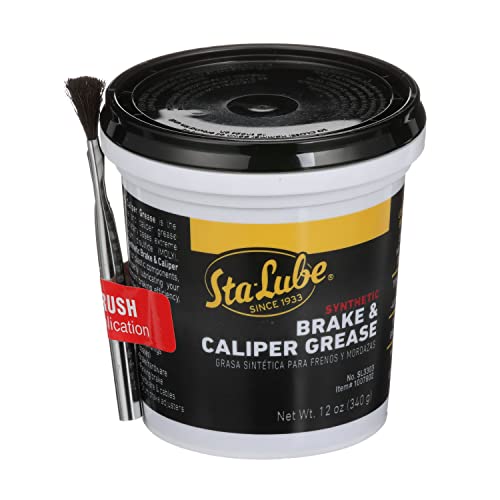
CRC Sta-Lube SL3303 delivers the largest container in this review at 12 oz, making it the economical choice for high-volume DIYers or small independent shops that need to keep a bulk supply on hand. The synthetic blend includes PTFE and graphite particles that reduce friction on sliding pins while remaining plastic-safe for the pin bushings. The 500°F flash point provides adequate thermal margin for street-driven cars, though it doesn’t reach the extreme ceiling of ceramic-infused options.
Real-world user stories include using this grease to revive a Weber grill gas valve whose dried-out lube had caused binding, and applying it to pool filter O-rings for easier disassembly — indications that the synthetic base is compatible with a broader range of materials than a pure petroleum product. For its primary brake application, it prevents caliper binding and pad squeal when used in conjunction with fresh hardware.
One mechanic noted that the texture feels slightly thinner than the included grease that comes with AC Delco hardware kits, raising a minor durability question for extremely high-mileage use. The 12 oz bottle also lacks a brush applicator, so you’ll need a small pick or gloved finger to transfer grease to each pin.
Why it’s great
- 12 oz container provides excellent value per ounce
- Synthetic formula with PTFE and graphite for low friction
- Works beyond brakes — gas valves, pool O-rings, rubber seals
Good to know
- No applicator brush; requires a separate tool
- Consistency is thinner than some OEM-supplied greases
FAQ
Can I use standard multi-purpose grease on caliper pins?
How often should I re-grease brake caliper pins?
Final Thoughts: The Verdict
For most users, the grease for brake caliper pins winner is the Keze High Temp Ceramic because its 3000°F flash point and thick, clingy formula handle everything from commuting to track days without washing out. If you want maximum rubber safety and multipurpose utility, grab the Super Lube 97008 with its NSF H1 rating and proven EPDM compatibility. And for bulk value that works on brakes plus garage gear like gas valves and O-rings, nothing beats the CRC Sta-Lube SL3303 at 12 ounces for the price.