
A grinding, skipping gear in a DVD player, a 3D printer axis that stutters, or a power tool that suddenly binds—these failures often trace back to one mistake: using the wrong lubricant. Standard greases can swell, crack, or dissolve polycarbonate, nylon, and acetal gears, turning a simple maintenance job into a costly replacement. The right formulation stops friction without attacking the polymer.
I’m Mohammad Maruf — the founder and writer behind Drink4Good. I’ve spent years analyzing chemical compatibility data and machining test results to separate plastic-safe lubricants from those that cause long-term embrittlement.
This guide isolates the formulations that actually protect nylon, Delrin, ABS, and polycarbonate gears. Whether you are servicing a robot vacuum, a 3D printer, or a vintage train set, the best grease for plastic gears must resist washout, stay put under shear, and never trigger environmental stress cracking.
How To Choose The Best Grease For Plastic Gears
Selecting a plastic-safe grease is a chemistry decision, not a viscosity preference. The base oil and thickener system must be inert toward the specific polymer family in your gear train. Nylon, acetal (Delrin), ABS, polycarbonate, and polystyrene each react differently to mineral oils, esters, and silicones.
Base Fluid Type: Silicone vs PTFE vs Synthetic Hydrocarbon
Silicone greases offer broad polymer compatibility and wide temperature range (-40°F to 400°F+), but they can attract dust and are difficult to fully remove. PTFE-loaded greases (often labeled with PTFE micro-powder) create a low-friction boundary layer without attacking any common gear plastic. Straight synthetic hydrocarbons (polyalphaolefins) work well on nylon and acetal but may craze polycarbonate and polystyrene. For mixed-plastic assemblies, PTFE or silicone based formulations are the safest starting point.
Consistency Grade (NLGI) and Adhesion
Open gear faces need an NLGI 2 grease — thick enough to stay on vertical tooth surfaces under centrifugal force. NLGI 1 or semi-fluid greases fling off at higher RPM, leaving the gear train dry. A formulation with a high drop point (above 450°F) ensures the grease doesn’t melt and run into bushings or motor windings during sustained operation.
Certifications and Food-Grade Status
NSF H1 registration (incidental food contact) indicates the grease contains no known toxic heavy metals or endocrine disruptors. While not essential for a hobbyist 3D printer, food-grade certification guarantees the base oil and thickener are both chemically benign and safe if the lubricant migrates onto hands or surfaces near food preparation.
Quick Comparison
On smaller screens, swipe sideways to see the full table.
| Model | Category | Best For | Key Spec | Amazon |
|---|---|---|---|---|
| Labelle Plastic Compatible Grease w/ PTFE | PTFE | Model trains, DVD drives, small appliances | PTFE micro-powder carrier | Amazon |
| WD-40 Specialist Dry Lube PTFE Spray | Dry Lube | Power tool guide tracks, hinges, conveyor belts | -50°F to 500°F operating range | Amazon |
| Super Lube 97008 Silicone Brake Grease | Synthetic | 3D printer rails, brake calipers, electrical insulation | NSF H1 food-grade, NLGI 2 | Amazon |
| Aqua Flex Premium Silicone Lubricant Grease | Silicone | Pool/spa valves, O-rings, outdoor gear | NLGI 2, -40°F to 400°F | Amazon |
| Dow Corning 111 O-Ring Valve Lubricant | Silicone | Water filter O-rings, pressure valves, electrical seals | 204°C high-temp rating | Amazon |
In‑Depth Reviews
1. Labelle Plastic Compatible Grease w/ PTFE

The Labelle grease is formulated specifically for plastic gears found in model trains, DVD drive sleds, and RC cars. Its PTFE micro-powder carrier creates a dry-film boundary layer that reduces friction without causing plasticizers to leach out of ABS or polycarbonate. Users have successfully resurrected Xbox DVD drives that stopped reading discs — simply degreasing the old lubricant and applying this low-bleed formulation restores smooth gear movement.
At 0.5 ounces, the tube is small, but the required application volume is minimal. A pea-sized amount spread across gear teeth lasts for hundreds of operating hours. The grease stays put at moderate rotational speeds and does not fling off onto nearby circuit boards. The resealable tube prevents the PTFE carrier from drying out between uses.
The base viscosity is thin enough to penetrate tight gear mesh interfaces but thick enough to remain on vertical tooth faces in standard hobbyist applications. It works on nylon, Delrin, ABS, and polycarbonate without crazing or swelling — verified by years of model railroad use where paint and plastic compatibility is critical.
Why it’s great
- Specifically engineered for plastic gear compatibility — no swelling or cracking
- PTFE additive provides low coefficient of friction even at low RPM
- Resealable tube minimizes waste for small-quantity users
Good to know
- 0.5-ounce tube runs out quickly if used on multiple large gear trains
- Not suitable for high-temperature environments above 200°F
2. WD-40 Specialist Dry Lube PTFE Spray, Twin Pack
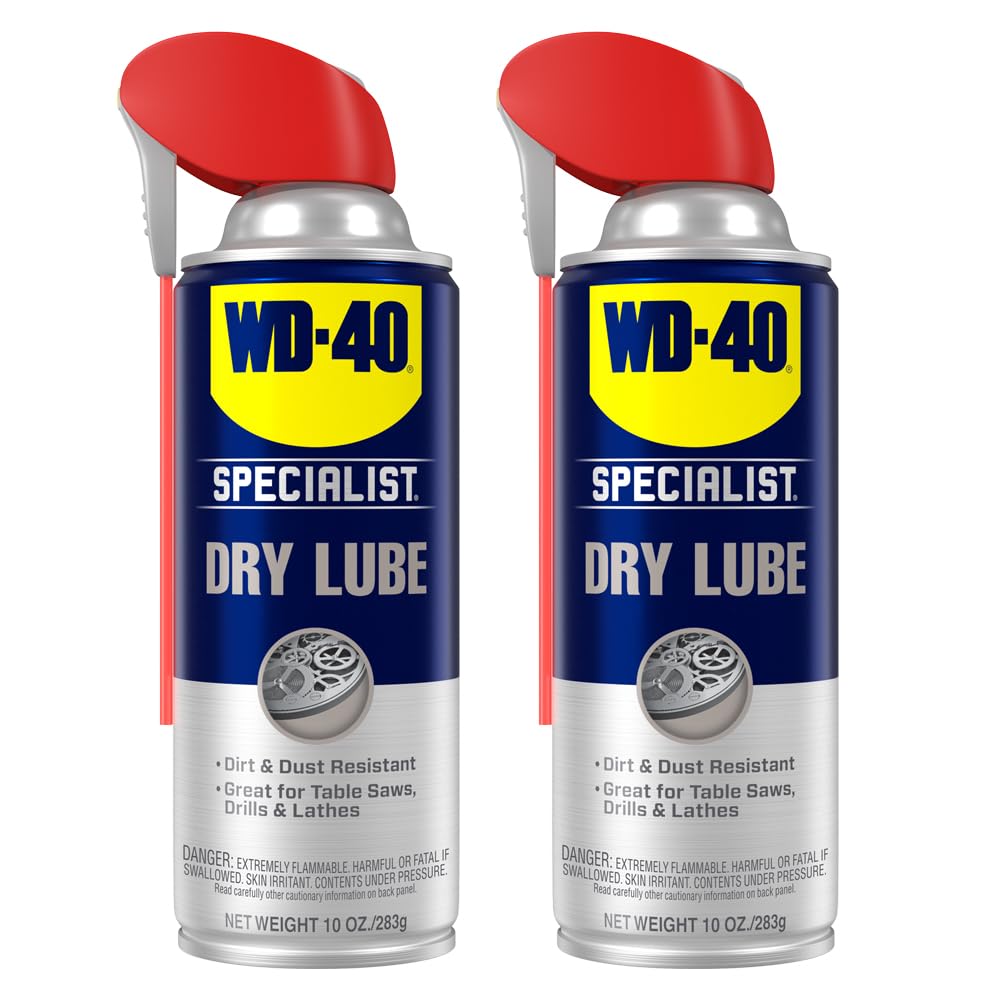
This aerosol dry lube uses PTFE in a fast-evaporating carrier that leaves a thin non-staining film. The 10-ounce twin pack covers large surfaces like table saw guide rails, drill press columns, and conveyor belt rollers without leaving a sticky residue that attracts sawdust or paper fibers. The Smart Straw nozzle provides precise spray patterns for gear teeth inside tight housings.
WD-40 Specialist is explicitly safe on most plastics — the manufacturer only excludes clear polycarbonate and polystyrene. For nylon, acetal, ABS, and filled polycarbonate blends, the dry film resists washout from moisture and does not degrade under UV exposure. The operating range of -50°F to 500°F makes it suitable for garage woodworking equipment that experiences extreme seasonal temperature swings.
One complaint is quality control on the aerosol cans — some units arrive partially discharged. The product itself, when properly pressurized, provides long-lasting corrosion protection on steel gear shafts and eliminates friction on polymer pinions. For applications where a spray format is convenient, this is the strongest mid-range option.
Why it’s great
- Dry film does not attract dust, dirt, or fibers common in woodworking
- Extreme temperature tolerance for unheated garages and outdoor use
- Safe on most plastics except clear polycarbonate and polystyrene
Good to know
- Twin pack occasionally has one defective can that arrives partially empty
- Spray format is less precise than a grease tube for small gear trains
3. Super Lube 97008 Silicone Brake Grease with PTFE
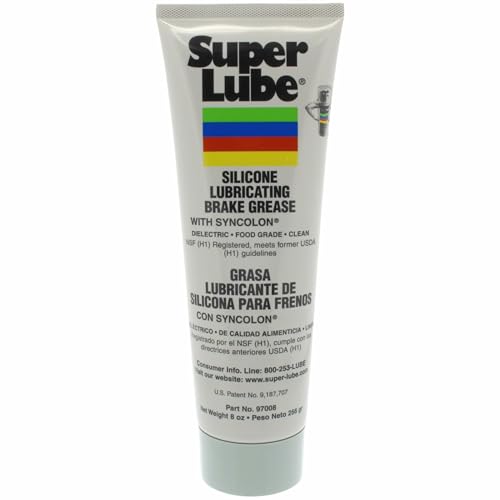
Super Lube’s silicone brake grease carries PTFE additive and NSF H1 food-grade certification, meaning it can contact food incidentally without toxicity concerns. On a 3D printer, it lubricates lead screws, linear rails, and Z-axis couplers without melting in heated enclosures that reach 140°F. The NLGI 2 consistency stays on vertical surfaces, preventing the common problem of grease dripping onto heat beds or print surfaces.
The high dielectric strength (400 volts per mil) allows the grease to insulate electrical connections on circuit boards. One user restored a 30-year-old remote control by applying a thin coat to corroded contacts — the silicone film sealed out moisture while the PTFE restored smooth switch feel. The 8-ounce tube is the largest volume in this guide, making the cost per application the lowest among premium options.
A minor handling note: after storage in high heat (above 90°F) with the cap downward, the silicone base can separate slightly. A quick shake before application restores the proper consistency. This is common with thick silicone greases and does not indicate product degradation.
Why it’s great
- NSF H1 food-grade registration for incidental food contact safety
- High dielectric strength suitable for electrical insulation applications
- 8-ounce tube provides long-term value for regular users
Good to know
- Silicone base can separate if stored in hot environments with cap down
- May feel slightly runny compared to pure lithium-based greases
4. Aqua Flex Premium Silicone Lubricant Grease

Aqua Flex delivers a food-grade silicone grease with a flash point of 820°F — far above the requirements of any plastic gear application. The NLGI 2 consistency provides excellent adhesion on O-rings and pump seals, and this same property makes it effective on slower-speed plastic gear meshes found in pool pumps and spa filters. The -40°F to 400°F range is generous for outdoor equipment exposed to freezing winters.
The tube form factor allows precise application to small gear trains. Unlike silicone grease designed primarily for plumbing, Aqua Flex does not separate in the tube over extended storage. Users report it works perfectly on pool pump basket lid O-rings and whole-house filter canisters. The NSF H1 registration means incidental contact with drinking water components does not introduce contaminants.
Where this grease falls slightly short is extreme shear conditions — high-RPM gearboxes may cause the NLGI 2 grease to resist flow into tight tooth engagements. For moderate-speed applications like RV dump valve seals or marine gear housings, the adhesion and water resistance are outstanding.
Why it’s great
- NSF H1 food-grade silicone safe for drinking water systems
- Extremely high flash point ensures no melting loss in hot environments
- Excellent moisture resistance for outdoor and marine gear housings
Good to know
- NLGI 2 may be too thick for high-speed gear engagement
- Tube is small at 1.76 ounces — best for focused applications
5. Dow Corning 111 O-Ring Valve Silicone Lubricant & Sealant

Dow Corning 111 is a classic silicone grease used in scuba equipment and pressure systems. Its 204°C (399°F) upper temperature rating exceeds standard food-grade silicones, making it suitable for gear trains in heat-exposed environments like commercial dishwashers or close-to-motor assemblies. The thick, sticker-like consistency stays in place on O-rings and seals, which translates to reliable lubrication on plastic gear faces that also serve a sealing function.
Users confirm that this grease can seal water filter O-rings and RV toilet seals without contaminating the water supply. The silicone base is inert against polycarbonate, nylon, and ABS — verified by decades of use in water softener valves where plastic components are standard. The 2-ounce bottle format allows easy application via cotton swab or small brush.
The primary limitation is its intended use case: this is optimized for sealing and static O-ring lubrication rather than high-speed gear rotation. On fast-spinning gears, the high tackiness may create drag, increasing current draw on small motors. For slow-turning gear trains where water exclusion and temperature resistance are priorities, it is unmatched.
Why it’s great
- Excellent water resistance for submerged or splash-prone gear housings
- High-temperature tolerance suitable for motor-adjacent applications
- Genuine Dow Corning formulation trusted across scuba and industrial sectors
Good to know
- High tackiness may increase drag on high-RPM gear trains
- 2-ounce bottle is small for large-scale maintenance tasks
FAQ
Can I use lithium grease on plastic gears?
How often should I reapply grease to plastic gear trains?
Final Thoughts: The Verdict
For most users, the best grease for plastic gears winner is the Labelle Plastic Compatible Grease w/ PTFE because its PTFE carrier is inert toward all common gear plastics and the small tube eliminates waste for hobbyist quantities. If you need a spray format for large gear racks or power tool guides, grab the WD-40 Specialist Dry Lube PTFE Spray. And for high-heat environments such as heated 3D printer enclosures or motor-adjacent gear trains, nothing beats the Super Lube 97008 Silicone Brake Grease.