
Staring at a wall of old, crumbling grout lines with a manual scraper in hand is a special kind of frustration. The wrist fatigue, the risk of chipping a tile you want to keep, and the sheer time it consumes can turn a simple bathroom refresh into a weekend-long battle. The right tool changes everything, turning that tedious grind into a precise, controlled operation that protects your tiles and your sanity.
I’m Mohammad Maruf — the founder and writer behind Drink4Good. My analysis of home renovation hardware focuses on real-world endurance, material compatibility, and the measurable specs that separate a tool you’ll reach for again from one that shatters mid-job.
After evaluating dozens of blades, attachments, and multi-tool kits, I’ve narrowed the market down to the five best contenders for tackling this specific job. Whether you are a weekend DIYer or a seasoned pro, this guide to the best grout removal tool will help you pick the right option for your specific tile type and project scope.
How To Choose The Best Grout Removal Tool
Choosing the correct tool for grout removal isn’t just about brute force; it’s about matching the tool’s design to the specific constraints of your tile work. The wrong blade can chip glazed ceramic or take forever on cured thinset, so understanding a few key technical differentiators is essential for a successful project.
Blade Material: Diamond vs. Carbide Grit
The most significant performance variable is the cutting edge’s material. Diamond grit blades are sintered with industrial diamonds and excel on hard, abrasive materials like porcelain, unglazed ceramic, and old cement-based grout. They typically last five times longer than their carbide counterparts. Carbide grit blades, often with a brazed tungsten coating, are more budget-friendly and effective on softer substrates like sanded grout, soft stone, and concrete backer board, but they wear down faster on dense materials.
Kerf Width and Line Matching
Kerf is the width of the cut the blade makes. Standard grout lines range from 1/16-inch (narrow wall tile) to 1/4-inch (floor tile). Using a blade that is too wide will chew into the tile shoulders; one that is too narrow won’t clear the old material effectively. Look for a blade set that offers multiple kerf options (for example, 1.6 mm, 1.8 mm, and 2.2 mm) so you can dial in a perfect fit for your specific installation.
Attachment Type: Oscillating vs. Rotary
Oscillating multi-tool blades are the go-to for versatility and control, allowing you to scrape, flush-cut, and grind in tight corners. They excel at removing the bulk of the grout quickly. Rotary tool attachments, like a dedicated guide for a Dremel, offer more precise depth control and a centered cutting path, making them ideal for thin vertical lines where you can’t afford to slip, though they are slower and require a separate rotary tool to operate.
Quick Comparison
On smaller screens, swipe sideways to see the full table.
| Model | Category | Best For | Key Spec | Amazon |
|---|---|---|---|---|
| Bosch OSL234HG | Hybrid Blade | Dual grinding and rasping | Starlock interface | Amazon |
| EZARC Diamond Set | Multi-Kerf Kit | Matching exact grout width | 0.06″–0.09″ kerf options | Amazon |
| HEMUNC Diamond 6-Pack | Flush Cut Pack | Tight spaces & trim work | Straight thin profile | Amazon |
| Dremel 568-01 | Rotary Guide | Controlled precision cutting | Adjustable depth to 3/8″ | Amazon |
| HEMUNC Carbide 6-Pack | Budget Variety | Light mortar and backer board | 3 blade shape types | Amazon |
In‑Depth Reviews
1. Bosch OSL234HG Hybrid Grout Blade
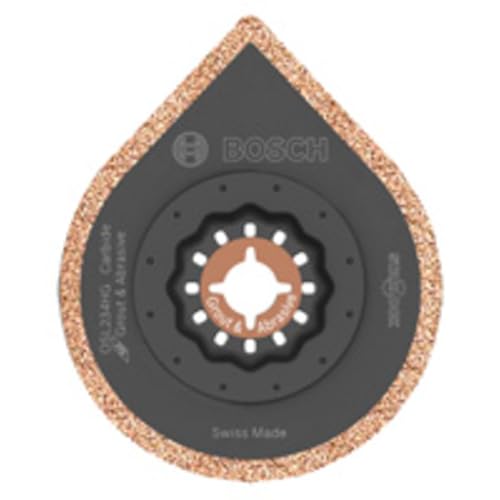
The Bosch OSL234HG is a premium example of a hybrid teardrop blade designed for professionals who need one tool to handle both grinding and rasping. The teardrop shape is the standout feature here: the pointed tip excels at digging into grout lines for initial removal, while the rounded edge can shave down tile edges for a precise fit without switching blades. Swiss precision manufacturing ensures the carbide grit is uniformly applied for consistent performance.
Users report that a low to medium speed setting on an oscillating tool provides maximum control, preventing the blade from walking off the grout line and damaging adjacent tile. A light spray of water helps control dust and keeps the blade cool, extending its cutting life significantly. The Starlock interface locks the blade securely, eliminating any wobble during high-torque applications.
While the upfront cost sits in the mid-range tier, its dual-function design effectively replaces two separate blades. The hybrid geometry also makes it a strong choice for post-installation cleanup where thinset has squeezed up through the grout lines, as the rounded side can scrape it flush without gouging the new tile.
Why it’s great
- Hybrid teardrop shape for both grinding and rasping
- Precision Swiss-made carbide grit for longevity
- Secure Starlock interface for zero-wobble control
Good to know
- Premium pricing relative to entry-level packs
- Single blade; multi-pack not included
2. EZARC Diamond Oscillating Tool Blade Set

The EZARC 4-pack is a specialized set that solves the most common beginner mistake: using the wrong kerf width. It includes blades with three distinct cutting widths — 0.06 inches (1.6 mm), 0.07 inches (1.8 mm), and 0.09 inches (2.2 mm) — allowing you to match the exact width of your grout line. This precision reduces the risk of chipping the glazed edge of your tile, a major advantage for those working on delicate or expensive subway tile.
The diamond grit construction is specifically engineered for the high abrasion of grout and mortar, with users noting that the diamond coating can outlast carbide equivalents by a factor of three or more on standard cement-based grout. The set includes a straight blade for tight spaces, a curved blade for larger areas, and a half-moon blade for detail work. This variety is particularly useful for complex projects involving both floor and wall tiles.
A practical tip from experienced users is to buy two sets and swap blades every five minutes during heavy use. This helps prevent the thin diamond matrix from overheating and dulling prematurely. The blades are compatible with all standard oscillating tool interfaces, including Bosch, Fein, Ryobi, and DeWalt systems.
Why it’s great
- Three different kerf widths for precise line matching
- Diamond grit coating significantly outlasts carbide
- Versatile blade shapes for varied tile layouts
Good to know
- Thin blades can overheat quickly without rotation
- Half-moon blade may be too small for deep grout lines
3. HEMUNC Diamond Oscillating Tool Blades 6-Pack
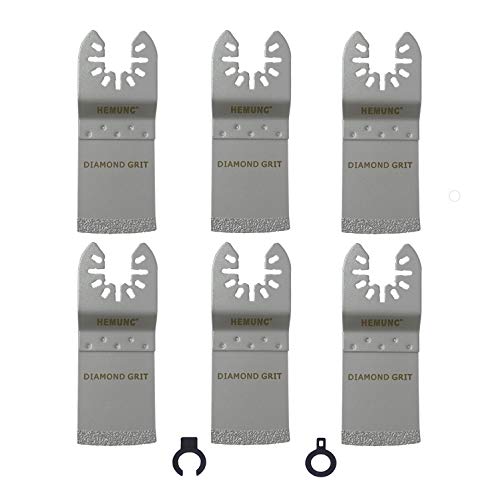
HEMUNC’s 6-pack of straight-profile diamond blades is engineered specifically for flush-cut applications where standard oval or round blades simply can’t fit. The straight, thin design allows the blade to reach into tight crevices around door frames, electrical outlets, and shower niches where a wider blade would scrape the adjacent wall surface. This makes it an indispensable tool for finishing work and precision repairs.
Users consistently report that these blades outperform carbide-tipped options on standard grout removal tasks, providing fast, clean cuts without forcing the tool. The diamond coating allows the blade to handle not only grout but also thinset mortar, cement board, and even light concrete without significant degradation. The universal quick-release system means they will fit on most major oscillating tools from DeWalt, Bosch, Dremel, and Makita.
The key to maximizing the lifespan of these blades is to avoid rushing. Applying too much downward pressure generates heat that can strip the diamond coating. Allowing the tool’s oscillation to do the work at a moderate speed yields the best results. While they are not as durable as a premium single-blade option, the value per blade in this pack is strong for medium-scale DIY projects.
Why it’s great
- Straight profile accesses tight flush-cut areas
- Diamond coating outlasts carbide in grout
- Good value for a 6-pack of diamond blades
Good to know
- Thin design is more brittle; can break under heavy force
- Lifespan shorter on abrasive concrete backer board
4. Dremel Grout Removal Rotary Tool Attachment 568-01

The Dremel 568-01 takes a fundamentally different approach from oscillating blades. It is a dedicated guide system for a rotary tool, featuring a 30-degree cutting angle that allows you to maintain a consistent, safe trajectory along the grout line without worrying about blade slippage. Two special guides on the underside keep the cutting bit perfectly centered between the tiles, which is a game-changer for novices who are nervous about damaging their tile work.
The large viewing window provides excellent visibility, and the depth adjustment mechanism allows you to set a cutting depth of up to 3/8-inch below the tile surface. This is crucial for removing deep, old grout without accidentally cutting into the substrate or the tile edges. The attachment works with both wall and floor grout, and the ability to dial in the depth prevents you from over-cutting and creating a cavity that is difficult to fill.
Users note that the included 1/16-inch bit is quite thin and prone to breaking if you apply lateral pressure. Many experienced users recommend replacing it immediately with a 1/8-inch carbide or diamond bit for better durability. The guide is designed for Dremel’s extra-long bits, but standard bits can be used by adjusting the chuck. Though it adds an extra step—you need to own a rotary tool—the control it provides is unmatched for precision work.
Why it’s great
- Centered guides prevent tile edge damage
- Adjustable depth up to 3/8-inch for deep grout
- Large window improves visibility during cutting
Good to know
- Requires a separate Dremel rotary tool
- Included 1/16″ bit is fragile; upgrade recommended
5. HEMUNC 6pc Universal Carbide Oscillating Saw Blades

The HEMUNC 6-piece carbide pack is the entry-level workhorse, offering three distinct blade shapes—finger rasp, semicircle, and triangle—to handle a wide range of tasks beyond just grout removal. The finger rasp blade is excellent for detail work on fillers and concrete, while the carbide grit semicircle blade cuts into defective tile joints. The triangle blade is ideal for sanding trim and grinding in tight corners, making this kit a versatile addition to any toolbox.
Users report that these blades are effective for light to medium grout removal and cleaning up mortar residue, particularly on softer surfaces like concrete backer board and sanded grout. They arrive with the necessary adapter washers, making them compatible with a wide range of tools including Dremel, Ryobi, Milwaukee, and DeWalt. The cost per blade is among the lowest in the category, which makes them an attractive option for one-time projects.
The primary trade-off is durability. Several users noted that the thin shank of the triangle blade can break under the stress of deep or aggressive cutting, especially on hard cement board. They are best suited for light-duty tasks like widening a grout line for low-voltage wiring or removing a small section of mortar. For a full bathroom floor, a diamond-coated set like the EZARC or the Bosch hybrid will provide more reliable long-term performance.
Why it’s great
- Lowest cost entry point for a variety pack
- Three different blade shapes for multiple applications
- Universal fit with included adapter washers
Good to know
- Triangle blade shank can break under stress
- Not as durable as diamond grit on hard grout
FAQ
Can I use a standard oscillating blade to remove grout?
How do I prevent damaging my tiles during removal?
Final Thoughts: The Verdict
For most users, the best grout removal tool winner is the Bosch OSL234HG because its hybrid teardrop design and premium carbide grit offer professional-grade control and dual-function versatility in a single, durable blade. If you want to match the exact kerf of your grout line for maximum tile protection, grab the EZARC Diamond Set. And for the safest, most beginner-friendly precision on tight wall lines, nothing beats the Dremel 568-01 rotary guide.