
Indoor citrus trees are notorious for dropping leaves, refusing to bloom, and producing sour or nonexistent fruit. The culprit is almost always insufficient light — a standard windowsill can’t replicate the intense, full-spectrum sunlight a citrus tree needs to thrive indoors.
I’m Mohammad Maruf — the founder and writer behind Drink4Good. I’ve spent years analyzing PPFD (Photosynthetic Photon Flux Density) maps, spectrum charts, and real-world grow light performance to find fixtures that can keep a Meyer lemon or kumquat tree happy through dark winters.
After testing multiple models against citrus-specific requirements,there’s one fixture that consistently delivers the intensity and spectrum coverage needed for healthy foliage, flowering, and fruit set. This guide breaks down the top performers so you can confidently choose the best grow light for citrus tree cultivation.
How To Choose The Best Grow Light For Citrus Tree
Citrus trees are heavy feeders of light. Unlike low-light succulents or herbs, citrus needs at least 8-12 hours of intense, full-spectrum light daily, with a specific emphasis on red wavelengths for flowering and fruit set. A generic “grow light” may keep the plant alive, but it won’t push it to produce fruit. Focus on these three pillars.
PPFD and Coverage Area
PPFD (Photosynthetic Photon Flux Density) measures how many photons hit a specific area. For citrus, you need a PPFD of at least 400-600 umol/m²/s at canopy level. The light’s advertised wattage is less important than its actual power draw (real watts) and the size of the coverage footprint at a reasonable hanging height. A light covering a 2x2ft area intensely is better than a weak one covering 4x4ft.
Full Spectrum Wavelengths
Citrus needs the full 380-800nm range. Blue light drives vegetative growth and compact foliage, while deep red light (660nm) triggers the flowering hormones necessary for fruit development. Look for fixtures that explicitly include red, white, and blue diodes, or UV/IR supplementation. Avoid lights that are heavily skewed toward one color (like pure blurple).
Timers and Dimmability
Citrus trees are photoperiod-sensitive. A built-in auto timer (4/8/12/16-hour cycles) is essential for providing consistent day length year-round without manual switching. Dimmability is a major bonus: you can gradually increase light intensity as the tree grows or transitions from vegetative to flowering stage, simulating natural seasonal changes.
Quick Comparison
On smaller screens, swipe sideways to see the full table.
| Model | Category | Best For | Key Spec | Amazon |
|---|---|---|---|---|
| Beelux 1000w LED | Panel | Larger Citrus Trees | Actual 100W draw, 5130 Lumens | Amazon |
| SANSI 4-Gooseneck 600W | Clip/Gooseneck | Focused Canopy Targeting | Actual 40W draw, 4000 Lumens | Amazon |
| SANSI 3-Gooseneck 450W | Clip/Gooseneck | Desktop/Stand Mount | Actual 30W draw, 3000 Lumens | Amazon |
| Garpsen 882 LED 6-Panel | Strip | Under Cabinet/Seedlings | 882 LEDs, 5-Level Dimmable | Amazon |
| Uallhome 2-Pack Panel 200W | Panel | Strategic Side Lighting | Full Spectrum UV IR, 100,000 hr Life | Amazon |
In‑Depth Reviews
1. Beelux 1000w LED Grow Light

This panel hits the sweet spot for a 3-4ft tall citrus tree. The 1000W rating is a marketing label, but its actual 100W draw delivers a measured PPFD of approximately 1000 umol/m²/s at 12 inches. That intensity is enough to push a Meyer lemon or lime tree into active fruiting, not just survival mode. The dual switch lets you run only the veg (blue-heavy) or both veg and bloom (red-heavy) channels, giving you seasonal spectrum control — essential for triggering citrus flowers.
The passive cooling design is surprisingly effective. Customer reports confirm it doesn’t overheat even in a 105°F environment, which is critical for a durable good expected to run 10-12 hours daily. The 2.9-pound weight and included adjustable hanging ropes make it easy to raise as the tree grows, and the 12.6 x 8.7-inch footprint fits comfortably over a single large pot. At this coverage, it’s better for a single mature citrus tree than for a multi-shelf seedling operation.
One detail citrus growers will appreciate: the extra red LEDs are specifically tuned to boost yield, and many cannabis growers have verified its spectrum efficacy. For the home citrus enthusiast, that translates to more fragrant blossoms and sweeter fruit. The 4x4ft coverage claim is generous, but for high-light citrus, treat it as a 2x2ft sweet spot.
Why it’s great
- True high PPFD output for citrus flowering
- Dual switch for veg/bloom spectrum control
- Passive cooling stays reliable even in heat
Good to know
- No built-in timer; needs external plug timer
- Runs hot enough to warrant a small add-on fan
2. SANSI 4-Gooseneck 600W Full Spectrum

This SANSI model is the strongest clip-on option for citrus. Each of the four adjustable heads houses a 10W PAR20 bulb that delivers a combined 4000 lumens of full-spectrum light (380-800nm). The four goosenecks let you surround a citrus tree’s canopy — you can aim one head at the upper crown and three at the lower branches, ensuring light reaches the entire leaf surface. This is particularly valuable for bushy citrus varieties like calamondin or kumquat.
The built-in timer (4/8/12-hour cycles) is a huge convenience for citrus photoperiod management. Setting it to 12 hours daily gives consistent day length without any manual adjustment. The bulbs are replaceable — a rare feature — and SANSI backs them with a lifetime free replacement guarantee. The 40W actual draw is energy-efficient for the coverage, and the natural white light (4000K) is far more pleasant in a living room than harsh blurple LEDs.
The main limitation for citrus is the clip mount. While sturdy, the clip is designed for shelves, desks, or cabinet edges — it cannot hang from a ceiling. The goosenecks also need careful positioning because the bulbs get hot enough to burn foliage if placed too close (within 4-6 inches). A few customers report the necks drooping under the weight of the aluminum heads over time.
Why it’s great
- Four adjustable heads for precise canopy coverage
- Lifetime free bulb replacement policy
- Built-in auto timer for photoperiod control
Good to know
- Clip mount only; no hanging or stand option
- Bulbs can burn leaves if placed too close to foliage
3. SANSI 3-Gooseneck 450W Full Spectrum

The three-head version of the SANSI clip light is a strong candidate for smaller citrus trees or for use as a full-spectrum booster on a plant stand. The 30W actual draw produces 3000 lumens of clean white light, enough for a 2-3ft tall dwarf citrus variety sitting on a desk or table. Each head is independently adjustable via gooseneck, allowing you to create a triangular light bath around the canopy rather than a single top-down beam.
The auto timer (4/8/12-hour cycles) and the natural white light (4000K) make this a set-and-forget solution for the home grower. SANSI’s lifetime replacement on the bulbs is a standout feature — when a bulb degrades after thousands of hours, you don’t have to buy a new fixture. Reviewers note the fiber-reinforced goosenecks hold position well for months, and the clamp feels robust against a desk or shelf up to 1.5 inches thick.
For citrus specifically, the 10W per bulb limitation means you need to position the heads closer to the foliage (around 6-10 inches) to achieve a PPFD in the 400-500 umol range. This works for a single compact citrus tree but won’t penetrate a dense, multi-foot-wide canopy. The clip is sturdy overall, but some users note the clamp base can struggle with the weight of the three heads if the surface edge is narrow.
Why it’s great
- Triangular coverage pattern for small citrus canopies
- Lifetime bulb replacement eliminates long-term cost
- Set-and-forget 12-hour timer for photoperiods
Good to know
- Maximum 10W per bulb limits intensity for large trees
- Clip mount may not grip very thick or slippery surfaces
4. Garpsen 882 LED 6-Panel Full Spectrum
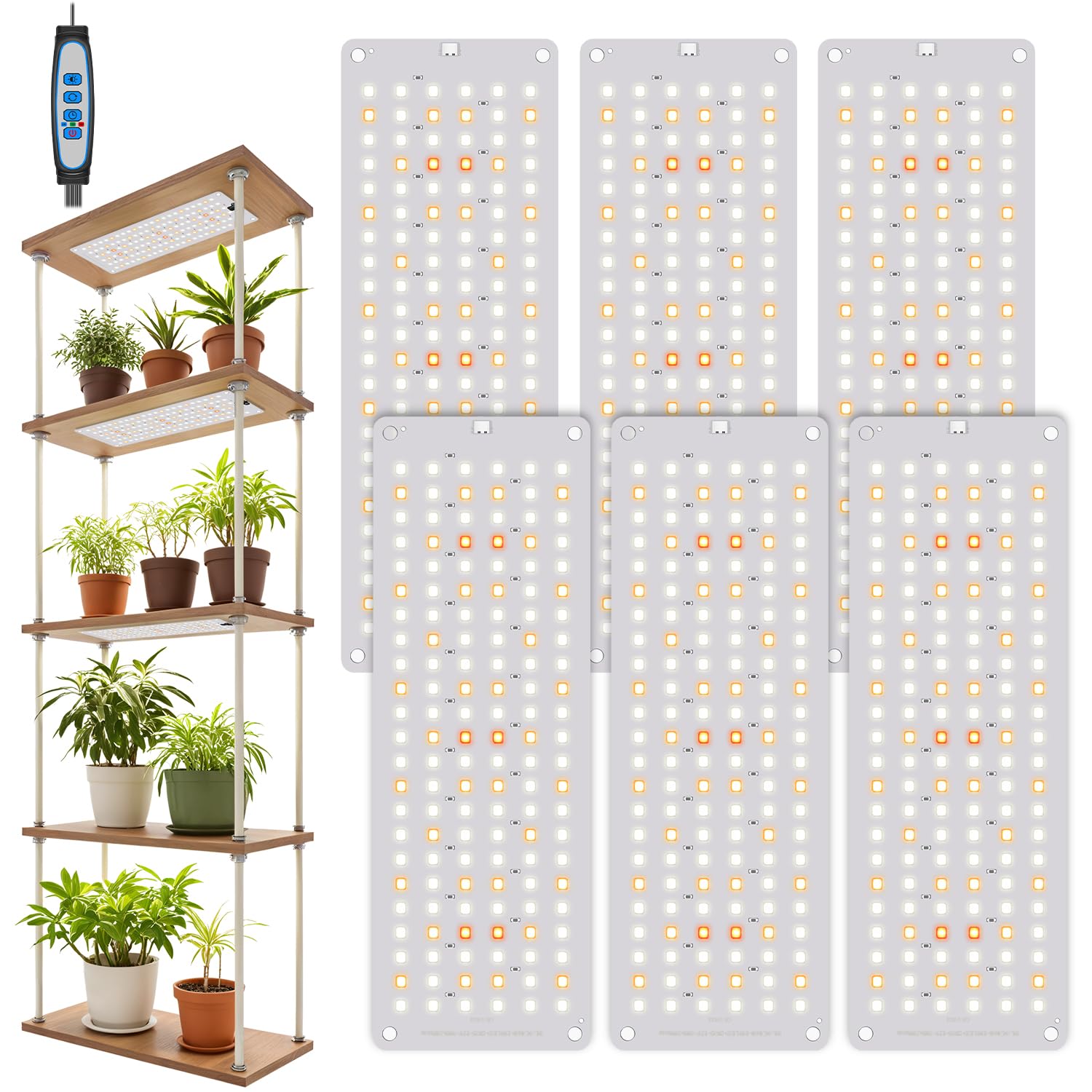
The Garpsen 6-panel system is designed for modularity. Each aluminum panel measures 11.8 x 3.9 inches, and the six panels can be arranged in a row (ideal for a plant shelf) or clustered together to form a larger light surface. This configuration is excellent for a row of three citrus trees or for use as a supplemental light source under a cabinet. The 882 LEDs include a mix of white, red, blue, UV, and IR diodes for a wide spectrum.
The smart controller is the highlight here: five dimmable levels (20% to 100%) and three color modes (6000K cool white, 3500K warm light, and 5000K full spectrum). For citrus, running the full spectrum mode at 80-100% brightness for 12-16 hours mimics summer sun. The 16-hour timer setting is particularly useful for encouraging vegetative growth in young citrus trees before you switch to a 12-hour cycle to trigger blooming. The panels run cool to the touch, which is safe for enclosed spaces.
The biggest durability concern across reviews is the USB-C power connector. Several users report the connector is fragile and can detach from the board with minimal force. Garpsen customer service appears to address this proactively, but the design feels delicate for a long-term fixture. The panels are also relatively thin and light, making them easy to mount but not rugged if frequently moved.
Why it’s great
- Modular panel design fits various shelf sizes
- 5-level dimming and 16-hour timer for citrus seasons
- Runs cool and silent for indoor environments
Good to know
- Fragile USB-C power connector is a common fail point
- Best suited for smaller trees or as supplemental side lighting
5. Uallhome 2-Pack Panel 200W Full Spectrum

This 2-pack panel setup is the entry-level champion for citrus growers on a budget. Each panel is only 12 x 12 x 1 inches thin, weighing almost nothing, and includes UV and IR diodes alongside the standard white, red, and blue. The two panels can be positioned on opposite sides of a single citrus tree (providing side-to-side coverage) or placed end-to-end over a long row of seedlings. The combination of UV and IR light better mimics natural sunlight than basic red-blue lights.
The passive cooling and low heat output mean you can safely position these panels 6-8 inches from the tree canopy without burning leaves. This close proximity is critical for citrus because it maximizes the photon delivery per square inch without the expense of a high-wattage fixture. The 100,000-hour lifespan rating suggests these panels will outlast many citrus trees by decades. They are also completely silent — no fan noise.
The lack of features is the trade-off. There is no timer, no dimmer, and no spectrum switching — it’s a simple on/off fixture. For citrus, you will need an external outlet timer. The hanging hardware included is also basic; several reviews mention it’s short for ceiling mounting, so you may need additional ratchet clips. The brightness (deep violet/white blend) can be eye-straining in a living room, making these panels better suited to a grow tent or a dedicated indoor garden space.
Why it’s great
- Two panels for around-the-tree coverage
- Ultra-thin, low-heat, and completely silent
- UV and IR diodes enhance natural light simulation
Good to know
- No timer, no dimmer, no spectrum control
- Included hanging hardware is too short for ideal placement
FAQ
Can I use a regular LED bulb instead of a grow light for my citrus tree?
How close should I position the grow light to my citrus tree canopy?
How many hours should a citrus tree get from a grow light each day?
Will a blurple (purple) light work for citrus trees?
Final Thoughts: The Verdict
For most users, the best grow light for citrus tree winner is the Beelux 1000w LED because its high PPFD and dual veg/bloom switches give a single large citrus tree everything it needs to flower and fruit. If you want precise directional targeting around a bushy canopy, grab the SANSI 4-Gooseneck 600W. And for a budget-friendly entry point to citrus cultivation, nothing beats the Uallhome 2-Pack Panel 200W for its side-lighting flexibility.