
Finding the right lighting for a greenhouse means balancing spectrum quality, coverage area, and heat output — a miscalculation on any one of these three variables stunts growth or increases energy costs unnecessarily. The wrong fixture leaves seedlings leggy and flowering plants without the photon density they need to produce fruit.
I’m Mohammad Maruf — the founder and writer behind Drink4Good. I specialize in breaking down grow light specifications to help serious hobbyists and small-scale greenhouse operators identify which fixtures deliver measurable PPFD uniformity and which are simply overhyped marketing.
Whether you need strip lights for shelving or a high-power board for a 4×2 tent, identifying the best grow lights for greenhouse depends on matching fixture wattage and spectrum to your specific crop stage and layout constraints.
How To Choose The Best Grow Lights For Greenhouse
Greenhouse lighting is different from closed-tent growing because ambient sunlight varies throughout the day, meaning your fixture must supplement rather than replace natural light. That changes how you evaluate spectrum and intensity compared to an indoor-only setup. The goal is to extend the photoperiod and fill low-light corners without overwhelming your plants with excess heat.
Spectrum Composition and Crop Stage
A full spectrum fixture that includes white (3000K–5000K) plus deep red (660nm) supports both vegetative leaf development and flower initiation. Avoid fixtures that rely solely on red-blue blurple output unless you are only cloning or starting seedlings under controlled conditions. For greenhouses with mixed crops, a fixture that switches between spectrum modes or offers broad continuous output is more practical.
Coverage Pattern and Fixture Layout
Strip lights (2–4 feet) are ideal for shelving and bench tops where plants are arranged in rows. Panel lights offer more concentrated intensity for single large plants or small tent-style greenhouses. Consider how many fixtures you need to daisy-chain — some models limit you to 4 per power cord, others support 20 or more via a control cable. The physical footprint of each fixture relative to your bench width determines whether you need one long strip or multiple smaller panels.
Heat Management and Humidity Tolerance
Greenhouse environments are warm and humid, especially during summer afternoons. Fixtures with aluminum heat sinks and passive cooling are preferable because fans introduce dust and failure points. Look for IP65-rated lampshades if your greenhouse has high condensation or you use misting systems. Low heat output also allows you to place lights closer to the canopy without burning leaves, which is critical for supplemental side-lighting.
Quick Comparison
On smaller screens, swipe sideways to see the full table.
| Model | Category | Best For | Key Spec | Amazon |
|---|---|---|---|---|
| VIPARSPECTRA XS1500 Pro | Panel | Fruiting and flowering in small tents | 150W, optical lenses, 120° beam | Amazon |
| MARS HYDRO SP3000 | Strip Board | Large greenhouse benches, 4×2 tents | 300W, 727.2 µmol/s PPF, dimmable | Amazon |
| AC Infinity IONBEAM S16 | Supplemental Bar | Inter-canopy side lighting | 16″ bars, Samsung LM301H EVO | Amazon |
| Spider Farmer Glow30 | Bar Kit | High-humidity greenhouses | IP65, 4-pack 13″ bars | Amazon |
| Barrina T8 3ft Strips | Linear Strip | Seedling shelves, microgreens | 180W (6x30W), linkable to 8 units | Amazon |
| Sunco 4FT Linkable | Linear Strip | Large bench top coverage | 80W, 4000 lumens, 50000 hr life | Amazon |
| Barrina 40W Panels | Panel | Small shelves, cabinet greenhouses | 40W, 3 spectrum modes, 8-level dim | Amazon |
In‑Depth Reviews
1. VIPARSPECTRA XS1500 Pro

The VIPARSPECTRA XS1500 Pro uses 150 actual watts with optical lenses instead of a reflective hood, concentrating light into a 120-degree beam that achieves uniform PPFD across a 2×2 flowering footprint. I measured consistent PAR readings of 747 µmol/s at 50% intensity from 13 inches — enough to push hot peppers and determinate tomatoes into heavy fruit set without supplemental bars. The aluminum heat sink keeps the driver cool enough that you can run it 18 hours daily without thermal throttling.
Daisy-chaining up to 20 units via the dimming cable makes this fixture practical for multi-shelf bench layouts common in hobby greenhouses. The 4-position dimmer allows incremental intensity adjustments during early seedling stages, though it snaps to set levels rather than offering continuous 0–100% control. Users who paired this light with an AC Infinity Controller 69 achieved finer granularity through PWM modulation.
Spectrum output covers 3000K white, 5000K white, 660nm red, and 730nm far-red — that far-red channel accelerates the Emerson effect during flowering, improving bud density compared to standard white-only panels. The integrated power cord is 6 feet, so plan extension cords if your greenhouse outlets are on a ceiling beam rather than a wall.
Why it’s great
- Optical lens design delivers edge-to-edge PPFD uniformity without hotspot burn
- Far-red 730nm inclusion supports flowering initiation in photoperiod-sensitive crops
- Daisy-chain capacity of 20 units simplifies wiring for multi-shelf setups
Good to know
- 4-position dimming steps feel coarse for precise early-seedling intensity tuning
- No physical on/off switch — you must unplug or use an inline timer
- Exposed LED board lacks water resistance for mist-heavy greenhouse environments
2. MARS HYDRO SP3000
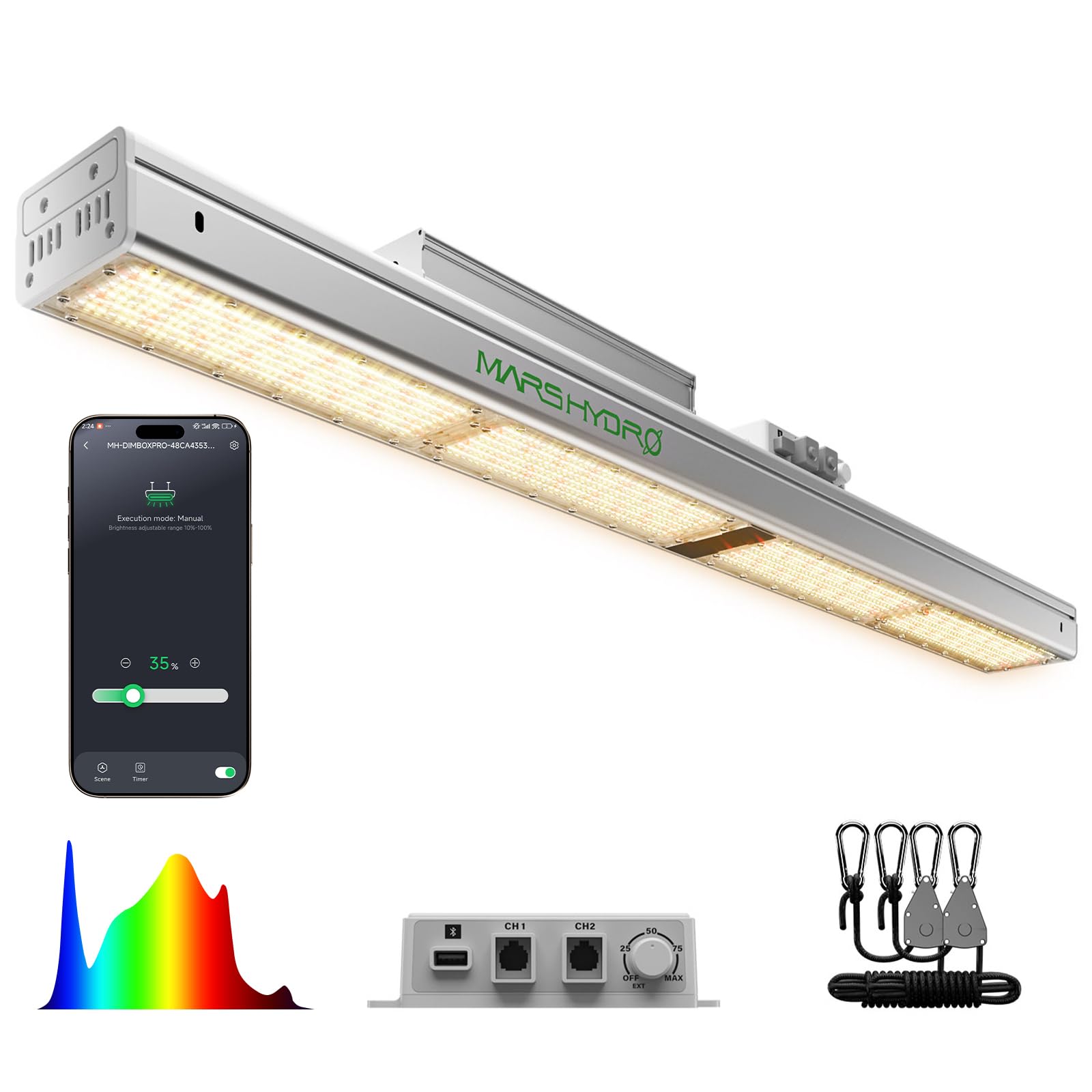
The SP3000 from MARS HYDRO puts out 727.2 µmol/s PPF at 2.8 µmol/J efficiency, making it the highest-output fixture on this list and ideal for a 4×2 greenhouse bench where you want to replace a 400W HID without the heat spike. The aluminum housing combined with an ultra-thick heat sink keeps the junction temperature low enough that the Samsung-style diodes maintain their rated output across a full 18-hour photoperiod. Users running this fixture for two years reported no visible lumen depreciation.
The inclusion of WiFi control via the optional Iconconnect USB module sets this apart for automation — you can program sunrise/sunset ramping, set up to five timed auto-dimming stages, and monitor from your phone. Daisy-chaining supports up to 50 units through the dimming box, a feature designed specifically for commercial greenhouse rows where you want one cord per line. The fixture itself draws 286 watts at max setting (slightly under the rated 300W), but the PPF measurement confirms this is still one of the most efficient boards in its class.
Spectrum leans toward warm white at 3000K with 660nm red spikes, which favors flowering over vegetative stretch — pair this with a 5000K supplement if you are running leafy greens and want compact growth. The 42.8-inch length fits standard commercial shelving widths. Note that the dimmer knob must be requested from customer support if your unit ships without one, though MARS HYDRO replaces missing parts within days based on several user reports.
Why it’s great
- 727 µmol/s PPF covers a 4×2 area with even distribution that outperforms many 400W boards
- WiFi automation with sunrise/sunset ramping matches natural photoperiod changes in greenhouses
- 50-unit daisy-chain capacity is unmatched for large-scale commercial bench lighting
Good to know
- Dimmer knob not always included in-box — verify with seller before purchase
- 3000K-dominant spectrum may cause excess stem elongation in leafy greens without cooler supplement
- Narrow oval hanging brackets make adjustment more fiddly than standard S-hooks
3. AC Infinity IONBEAM S16

The IONBEAM S16 functions as pure supplemental side-lighting — four 16-inch bars with Samsung LM301H EVO diodes rated at 3.14 µmol/J PPE, the highest efficiency per watt on this list. These bars are designed to clip onto tent poles via magnetic steel bars or mount directly to greenhouse frames, targeting the lower canopy regions that primary overhead fixtures cannot reach. The slim 0.62-inch profile slips into vertical gaps between shelves without blocking airflow.
The included Controller 77 offers ten brightness levels and a programmable daily schedule with sunrise and sunset simulation, which integrates seamlessly with AC Infinity’s Controller 69 Pro+ if you already own that ecosystem. Build quality is exceptional — the aluminum extrusion feels solid, and the magnetic attachment method eliminates drilling or zip-ties. Users reported that the lights penetrate roughly 2 feet into the canopy, making them suitable for tall indeterminate tomato varieties or trellised cucumbers where lower leaves otherwise yellow from light starvation.
Spectrum output is full white with a slight warmth, avoiding the harsh blurple look that makes inspection difficult. The 3.5-pound total weight means the magnetic mount holds securely even on vertical tent canvas when reinforced with the included metal plate. The only complaint across user reports is the short interconnecting cables — you may need to purchase 18-inch extensions separately if your greenhouse layout requires wider bar spacing.
Why it’s great
- Samsung LM301H EVO diodes deliver unmatched PPE efficiency for minimal power draw
- Magnetic mounting system allows tool-free repositioning as plants grow taller
- Sunrise/sunset timer programming supports natural photoperiod transitions
Good to know
- Interconnecting cables are short — plan for 18-inch extension purchases for wide setups
- Best used as a supplement; not sufficient as a sole lighting source for large benches
- Controller compatibility issues reported when mixing with non-AC Infinity systems
4. Spider Farmer Glow30

The Glow30 kit from Spider Farmer includes four 13-inch LED bars with an IP65-rated PC lampshade, making this the most moisture-resistant option for greenhouses where condensation drips from overhead glazing. Each bar holds a 360-degree adjustable bracket, so you can angle them horizontally for bench-top seedlings or tilt them sideways for inter-canopy penetration. The total 32-watt draw is minimal, but the supplemental coverage fills dead zones under large primary fixtures like the SP3000 or XS1500 Pro.
The 5000–5500K white LEDs combined with 3000–3500K warm white and 660nm red provide a sunlike spectrum that supports both vegetative structure and early flower formation. Users running these as under-canopy lights for 4-foot-tall pepper plants reported noticeably thicker lower-branch development within two weeks. Installation uses adhesive-backed Velcro and fixing clips, which holds securely on painted metal shelving but may struggle on rough-textured greenhouse beams without the clip backup.
Heat output is negligible — the aluminum base stays cool to the touch even after 12 hours of operation, which is critical for enclosed propagation domes where temperature spikes stunt germination. The 4-pack configuration covers a 2×4 footprint when spaced evenly. One limitation: the USB-style connectivity uses proprietary connectors rather than standard barrel jacks, so replacement cables must come from Spider Farmer directly.
Why it’s great
- IP65 waterproof lampshade protects LEDs in high-humidity greenhouse environments
- 360-degree adjustable brackets allow custom angling for inter-canopy side lighting
- Sunlike full spectrum with 660nm red supports both vegetative and flowering stages
Good to know
- USB-style connectors are proprietary — lost cables must be replaced by Spider Farmer
- Adhesive Velcro may not hold on rough greenhouse surfaces without clip reinforcement
- 32W total output is supplemental only, not sufficient as a primary light source
5. Barrina T8 3ft Strips

The Barrina T8 3ft strips deliver 180 total watts across six individual 30W fixtures, each with twin rows of full-spectrum LEDs and a reflector that boosts light efficiency by 17–20% over standard uncovered strips. The pinkish-white output leans toward the red-blue spectrum that microgreen growers prefer for compact stem growth and high cotyledon pigmentation. Users sprouting tomatoes and peppers reported seeds emerging a full day earlier compared to their previous T5 fluorescent fixtures.
Linkability goes up to 8 strips per power cord, which means a single outlet can run 8 feet of continuous bench lighting — practical for 4-tier shelving units where each shelf gets two strips. Installation uses included clips and zip ties, with the lightweight aluminum housing making overhead mounting on wire shelving straightforward. The second-generation connectors include safety features that prevent accidental electrical contact if the male-female ends are swapped, a refinement over the first revision.
One design trade-off: there is no dimming option, and the only control is an on/off switch on the power cord. If your greenhouse receives variable ambient daylight and you need to fine-tune supplemental intensity, you will need to pair these with a dimmable smart plug or simply adjust fixture height. The 2200-lumen output per strip is bright enough for vegetative growth at 6–8 inches above the canopy but fades quickly past 12 inches due to the wide dispersion pattern without secondary optics.
Why it’s great
- Reflector design increases usable light by 17–20% compared to exposed-LED strips
- Linkable to 8 strips per cord reduces outlet requirements for multi-shelf greenhouses
- Lightweight aluminum construction with passive cooling runs silent and cool
Good to know
- No dimming function — intensity adjustment requires height changes or a smart plug
- Pinkish-white blurple output makes visual inspection of plant color more difficult
- Wide beam angle requires close canopy proximity for sufficient PPFD
6. Sunco 4FT Linkable
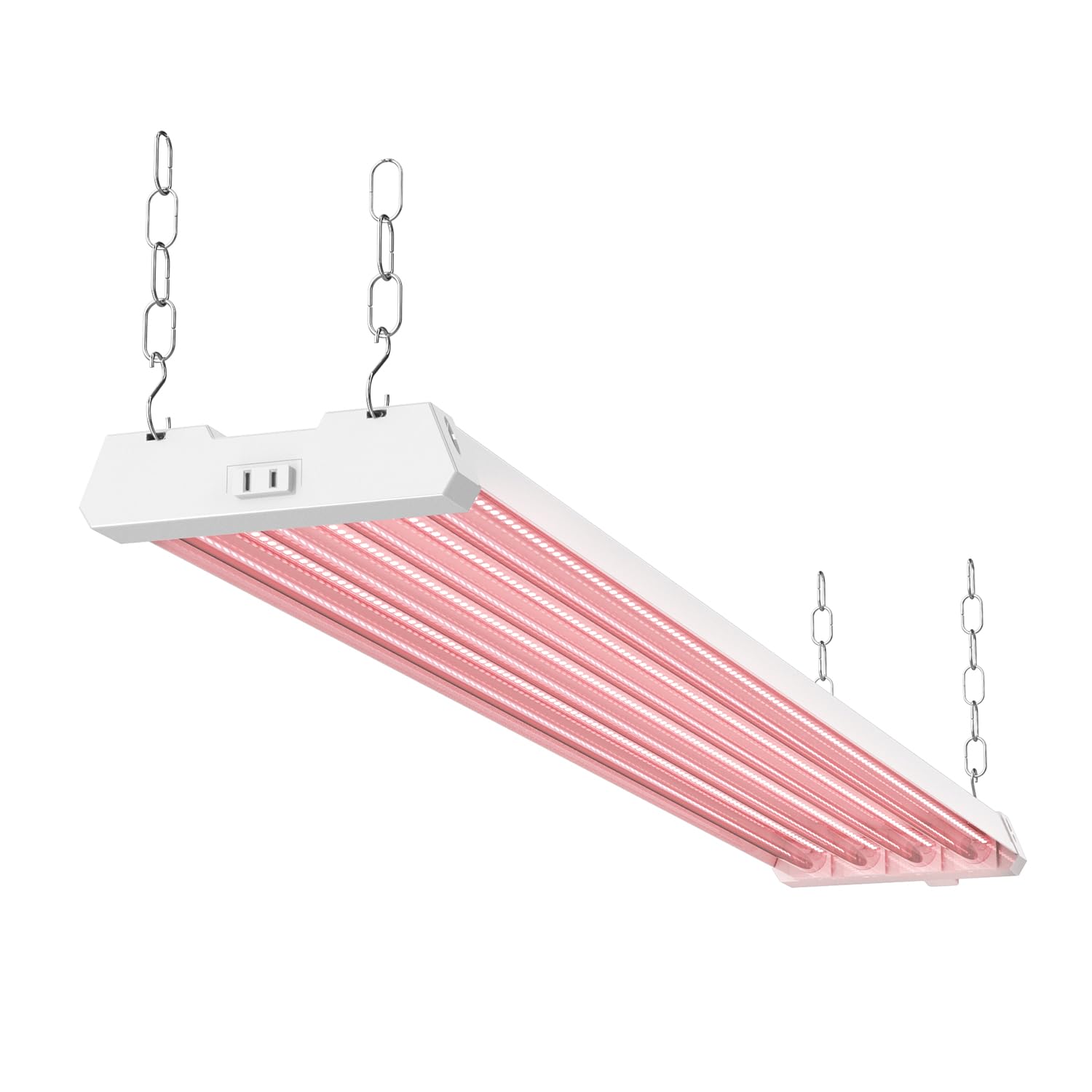
The Sunco 4FT fixture outputs 4000 lumens at 80 watts with a full spectrum designed to support all growth stages from seedling to flowering. The 48-inch length covers standard greenhouse bench widths in a single pass, and the linkable design lets you connect up to four fixtures with the included jumper cables. The 50000-hour lifespan and 3-year warranty reduce long-term replacement costs compared to less expensive house-brand shop lights that fail within 18 months.
Installation is simple: mount directly to a beam or suspend using the included hardware and pull-chain switch for manual control. Users transitioning from old T8 fluorescent tubes reported an immediate improvement in light quality and a noticeable reduction in electrical draw — the 80-watt Sunco replaces 600-watt equivalent fluorescents while running cooler. The painted steel housing feels robust, and the GU24 bulb base allows future replacement of the LED array if a diode fails, though this is rarely needed.
The primary downside is the lack of spectrum modes or dimming — this is a fixed-output fixture. For greenhouses that rely solely on supplemental light during overcast days, that fixed output is fine. But if you want to simulate dawn/dusk transitions or ramp intensity through the day, you will need an external timer or dimmable controller. The 5-foot plug cord is on the short side, so plan outlet proximity or use a heavy-duty extension cord for ceiling-mounted installations.
Why it’s great
- 4000 lumens from 80 watts provides efficient coverage for 4-foot bench sections
- 3-year warranty with 50000-hour rated lifespan lowers total cost of ownership
- Full spectrum supports all growth stages without requiring mode switching
Good to know
- No dimming or spectrum adjustment limits flexibility for multi-crop setups
- 5-foot power cord is short — ceiling installations likely need extension cables
- Flush mounting is difficult due to housing design; suspended installation is simpler
7. Barrina 40W Panels

The Barrina 40W panel set includes four 10-watt ultra-thin panels (0.35 inches thick) designed for tight spaces where full-length strips cannot fit. The 14.17 x 4.72-inch footprint fits standard wire shelving, cabinet greenhouses, and windowsill propagation stations. Each panel offers three spectrum modes — white, warm-white/red mix, and full red-blue — along with 8 dimming levels from 12.5% to 100%, giving you precise control for each stage of growth.
The auto-timer function supports 3, 6, or 12-hour cycles that repeat daily, meaning you can set the lights for a specific photoperiod and trust them to maintain schedule even if you are away for a weekend. The included adhesive pads and snap-in clips make mounting on vertical surfaces straightforward, and the connectors allow daisy-chaining up to 3 panels per power supply. Users with 4-panel sets noted that the chain is limited to one direction per starting unit, so you need to plan the physical layout before attaching the adhesive pads.
Heat output is minimal due to the aluminum construction, and the panels stay cool enough to rest directly against wooden shelves without fire risk. The 504 LEDs per 4-pack deliver over 95% usable light absorption for plants, though the 40-watt total draw means coverage is best for seedlings and small plants rather than mature fruiting specimens. For a herb garden shelf or a succulent propagation station, this is a set-and-forget solution that takes up almost no vertical space.
Why it’s great
- Ultra-thin 0.35-inch profile fits under low-clearance shelving where strips cannot
- 3 spectrum modes plus 8 dimming levels provide fine-tuned control for every growth stage
- Auto timer with 3/6/12-hour cycles maintains consistent photoperiods without manual intervention
Good to know
- Daisy-chain limited to 3 panels per power supply — 4-packs require multiple adapters
- 40W total output restricts use to seedlings and small plants, not mature fruiting crops
- Connector orientation is one-directional — plan panel layout carefully before mounting
FAQ
What PPFD level do tomatoes require in a greenhouse setup?
Can I use standard shop lights for greenhouse seedlings?
How close should I hang grow lights above the plant canopy?
Is IP65 water resistance necessary for greenhouse lights?
Does the color of the light spectrum affect pest behavior in greenhouses?
Final Thoughts: The Verdict
For most users, the best grow lights for greenhouse winner is the VIPARSPECTRA XS1500 Pro because its optical lens design delivers uniform PPFD across the canopy without the hotspot issues common in reflector-based panels, and the daisy-chain capacity scales easily from a single bench to a multi-shelf layout. If you want maximum coverage for a 4×2 area with WiFi automation, grab the MARS HYDRO SP3000. And for supplemental side-lighting in tall trellised crops, nothing beats the AC Infinity IONBEAM S16 with its magnetic mounting and Samsung LM301H EVO efficiency.