
That prized Monstera is getting pale, and the succulent you propped last month now looks like a stretched-out stick figure. When you can’t offer your houseplants a south-facing window, the solution isn’t less hope — it’s the right full-spectrum diode array. A quality LED panel replicates the solar wavelengths plants crave for photosynthesis, stopping the leggy growth before it starts.
I’m Mohammad Maruf — the founder and writer behind Drink4Good. I’ve spent years digging through horticultural lighting research, comparing PPFD maps, and filtering out the gimmicky units from the ones that actually push chlorophyll production.
Whether you manage a shelf of low-light pothos or a collection of high-intensity succulents, this guide breaks down the essential specs behind the best grow lights for houseplants so you can match the hardware to the plant’s real needs.
How To Choose The Best Grow Lights For Houseplants
Houseplants have very different light demands than a flowering cannabis crop, but most grow light marketing targets the latter. For your living room collection, chasing 1000 PPFD is unnecessary and can burn leaves. Focus on three factors: spectrum completeness, usable coverage area at the distance you need, and the convenience of a built-in timer or smart scheduling feature.
Full Spectrum vs. Blurple vs. White Light
Older “blurple” lights (deep red and blue diodes only) are less pleasant to look at and harder to judge true leaf color under. Modern full-spectrum white LEDs (3000K to 5000K) let you see the plant as it would appear in natural daylight, while still packing the 660nm red photons needed for flowering and compact growth.
Light Intensity and Coverage Shape
PPFD decreases with the square of distance. A small puck or clamp light might cover one pot at six inches, while a bar-style panel can cover a 2×2 ft shelf at twelve inches. Measure your shelf depth and count the number of plants — this tells you whether you need a single spotlight or a linkable array.
Quick Comparison
On smaller screens, swipe sideways to see the full table.
| Model | Category | Best For | Key Spec | Amazon |
|---|---|---|---|---|
| VIPARSPECTRA XS1500 Pro | Panel | High-light plants & growing tent | 150 Watt draw, optical lens PPFD | Amazon |
| GLOWRIUM G462pro | Floor | Tall plants & app-free scheduling | 70.9″ pole height, stepless dim | Amazon |
| Wolezek 2ft T5 Stand | Stand | Seed starting & seedlings | 32W, reflective cover, chain adjust | Amazon |
| Orchbloom Tabletop 25W | Desk | Desk-top bonsai & seedlings | 5 timer modes, 2500 lumens | Amazon |
| FECiDA Desk Grow Light | Desk | Aroids & variegated plants | UV-IR full spectrum, daisy chain | Amazon |
| Hlite 16in 4-Pack | Strip | Shelf arrays & greenhouse shelves | 20W each, link up to 6 units | Amazon |
| SANSI Puck 10W | Puck | Small shelves & mounted cabinets | Ceramic heat sink, 4-level dim | Amazon |
In‑Depth Reviews
1. VIPARSPECTRA XS1500 Pro

This panel skips the cheap reflector-and-blurple trick and instead uses individual optical lenses over each diode to concentrate photons with near-zero spill. The result is a uniform PPFD map that hits over 740 µmol/m²/s at 13 inches even at half power — enough for high-light philodendrons or a small grow tent.
The daisy chain feature links up to 20 units through a single dimming cable, so if you scale from one shelf to a 4×2 tent, the control stays centralized. The 150W actual draw replaces a 250W HPS without the heat, and the aluminum heatsink manages thermals well enough to keep leaf-tip burn unlikely at recommended hanging distances.
Keep in mind that the exposed diodes aren’t water-resistant, and the four-position dimmer switch feels basic compared to stepless knobs. But for PPFD-per-dollar in a small indoor garden, this is the strongest performer on the list.
Why it’s great
- Exceptional PAR uniformity across the canopy
- Daisy-chain dimming for multi-panel setups
- Runs cool enough for tight spaces
Good to know
- No physical on/off switch — unplug to shut down
- Overkill for low-light houseplants like pothos
2. GLOWRIUM G462pro Single Head
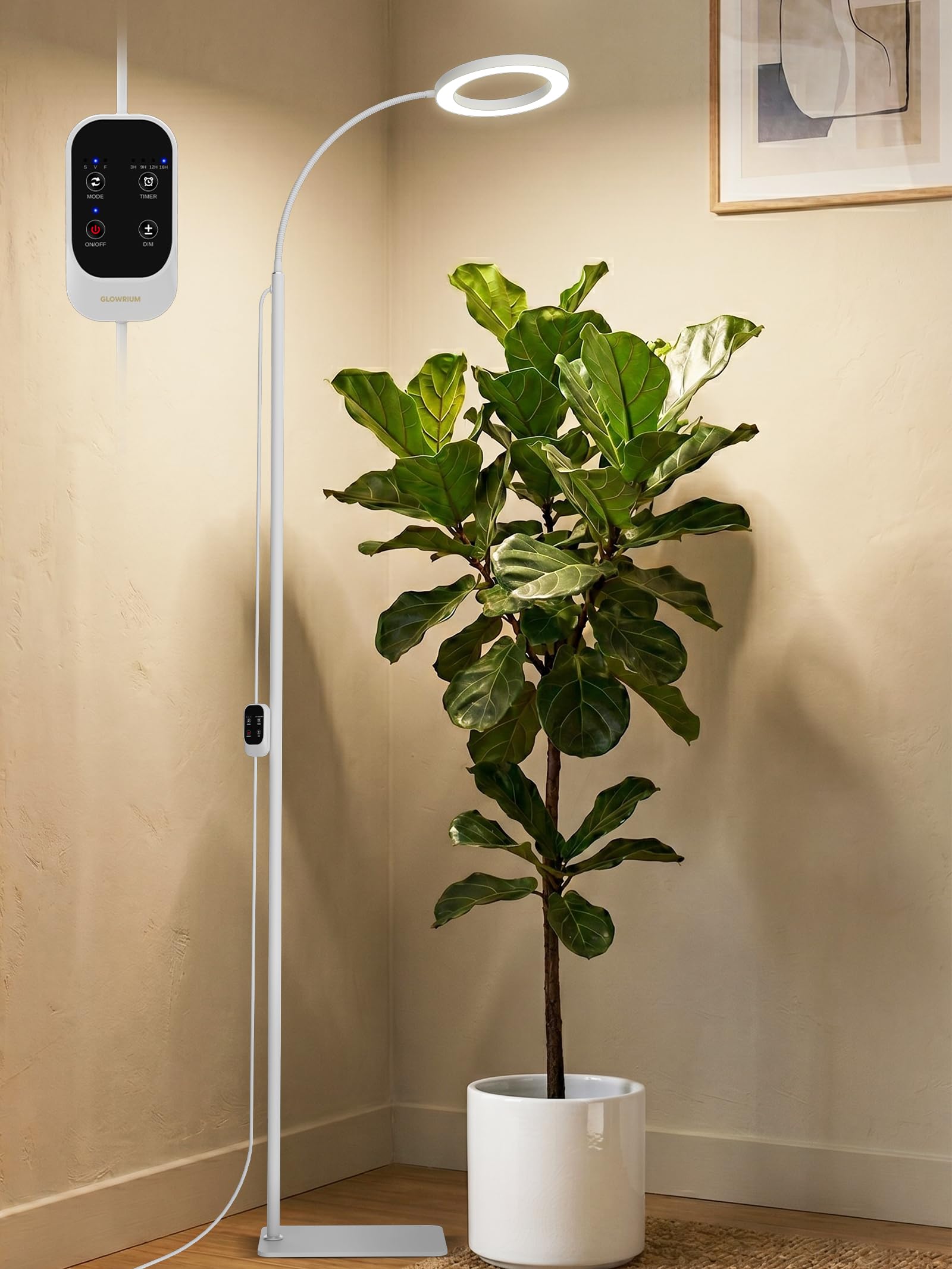
Most desk-mounted lights top out at 24 inches, which forces you to stack books under the pot. The G462pro solves this with a four-section pole that extends to nearly 71 inches, making it a rare option for tall fiddle-leaf figs or floor-standing planters. The enlarged lamp head paired with a 360-degree gooseneck lets you direct light at an angle rather than only straight down.
The true selling point is the stepless dimming combined with four timer intervals (3, 9, 12, 16 hours) that do not require a smart plug. Users report African violets blooming and cherry tomatoes fruiting indoors under 16-hour cycles without a noticeable electric bill increase because the 24W draw is very efficient.
The built-in plant care assistant feature offers watering and fertilizer reminders, which is handy for beginners who forget to rotate their succulents. The base is lightweight, so tall pots might shift it — zip-tying the pole to a stand solves that.
Why it’s great
- Exceptional height range for tall houseplants
- Stepless dimming from soft glow to intense output
- App-free timer saves you from buying a smart outlet
Good to know
- Base needs a heavy pot for stability
- Not designed for daisy-chaining multiple units
3. Wolezek 2ft T5 Stand

Seedlings are notoriously unforgiving — stretch just one day toward weak light and they never recover. The Wolezek stand uses a dedicated reflective cover that boosts brightness by about 30 percent, pushing 144 LED chips (a mix of 660nm red, 3000K and 6000K white) directly onto the grow tray. The PVC stand and chain height adjustment let you lower the bars to within two inches of the soil surface without crushing tender stems.
Installation takes about five minutes with no screws required. The dual-tube design covers a full 72-cell starter tray plus two 5-inch pots on the side. Users report faster germination and stockier stems compared to windowsill-only starts, especially for tomatoes and peppers that typically race toward the glass.
The trade-off is a fixed brightness — there is no dimmer, so you must physically raise the chain to reduce intensity. Also, the mounting clips are a bit fragile when snapped into place.
Why it’s great
- Reflective cover improves PAR near the canopy
- Tool-free assembly in under five minutes
- Chain adjustment keeps light close to seedlings
Good to know
- Not dimmable — single brightness only
- Clips can crack if over-tightened
4. Orchbloom Tabletop 25W
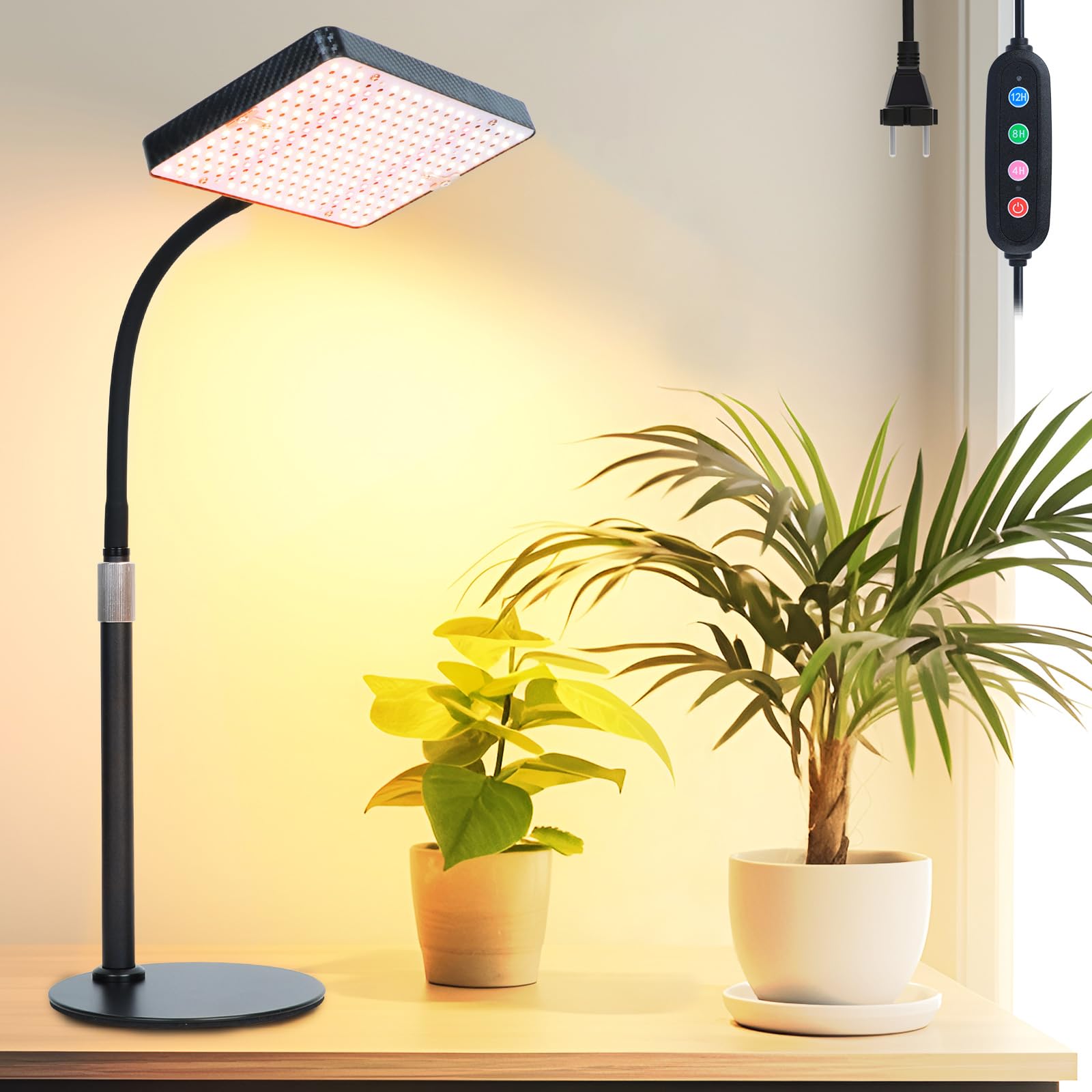
The Orchbloom packs 208 high-quality LEDs into a slim 8-inch head that puts out a daylight-balanced 4000K color temperature — very comfortable for a desk environment where you also work or read. It delivers 2500 lumens from a 25W draw, so it runs cool enough to place within six inches of a leaf without causing heat stress.
Five timer modes (4, 8, 12, 16, 20 hours) give you more flexibility than the usual 4/8/12 options, and the auto on/off memory works dependably cycle after cycle. A 360-degree gooseneck and adjustable 16-to-24-inch stand mean you can angle the lamp around a bushy basil plant or dial it low for a tray of succulent props.
The plastic casing feels a bit thin — if you bump it hard, it could crack. But at this price tier, the combination of high lumen output, multiple timers, and a natural-looking spectrum makes it a solid choice for any desk-side snake plant or peace lily.
Why it’s great
- Very bright (2500 lumens) for its size
- Five timer modes — rare at this price
- Gooseneck directs light precisely where needed
Good to know
- Plastic housing feels less robust
- Can tip over if the desk is bumped
5. FECiDA Desk Grow Light
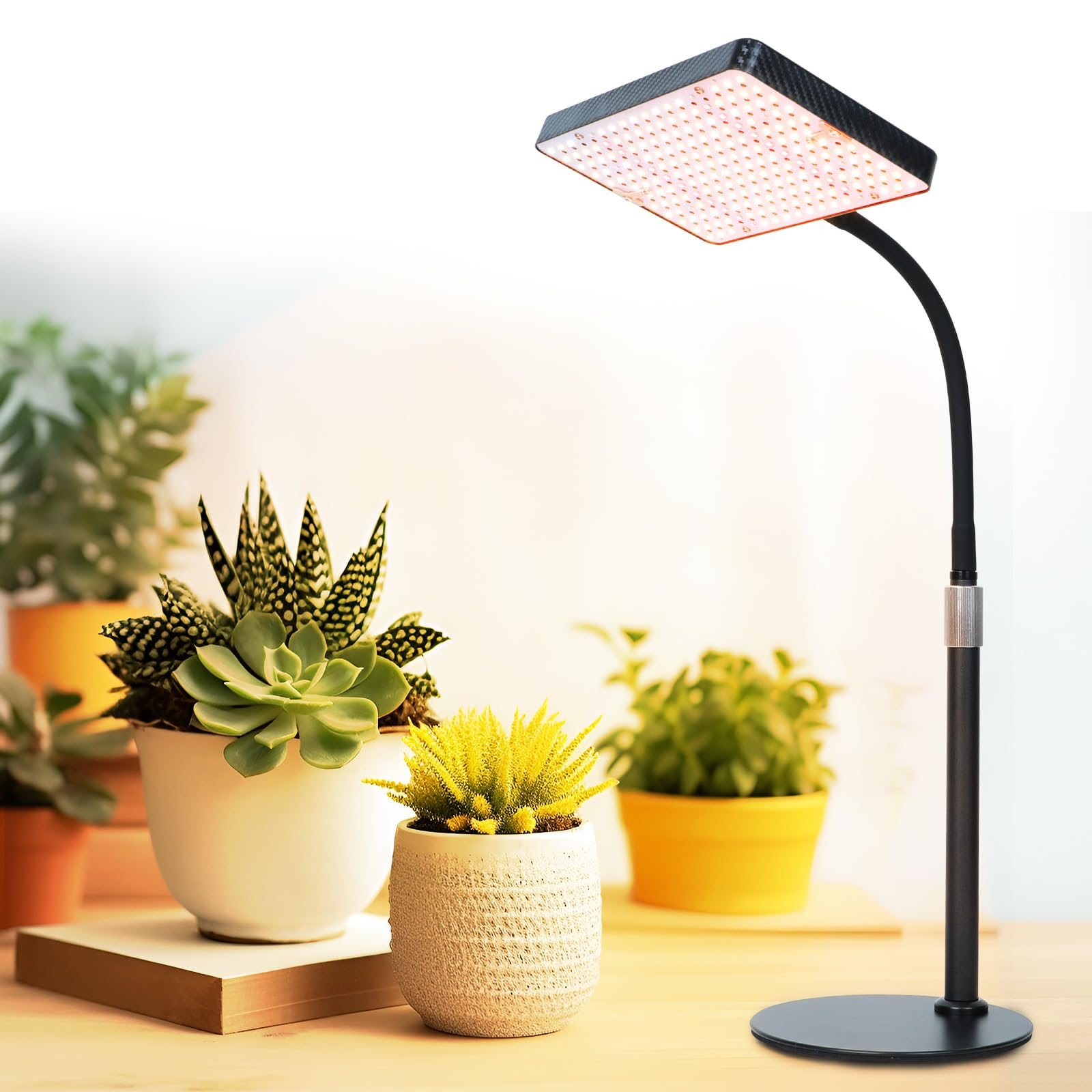
The FECiDA is one of the few lights in the sub- bracket that explicitly adds UV (395nm) and IR (730nm) diodes alongside the usual reds and whites. While UV is often marketed for resin production in herb, for houseplants it helps harden growth and make leaf colors pop. The 660nm red boosts flowering, so it works well for Anthuriums and blooming succulents.
With 2000 lumens and a 25W draw, it sits in the same power class as the Orchbloom but differentiates itself with the daisy chain outlet. You can run up to four units off one wall plug, which is a clean solution if you own a multi-shelf plant cart. The 16-to-24-inch adjustable stand is stable on a tabletop.
There is no built-in timer, so you will need a smart plug to automate a schedule. Users have daisy-chained sixteen of these units to a single timer outlet for a whole plant rack setup.
Why it’s great
- UV-IR spectrum improves color and structural growth
- Daisy chain reduces power outlet clutter
- Very bright for a desktop fixture
Good to know
- No built-in timer
- Not designed for wall mounting
6. Hlite 16-inch 4-Pack
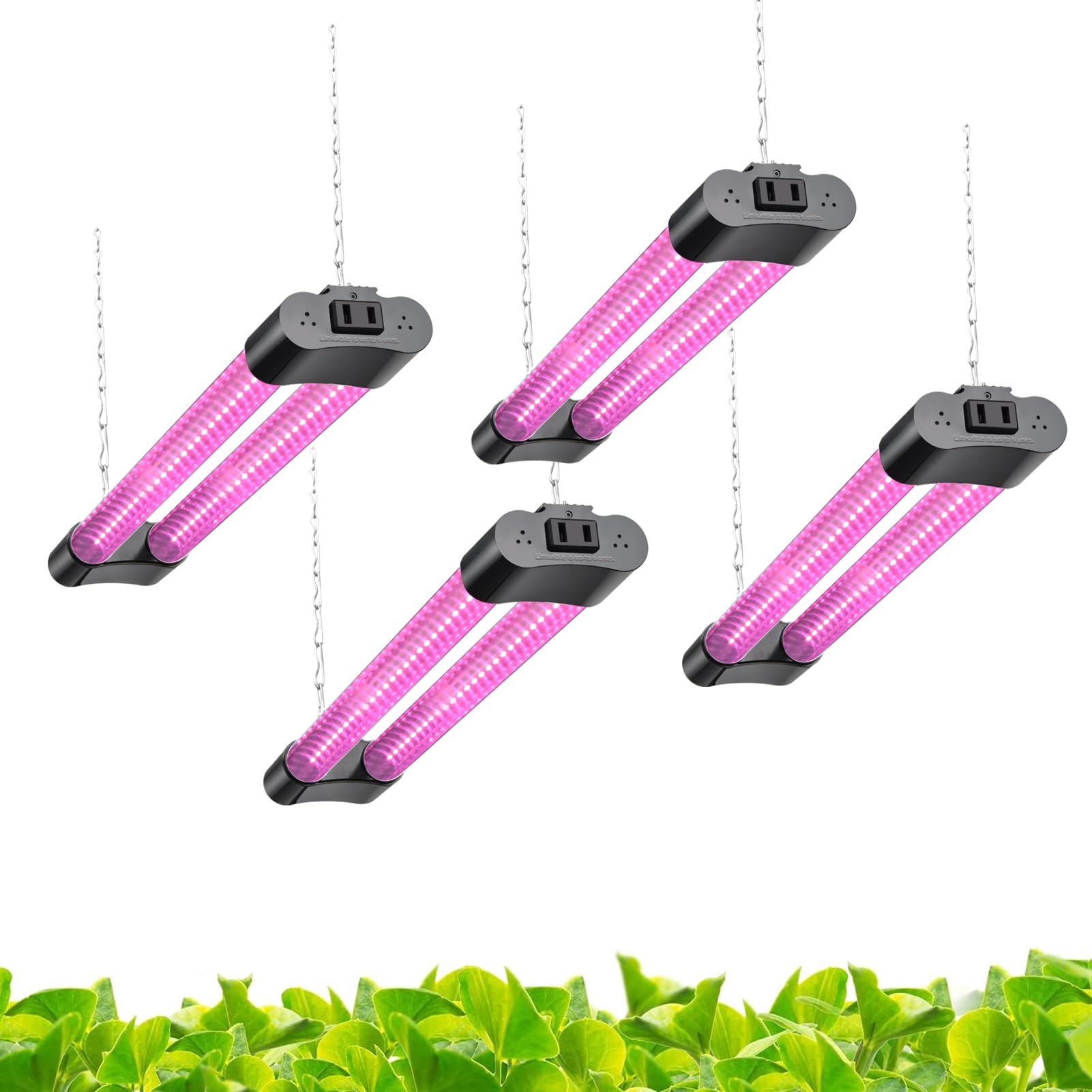
When you need to cover multiple shelves of a plant stand, individual clamp lights quickly become a tangle of cords. The Hlite 4-pack gives you four 16-inch bars that can be daisy-chained together (up to six total), fed by a single plug. Each bar draws 20W and emits a pinkish full-spectrum light optimized for seedlings, vegetative growth, and flowering.
The mounting kit is generous — hooks, chains, zip ties, brackets, and screws are all included, so you can hang them under a shelf, inside a 2×2 grow tent, or across a greenhouse rack. Users have reported healthier tomato starts and Aglaonema color retention after swapping to these bars from windowsill-only light.
There is no dimming or timer, and the light has a noticeable pink hue that some find less pleasant to look at in a living space. The bars also cool quickly after use, making them safer for enclosed wooden shelving than older T5 fluorescents.
Why it’s great
- Excellent value for multi-shelf coverage
- Linkable — one outlet powers the whole row
- Cool operation safe for enclosed shelving
Good to know
- Pink light is less decorative in living rooms
- No built-in timer or dimmer
7. SANSI Puck 10W

Size-wise, this is the smallest light on the list, but the ceramic heat sink technology is a serious advantage. Most LED grow bulbs fail early because heat builds up at the PN junction of the chip and degrades the phosphor. SANSI bonds the LED directly to a ceramic substrate, pulling heat away much faster than a standard aluminum MCPCB. This extends the usable lifespan considerably.
The two-head puck draws only 10W but delivers a 150W equivalence thanks to the efficient ceramic design, and the full 4000K spectrum with a CRI close to 100 means you see true leaf colors. The built-in timer cycles through 4, 8, or 12 hours and remembers the last brightness level set. Four dimming steps (25% to 100%) let you dial intensity from a closet shelf to a well-lit windowsill supplement.
Double-sided tape and zip ties are included for mounting, and the 71-inch cord gives plenty of reach. The heads share one control, so you cannot place them far apart and dim independently. But for tiny shelves or mounting under cabinets, the SANSI delivers impressive intensity per square inch.
Why it’s great
- Ceramic heatsink extends LED lifespan
- Very compact and easy to stick-mount
- Four dimming levels with memory function
Good to know
- Single control limits placement distance between heads
- 10W may be insufficient for large leafy plants
FAQ
How many hours should I run my grow lights for houseplants?
Can I use regular LED bulbs as grow lights?
How close should the light be to my houseplants?
Final Thoughts: The Verdict
For most users, the best grow lights for houseplants winner is the VIPARSPECTRA XS1500 Pro because it delivers professional-grade PPFD uniformity and daisy-chain control without requiring a large footprint. If you want adjustable height for tall floor plants, grab the GLOWRIUM G462pro. And for a budget-friendly multi-shelf setup, nothing beats the linkable Hlite 4-Pack.