
Your indoor vegetable seedlings stretch, turn pale, and produce thin, flavorless leaves because the window light just isn’t enough. For a harvest that delivers crisp leaves and robust fruit, you need a dedicated source that delivers the specific nanometers of light your plants demand.
I’m Mohammad Maruf — the founder and writer behind Drink4Good. I’ve spent years analyzing the hardware specifications and real-world performance data of LED horticultural lighting to understand exactly what drives successful fruiting indoors.
After weeks of market research comparing spectrum charts, wattage draw, and PPFD maps, these are the best grow lights for vegetables that actually deliver measurable improvements in plant growth and yield.
How To Choose The Best Grow Lights For Vegetables
Not all plant lights are equal when the goal is to grow edible crops. Leafy greens like lettuce and basil demand different light intensity and duration than fruiting vegetables like tomatoes and peppers. Start with the three specs that matter most for food crops.
Spectrum and Wavelengths
Vegetables need robust blue photons for vegetative growth, but they require deep reds around 660nm and far-reds near 730nm to trigger flowering and fruit set. A fixture that advertises “full spectrum” should cite specific red diodes. Avoid lights that only output harsh blurple without any white or warm supplement.
Real Power Draw vs. Coverage Area
A light that claims 1000 watts but draws only 50 from the wall will not ripen a pepper. Check the actual wattage on the label or listing. For a 2×2 foot area, a minimum of 80 true watts is recommended for fruiting crops. For a 3×3 foot space, 150 true watts is the baseline target for decent vegetable yields.
PPFD Uniformity and Penetration
PPFD measures the usable light reaching the canopy. A good vegetable light distributes this evenly across the footprint so that outer plants don’t lag behind. Optics and bar-style designs outperform single panels in delivering consistent intensity to lower leaves, which is critical for tall indeterminate tomato plants.
Quick Comparison
On smaller screens, swipe sideways to see the full table.
| Model | Category | Best For | Key Spec | Amazon |
|---|---|---|---|---|
| VIPARSPECTRA XS1500 Pro | Premium | Fruiting vegetables in 2×2 | 150W, 660nm & 730nm diodes | Amazon |
| AC Infinity IONFRAME EVO3 | High-End | Commercial-grade grows | 280W, Samsung LM301H EVO | Amazon |
| Elufah UAP800 | Mid-Range | Seed starting & veg | 80W, 5-level dimmable | Amazon |
| FECiDA 6 Head | Value | Desk-top seedling trays | 54W actual, 5 timer modes | Amazon |
| Ahopegarden Hydroponics | System | Countertop herb & lettuce | 5L tank, 12-pod system | Amazon |
| Yehsence 10 in 1 | Stand | Large plant collections | 500 LEDs, CRI 95 | Amazon |
| Orchbloom 5-Pack | Budget | Shelves & cabinets | 50W total, linkable | Amazon |
In‑Depth Reviews
1. VIPARSPECTRA XS1500 Pro

The XS1500 Pro pulls a genuine 150 watts from the wall and uses white 3000K and 5000K LEDs plus separate 660nm red and 730nm far-red diodes. This combination delivers the exact wavelengths that tomatoes and peppers need during their reproductive phase. The built-in optical lens concentrates light with minimal loss, producing a PPFD of 747 µmol/m²/s at 50% power and 13 inches — more than sufficient for a dense 2×2 foot flowering canopy.
Daisy chaining up to 20 units via the dimming cable makes this fixture a flexible building block for larger grow tents or vertical racks. The dimmer allows fine intensity adjustment, which is essential when seedlings sit close to the panel and can be scorched by full power. The aluminum heatsink dissipates heat efficiently enough that no fan noise disturbs your grow room.
Real-world users report explosive growth on hot peppers and ornamental flowers, with some measuring fruit yields that rival commercial lights. The only catch is the lack of a physical off switch — you need to unplug the driver or use an external timer. For any grower moving from blurple consumer lights to a serious fruiting fixture, this is the logical first step.
Why it’s great
- Real 150W draw with efficient Samsung-style diodes
- Precise dimmer for early seedling stages
- Daisy-chains for tent expansion
Good to know
- No physical on/off rocker switch
- Exposed LED board has no splash guard
2. AC Infinity IONFRAME EVO3
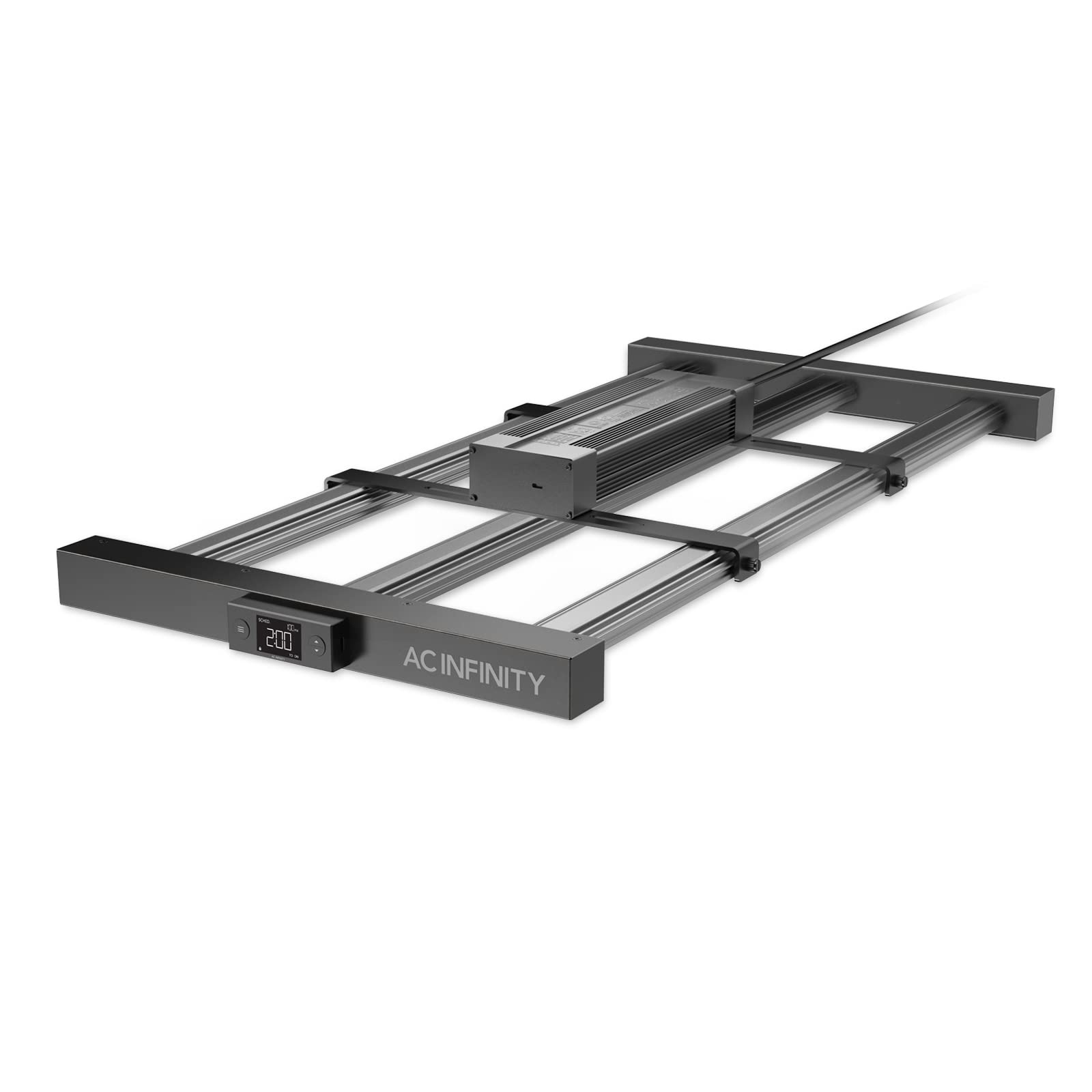
The IONFRAME EVO3 is built around Samsung LM301H EVO diodes rated at 3.14 µmol/J PPE — among the highest photon efficiency available. Its 840 LEDs are spaced in a bar configuration that eliminates hotspot issues common to dense panel lights. The result is a uniform PPFD map across a 2×4 foot flowering footprint, with deep canopy penetration thanks to the algorithmically arranged diode layout.
The UIS platform controller unlocks sunrise and sunset dimming simulations, ten brightness levels, and WiFi app management. This means you can mimic a gradual dawn in your grow tent without physically touching the fixture. Passive cooling keeps noise at zero, and the removable driver helps balance heat distribution inside the tent. Daisy chaining supports up to 80 lights in commercial facilities.
Users consistently mention the high-quality construction, lightweight feel, and excellent customer support. The measured lux of 85,000 at 12 inches confirms its intensity. For a serious indoor vegetable garden — especially one with flowering crops that need both intense top light and good side penetration — this fixture represents the current standard in the enthusiast tier.
Why it’s great
- Ultra-efficient Samsung LM301H EVO chips
- Full app-based scheduling with sunrise dimming
- Silent passive cooling
Good to know
- Premium price compared to panel-style lights
- Requires compatible UIS controller for advanced features
3. Elufah UAP800
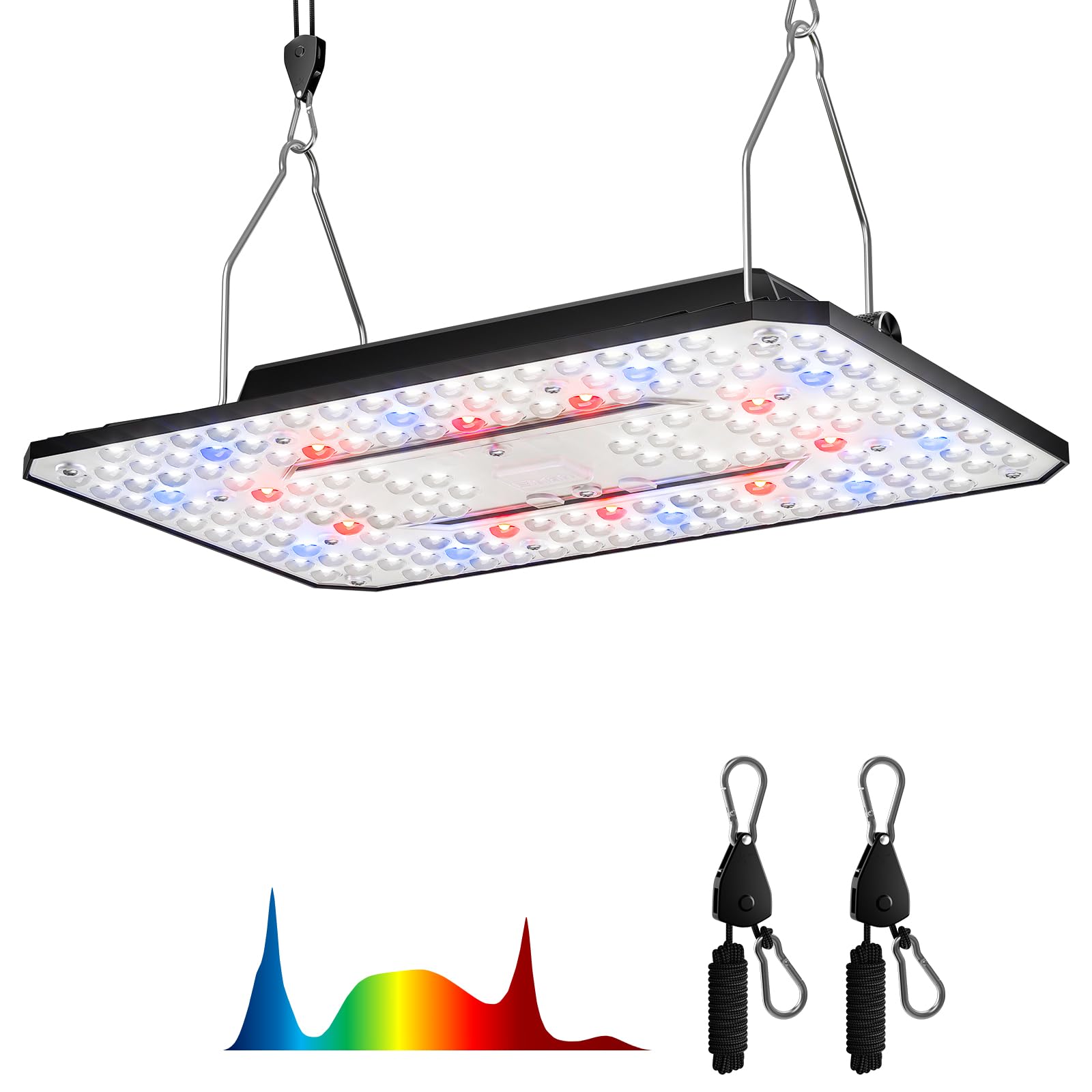
The UAP800 pairs a compact 80-watt draw with an optical lens design that delivers uniform PPFD across a 2×2 foot area — no weak corners. The spectrum includes 6200K white, 437nm blue, 660nm red, and 730nm far-red, covering the full chain from seed starting to fruit ripening. A 5-level dimmer (25% to 100%) lets you dial in intensity for each growth stage without moving the fixture.
Real-world testers have reported that running the UAP800 at just 20-30% power produced explosive growth on peppers and dahlias, while full intensity was reserved for dense flowering. The passive aluminum body stays cool even during extended 18-hour photoperiods. Users switching from older blurple lights noted immediate improvements in leaf color and flower density within days.
Hooks and ratchet hangers come included, and the daisy-chain RJ12 cable simplifies expansion. The light is rated at 24000 lumens maximum, which is high for an 80W fixture. The main limitation is coverage — it excels in a 2×2 space but cannot replace a 150W fixture if you need to fill a 3×3 area.
Why it’s great
- Five-step dimmer ideal for seedling adjustment
- Lens optics provide edge-to-edge light uniformity
- Includes both 660nm red and 730nm far-red diodes
Good to know
- Coverage limited to 2×2 foot area
- No integrated timer — external device needed
4. Ahopegarden Hydroponics Growing System

This is a complete hydroponic kit that integrates a full-spectrum grow light, a 5-liter water tank, and an LCD touch panel into one countertop unit. The light head extends up to 17 inches, which allows for taller crops like cherry tomatoes and bell peppers, not just microgreens. The 12 pod system uses planting sponges and baskets, and a quiet water pump cycles on a 30-minute schedule to keep roots oxygenated.
The dual light modes and a 22-hour timer option accelerate growth for crops that benefit from extended photoperiods. Users report that the adjustable light height prevents burn on developing leaves, while the round planting baskets reduce algae growth compared to cheaper rectangular systems. The included A and B nutrient solution simplifies the nutrient dosing for beginners.
Reviews consistently note that this unit outperforms older Aerogarden models in value and water capacity, and that the plastic construction feels durable. The touch panel responds reliably to schedule changes. It is designed strictly for indoors and produces minimal noise. For an all-in-one solution where you want to grow lettuce and herbs without buying separate lights, pumps, and trays, this package works seamlessly.
Why it’s great
- Works as a complete system — no separate light purchase needed
- 17-inch max height fits tall vegetable varieties
- 5-liter water tank reduces refill frequency
Good to know
- Light panel width is fixed, not expandable
- Some tall crops may still outgrow the 17-inch clearance
5. Yehsence 10 in 1
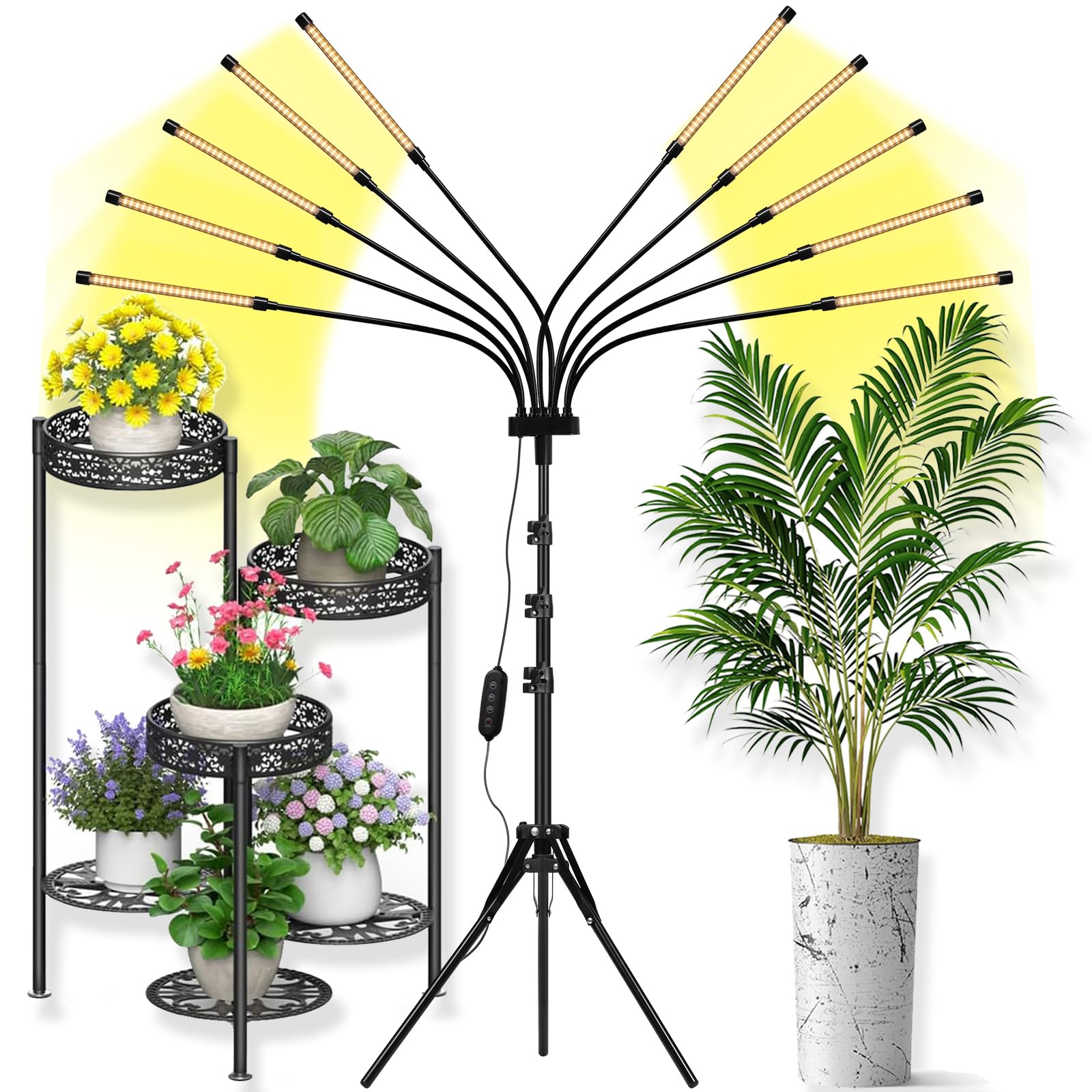
The 10 independently adjustable gooseneck heads on a tripod stand give this light an unusual degree of directional flexibility. Each head carries 50 LEDs — 500 total — producing a full spectrum that includes blue and red wavelengths. The CRI rating of 95 ensures that the light appears natural to the eye, which is useful if the fixture is placed in a living room or home office near the grow area.
Auto on/off timer cycles of 4, 8, or 12 hours maintain consistent photoperiods without daily intervention. Users report that the bright white light reduces legginess in tropical plants and seedlings alike. The tripod base is reinforced to handle the weight of the 10 heads, though the center of gravity becomes top-heavy when fully extended. One user noted that a single unit flickered, but customer service replaced it quickly.
Coverage is excellent for a collection of potted vegetables on a table or floor. The 16-inch overall width spreads light across multiple plant pots without creating dark shadows. The lack of a dimmer means brightness is fixed, so you must raise the heads to reduce intensity. Overall, this is a versatile solution for someone who wants to light a diverse group of plants on a single stand.
Why it’s great
- Ten independently adjustable heads for targeted coverage
- High CRI 95 renders colors naturally
- Sturdy tripod with automatic timer
Good to know
- Top-heavy at maximum height extension
- No dimming option to reduce intensity
6. FECiDA 6 Head Table Top
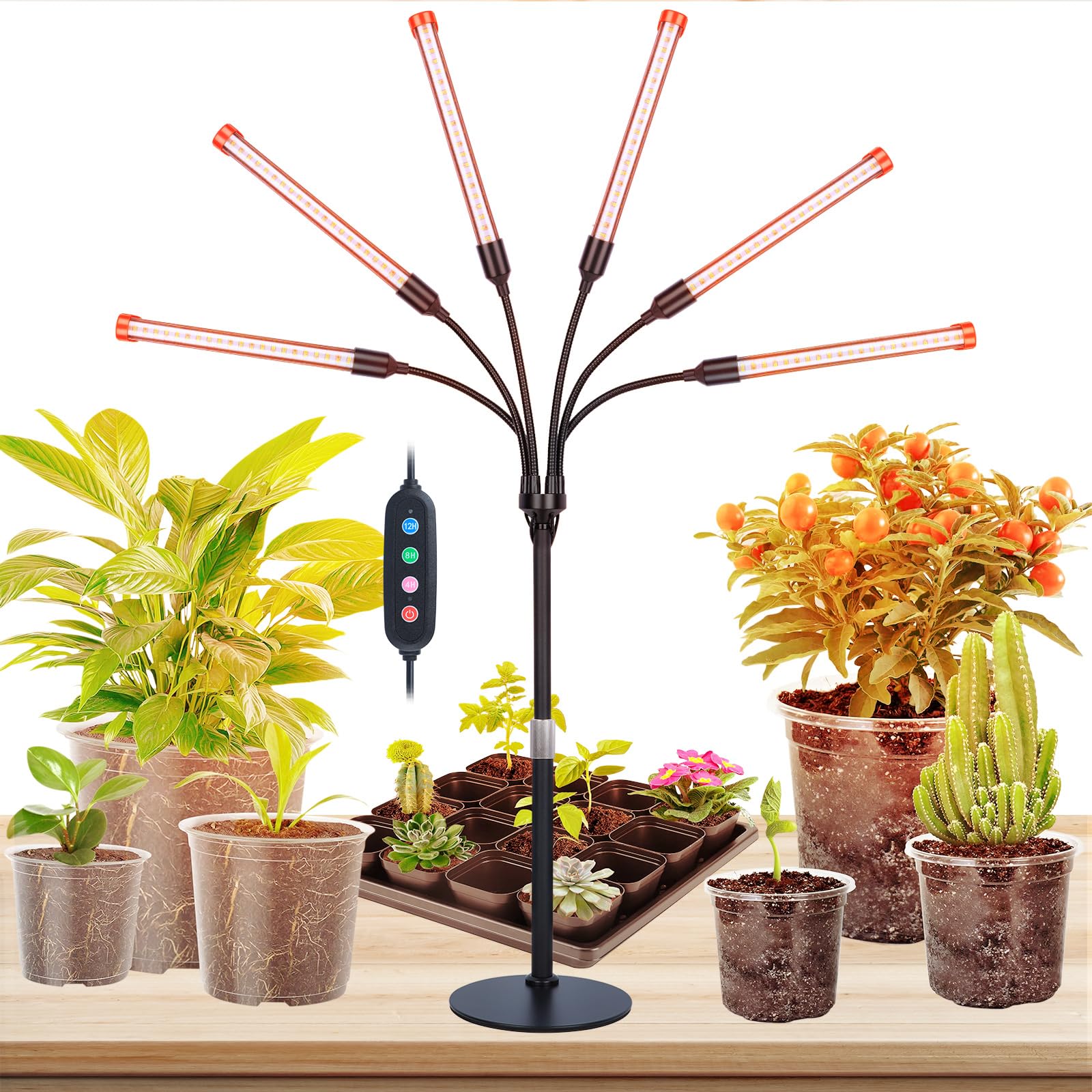
The FECiDA draws 54 real watts from the wall and provides five timer options — 4, 8, 12, 16, and 20 hours — controlled by pushing the button combinations. This allows a single fixture to serve both low-light seedlings and long-photoperiod leafy greens. The full-spectrum LEDs emit a natural white light that is easier on the eyes than harsh blurple alternatives.
The height adjustable arm extends from 16 to 24 inches, and the stable base keeps the light upright on a desk or table. Users report that the light is remarkably bright for its size, with some stating they had to move it to another room because it lit up the entire area. The clip attachment is strong enough to hold the lightweight panel to a shelf edge if you don’t want the base.
Seedlings placed under this light have been shown to thrive where window sunlight had previously failed. The ABS and metal construction feels solid, though a few users mentioned the arm can feel a bit flimsy when fully extended. It runs warm after a 12-hour cycle but not hot. For a dedicated seed-starting station on a kitchen counter or office desk, this is a compact and reliable choice.
Why it’s great
- Five timer modes including 20 hours for long-day plants
- No adapter needed — plugs directly into wall
- Natural white light for comfortable workspace
Good to know
- Arm stability decreases at maximum height
- Heads cannot be independently angled
7. Orchbloom 5-Pack Panel
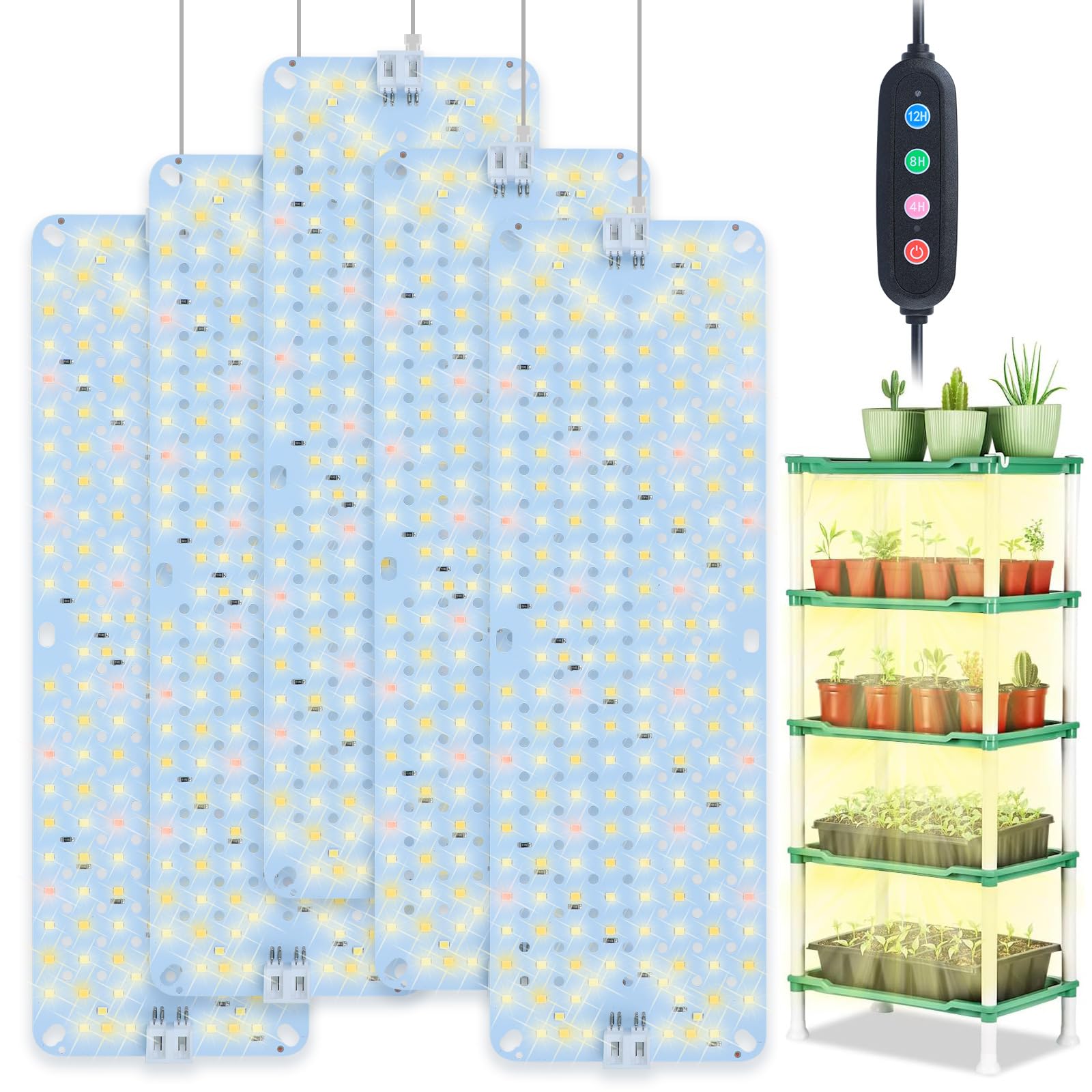
This five-panel set provides 50 total watts (10W per panel) with an automatic timer that offers 4, 8, 12, 16, and 20-hour daily cycles. Each panel is linked via a single power supply, so you only need one wall outlet to run all five. The full-spectrum LEDs produce a cool white light that supports photosynthesis across all growth stages.
Installation is straightforward with zip ties and a clip, and the panels can be connected in series or parallel. Users have mounted them on greenhouse tables, wire shelving, and cabinet bottoms. One gardener reported that previously stagnant plants grew 6 inches in a month under these lights. The aluminum body dissipates heat well, and the low wattage means minimal electricity cost.
The main tradeoffs are the lack of a dimmer and the fixed panel arrangement — each head is a flat rectangle, not a gooseneck. The brightness is genuinely high enough to light up a whole room, which may be disruptive if placed in a bedroom. For budget-conscious growers who need to illuminate multiple shelves of seedlings or microgreens, this pack offers the lowest per-square-foot cost.
Why it’s great
- Five panels run from a single outlet
- Timer covers short and long photoperiods
- Dual link supports parallel wiring
Good to know
- No dimming function — bright for all-night rooms
- Zip tie mounting included but no adhesive option
FAQ
Can I use a regular LED bulb to grow vegetables indoors?
How far should I hang the light from my tomato seedlings?
How many hours per day do vegetable seedlings need?
Final Thoughts: The Verdict
For most users, the best grow lights for vegetables winner is the VIPARSPECTRA XS1500 Pro because it delivers a true 150 watts with red and far-red diodes, a dimmer for precise intensity control, and daisy-chain capability for future tent expansion — all at a price that doesn’t require commercial farming budget. If you want an all-in-one system that includes the pump, tank, and light in one countertop footprint, grab the Ahopegarden Hydroponics System. And for a premium, app-controlled fixture with Samsung EVO chips and silent operation that covers a 2×4 foot area, nothing beats the AC Infinity IONFRAME EVO3.