
Stale, humid air inside a grow tent is the fastest way to invite powdery mildew, bud rot, and a disappointing harvest. Whether you are nursing seedlings or pushing plants into heavy flower, dialing in the vapor pressure deficit (VPD) is the single most impactful variable you can control — and that starts with a dedicated dehumidifier that can keep up with the transpiration load of a densely packed canopy.
I’m Mohammad Maruf — the founder and writer behind Drink4Good. I spend my weeks cross-referencing manufacturer spec sheets, customer durability reports, and real-world extraction rates to find the hardware that actually holds a precise humidity target inside a sealed grow environment.
In this guide, I cut through the marketing noise to rank the best grow tent dehumidifier options on the market, focusing on the features that matter most to indoor cultivators — real extraction capacity, remote sensor accuracy, heat output, and continuous drainage reliability.
How To Choose The Best Grow Tent Dehumidifier
Selecting the right dehumidifier for a grow tent is fundamentally different from picking one for a damp basement or a spare bedroom. In a grow tent, you are managing a sealed ecosystem where temperature, humidity, and CO2 are all tightly interconnected. A bad choice can add excess heat, cycle on and off at the wrong times, or simply lack the extraction power to keep up with a mature canopy. Here are the critical factors you need to weigh.
Match Extraction Capacity to Tent Size and Light Load
Extraction capacity is measured in pints per day, but the rating you see on the box is usually taken at 95°F and 95% relative humidity. Real-world performance inside a tent running HID or high-power LED lights can drop significantly. For a 4×4 tent during peak flower, you want a unit rated for at least 30–40 pints per day to keep relative humidity below 55%. Under-sized units will run continuously without ever catching up, which wastes energy and adds heat.
Remote Sensor Probes vs. Internal Hygrostats
Most off-the-shelf dehumidifiers sample air from the intake grille on the unit itself. If the dehumidifier sits outside your tent, that reading is worthless for the climate inside the canopy. The best grow-tent models come with a wired temperature and humidity sensor probe that you place at canopy level. That probe tells the dehumidifier exactly when to turn on and off based on the actual air the plants are breathing, not the ambient air in the room outside.
Heat Rejection and Placement Strategy
Compressor dehumidifiers reject significant heat through their exhaust. Placing the dehumidifier inside the tent adds that heat directly to your grow space, often raising temperatures by 3–5°F and forcing your exhaust fan to work harder. A growing number of premium units are designed to sit outside the tent and pull moist air in via a duct, then exhaust the hot, dry air outside the room entirely. This is the gold standard for serious cultivators who need precise environmental control.
Quick Comparison
On smaller screens, swipe sideways to see the full table.
| Model | Category | Best For | Key Spec | Amazon |
|---|---|---|---|---|
| Spider Farmer 38-Pint | Compressor | 4×4 tents with ducted placement | 32 Pints/Day at 95°F/90% RH | Amazon |
| VIVOSUN AeroDrain D12 | Smart Compressor | Smart tent integration up to 5×5 | 12L/Day with remote temp/RH probe | Amazon |
| AEOCKY ARION-001 40-Pint | Compressor | 2800 sq ft rooms and large tents | 40 Pints/Day, 8″D x 11″W footprint | Amazon |
| AEOCKY X1-Pro Desiccant | Rotary Desiccant | Cold garages and small tents | 80 oz/Day, frost-free to 34°F | Amazon |
| Onsekin 2000 Sq.Ft | Rotary Desiccant | Cold climates and RVs | 2.2L/Day, 270W rotary wheel | Amazon |
| Airvip 34-Pint | Compressor | Small home grows and basements | 34 Pints/Day, 2.5L tank | Amazon |
| Spacekey 1000 Sq.Ft | Peltier | Small closets and veg tents | 40 oz/Day semiconductor | Amazon |
In‑Depth Reviews
1. Spider Farmer 38-Pint Dehumidifier
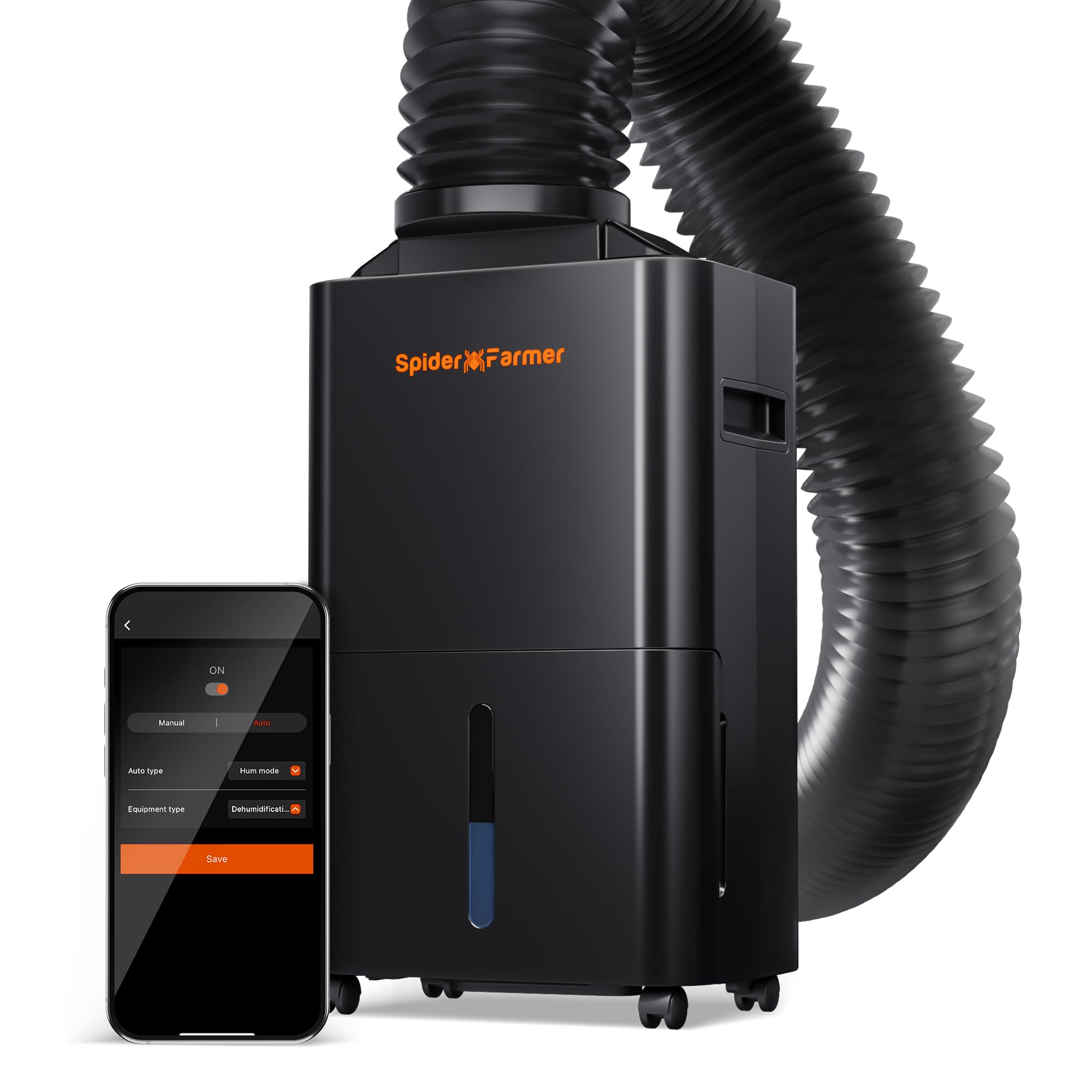
Spider Farmer designed this unit specifically for grow tent use, and it shows in every design decision. The unit comes with an air duct so you can place the dehumidifier outside the tent and route the intake directly into the canopy — a critical feature that keeps compressor heat out of your grow space. At 32 pints per day (rated at 95°F, 90% RH), it has enough extraction power for a 4×4 tent in heavy flower without breaking a sweat.
The included temperature and humidity sensor probe is the star of the show. You place the probe at canopy level, and the dehumidifier reads that air rather than the ambient air outside the tent. The humidity setpoint ranges from 30% to 80%, and the unit features three fan modes plus a 24-hour timer. The 360-degree wheels and built-in handle make it easy to reposition, and the washable filter cuts down on long-term maintenance costs.
The metal and plastic chassis feels solid, and the compressor is surprisingly quiet at low fan speed — around the hum of a box fan on low. The auto-defrost function prevents icing in cooler environments, extending the usable season. For dedicated indoor growers who want a purpose-built machine, this is the gold standard in its class.
Why it’s great
- Ducted intake allows outside-tent placement, keeping heat out of the canopy
- Remote sensor probe ensures the dehumidifier responds to actual tent conditions
- Compact 11.8″ x 7.9″ footprint fits easily beside a 4×4 tent
Good to know
- The 2.1-liter internal tank fills quickly; plan to use continuous drain hose
- Reported hysteresis issue in auto mode — it may allow humidity to rise 15% before kicking back on
2. VIVOSUN AeroDrain D12 Smart Dehumidifier
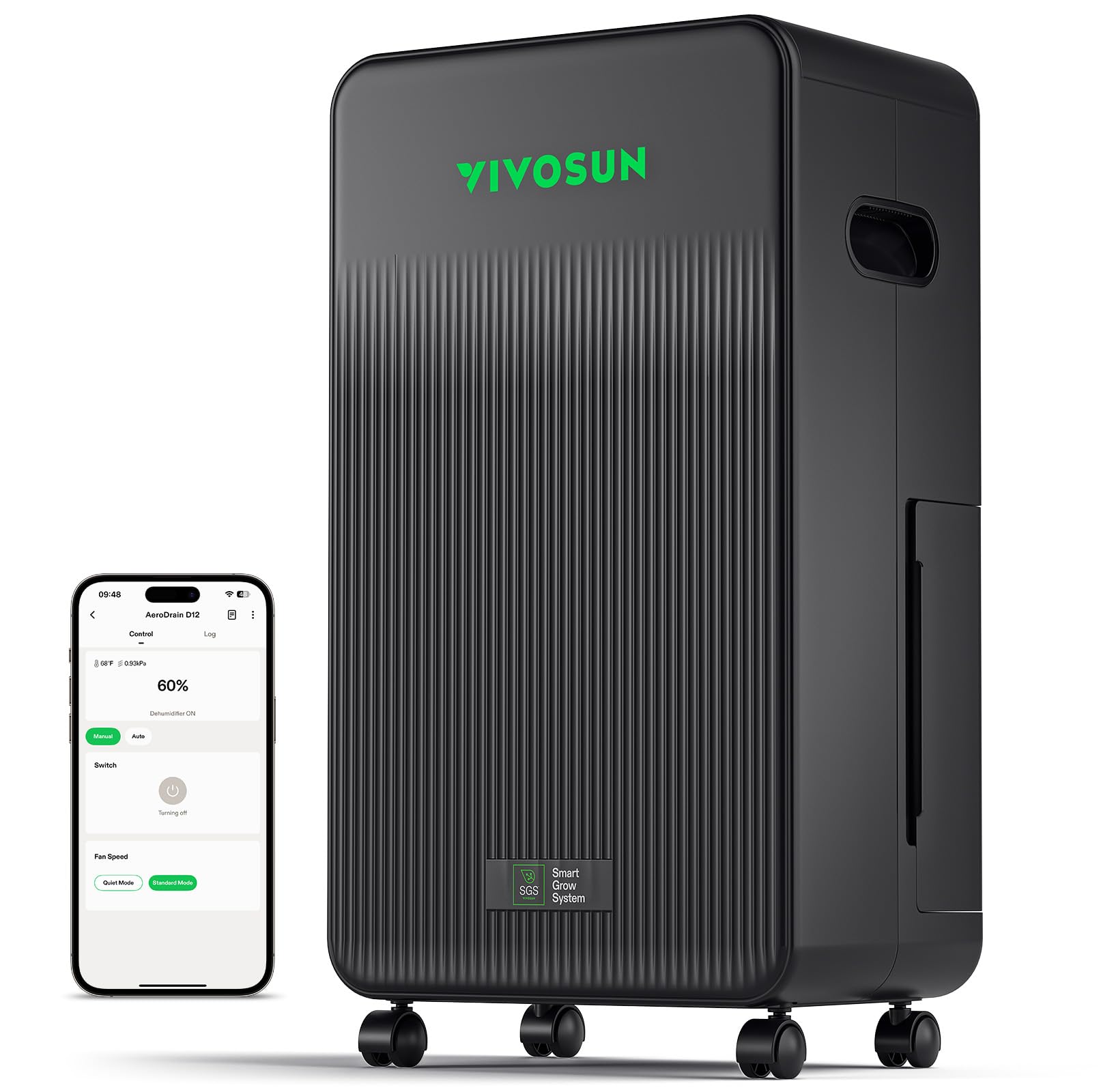
VIVOSUN’s AeroDrain D12 is the most technologically advanced option on this list. It pairs a high-efficiency compressor rated for 12 liters of extraction per day with a dedicated app that integrates into the VIVOSUN Smart Grow System. You can monitor temperature, humidity, and VPD in real-time from your phone, and set the dehumidifier to synchronize automatically with other smart devices in the tent.
The unit features dual air ducts — one for intake and one for exhaust — allowing it to sit outside the grow tent and pull moisture-laden air directly from the canopy. The remote temperature and humidity sensor probe provides accurate readings at plant level, and the compressor draws a maximum of just 200W, making it energy-efficient for a continuous-run appliance. The 2-liter tank is relatively small, but the continuous drain hose connection means you can run it indefinitely without manual emptying.
Build quality is excellent, with smooth-rolling caster wheels and integrated handles that make positioning effortless. The tool-free duct connection system means setup takes under five minutes. For growers who want full data logging and automation, the D12 is the undisputed smart leader.
Why it’s great
- Full VPD monitoring and app-based automation for hands-off control
- Dual-duct external placement keeps heat and noise out of the tent
- Low power draw (200W max) for a 12L/day compressor unit
Good to know
- Connectivity setup can be finicky; some users needed support to pair with the app
- Struggles to maintain setpoint in very high ambient humidity environments
3. AEOCKY ARION-001 40-Pint Dehumidifier
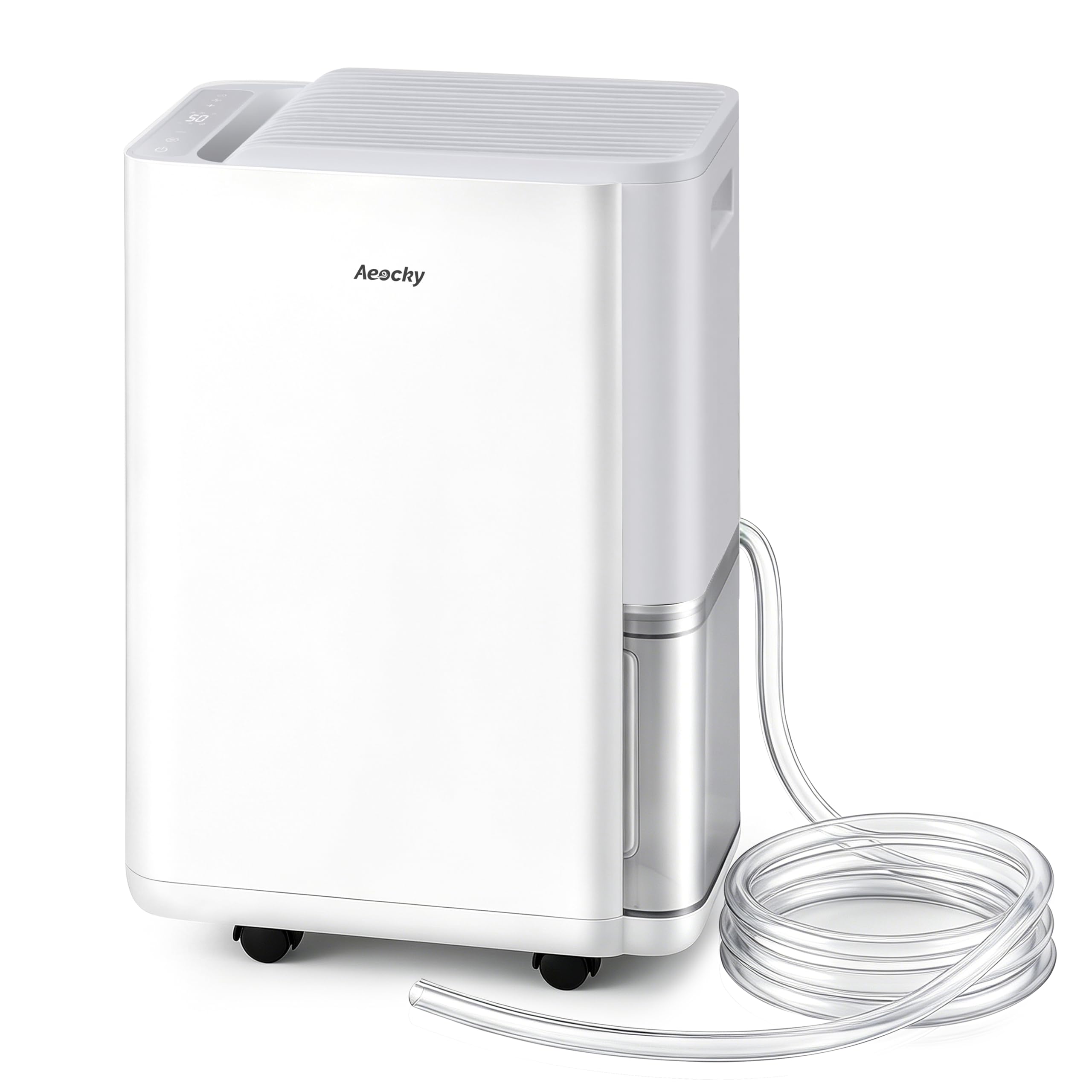
AEOCKY’s ARION-001 punches well above its weight class. Despite a remarkably compact footprint — just 8 inches deep and 11 inches wide — it delivers a genuine 40 pints per day of extraction (rated at 95°F, 95% RH). That kind of capacity makes it suitable not just for large grow tents up to 5×5 feet, but also for the entire lung room or basement where the tent sits.
The unit uses a Pro+ piston compressor paired with a brushless DC inverter motor. The energy efficiency is noteworthy: AEOCKY claims a 50% reduction in power consumption compared to poorly optimized competitors. The 0.5-gallon tank is small for a unit this powerful, but the included drain hose and garden hose adapter allow for continuous gravity drainage. The auto-defrost system prevents frost buildup when pulling humid air from a cool basement.
The control panel offers four modes — Continuous, Sleep, Auto, and Constant Humidity (40%–80% adjustable). The noise-reduction system keeps things quiet enough for a bedroom, and the 360-degree casters make it easy to roll into position. AEOCKY backs this unit with a 3-year warranty, which is unusually generous for this price tier.
Why it’s great
- 40 pints/day extraction in an ultra-compact 8-inch-deep chassis
- Brushless DC motor and inverter compressor save significant energy
- 3-year warranty signals confidence in long-term durability
Good to know
- Small 0.5-gallon tank requires continuous drain setup for extended runs
- Weighs about 25 lbs; small wheels can tip on uneven floors
4. AEOCKY X1-Pro Rotary Desiccant Dehumidifier
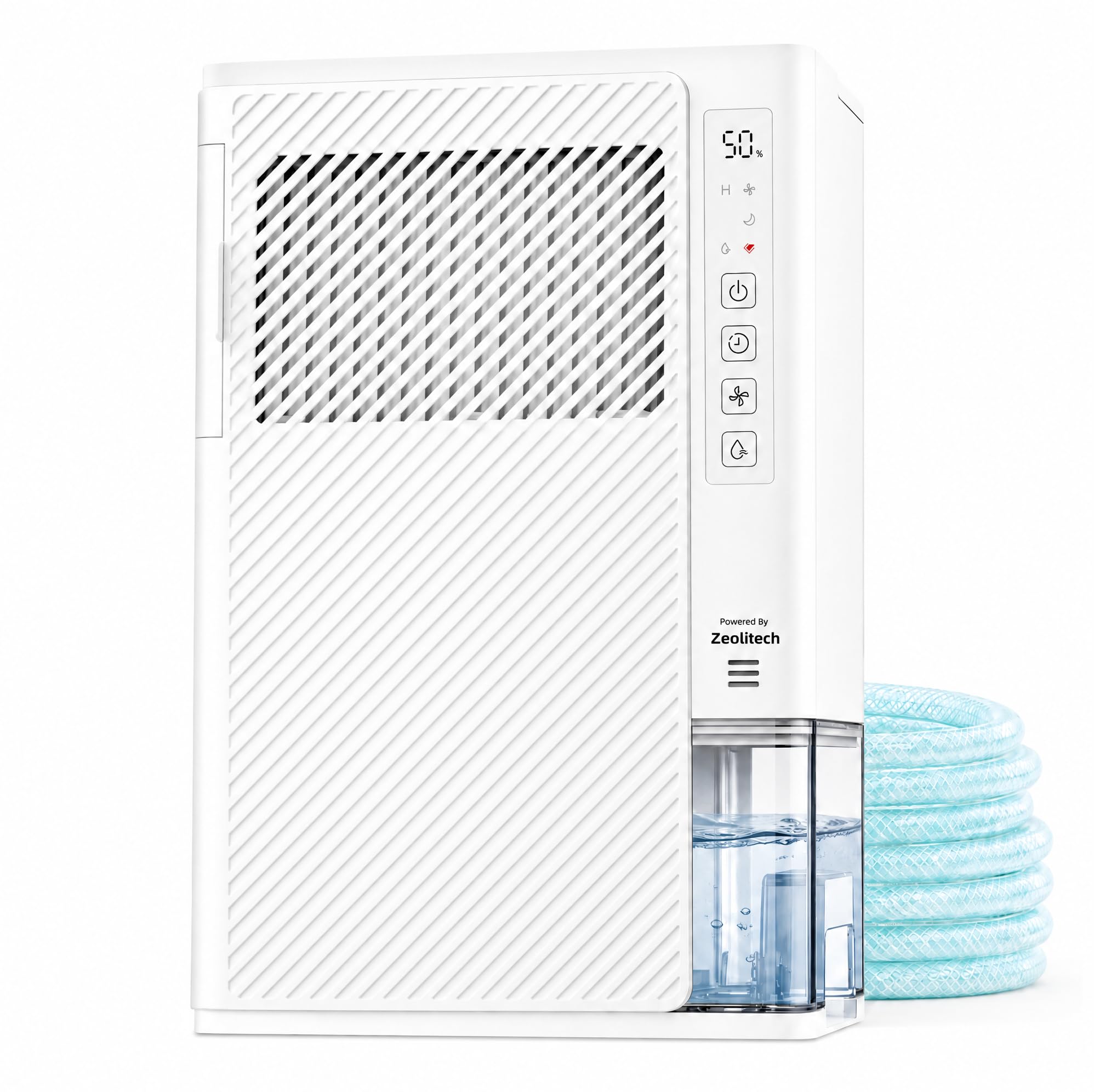
The X1-Pro uses rotary desiccant technology, which operates on a completely different principle than compressor units. Instead of condensing moisture on cold coils, a molecular sieve wheel absorbs water vapor and releases it through a heated exhaust. This makes the X1-Pro frost-free down to 34°F — a major advantage if your grow tent is in an unheated garage or basement during winter.
At 80 ounces per day (roughly 5 pints), the extraction rate is lower than a big compressor unit, but the X1-Pro is designed for tight spaces. It measures just 11.8″ x 6.3″ x 15.4″ and weighs only 8.8 lbs. The foam and plastic construction keeps it whisper-quiet: real-world tests show 39 dB at full power and just 25 dB in sleep mode. The intelligent humidistat can be set from 40% to 80%, and the 85-ounce tank is generous for a unit this size.
One quirk: the desiccant process produces a noticeable amount of warm exhaust air. If you place the X1-Pro inside the tent, that heat will raise canopy temperatures. It works best as a supplemental unit for small tents (2×2 or 3×3) or as a spot-treatment option during the drying phase.
Why it’s great
- Frost-free operation down to 34°F, perfect for cold-weather grows
- Extremely quiet in sleep mode at only 25 dB
- Lightweight 8.8 lb design is easy to move between tents
Good to know
- Desiccant wheel emits warm exhaust air that can heat the tent
- Slight plastic/chemical smell during first few hours of use
5. Onsekin 2000 Sq.Ft Rotary Dehumidifier
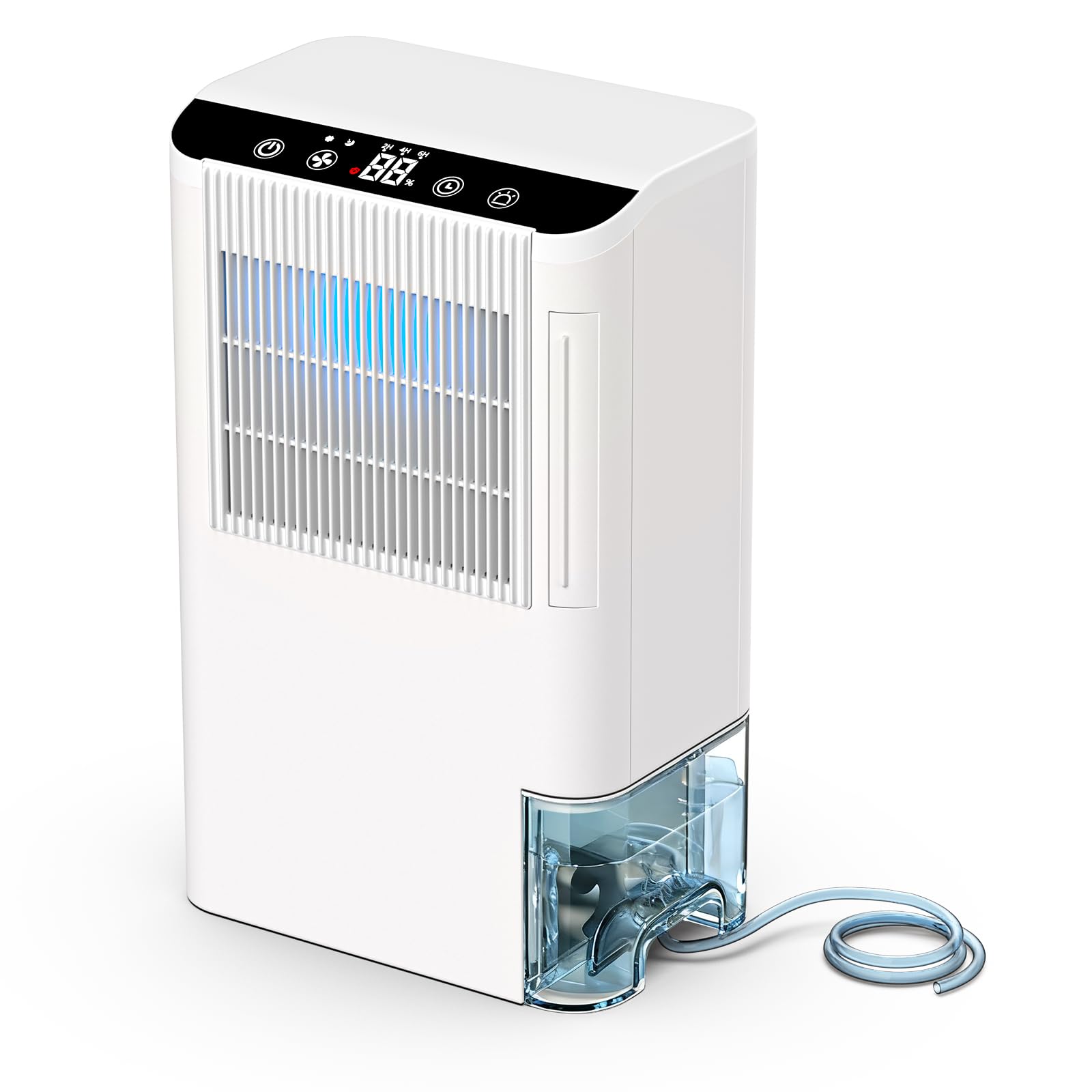
The Onsekin rotary dehumidifier is engineered specifically for environments where standard compressor units fail. It uses a desiccant wheel driven by a synchronous motor that rotates at a calm 3 RPM, paired with a 270W heater. This design maintains full extraction performance even when the ambient temperature drops below 41°F, outperforming compressor-based alternatives by 40–60% in cold conditions.
The digital hygrostat samples the room air every three seconds and modulates the heater and fan to hit your chosen humidity setpoint with ±2% accuracy. The 2.5-liter tank is on the smaller side for a unit that can handle up to 2000 square feet, but the included 3.3-foot drain hose enables continuous operation. The sleep mode drops fan speed from 2200 RPM to 1900 RPM, cutting noise to just 46 dB and reducing power consumption to 62.5%.
Safety features are robust: a magnetic float switch prevents overflow, a tilt sensor cuts power if the unit is knocked over, and a 45-second delayed cooling cycle protects internal components during shutdown. For growers running tents in unheated garages or basements that dip into freezing territory, this is a reliable year-round solution.
Why it’s great
- Maintains full extraction in ambient temperatures below 41°F
- Digital hygrostat with ±2% precision for tight VPD control
- Compact 9.8″ x 6.4″ footprint with built-in carry handle
Good to know
- 270W heater adds noticeable heat to the surrounding air
- Small 2.5L tank fills quickly in high-humidity conditions
6. Airvip 34-Pint Compressor Dehumidifier
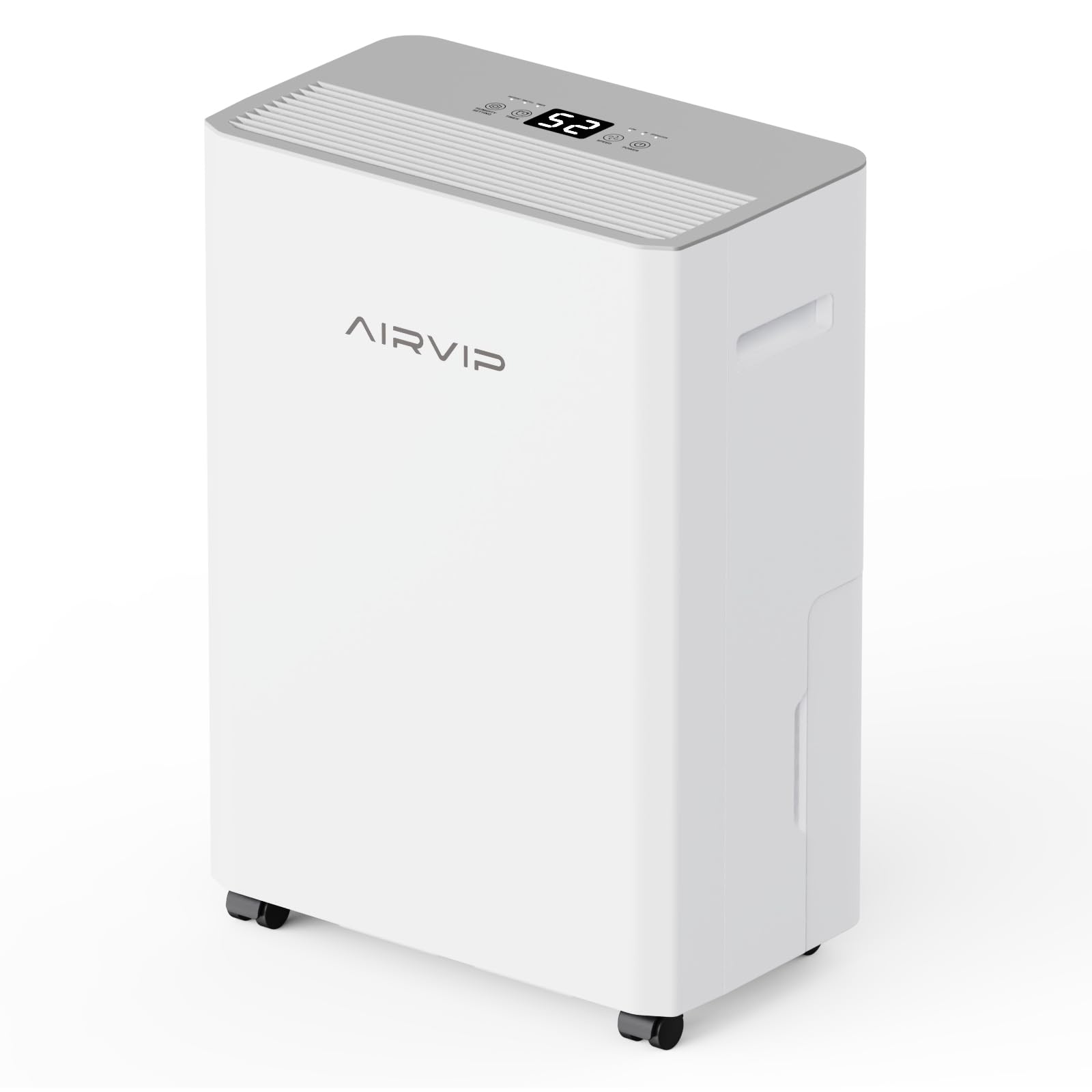
Airvip’s 34-pint compressor unit sits at the intersection of performance and budget-friendly pricing. It removes up to 34 pints per day (rated at 95°F, 95% RH) and can cover up to 2441 square feet, making it capable of handling a 5×5 tent plus the surrounding lung room. The soundproof panel design keeps noise to a minimum, and the frost-free tech with a 1-minute auto-defrost cycle prevents ice buildup in cool basements.
The 3-in-1 control system offers Continuous mode for constant extraction, Comfort mode for automatic optimization, and Manual mode where you set the target humidity between 30% and 90% in 5% increments. The 2.5-liter tank auto-shuts when full, and the included 6.6-foot drain hose enables gravity-fed continuous drainage. The compact dimensions (11.42″ x 6.69″ x 16.34″) and 360-degree wheels let you roll it between rooms easily.
Customer feedback consistently highlights how much faster it pulls humidity down compared to older units. The control panel is responsive, and the digital display shows current humidity readings clearly. For home growers who want solid extraction without a premium price tag, this unit delivers surprisingly strong performance.
Why it’s great
- 34 pints/day extraction in a compact, wheeled chassis
- Three operating modes including a continuous drain option
- Auto-defrost allows year-round operation in cool basements
Good to know
- Small 2.5L tank needs frequent emptying without continuous drain
- Not designed for external ducting; must sit inside or near the tent
7. Spacekey 95 oz Peltier Dehumidifier
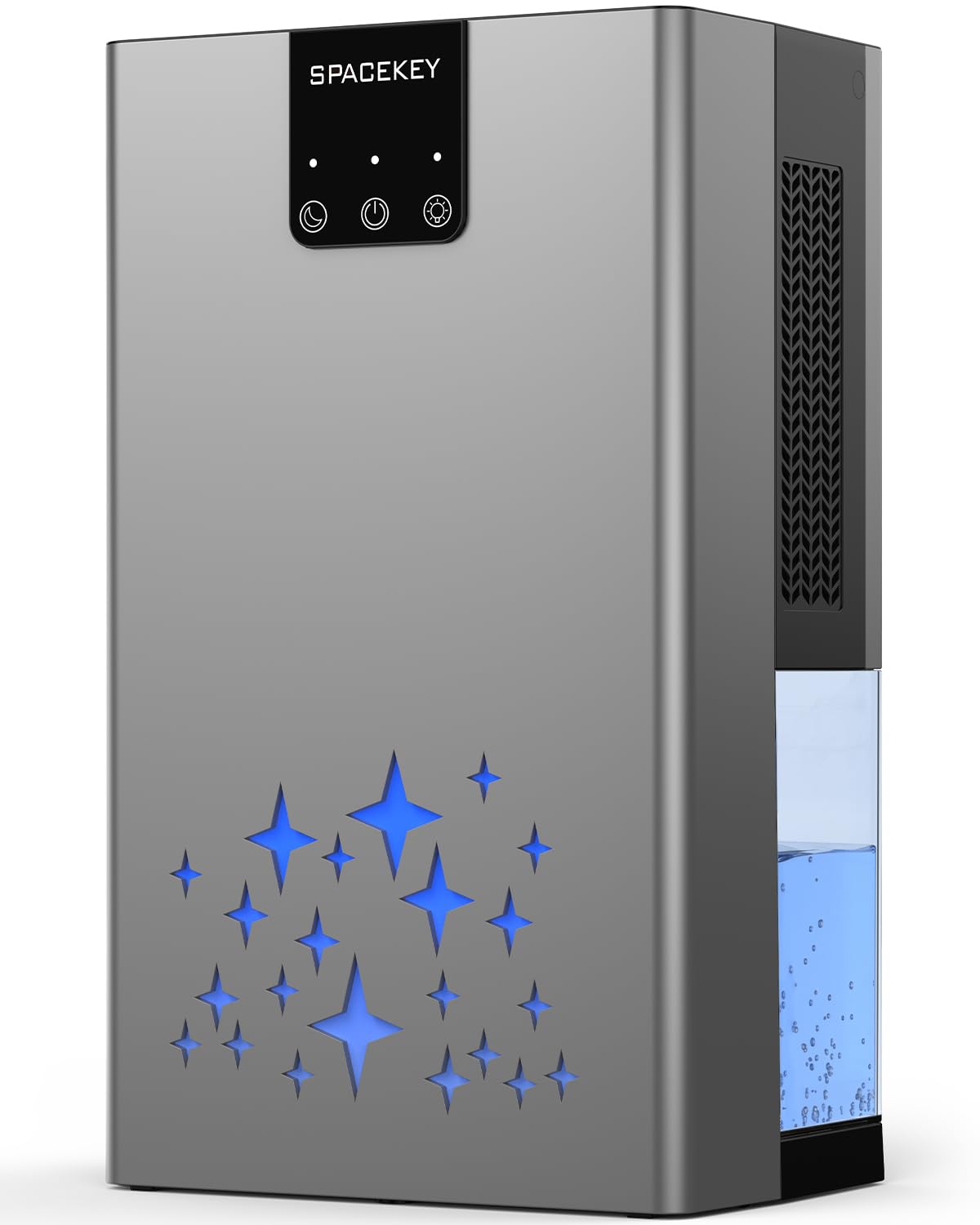
The Spacekey unit uses Peltier (thermoelectric) technology, which is fundamentally different from the compressor and desiccant designs above. It extracts up to 40 ounces per day using a solid-state cooling plate — no compressor, no refrigerant, no moving parts except a small fan. This makes it nearly silent at 20 dB in sleep mode, which is essentially a whisper.
The 95-ounce water tank is generous for a Peltier unit, reducing the frequency of manual emptying. The built-in 7-color LED ambient light and starry front panel add a decorative touch that some growers appreciate for a small veg or mother tent. The coverage claim of 1000 square feet is optimistic — real-world extraction is best suited for a 2×2 or 2×4 tent with a low transpiration load.
Where this unit falls short is extraction speed. Peltier dehumidifiers pull moisture slowly, and they cannot keep up with a fully mature 4×4 canopy in flower. The auto shut-off function works reliably, and the compact form factor (5.6″ deep, 8.2″ wide) fits into tight corners. This is a viable option for a small seedling/clone tent or as a supplemental moisture remover during the drying phase, but it is not a primary solution for a high-yield grow.
Why it’s great
- Near-silent operation at 20 dB in sleep mode, ideal for bedrooms
- Large 95-ounce tank minimizes refill frequency
- Compact and lightweight, fits in tight tent corners
Good to know
- Peltier tech extracts moisture slowly — cannot handle a heavy-flower canopy
- Some users report the unit is much smaller than expected from photos
FAQ
Can I use a regular home dehumidifier in my grow tent?
Should I get a compressor or a desiccant dehumidifier for my tent?
Where should I place the dehumidifier relative to my tent?
What size dehumidifier do I need for a 4×4 grow tent?
Can a Peltier dehumidifier work for a grow tent?
Final Thoughts: The Verdict
For most growers, the best grow tent dehumidifier winner is the Spider Farmer 38-Pint because it combines a ducted design for external placement, a remote sensor probe for accurate canopy-level readings, and enough extraction power to handle a 4×4 tent without breaking the budget. If you want full app integration and VPD automation, grab the VIVOSUN AeroDrain D12. And for a cold-weather grow in an unheated garage, nothing beats the frost-free reliability of the AEOCKY X1-Pro desiccant unit.