
Chasing that perfect guitar tone on a budget isn’t about compromise—it’s about knowing which specifications and features deliver the most musical noise per dollar spent. From bedroom practice to small gigs, the right amplifier transforms your playing experience without emptying your wallet.
I’m Mohammad Maruf — the founder and writer behind Drink4Good. I’ve spent years analyzing the intersection of music gear performance and market pricing, focusing deeply on amplifier circuitry, speaker quality, and feature-to-cost ratios that actually matter to guitarists.
The most serious challenge in this price tier is separating the noise from the signal: finding a guitar amp under $200 that offers real spring reverb, a usable effects loop, or authentic modeling without sacrificing basic reliability.
How To Choose The Best Guitar Amp Under $200
Picking the right amplifier in this price range is about matching your specific playing context—bedroom practice, live jamming, silent recording, or busking—with the amp’s core architecture. The most common mistake is prioritizing wattage alone, ignoring speaker size, onboard effects, and connectivity that define real-world usability.
Solid-State vs. Digital Modeling
Solid-state amps like the Fender Frontman series offer straightforward, reliable clean tones and take pedals well. Digital modeling amplifiers like the Line 6 Spider and SONICAKE QAM-20 pack dozens of effects and amp simulations into a single box, saving money on separate pedals. If you prefer simplicity and pedal-based tone shaping, go solid-state. If you want variety in one package, choose modeling.
Speaker Size & Wattage
An 8-inch speaker is standard for practice amps under $200 and delivers enough projection for bedroom volumes. A 10-inch speaker, like in the Monoprice Stage Right, provides significantly fuller low-end and can handle small rehearsals. Wattage between 10 and 40 watts is typical—more wattage gives clean headroom, but speaker size impacts tonal character more dramatically at this price point.
Connectivity & Portability
Headphone outputs, auxiliary inputs, and USB recording capabilities expand an amp’s utility beyond loud playing. Rechargeable battery-powered amps like the SONICAKE and JOYO Jam Buddy II offer true portability for outdoor practice or busking. Built-in tuners and drum machines add practice value without extra gear.
Quick Comparison
On smaller screens, swipe sideways to see the full table.
| Model | Category | Best For | Key Spec | Amazon |
|---|---|---|---|---|
| Line 6 Spider V 20 MKII | Digital Modeling | Versatile modeling & effects | 20 Watts / 8-inch speaker | Amazon |
| Marshall MG15GR | Solid State | Classic Marshall tone | 15 Watts / 8-inch speaker | Amazon |
| Monoprice Stage Right | Solid State | Spring reverb & effects loop | 40 Watts / 10-inch speaker | Amazon |
| Fender Frontman 20G | Solid State | Simple reliable practice | 20 Watts / 8-inch speaker | Amazon |
| JOYO Jam Buddy II | Digital Modeling | Ultra-portable practice | 10 Watts / Dual 2-inch speakers | Amazon |
| Fender Frontman 10G | Solid State | Entry-level clean tones | 10 Watts / 6-inch speaker | Amazon |
| SONICAKE QAM-20 | Digital Modeling | Portable & effects-loaded | 10 Watts / 3-inch speaker | Amazon |
In‑Depth Reviews
1. Line 6 Spider V 20 MKII

The Line 6 Spider V 20 MKII is a benchmark digital modeling amp at this tier, offering 16 factory presets with three simultaneous effects plus independent reverb. The tap-tempo function and built-in tuner make it exceptionally practical for daily practice, and the free Spider V Remote app unlocks over 200 amps and effects for deep editing.
Its 20-watt output through an 8-inch custom speaker delivers enough clean headroom for bedroom practice and small jam sessions. The headphone output reveals more sonic detail than the internal speaker—a common trait but particularly noticeable here with the modeling engine’s clarity. USB connectivity allows direct recording to Mac or PC, adding studio utility without extra hardware.
The app-based editing is essential for unlocking the amp’s full potential; the physical controls are streamlined for quick tone selection but limit deep parameter tweaking. Some users report that the built-in speaker sound is slightly inferior to older Spider models, though the modeling engine itself remains competitive.
Why it’s great
- Massive amp and effects library via app
- Tap-tempo and built-in tuner
- USB recording and editing on desktop
Good to know
- App is necessary for deep editing
- Speaker sound quality can vary from older models
2. Marshall MG15GR

The Marshall MG15GR brings the iconic brand’s aesthetic and voicing into a compact 15-watt combo with an 8-inch custom speaker. It features separate clean and overdrive channels, a fully adjustable digital spring reverb, and a 3-band EQ that allows precise tonal shaping. At 18.67 pounds, it’s portable but feels solidly constructed with a closed-back MDF cabinet.
The headphone output doubles as a silent practice tool, while the MP3/line-in input lets you jam along to backing tracks. The clean channel delivers the classic British chime, and the overdrive channel covers blues to moderate rock gain. The digital reverb is adjustable from subtle ambience to expansive depth, adding dimension without the mechanical noise of a real spring tank.
The overdrive channel lacks the saturation of higher-end Marshall tube amps, but it takes external pedals exceptionally well. Some units have reported detached reverb tanks during shipping, so inspecting upon arrival is advisable. The 15-watt output is best suited for bedroom practice and quiet jamming rather than keeping up with a drummer.
Why it’s great
- Authentic Marshall clean and overdrive tones
- Fully adjustable digital spring reverb
- Headphone and aux inputs for silent practice
Good to know
- Not loud enough for live drums
- No external speaker output
3. Monoprice 1×10 Guitar Combo Amplifier

The Monoprice Stage Right is a 40-watt solid-state amplifier with a genuine 10-inch 4-ohm speaker—a rare speaker size at this price point. It features a real spring reverb tank, a 3-band EQ centered at 100 Hz, 1 kHz, and 3 kHz, plus both high and low input jacks. An effects loop is included, allowing pedal integration without signal degradation.
The clean channel has a tube-like warmth and headroom that surpasses many competitors, thanks to the larger speaker and 40-watt output. The spring reverb is genuinely functional and adds authentic analog ambience. The overdrive channel is decent but many users prefer running pedals into the clean channel for better distortion character.
The line output can introduce noise when connected to a second amp or recording interface, a known quirk of this model. The speaker requires a break-in period of around 25 hours to reach its full tonal potential. At 1.5 pounds shipping weight (the speaker is heavier), it’s surprisingly portable for a 10-inch combo but not as compact as practice amps.
Why it’s great
- Real spring reverb and effects loop
- 40 watts with 10-inch speaker for fuller sound
- Takes pedals exceptionally well
Good to know
- Line output can be noisy
- Speaker requires break-in period
4. Fender Frontman 20G

The Fender Frontman 20G is a no-fuss 20-watt solid-state amplifier with a 6-inch Fender Special Design speaker and intuitive controls. It offers a clean channel with volume plus 3-band EQ and a separate switchable drive channel with its own volume, allowing independent level adjustment between clean and overdriven sounds. The 1/8-inch aux input and headphone jack add modern practice convenience.
The clean channel delivers the classic Fender clarity—bright, articulate, and pedal-friendly. The overdrive channel is compressed but functional, best suited for classic rock tones. The cabinet measures 10x16x16 inches and weighs 11 pounds, making it easy to move around the house. The two-year warranty from Fender provides confidence in build quality.
The drive channel lacks the dynamics of a tube amp, and there is no built-in reverb, which some players may miss. The 6-inch speaker limits low-end response compared to 8-inch models, but it remains perfectly adequate for beginner practice and small rooms. The simple layout encourages focusing on playing rather than menu-diving.
Why it’s great
- Classic Fender clean tone at any volume
- Simple intuitive controls
- Two-year warranty included
Good to know
- No reverb built in
- Small speaker limits bass
5. JOYO JAM Buddy II
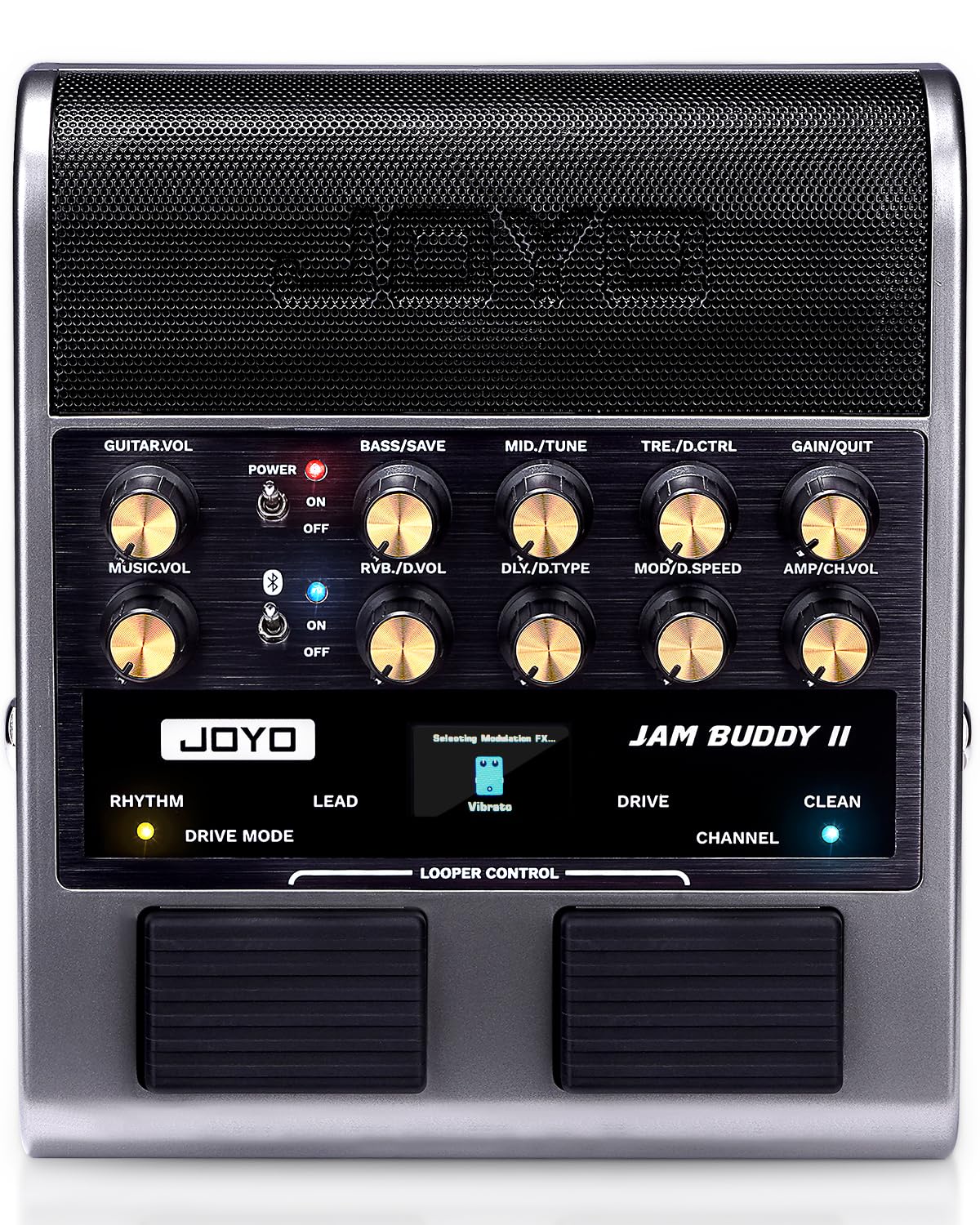
The JOYO JAM Buddy II is a palm-sized digital modeling amp that redefines portable practice. It weighs only 940 grams yet packs 14 amp models, 9 effects (modulation, delay, reverb), a 36-pattern drum machine, a 30-second looper, and three independent channels—Clean, Rhythm, and Lead. Dual 2-inch full-range speakers with a bass radiator deliver surprisingly balanced sound for its size.
The built-in rechargeable battery provides up to 5 hours of playtime, and the OTG USB-C port enables direct recording to phones or computers—perfect for content creators. Bluetooth audio streaming allows jamming over backing tracks, with separate volume knobs for guitar and Bluetooth signals. The included phone mount keeps your device visible for tabs or recording apps.
The small speaker size limits maximum volume and low-end punch compared to traditional combo amps. It’s best suited for bedroom practice, headphone sessions, or ultra-portable use. The looper is a powerful practice tool but limited to 30 seconds, which may feel constraining for longer improvisations.
Why it’s great
- 14 amp models and 9 effects in one unit
- Built-in drum machine and looper
- Rechargeable battery for true portability
Good to know
- Small speakers limit bass response
- Looper restricted to 30 seconds
6. Fender Frontman 10G

The Fender Frontman 10G is the entry cornerstone of the Fender amplifier family, offering 10 watts through a 6-inch Fender Special Design speaker. It features a gain control, overdrive select switch, volume, treble, and bass—keeping the control set minimal and effective. The closed-back design provides a heavier bass response than many open-back competitors of this size.
The clean channel is genuinely excellent, delivering the bright Fender character that takes pedals wonderfully. The overdrive channel is compressed and not particularly dynamic, but it works for classic rock at practice volumes. The headphone output is a welcome addition for silent practice. Many users report upgrading the speaker to a Jensen MOD 6-15 for dramatically improved clarity and volume—a simple 5-minute modification.
There is no midrange EQ control and no effects loop, which limits tonal versatility. The 10-watt output is sufficient for solo practice but will not keep up with a drummer. It remains one of the most reliable and affordable ways to get a genuine Fender sound in your bedroom.
Why it’s great
- Authentic Fender clean tone
- Closed-back design for better bass
- Headphone output for silent practice
Good to know
- No midrange EQ control
- Overdrive channel is compressed
7. SONICAKE 10W BT Guitar Amplifier QAM-20

The SONICAKE QAM-20 is a 10-watt digital modeling amplifier that prioritizes portability and feature density. It houses 80 professional effects and 100 preset tones in a cabinet measuring 10.5×4.8×7 inches and weighing only 1.4 kg. Bluetooth 5.0 connects to the SONICAKE app for preset editing, drum machine control, and backing track playback. The built-in rechargeable battery offers approximately 4 hours of playtime.
This amp supports USB recording, MIDI control, and NAM (Neural Amp Modeler) file imports—features rarely seen at this price point. The 3-inch full-range speaker delivers clear tones suitable for bedroom practice, and the battery power makes it ideal for busking or outdoor jamming. The app-based editing is intuitive and allows deep customization of effects chains.
The single 3-inch speaker limits maximum volume and low-end response, making it best for solo practice or headphone use. Some users note a slight hissing noise when plugged into AC power, and the built-in tuner can be slightly inaccurate on low strings. The plastic cabinet construction feels less durable than wood-paneled competitors.
Why it’s great
- 80 effects and 100 presets via app
- Portable with rechargeable battery
- Supports NAM file imports and USB recording
Good to know
- Small speaker limits volume and bass
- AC power can introduce hiss
FAQ
Is 10 watts enough for a guitar amp under $200?
Can I use pedals with a modeling amp this cheap?
What does the effects loop do on a budget amp?
Final Thoughts: The Verdict
For most users, the guitar amp under $200 winner is the Line 6 Spider V 20 MKII because it balances versatile digital modeling, practical features like tap-tempo and a tuner, and expandability via its editing app. If you want authentic spring reverb and an effects loop for pedal-based tone shaping, grab the Monoprice Stage Right. And for ultra-portable practice with a drum machine and looper, nothing beats the JOYO Jam Buddy II.