
Finding a guitar amplifier that delivers genuine tonal character without devouring your entire gear budget feels like an impossible hunt. The market is flooded with lifeless solid-state boxes that turn your carefully dialed-in sound into a thin, brittle mess the moment you push the volume past three. You need an amp that breathes with your playing—giving you sparkling cleans, a growling crunch, and enough headroom to be heard over a drummer—all without forcing you to sell your prized Les Paul.
I’m Mohammad Maruf — the founder and writer behind Drink4Good. I’ve spent years analyzing the engineering trade-offs in affordable guitar gear, comparing output transformer specs, preamp tube configurations, and speaker sensitivity ratings to separate genuine value from marketing hype.
After scouring the sub-$300 landscape, I’ve compiled the definitive list of the best guitar amp under $300 that actually delivers the goods for bedroom practice, recording, and even small club gigs.
How To Choose The Best Guitar Amp Under $300
Selecting the right amp in this price tier requires understanding the trade-off between raw wattage, preamp flexibility, and speaker quality. You don’t get infinite headroom, but you can absolutely get a responsive, gig-worthy tone if you prioritize the right specs.
Wattage and Speaker Efficiency
A 20-watt solid-state amp can be as loud as a 50-watt modeling amp depending on its speaker’s sensitivity rating, measured in dB SPL per watt. Lower-rated speakers sound muffled and get lost quickly in a mix. Look for an 8-inch or 10-inch speaker with at least 95 dB sensitivity to ensure your clean tone cuts through without distorting prematurely.
Tone Stack and Preamp Architecture
Three-band EQ (bass, middle, treble) is the bare minimum. Premium options in this range add a presence control, switchable gain channels, and a separate reverb circuit. Modeling amps go further, digitally emulating classic preamp circuits from vintage Plexis to modern high-gain stacks. If you want authentic tube breakup without pedals, consider a low-wattage all-tube combo with a 12AX7 preamp tube and a 6V6GT power tube.
Connectivity and Built-in Effects
A headphone jack with emulated output, a 3.5mm aux input, and a USB audio interface for direct recording are table stakes. Built-in reverb, delay, modulation, and a chromatic tuner save you from buying external pedals. Some models add Bluetooth streaming and smartphone app integration for preset management and backing tracks.
Quick Comparison
On smaller screens, swipe sideways to see the full table.
| Model | Category | Best For | Key Spec | Amazon |
|---|---|---|---|---|
| Positive Grid Spark | Modeling | Smart practice & backing tracks | 40W, 4″ speaker, 50k+ ToneCloud | Amazon |
| HeadRush FRFR108 MKII | FRFR | Modelers & multi-FX pedalboards | 2000W, 8″ woofer + 1″ compression | Amazon |
| Fender Mustang LT50 | Modeling | Versatile preset platform | 50W, 12″ speaker, USB recording | Amazon |
| Marshall CODE50 | Digital Modeling | Authentic Marshall voicings | 50W, 12″ speaker, 100+ presets | Amazon |
| Marshall MG30GFX | Solid State | Classic Marshall rock tones | 30W, 10″ speaker, 4 channels | Amazon |
| Orange Crush 20RT | Solid State | 2-channel analog simplicity | 20W, 8″ Voice of the World | Amazon |
| Monoprice Stage Right 5W | Tube | Authentic valve breakup at low volume | 5W, 8″ Celestion, 1W/5W switch | Amazon |
| Line 6 Spider V 20 MKII | Digital Modeling | Massive effects library on a budget | 20W, 8″ speaker, 200+ app amps | Amazon |
| Fender Frontman 20G | Solid State | Budget-friendly clean channel | 20W, 6″ special design speaker | Amazon |
In‑Depth Reviews
1. Positive Grid Spark

The Positive Grid Spark is the smartest practice amp on the market at this price. Its 40-watt combo uses Positive Grid’s BIAS virtual tube modeling to deliver 33 amp models, 43 effects, and access to over 50,000 user-uploaded presets via the ToneCloud platform. The four-speaker array (two 4-inch woofers and two tweeters) creates an immersive, stereo-like field that feels far wider than its compact 13.8″ width suggests.
The real party trick is the Smart Jam engine: it listens to your playing in real time and generates authentic bass and drum accompaniment that matches your tempo and style. You can also import any song from Spotify or YouTube, and the app will display the guitar chords synced to the audio. The built-in chromatic tuner, tap-tempo, and USB audio interface for recording make this a complete practice workstation.
It is not loud enough for a full-band rehearsal without PA support—think of it as the ultimate bedroom and recording tool. The app dependency for deep editing is a mild inconvenience, but the onboard tone stack controls let you tweak on the fly. The 15.2-pound weight and pearl vinyl finish make it a handsome, portable companion.
Why it’s great
- Smart Jam auto-accompaniment learns your style
- 50k+ ToneCloud presets to explore
- USB audio interface with direct recording
- Compact and lightweight for its feature set
Good to know
- 40W is insufficient for gigging without PA support
- Advanced features require the smartphone app
- No dedicated line out
2. HeadRush FRFR108 MKII
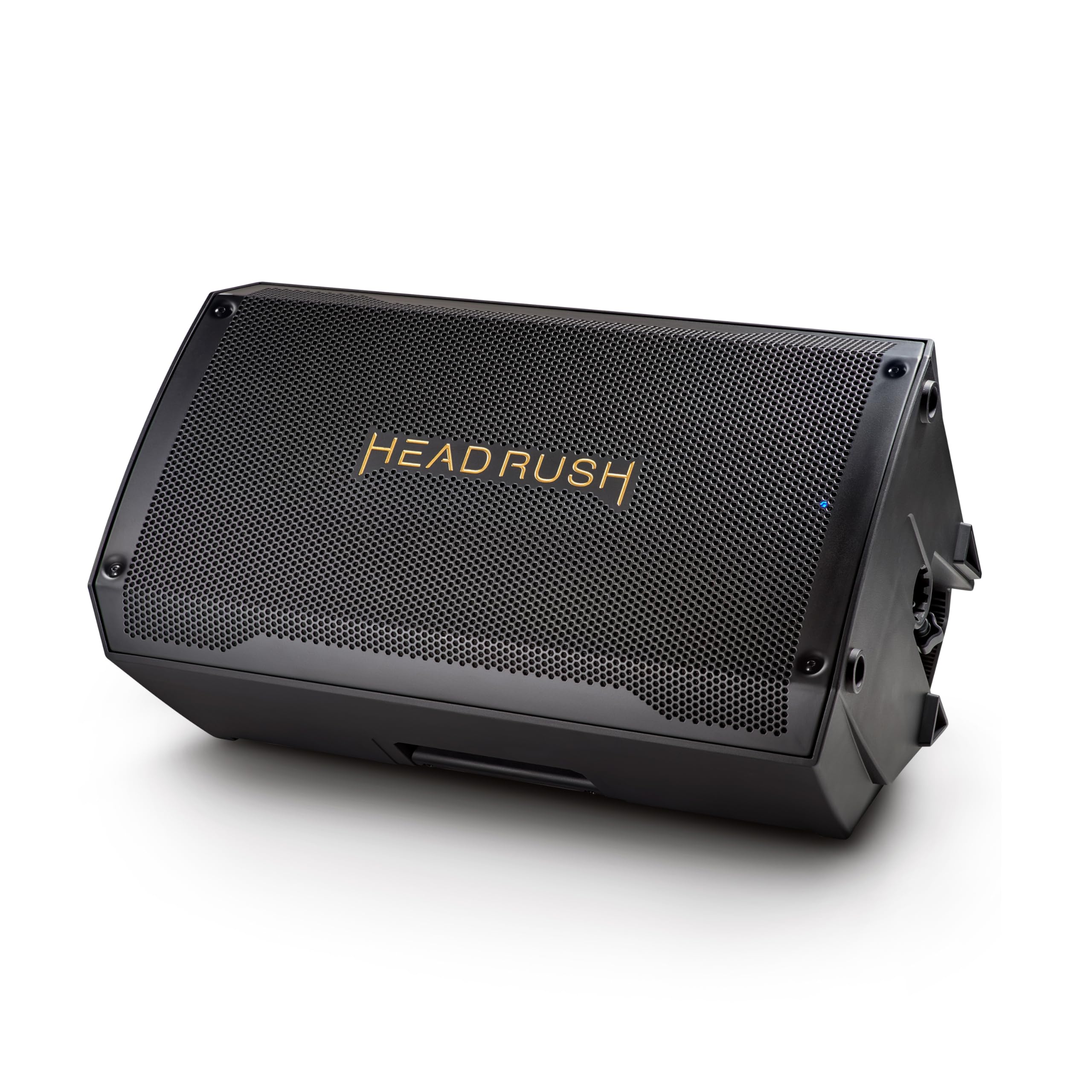
The HeadRush FRFR108 MKII is not a traditional guitar amp—it is a full-range, flat-response powered speaker designed to be the perfect companion for modelers and multi-FX pedalboards. The 2000-watt peak amplification (class-D) drives an 8-inch woofer and a 1-inch high-frequency compression driver, reproducing every nuance of your amp sims without any cabinet coloration.
Its flexibility is unmatched: use it as a wedge monitor on stage, upright on the floor, or pole-mounted for PA duty. The two XLR/TRS combo inputs have independent volume controls, and the XLR link output lets you daisy-chain multiple units for a stereo rig. Bluetooth 5.0 streaming lets you play backing tracks or click tracks from your phone between sets.
At 21 pounds, it is heavier than the Spark but still easily portable. The HPF EQ switch helps cut through muddy stage mixes, and the ground-lift switch eliminates hum from ground loops. This is not for players who want a simple plug-and-play amp—it requires a modeler to sound like a traditional amp. But paired with a unit like the Valeton GP200 or Fractal FM3, it delivers pro-level clarity.
Why it’s great
- True flat response for accurate amp modeling
- 2000W peak power, loud enough for medium venues
- Bluetooth 5.0 and dual combo inputs
- Multiple positioning options (wedge, pole, upright)
Good to know
- Requires a separate modeler for traditional amp tones
- Stock tweeter can sound shrill on high-gain settings
- Heavier than comparable modeling combos
3. Fender Mustang LT50

The Fender Mustang LT50 packs 50 watts through a 12-inch custom-voiced Fender speaker, offering genuine stage volume for small-to-medium gigs. It comes loaded with 30 onboard presets that cover everything from sparkling blackface Fender cleans to high-gain metal, plus 25 built-in effects including multiple distortions, delays, reverbs, modulations, and octave effects.
The USB audio interface is a killer feature for home recording—plug it into your computer and track directly into your DAW without needing a separate interface. The presets are surprisingly well-voiced right out of the box, meaning beginners can sound great immediately without deep menu diving. You also get 99 programmable slots to save your own custom tones.
The 23.5-pound weight is heavier than the Spark but still manageable for a 12-inch combo. Note that the Bluetooth feature is limited to the higher-end GTX series—the LT50 only connects via USB for app-based editing. The Fender 2-year warranty adds peace of mind, and the overall build quality feels robust enough for regular rehearsal use.
Why it’s great
- 50W through a 12″ speaker, gig-ready
- USB audio interface for direct recording
- 30 excellent factory presets
- 99 programmable user slots
Good to know
- No Bluetooth—USB-only for app control
- Heavy at 23.5 pounds
- Not ideal for silent practice without headphones
4. Marshall CODE50
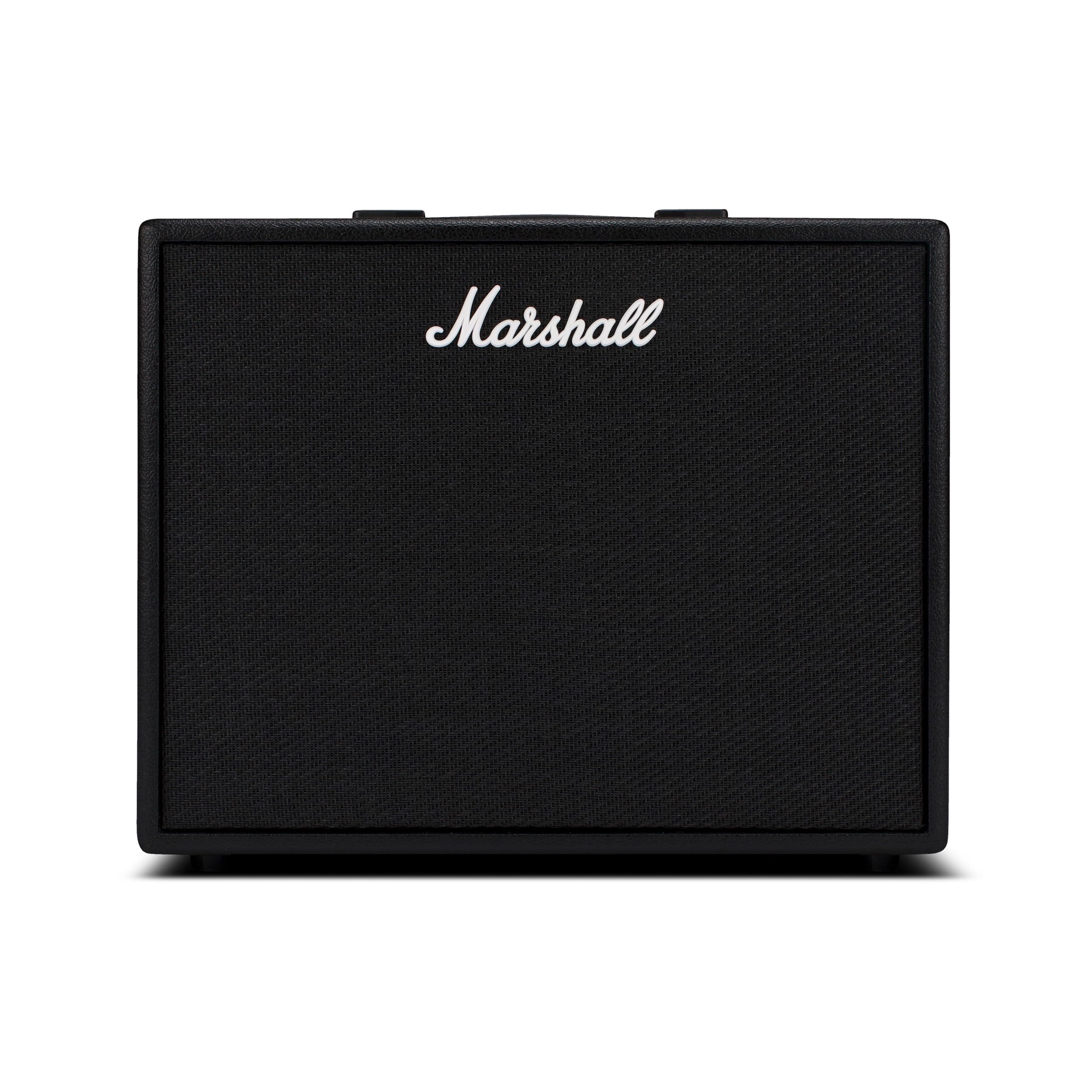
The Marshall CODE50 delivers genuine Marshall tonal DNA in a digital modeling package. It features 14 MST preamp models based on iconic circuits like the Plexi, JVM, DSL, and Silver Jubilee, paired with 4 power amp emulations (EL34, EL84, 6L6, 5881) and 8 speaker cabinet simulations modeled after the classic Marshall 1960 and 1936 cabs.
The 50-watt power stage through a 12-inch custom-voiced speaker gives you real stage volume—you will rarely need past 30% at rehearsal. The 24 onboard digital effects include reverb, delay, chorus, flanger, and tremolo, all editable via the front panel or the Marshall Gateway app over Bluetooth. You can upload and download presets from a global online library.
The 28.6-pound weight makes it the heaviest amp on this list, but the cabinet is built like a tank with a sealed back that produces tight, focused low end. The factory presets are mediocre out of the box, but once you dial in your own sounds—especially by increasing the Presence control—the CODE50 rewards with rich, dynamic tones. The headphone output doubles as a direct recording out with cabinet emulation.
Why it’s great
- Authentic Marshall preamp and cab models
- 50W with 12″ speaker, genuine stage volume
- Bluetooth app for editing and preset sharing
- Built like a pro-level cabinet
Good to know
- Factory presets are poorly voiced
- Heaviest amp on the list at 28.6 lbs
- Top-mounted controls are awkward when stacked
5. Marshall MG30GFX

The Marshall MG30GFX is a straightforward solid-state combo that delivers the classic Marshall crunch at a price well under premium modeling amps. Its 30 watts of RMS output through a custom 10-inch speaker produce enough volume for home practice and small rehearsals, with four voicings (Clean, Crunch, OD1, OD2) accessible via the front-panel rotary switch.
The built-in digital effects include reverb, delay, chorus, and flanger, all with dedicated level controls. The emulated headphone output is surprisingly good for late-night practice, and the aux input lets you jam along with backing tracks. The manual/preset button lets you store two of your own settings for quick recall.
The 10-inch speaker gives a slightly tighter low end than an 8-inch, but the stock speaker can lack the warmth of upgraded options. Several users successfully swapped in a Celestion Creamback for a dramatic improvement in headroom and clarity. The 3-band EQ is responsive, and the channel switching is smooth. It is not a do-everything modeling amp, but it nails the Marshall formula for rock and blues players.
Why it’s great
- Classic Marshall crunch and overdrive tones
- 4-channel voicing with built-in effects
- Emulated headphone output for silent practice
- Speaker upgrade path yields huge improvement
Good to know
- Limited effects compared to modeling competition
- Stock speaker lacks warmth at higher volumes
- No USB or Bluetooth connectivity
6. Orange Crush 20RT

The Orange Crush 20RT is the benchmark for straightforward, analog solid-state tone at this price. Its custom-voiced 8-inch Voice of the World speaker delivers the distinctive Orange sound—a fat, slightly fuzzy clean channel that breaks up nicely when pushed, and a separate dirty channel that goes from a gritty blues crunch to a saturated hard-rock distortion.
The built-in digital reverb is simple but usable, and the integrated chromatic tuner lets you mute your signal and tune silently. The headphone output and aux input are standard, but the lightweight 15.9-pound chassis makes it the most portable option in this tier. The 20 watts are ideal for bedroom practice and can just about keep up with an acoustic jam.
The main limitation is the 8-inch speaker—it lacks the low-end punch of a 10-inch or 12-inch, making it less suitable for band rehearsals. Some users found the reverb too shallow and replaced the speaker with a Jensen C8R for deeper resonance. The controls are dead simple: volume, shape, gain, reverb, and channel select. If you want an instant plug-and-play amp with character, this is it.
Why it’s great
- Signature Orange tonal character
- Lightweight and ultra-portable (15.9 lbs)
- Simple 2-channel analog design
- Built-in chromatic tuner with mute
Good to know
- 8″ speaker lacks low-end for band rehearsal
- Reverb is shallow and limited
- No effects loop or USB interface
7. Monoprice Stage Right 5W

The Monoprice Stage Right 5W is the only true all-tube amplifier on this list, featuring a 12AX7 preamp tube and a 6V6GT power tube driving an 8-inch Celestion Super 8 GBA-15 speaker. It offers a genuine tube experience—warm, dynamic cleans that gradually break up into rich, even-order harmonics as you push the volume—something no solid-state or modeling amp can fully replicate in this price range.
The 1W/5W power switch is a godsend for apartment players: the 1-watt setting delivers that sweet tube breakup at neighbor-friendly volumes, while the 5-watt mode is surprisingly loud and can keep up with a quiet band rehearsal. The two inputs (high and low) let you pad the signal by about 50% for hotter pickups, making it easier to dial in the perfect amount of overdrive.
The stock 8-inch Celestion is decent but can sound bright and thin—many users report a massive improvement by upgrading to a Celestion Eight 15 or a 12-inch extension cabinet via the external speaker out. The build quality is solid for the price, though some units have minor QA issues like protruding screws. At just over 1 pound (including tubes), it is incredibly portable and makes an ideal recording amp.
Why it’s great
- Genuine all-tube architecture (12AX7 + 6V6GT)
- 1W/5W switch for apartment-friendly breakup
- External speaker output for cab expansion
- Incredibly lightweight and portable
Good to know
- Stock 8″ speaker can sound thin
- No reverb, effects loop, or headphone out
- Minor QA issues reported on some units
8. Line 6 Spider V 20 MKII

The Line 6 Spider V 20 MKII is the budget king of modeling versatility, offering 16 editable presets with up to 3 simultaneous effects plus independent reverb on each. The new classic speaker mode in the MKII revision enhances the sound and feel, making the 8-inch speaker punch above its weight class. You get a built-in chromatic tuner and tap-tempo function for delay and modulation effects.
The real power is in the free Spider V Remote app, which unlocks over 200 amps and effects drawn from Line 6’s flagship Helix technology. You can edit presets, download new tones, and even use the amp as a USB audio interface for recording on Mac, PC, iOS, or Android. The headphone output sounds better than the speaker for detailed practice.
At 5.8 kilograms (12.8 pounds), it is light enough to toss in a car trunk for jam sessions. The speaker is not designed for live performance—it is a pure practice and recording tool. Some users report that the headphone tone is significantly better than the speaker output, so pairing it with high-quality headphones is recommended. The app unlocks vastly more sounds than the front panel suggests.
Why it’s great
- 200+ Helix-derived amps and effects via app
- 16 onboard presets with 3 simultaneous FX
- USB audio interface for direct recording
- Lightweight and easy to transport
Good to know
- Speaker output is inferior to headphone output
- Not loud enough for live gigging
- Some units arrive with initial defects
9. Fender Frontman 20G

The Fender Frontman 20G is the most affordable amp on this list, but it punches above its weight for clean channel clarity. The 20-watt solid-state circuit drives a 6-inch Fender Special Design speaker that delivers surprisingly articulate cleans, making it ideal for beginner players or as a secondary practice amp. The 3-band EQ (bass, middle, treble) gives you more tonal control than most budget amps.
The dual-channel design includes a separate switchable Drive channel with its own volume control, though the overdrive is moderate and not aggressive—think bluesy crunch rather than metal distortion. The 1/8-inch aux input lets you play along with tracks, and the headphone jack features a speaker-emulated output for silent practice. The 2-year Fender warranty is a confidence booster for a budget amp.
The 6-inch speaker is the obvious bottleneck—it lacks low-end response and will sound boxy at higher volumes. This is strictly a bedroom amp. Some users note the lack of reverb as a downside, and the drive channel is basic. But for the price, you get a well-built, iconic-looking Fender amp with clean tones that rival amps costing twice as much.
Why it’s great
- Exceptional clean channel clarity
- 2-year Fender warranty
- Simple, intuitive controls
- Headphone and aux inputs for practice
Good to know
- 6″ speaker lacks low-end and headroom
- No reverb or effects loop
- Drive channel is basic and non-aggressive
FAQ
Can a 20-watt amp under $300 keep up with a drummer?
What is the difference between a solid-state and a modeling amp?
Is the headphone out on budget amps usable for silent practice?
Do I need an audio interface to record with an amp under $300?
Final Thoughts: The Verdict
For most users, the best guitar amp under $300 winner is the Positive Grid Spark because it combines smart practice features with great tone. If you want authentic tube breakup at low volume, grab the Monoprice Stage Right 5W. And for full-band rehearsals and small gigs, nothing beats the gig-ready power of the Fender Mustang LT50.