
Finding a guitar amplifier under five hundred dollars that delivers professional-grade sound, reliable build quality, and the features you actually need for practice, recording, or small gigs is a serious challenge. The market is flooded with beginner amps that sound thin and modeling units that promise the world but deliver mediocre digital artifacts. Your wallet is ready, but your ears deserve better.
I’m Mohammad Maruf — the founder and writer behind Drink4Good. I’ve spent hundreds of hours analyzing amplifier specifications, parsing through multi-effect processor signal chains, and comparing customer experiences to cut through the marketing noise and find the gear that genuinely performs at this critical price ceiling.
After an exhaustive deep-dive into wattage ratings, speaker sizes, modeling algorithms, input/output flexibility, and real-world user feedback, I’ve separated the tone chasers from the tone fakers to present this definitive guide to the best guitar amp under $500.
How To Choose The Best Guitar Amp Under $500
At this price, you are not just choosing between solid-state and modeling — you are choosing between a simple practice companion and a complete tone platform. The wrong decision leaves you shopping for an upgrade within a year. The right one gives you an amp that grows with you from bedroom practice to stage use.
Wattage and Speaker Size: The Foundation of Your Sound
Wattage determines headroom and clean volume; speaker size dictates low-end thump and projection. Under $500, a 20-35 watt combo with an 8-to-10-inch speaker (like the Orange Crush series) is ideal for home use and small jams. For gigging, look for 50-100 watts and a 12-inch speaker (the BOSS Katana-100 Gen 3 checks this box). Be skeptical of tiny speaker combos claiming big stage volume — physics is not negotiable.
Modeling vs. Analog: Versatility or Simplicity
Modeling processors in this range (Zoom G6, Valeton GP-200X, Hotone Ampero) pack dozens of amp and cab simulations, effects, and USB recording into a single box. Analog combo amps (Orange Crush, BOSS Katana) offer simpler signal paths but respond more naturally to picking dynamics. Your choice depends on whether you prioritize a vast effects library or a more immediate, tactile guitar-playing experience. The BOSS Katana splits the difference with its digital modeling engine built into a traditional combo format.
Connectivity: FX Loop, XLR Out, and USB Audio Interface
An FX loop allows you to place modulation, delay, and reverb pedals after the preamp for a cleaner sound — critical if you use time-based effects. Balanced XLR outputs let you plug directly into a PA or audio interface for silent stage or recording setups. A USB audio interface streamlines home recording without extra gear. If you ever plan to record or play live, prioritize amps or modelers with these connections. The SONICAKE Matribox II and Valeton GP-200X offer all three at very competitive price points.
IR Cabinet Support and Impulse Responses
Impulse Response (IR) loading allows you to replace the built-in cabinet simulation with professionally captured mic’d cabinet sounds. This feature elevates modeling units like the MOOER GE150 Pro and Hotone Ampero far above their price class for direct recording or FOH use. If you want convincing recorded tones without a real cabinet, IR support is your most important spec.
Quick Comparison
On smaller screens, swipe sideways to see the full table.
| Model | Category | Best For | Key Spec | Amazon |
|---|---|---|---|---|
| BOSS Katana-100 Gen 3 | Digital Modeling Combo | Gigging & Stage Use | 100W, 12″ speaker, Tube Logic | Amazon |
| Valeton GP-200X | Multi-FX Processor | Versatile Gigging & Recording | 45 amp models, 20 IR slots | Amazon |
| Hotone Ampero MP-100 | Multi-FX Processor | Portable Recording Rig | 64 amp models, 4″ touchscreen | Amazon |
| Orange Crush 35RT | Solid-State Combo | Analog Tone & Jams | 35W, 10″ speaker, FX loop | Amazon |
| Zoom G6 | Multi-FX Processor | Touchscreen Patch Management | 4.3″ touchscreen, 7 effects chains | Amazon |
| Orange Crush 20RT | Solid-State Combo | Bedroom Practice | 20W, 8″ speaker, built-in tuner | Amazon |
| IK Multimedia TONEX One | Micro Modeler Pedal | AI Amp Capture & Pedalboard | 25,000+ Tone Models, micro pedal | Amazon |
| MOOER GE150 Pro | Multi-FX Processor | Budget All-in-One Practice | 55 amp models, OTG recording | Amazon |
| SONICAKE Matribox II | Multi-FX Processor | Entry-Level Modeling Center | 63 amp models, FX loop included | Amazon |
In‑Depth Reviews
1. BOSS Katana-100 Gen 3
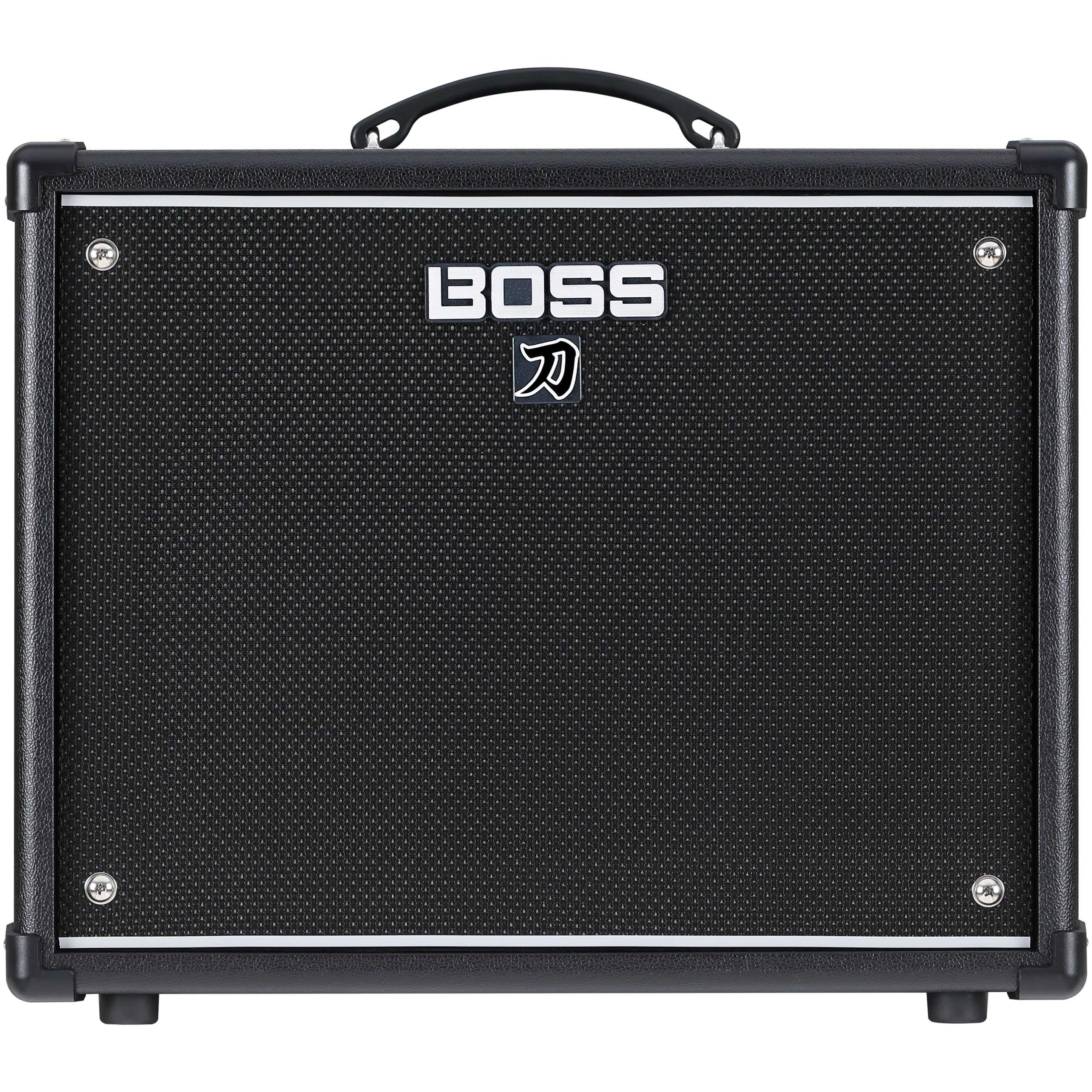
The BOSS Katana-100 Gen 3 is the logical peak of the under-$500 amp market because it solves the core problem — delivering a responsive, stage-ready 100-watt combo with a 12-inch custom speaker that convincingly mimics tube feel without the tube maintenance. The new Tube Logic enhancements include an expressive Pushed amp character that captures edge-of-breakup dynamics beautifully, while the six amp characters each have a variation expanding your palette to twelve distinct voices. At this price, no other combo amp offers this wattage, speaker size, and tonal flexibility in one package.
BOSS packed five independent effects sections — Booster, Mod, FX, Delay, and Reverb — all controllable via the free BOSS Tone Studio software. The headphone output with cab simulation is usable for silent practice, and the USB-C connectivity modernizes patch management. The 100-watt rating provides genuine clean headroom for gigging with a drummer, something even the 50-watt version cannot match. The wood enclosure adds resonance absent from plastic modeling units.
The main drawback is the extra cost for the Bluetooth adapter and foot switch, which together add roughly — a significant hidden expense if you plan to control patches wirelessly or switch channels live. A few users reported reliability issues affecting the power section across multiple units, though these appear to be outlier cases rather than widespread defects. For pure stage versatility at this ceiling, the Katana-100 Gen 3 remains the benchmark.
Why it’s great
- Genuine 100-watt clean headroom with a 12-inch speaker
- Twelve amp characters via six models and variations
- Five independent effects sections built-in
- USB-C connectivity for patch management
Good to know
- Bluetooth and footswitch sold separately (add ~)
- Occasional reports of power section failures
- BOSS Tone Studio has a learning curve
2. Valeton GP-200X
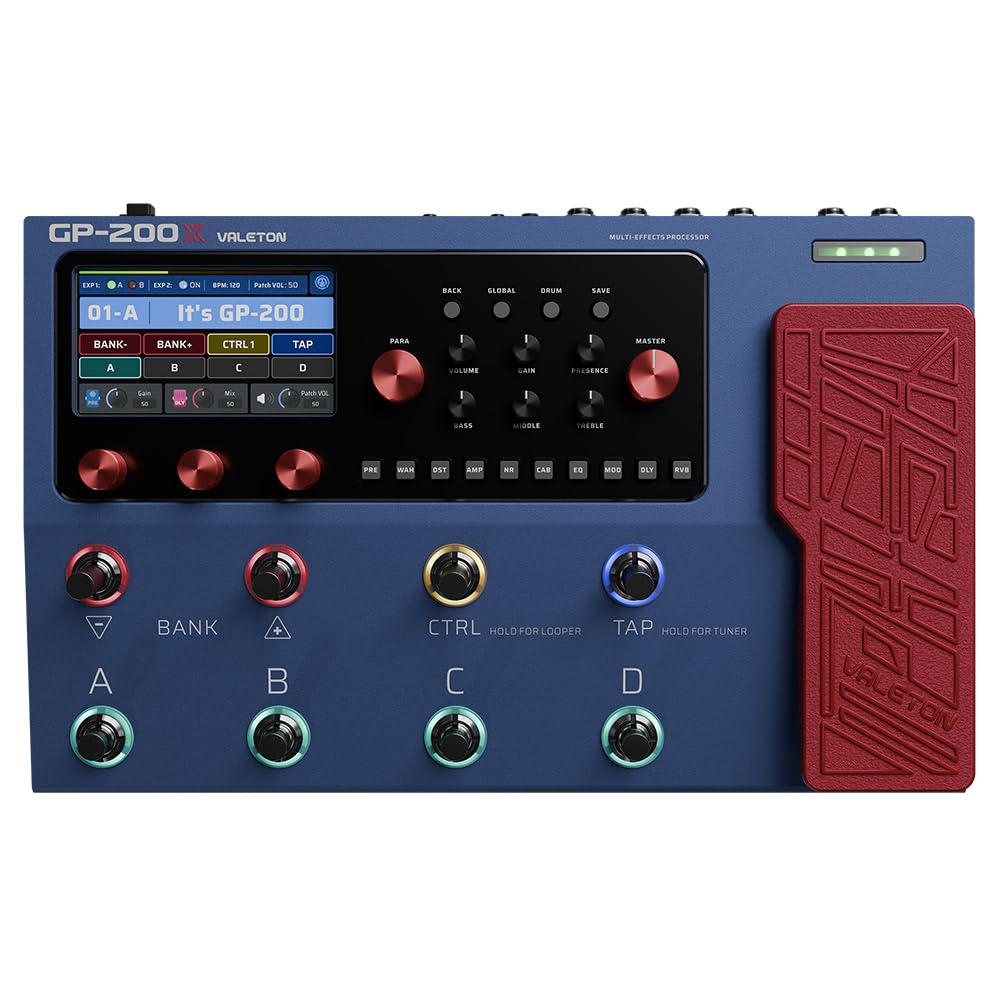
The Valeton GP-200X is a serious contender for guitarists who need a complete multi-effects solution with professional connectivity. It features over 140 built-in effects for guitar, bass, and acoustic instruments, powered by 24-bit / 44.1 kHz digital signal processing that keeps noise low and clarity high. The 45 amp models and 40 factory cabinet impulse responses give you a huge tonal palette, and the 20 user IR slots let you load your own cabinet captures for direct-to-PA or recording use. The built-in looper with 90 seconds of recording time and 100 rhythm patterns turn it into a full practice station.
Connectivity is where the GP-200X really shines for its price tier. It offers stereo outputs, an FX loop for integrating your own pedals, MIDI I/O for advanced rig control, and USB audio interface functionality for recording on computers or mobile devices via an OTG cable. The expression pedal has a smooth sweep that reviewers consistently praise, and the metal chassis feels robust enough for regular transport. The 198 total presets (99 factory, 99 user) give you a solid starting point without requiring hours of tweaking from scratch.
The downsides are specific but important. Several users reported that the company’s warranty support is unresponsive, which creates real risk if a unit fails. A few also noted difficulty exporting edited presets from the editing software, which limits customization if you want to save and share your patches. For its feature density and build quality, the GP-200X is a strong pick as long as you accept the support gamble.
Why it’s great
- 140+ effects with 45 amp models and 20 user IR slots
- Full connectivity: FX loop, MIDI, USB audio interface
- Metal chassis and smooth expression pedal
- Includes looper and 100 rhythm patterns
Good to know
- Warranty support reported as unresponsive
- Issues exporting edited presets from software
- Some rhythm patches need manual tweaking
3. Hotone Ampero MP-100

The Hotone Ampero MP-100 packs a staggering amount of processing power into a lightweight, backpack-friendly chassis. Its 4-inch dynamic color touchscreen provides fast patch navigation and parameter editing, while the 64 amp models, 60 cab models, and 100+ legendary pedal models give you access to essentially any sound you can imagine. The CDCM HD and F.I.R.E. modeling technologies deliver responsive amp feel that reacts well to picking dynamics, a rare quality at this price. The built-in looper supports up to 120 seconds of recording time, and the onboard drum machine offers 100 patterns for practice.
The Ampero’s connectivity is studio-grade: two balanced XLR outputs allow direct connection to a mixer or PA without needing a DI box, and the USB port functions as an audio interface for recording via free Mac/PC software. The three input modes optimize for electric guitar, bass, acoustic guitar, or line-level instruments, making it the rare modeler that truly works across all your instruments. At just 1.4 kilograms, it is the lightest full-featured unit in this roundup.
The touchscreen interface, while visually impressive, is not the most intuitive for deep editing — some users find menu navigation tedious compared to dedicated knob-per-function layouts. A handful of reviewers also felt the amp models, while good, sounded generically similar across different patches, lacking the distinct fingerprint of higher-end modelers like Fractal or Kemper. For portable recording and silent practice, though, the Ampero MP-100 remains a top-tier choice.
Why it’s great
- 64 amp and 60 cab models with touchscreen control
- Balanced XLR outputs for direct PA connection
- Extremely lightweight at 1.4 kg
- Three input modes for guitar, bass, and acoustic
Good to know
- Menu navigation can be unintuitive
- Some amp models sound similar to each other
- Limited I/O compared to high-end modelers
4. Orange Crush 35RT

The Orange Crush 35RT proves that analog solid-state circuitry can deliver genuinely inspiring tube-like feel when executed properly. Its 4-stage high-gain preamp, paired with a 10-inch speaker, produces a dirty channel that reviewers consistently describe as having punch, articulation, and zero of the fizzy decay that plagues lesser solid-state amps. The clean channel is good but not exceptional — it works best as a pedal platform or for low-gain styles. The 35-watt power section offers enough volume for home use, band rehearsals, and small venues without needing to push past 50% on the dial.
The feature set is thoughtfully practical: a fully buffered effects loop allows seamless integration of external pedals, a cab-sim-loaded headphone output enables silent practice, and the built-in chromatic tuner and reverb are genuinely usable. The footswitchable channels (footswitch sold separately) add live versatility, and the 3-band EQ provides adequate tone shaping. The all-metal enclosure is reassuringly solid at 25.5 pounds — not too heavy to move but heavy enough to feel roadworthy.
The stock reverb is serviceable but not inspiring — it lacks the depth and shimmer of spring reverb units. The speaker, while good for the price, may benefit from a future upgrade to a higher-quality 10-inch driver for those seeking maximum clarity at higher volumes. For guitarists who prefer a simple, tactile analog experience over digital menu-diving, the Crush 35RT delivers arguably the best dirty channel in its class.
Why it’s great
- Exceptional dirty channel with tube-like feel
- Fully buffered FX loop for external pedals
- Cab-sim headphone out for silent practice
- Built-in chromatic tuner
Good to know
- Reverb is basic and lacks depth
- Footswitch for channel switching sold separately
- Clean channel is decent but not the star
5. Zoom G6
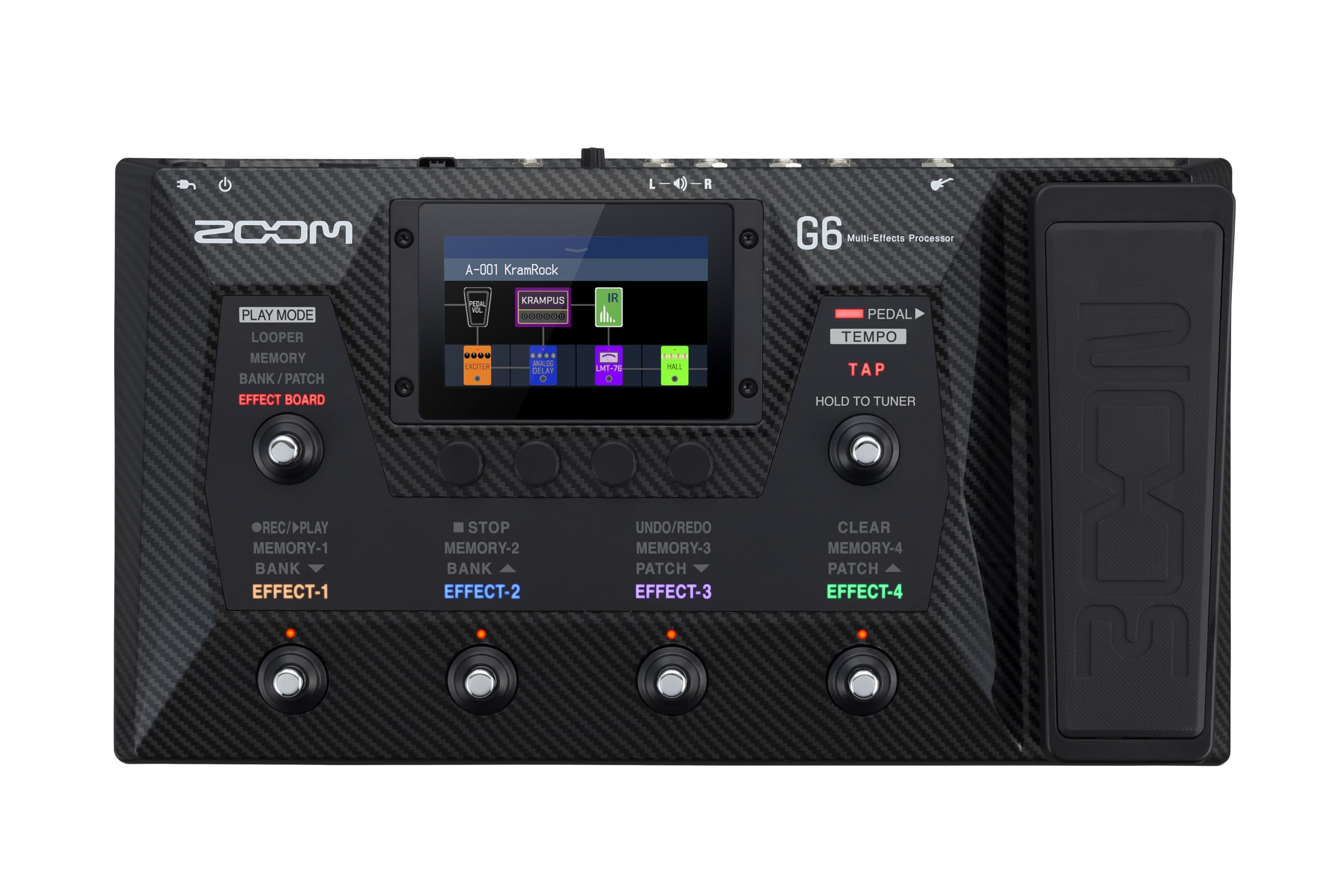
The Zoom G6 distinguishes itself with a 4.3-inch full-color touchscreen that makes patch navigation and editing feel modern and responsive. It chains up to seven effects plus amp modeling simultaneously, with 70 preloaded IRs and room for 100 more, giving guitarists a highly customizable tone-shaping platform. The four play modes — Effect Board, Bank/Patch, Memory, and Looper — adapt the interface to whether you are performing, practicing, or recording. The looper offers up to two hours of looped audio saved directly to an SD card, a feature that blows away competitors’ 30-to-90-second limits.
The Zoom G6 connects directly to your computer via USB for DAW recording and is fully compatible with Zoom Guitar Lab for downloading additional effects and managing patches. The expression pedal is built in, and the G6 supports an optional external expression pedal for expanded control. The 240 patches across four play modes offer massive preset storage for gigging musicians who need to cover multiple songs without looking at the floor.
The lack of physical knobs is the main trade-off — on-the-fly adjustments during a live set require looking at the touchscreen rather than reaching for a dedicated control. Some users noted that the G6 cannot use a standard USB-C cable for computer connection (a specific cable is needed), which adds minor friction. For guitarists who value a large, intuitive touchscreen interface and deep looping capabilities, the G6 is a compelling choice.
Why it’s great
- Large 4.3-inch color touchscreen for intuitive editing
- Up to 2 hours of loop time saved to SD card
- Seven simultaneous effects plus amp modeling
- USB DAW recording and Guitar Lab compatibility
Good to know
- No physical knobs for live on-the-fly adjustments
- USB-C cable compatibility may be picky
- Heavier than some competitors at ~6.4 lbs
6. IK Multimedia TONEX One

The IK Multimedia TONEX One is a micro-pedal that packs AI-powered tone modeling into a chassis smaller than most overdrive pedals. It loads up to 20 presets from a library of over 25,000 Tone Models captured from real amps, cabs, and pedals, and the included TONEX SE software lets you capture your own rig with surprising accuracy. The quality of the capture technology regularly receives comparisons to units costing well over , with reviewers praising the realistic transient response and attack. As a portable headphone amp powered via USB-C, it is exceptionally convenient for travel practice.
The pedal operates in Dual mode (two presets switchable via footswitch) or Stomp mode (on/off for a single preset), and includes an onboard tuner, EQ, noise gate, compressor, and reverb. The TRS mono/stereo output allows connection to real amps, PA systems, or FRFR cabinets. The customizable micro-knob colors and the ability to chain multiple TONEX One pedals for expanded control are thoughtful touches for the serious tone hunter.
The hardware UI is undeniably cramped — the tiny knobs and hidden button combos can be frustrating to navigate without the software. Some users found the out-of-box tones thin and weak outside of clean settings, requiring significant software configuration to unlock the pedal’s potential. The lack of built-in MIDI control (the larger TONEX pedal has it) limits integration into complex rigs. For the player who wants studio-grade amp captures in a pedalboard-friendly format, the TONEX One is an extraordinary value.
Why it’s great
- AI Tone Modeling rivals units costing +
- Access to 25,000+ Tone Models via included software
- Ultra-compact size fits on any pedalboard
- USB-C powered for portable headphone practice
Good to know
- Hardware UI is cramped and unintuitive
- Out-of-box tones may sound thin initially
- No built-in MIDI control
7. Orange Crush 20RT

The Orange Crush 20RT is the compact sibling of the 35RT, delivering the same signature Orange dirty channel in a 20-watt format with an 8-inch speaker. The twin-channel design with a high-gain preamp gives you that thick, British-voiced overdrive that Orange is famous for, compressed enough to sound great at bedroom volumes. The clean channel breaks up nicely when pushed, giving blues and classic rock players a natural edge without pedals. Despite its small footprint and lightweight 14.25 pounds, the 20RT is surprisingly loud and projects well for a practice amp.
The built-in chromatic tuner is accurate and convenient, saving pedalboard real estate and battery life. The aux-in and cab-sim-loaded headphone output allow silent practice with backing tracks from a phone or laptop. The simple three-band EQ and single gain/volume layout mean zero menu-diving — you plug in, twist, and play. The 8-inch speaker is adequate for practice but does not deliver the low-end authority of the 35RT’s 10-inch driver.
The stock speaker has been reported to struggle at maximum volume, with some users experiencing crackling or failure after extended use at high gain settings. Replacing it with a Jensen C8R restores clarity and headroom. The reverb is digital and basic, lacking the lushness of spring units. For a dedicated bedroom practice amp that nails the classic Orange grind, the 20RT is a focused and reliable choice.
Why it’s great
- Signature Orange dirty channel in a compact package
- Built-in chromatic tuner saves pedal space
- Aux-in and cab-sim headphone out for silent practice
- Very lightweight at 14.25 pounds
Good to know
- Stock speaker may crackle at high volumes
- Reverb is basic and digital
- 8-inch speaker lacks low-end punch for jamming
8. MOOER GE150 Pro

The MOOER GE150 Pro is the budget-friendly battery-powered multi-effects processor that prioritizes portability and immediate inspiration. Its built-in rechargeable lithium battery delivers up to 9 hours of runtime, making it the most travel-friendly unit in this roundup. The GE150 Pro features 55 amp models based on MOOER’s MNRS modeling technology, 26 high-quality cabinet simulations, and support for loading custom GNR and GIR sample files via 20 user slots each. The four multi-purpose footswitches provide flexible patch switching and control over the built-in 80-second stereo looper and 40-rhythm drum machine.
The Type-C USB interface supports OTG connectivity for direct audio recording to a mobile phone, making it exceptionally easy to capture ideas on the go. The upgraded effect chain control logic lets you use all four footswitches for live patch switching, and the global EQ ensures consistent tone regardless of venue. The included expression pedal supports both parameter control and volume control with a toe-tap feature for switching modes. At this price point, the feature density is genuinely impressive.
The expression pedal feels flimsy and bouncy compared to higher-end units, and the LCD screen is difficult to read in low-light stage conditions. The drum machine patterns lean toward basic rock beats and lack the genre variety (jazz, hip hop, reggae) that more versatile players need. Some users reported initial software connectivity issues that required firmware updates to resolve. For the traveling guitarist who needs an all-in-one practice and recording solution on a tight budget, the GE150 Pro is a smart, capable choice.
Why it’s great
- 9-hour rechargeable battery for portable use
- 55 amp models with MNRS modeling and 20 IR slots
- OTG USB recording to mobile phone
- Built-in looper, drum machine, and chromatic tuner
Good to know
- Expression pedal feels flimsy
- LCD screen is hard to read in low light
- Drum patterns lack genre variety
9. SONICAKE Matribox II

The SONICAKE Matribox II is the lowest-priced unit in this roundup but refuses to compromise on essential features. It packs 200+ built-in effects with 63 legendary amp models and 61 carefully selected IR cabinet simulations, plus 15 user IR slots for custom cabinet captures. The inclusion of an FX loop — a feature absent on many competing units like the MOOER GE150 and Nux MG-300 — makes the Matribox II a serious option for players who want to integrate their existing pedal collection into the modeling chain. The adjustable signal chain supports up to 10 simultaneous effect blocks, giving you immense flexibility for complex signal routing.
The Matribox II functions as a stereo USB audio interface with OTG support for direct mobile recording, and the free Mac/Windows software allows sound editing and preset management. The 198 presets (99 factory, 99 user) provide ample storage, and the 100 built-in drum rhythms with a 90-second looper make it a complete practice station. The solid build quality and intuitive layout have earned consistent praise for punching well above its price class.
The effects sound “good but not great” according to several users, and the amp/cab models, while impressive for the price, do not reach the fidelity of the TONEX One or BOSS Katana. The lack of a power switch is an odd omission, and the specified 1A power draw is significantly higher than the actual 260mA draw, indicating some inefficiency in the design. For the budget-conscious player who absolutely needs an FX loop and a massive effects library, the Matribox II is the smartest entry point.
Why it’s great
- Includes an FX loop — rare at this price
- 200+ effects with 63 amp models and 61 IRs
- USB audio interface with OTG mobile recording
- Lowest price point with excellent build quality
Good to know
- Effects quality is good, not mind-blowing
- No power switch on the unit
- Actual current draw lower than spec’d 1A
FAQ
Can a modeling processor replace a real amp for gigging?
Is a 20-watt amp loud enough to play with a drummer?
What does the number of amp models actually mean for my sound?
Do I need a footswitch for the Orange Crush 35RT?
Why do some multi-FX units have higher current draw specs than actual usage?
Final Thoughts: The Verdict
For most users, the guitar amp under $500 winner is the BOSS Katana-100 Gen 3 because it combines stage-ready wattage, a full-size 12-inch speaker, versatile modeling, and proven reliability in a package that genuinely sounds and feels like a tube amp. If you prefer the immediacy of analog tone and want the best dirty channel in the class, grab the Orange Crush 35RT. And for complete tonal flexibility with professional connectivity at a lower weight, nothing beats the Valeton GP-200X.