
Dialing in a guitar tone that cuts through a dense mix without collapsing into mush is the central battle of live performance. A boost pedal offers the solution — a dedicated signal amplifier that pushes your amp’s front end harder, raises your volume floor for solos, or simply adds the right harmonic texture to your clean tone. The challenge lies in picking the right flavor of boost: transparent, colored, mid-focused, or multi-voiced.
I’m Mohammad Maruf — the founder and writer behind Drink4Good. After analyzing circuit designs, customer feedback, and real-world application notes across dozens of booster and preamp pedals, I’ve built this guide around the specific specs and sonic signatures that separate a useful tool from a board-wasting one.
Whether you need a transparent signal lift for single-coil cleans or a harmonically rich push for dirt pedals, choosing the right guitar boost pedal comes down to understanding gain structure, buffer type, and mode flexibility — not just turning one knob louder.
How To Choose The Best Guitar Boost Pedal
A boost pedal’s job sounds simple — make your signal louder — but the circuit topology determines whether that loudness preserves your tone, colors it, or adds new harmonics. The three core considerations are headroom (measured in dB), voicing (transparent vs. mid-forward vs. preamp-style), and buffer implementation. A pedal that offers 30 dB of clean gain behaves very differently from one that caps at 15 dB with hard clipping. Likewise, a boost that shapes your EQ can help a bridge pickup sing or, if applied incorrectly, make a neck position sound honky. Always match the pedal’s character to your amp’s natural compression point and your band’s frequency space.
Headroom (dB) and Gain Structure
Headroom refers to how much clean gain the pedal can deliver before the signal distorts. Pedals offering 20 dB or more of clean boost are ideal for pushing a tube amp’s power section into natural breakup without altering your core tone. Lower-headroom designs (under 15 dB) often introduce their own clipping, which can be desirable if you want a colored overdrive interaction. For maximum flexibility in a pedalboard setup, look for at least 25 dB of clean range plus a separate gain or saturation control.
Voicing: Transparent, Mid-Focused, or Preamp-Style
Transparent boost pedals aim to leave your EQ untouched — they simply add volume. Mid-focused boosters (often called “sweet” boosters) emphasize the upper-midrange frequencies where electric guitars naturally sit, helping solos punch through a mix without sounding harsh. Preamp-style boosters emulate the input stage of a specific vintage effect or recording console, adding harmonic coloration that interacts with your amp’s preamp in musical ways. If you run a lot of dirt pedals, a transparent boost generally stacks cleaner. If you compete with a keyboard player or a second guitarist for midrange space, a mid-focused booster is the smarter choice.
Buffer and Input Impedance
A boost pedal with a high-quality buffer prevents signal degradation over long cable runs and after many true-bypass pedals. Input impedance above 500 kΩ ensures your guitar’s pickups — especially single-coils — retain their high-end sparkle. Some premium boosters offer selectable buffer types (standard vs. vintage) to fine-tune the interaction with your amp. If you plan to place the pedal at the very start of your chain, a low-noise buffer becomes as important as the boost itself.
Quick Comparison
On smaller screens, swipe sideways to see the full table.
| Model | Category | Best For | Key Spec | Amazon |
|---|---|---|---|---|
| Keeley Mini Katana | Clean Boost | Maximum clean headroom & hidden gain mode | 35 dB boost | Amazon |
| BOSS BP-1W | Preamp Booster | Vintage preamp simulation & variable buffer | 3 selectable voicings | Amazon |
| Xotic Super Sweet Booster | Mid‑Boost | Cutting through a dense live mix | Mid‑frequency EQ shaping | Amazon |
| MXR Micro Amp | Clean Boost | Simple, one‑knob clean boost for any rig | Single‑gain control | Amazon |
| Fender Hammertone Boost | Dual‑Mode Boost | Switching between opamp & JFET tonalities | 2‑band active EQ | Amazon |
| EarthQuaker Devices Arrows V2 | Preamp Booster | Driving dirt pedals into new gain territories | Single‑knob boost/cut | Amazon |
| MXR Distortion+ | Colored Boost | Vintage soft‑clipped distortion & boost combo | Germanium‑powered clipping | Amazon |
In‑Depth Reviews
1. Keeley Mini Katana Clean Boost Pedal

The Keeley Mini Katana delivers a staggering 35 dB of clean boost — enough to push even the most headroom-resistant tube amp into natural overdrive. Many transparent boosters cap out around 20 dB, so this headroom is genuinely category-leading. It also hides an internal Hi-Gain dip switch that flips the pedal into a thickened, creamy overdrive mode, plus a Hi-Cut switch that tames the treble bite of single-coil guitars. The result is a boost that doubles as an always‑on tone shaper or a standalone overdrive when needed.
User feedback consistently praises its transparent, uncolored character in standard mode — the pedal does not add unwanted treble or midrange bump. Reviewers note it works beautifully on both electric and acoustic rigs, and the compact enclosure fits even cramped pedalboards. The large output knob makes on‑the‑fly adjustments easy during a set. Battery access is straightforward, and the 9V power draw of 30 mA is modest for its capability.
Where the Mini Katana truly shines is its flexibility: you get a transparent clean boost, a voiced overdrive, and a treble-cut option all in one small chassis. The only compromise is that the Hi-Gain and Hi-Cut switches are internal, so you need to remove the backplate to change them mid‑session. For most players, these are set‑and‑forget tweaks. For the clean‑boost purist who occasionally wants grit, this pedal is an exceptional value.
Why it’s great
- Massive 35 dB clean headroom for any amp
- Internal Hi‑Gain switch adds overdrive versatility
- Compact footprint and large volume knob
Good to know
- Gain and cut switches require opening the chassis
- No external EQ or buffer selection
2. BOSS BP-1W Booster/Preamp

The BOSS BP-1W is a Waza Craft pedal that gives you three distinct preamp voices derived from classic BOSS and Roland gear: CE mode (bright, bell‑like preamp of the CE‑1 Chorus Ensemble), RE mode (fat, warm preamp of the RE‑201 Space Echo), and NAT mode (a natural, transparent clean boost). Beyond the voicings, it offers a selectable standard or vintage input buffer, letting you dial in exactly how the pedal interacts with your amp’s input stage.
Reviews highlight the BP-1W as an always‑on tone shaper that adds subtle body and richness without feeling obtrusive. The gain knob introduces saturation gradually — from a barely‑there warmth to a pushed, gritty edge — while the Level knob gives substantial volume control for solos. Build quality is typical BOSS: a rugged metal chassis that will survive years of touring. The relay‑based true bypass with auto‑bypass on power loss is a thoughtful touch.
The biggest advantage here is versatility: one pedal can function as a transparent boost, a vintage‑voiced preamp, or a harmonic coloration tool. The only potential drawback is that the voicing modes are not continuously variable — you pick CE, RE, or NAT. If you simply want a one‑knob clean boost and nothing else, a simpler pedal may suit you better. But for the player who wants a premium, multi‑character booster, the BP-1W is hard to beat.
Why it’s great
- Three iconic preamp voicings in one pedal
- Selectable buffer types for amp matching
- Rugged BOSS build with five‑year warranty
Good to know
- Voicings are fixed, not continuously variable
- Higher price point than single‑mode boosters
3. Xotic Super Sweet Booster Mini Boost Pedal
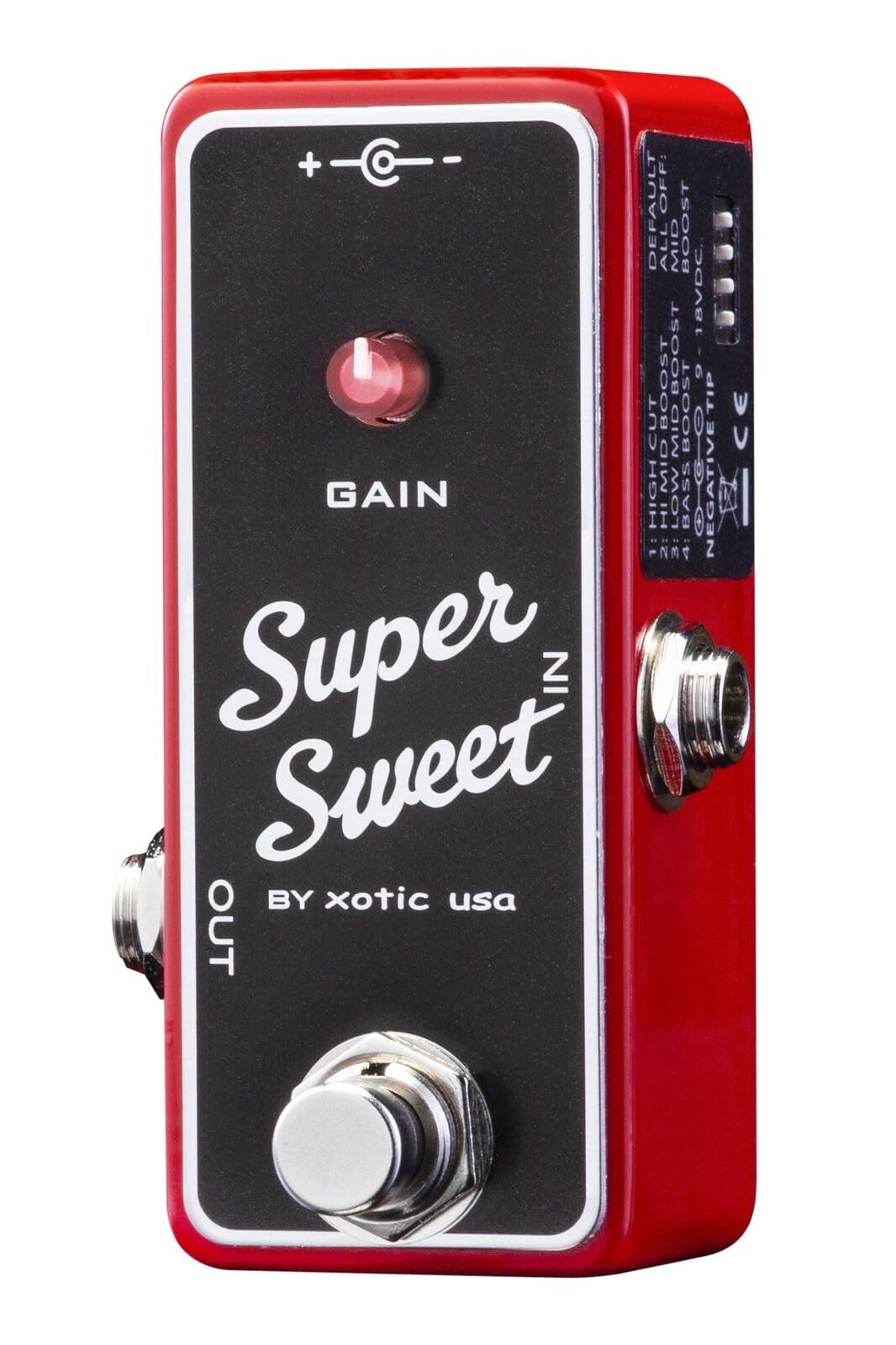
The Xotic Super Sweet Booster solves a specific problem: standard single‑knob clean boosts often sound harsh and thin when pushed high, because they boost every frequency uniformly. The SSB applies a musical mid‑frequency emphasis that helps your guitar cut through a full band mix without becoming ice‑picky. It is essentially a clean preamp with a carefully voiced EQ curve that sits the guitar right in the sweet spot of the frequency spectrum.
Players who have tested it in live settings consistently report that solos become instantly audible without having to crank the master volume to uncomfortable levels. The internal dip switches allow fine‑tuning of the boost frequency and low‑end content, which partially addresses the limited external controls. Build quality is solid — the all‑metal enclosure and top‑mounted jacks are board‑friendly — and the 10 mA current draw is minimal.
The main trade‑off is that the knob has a rapid taper: many users note that past 9 o’clock the volume jumps significantly, making fine adjustment tricky. The small knob size also makes foot adjustments less precise on a dark stage. If you primarily use a boost as a set‑and‑forget solo tool and value midrange focus over flat transparency, the Super Sweet Booster is a smart choice. If you need a subtle, continuously variable clean lift, look toward a pedal with a slower taper.
Why it’s great
- Voiced mid‑boost cuts through any mix
- Internal dip switches for frequency tweaking
- Compact, top‑mounted jack design
Good to know
- Knob taper is fast, making small adjustments tricky
- Small control size limits on‑stage precision
4. MXR Micro Amp

The MXR Micro Amp is the archetypal clean boost pedal — a single knob, pure analog circuit, no voicing switches, no buffers to configure. It simply takes your signal and amplifies it linearly. At unity gain it adds sparkle and thickness to a clean tone; cranked, it drives a non‑master‑volume Fender amp into natural power‑tube distortion. Bass players also love it: the transparent boost makes closed‑back combos feel significantly louder without altering the low‑end character.
Customer reviews consistently note how quiet the pedal is — no added hiss or hum — and how effective it is at pushing an amplifier’s front end while preserving the original EQ. Many players use it as an always‑on signal fattener or as a solo volume spike placed after overdrive pedals. The chassis is the classic MXR box: robust, road‑ready, and simple enough to operate blind. Power can come from a 9V battery or a standard DC adapter.
The limitation is obvious: it does one thing and one thing only. There is no EQ shaping, no gain mode switch, and no buffer selection. For a player who wants a modular, multi‑voiced boost, the Micro Amp will feel too basic. But for the working guitarist who needs a dead‑simple, reliable, and transparent volume lift that has been a studio and stage staple for decades, the Micro Amp remains a benchmark.
Why it’s great
- Dead‑simple one‑knob operation
- Absolutely transparent — no tonal coloration
- Proven durability and low noise floor
Good to know
- No EQ shaping or voicing options
- Fixed buffer type, cannot be changed
5. Fender Hammertone Boost
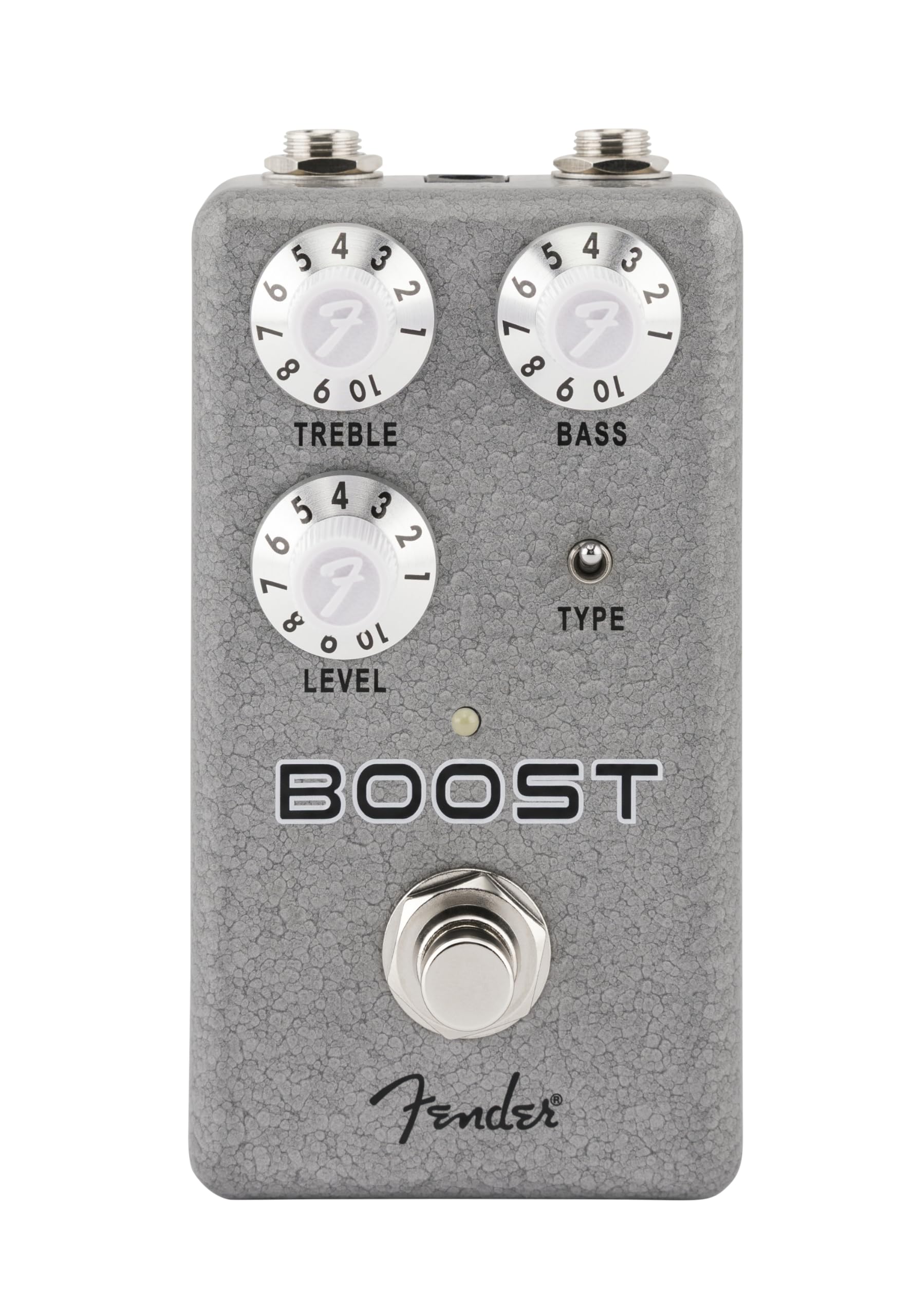
The Fender Hammertone Boost stands out by giving you two distinct boost circuits in one enclosure: an ultra‑clean opamp mode and a harmonically richer JFET mode. An active two‑band Bass and Treble EQ with center detents lets you shape the boosted signal beyond just volume — you can cut low end to tighten a flubby amp, or add treble to make a dark neck pickup sparkle. This is a rare feature set at its price tier.
Users appreciate the “road‑ready” aluminum enclosure and top‑mounted jacks, which simplify pedalboard layout. The soft‑touch relay true bypass is silent and includes auto‑bypass when power is removed, a thoughtful design detail. In practice, the opamp mode delivers a pristine, transparent lift suitable for pushing clean amps, while the JFET mode introduces a mild, musical compression that makes single‑note lines sing. The EQ controls have a wide sweep but maintain a flat response at the center detent, making it easy to dial in subtle corrections.
The only real drawback is its physical size — at 5.1 x 3.25 inches, it is larger than mini‑boosters like the Keeley Katana Mini. On a crowded board, that footprint matters. Also, the JFET mode is not a high‑gain overdrive; it is a subtle tonal coloration rather than a distortion generator. If you need a compact, feature‑rich boost that doubles as an EQ tool, the Hammertone is a compelling option.
Why it’s great
- Two boost voicings (opamp and JFET) in one pedal
- Active bass and treble EQ with center detents
- Soft‑touch relay true bypass with auto‑bypass on power loss
Good to know
- Larger enclosure than mini‑boost alternatives
- JFET mode is subtle, not a high‑gain mode
6. EarthQuaker Devices Arrows V2 Preamp Booster
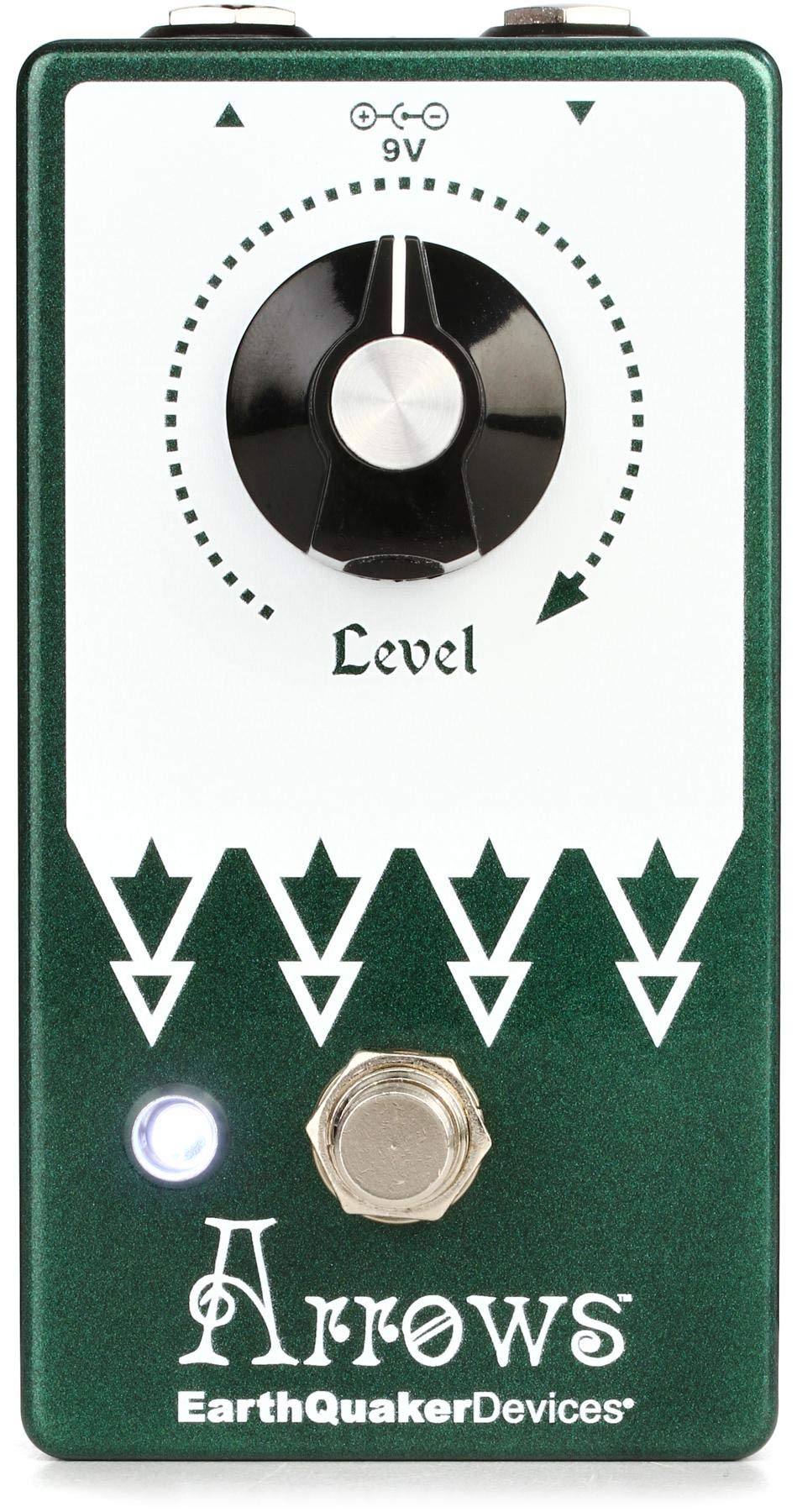
The EarthQuaker Devices Arrows V2 is a preamp booster designed primarily to interact with dirt pedals. Its all‑discrete analog circuit boosts the midrange, tightens the low end, and enhances top‑end clarity — effectively adding a new channel of gain to any overdrive or fuzz pedal placed after it. Bass‑heavy fuzz pedals gain articulation, and light overdrives bloom into thick sustaining tones that were previously out of reach.
The new V2 enclosure features top‑mounted jacks and silent relay‑based switching, addressing the ergonomic shortcomings of the original. The single control is no‑nonsense: it either boosts or cuts your signal, and the shift from cut to boost is smooth and musical. Even used alone into a clean amp, the Arrows adds a noticeable “pop” to the signal — it makes the guitar feel more present and immediate without sounding harsh.
The Arrows V2 is not a transparent boost. It deliberately shapes your EQ, particularly in the midrange, which is excellent for driving pedals but may not suit players who need a perfectly flat frequency response. Additionally, the single knob limits fine volume adjustment compared to a pedal with separate gain and level controls. If your goal is to push dirt pedals into new sonic territories, the Arrows is purpose‑built. If you need a pure clean boost, look elsewhere.
Why it’s great
- Tailored to maximize dirt pedal performance
- Silent relay switching and top‑mounted jacks
- Boosts midrange and tightens low end
Good to know
- Not transparent — noticeable EQ shaping
- Single knob limits fine volume control
7. MXR Distortion+

The MXR Distortion+ is not a pure boost pedal — it is a germanium‑powered, soft‑clipped distortion unit that can function as a colored boost when used strategically. Its two‑knob layout (Output and Distortion) allows it to be dialed in for a slight breakup or a full‑on distortion, making it a hybrid tool. Many players, particularly fans of vintage hard rock and Rush tones, use it as a boost in front of a clean amp to create a classic, mid‑focused crunch.
Reviewers consistently praise its ease of use and its ability to replicate the tones of late‑70s and early‑80s rock. The output knob has enough range to push an amp’s front end significantly, and the distortion knob, when turned down, yields a subtle, warm overdrive that thickens single‑note lines. The build quality is legendary — these pedals are known to survive decades of abuse. The 9 mA current draw is among the lowest of any pedal.
The Distortion+ is not a transparent clean boost. Its germanium clipping adds a distinct coloration, and the distortion character is not suitable for high‑gain metal. It also lacks a buffer, so long cable runs may affect high‑frequency content. If you want a vintage‑voiced distortion that can double as a light boost, this is an iconic choice. If your primary need is clean, uncolored volume, a dedicated clean boost pedal is a better fit.
Why it’s great
- Classic germanium distortion with boost capability
- Very low power draw (9 mA)
- Indestructible build with decades of proven reliability
Good to know
- Not a clean boost — adds distinct coloration
- No buffer; can affect tone over long cable runs
FAQ
Can I use a boost pedal as an always‑on tone shaper?
What is the difference between a boost pedal and an overdrive pedal?
Where should I place a boost pedal in my signal chain?
Do I need a boost pedal if my amp already has a lot of headroom?
Final Thoughts: The Verdict
For most users, the guitar boost pedal winner is the Keeley Mini Katana because it delivers the highest clean headroom (35 dB) in a compact form factor, plus hidden overdrive and treble‑cut switches that add genuine versatility beyond a one‑trick boost. If you want vintage preamp flavors and a selectable buffer, grab the BOSS BP-1W. And for a mid‑focused solo boost that cuts through any mix, nothing beats the Xotic Super Sweet Booster.