
You plug in, stomp on your board, and something is missing. That bite, that sparkle, the raw clarity you chase — it’s gone, swallowed by a chain of true-bypass pedals and a thirty-foot cable run. A guitar buffer pedal is the lone component designed to do one thing: restore your instrument’s high-end frequency and dynamic response, making your rig sound as immediate as a straight-into-the-amp connection, regardless of how many effects are in the path.
I’m Mohammad Maruf — the founder and writer behind Drink4Good. My market research focuses on the signal-integrity battle that every pedalboard faces, analyzing how buffer impedance, current draw, and placement within the chain actually affect the final tone you hear through your cabinet.
Choosing the right buffer means understanding input impedance, true bypass vs. buffered bypass interactions, and whether you need a dedicated unit or a multi-function pedal. This buying guide cuts through the noise to help you identify the best guitar buffer pedal for your specific rig, whether you’re a weekend warrior or a touring professional.
How To Choose The Best Guitar Buffer Pedal
Every foot of cable and every true-bypass pedal you add introduces capacitance that acts like a low-pass filter, rolling off your precious high end. A buffer converts your guitar’s high-impedance signal to a low-impedance signal, driving long cable runs and multiple pedal inputs without that tone-suck. The key is knowing what spec actually matters for your board.
Input Impedance: How High Is High Enough?
The input impedance of your buffer (or the first pedal in your chain) interacts directly with your guitar’s pickups. A very high input impedance (1 MΩ or above) preserves the natural resonant peak of passive pickups, keeping your tone bright and punchy. If you use active pickups, this matters less because they already output a low-impedance signal.
Placement: Start, End, or Sandwich?
A single buffer placed at the very beginning of your signal chain solves most cable-run issues. If you have a massive board with 15+ true-bypass pedals, consider a ‘sandwich’ — one buffer at the start and one at the end. Some players also run a buffer in the effects loop of their amp to combat long patch cable runs between the preamp and power amp.
Dedicated Buffer vs. Multi-Function Pedal
A dedicated buffer pedal is small, always-on, and does one job perfectly. Multi-function pedals like a tuner with a built-in buffer (e.g., the TC Electronic PolyTune 3) offer space savings but introduce extra circuitry. For pure signal integrity, a dedicated unit is often the quieter, more transparent choice.
Quick Comparison
On smaller screens, swipe sideways to see the full table.
| Model | Category | Best For | Key Spec | Amazon |
|---|---|---|---|---|
| Empress Buffer+ | Premium | Pro boards with noise issues | Integrated noise filter & clean boost | Amazon |
| TC Electronic PolyTune 3 Noir | Premium | Tuner & buffer in one mini pedal | Selectable analog buffer & true bypass | Amazon |
| Truetone CSPT Pure Tone Buffer | Premium | Transparent, neutral signal recovery | Unity gain with slight gain bump | Amazon |
| MOOER Audiofile | Mid-Range | Headphone practice & signal buffering | Class A headphone amp + cab sim | Amazon |
| JHS Little Black Buffer | Mid-Range | Low-profile always-on board integration | Hi-Z to Lo-Z conversion | Amazon |
| JOYO D57 Buffer | Budget | Budget dual-buffer with bonus boost | Dual buffer groups + 20dB boost | Amazon |
| Moskyaudio Mini Clean Buffer | Budget | Ultra-minimalist budget fix | Zinc-alloy body, always-on design | Amazon |
In‑Depth Reviews
1. Empress Buffer+ I/O Interface Pedal
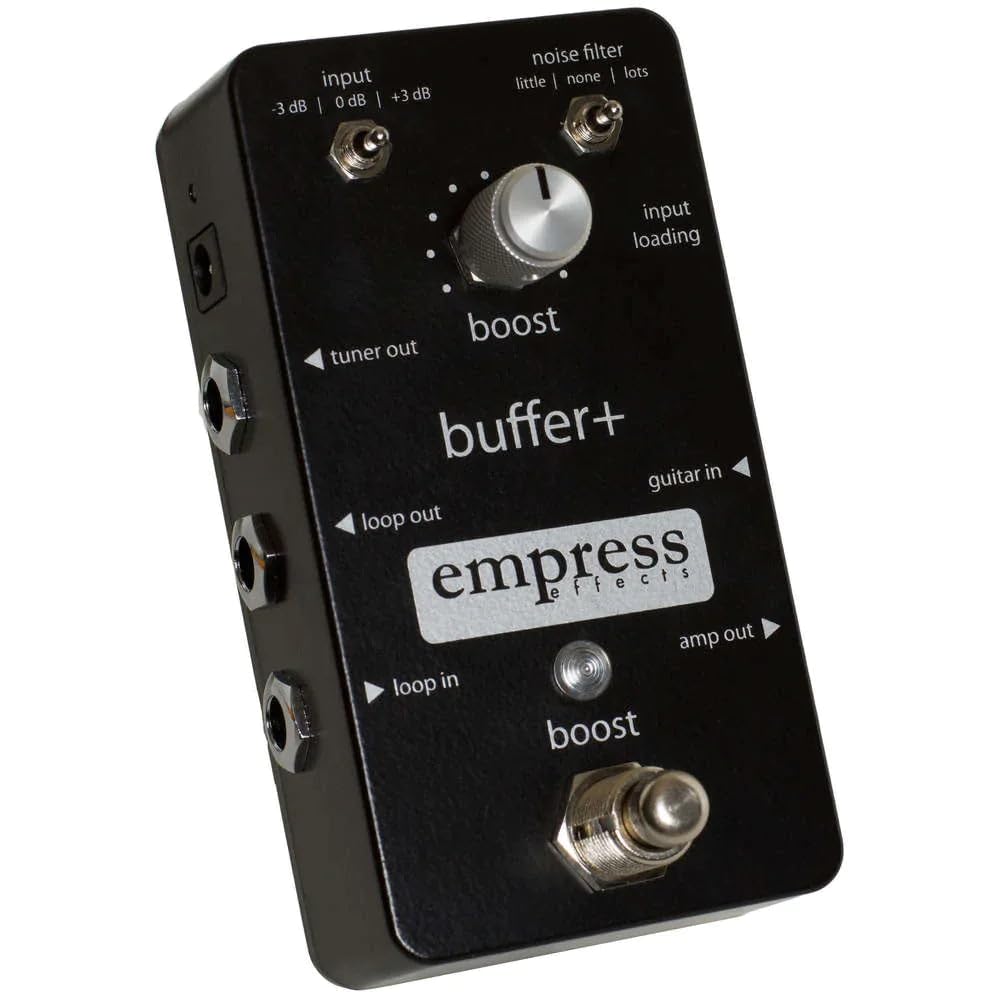
The Empress Buffer+ is the Swiss Army knife of the category, tackling signal buffering, noise suppression, and clean boost in a single compact enclosure. The onboard noise filter is particularly effective at taming hum from single-coil pickups or dodgy venue power without the abrupt gate-like feel of standard noise suppressors. This is a pedal designed for the player who demands every link in the chain to be pristine.
The clean boost section operates after the buffer, delivering up to 20dB of gain that works beautifully as a solo volume lift when placed at the end of your chain. The tuner mute footswitch is another practical addition, silently tuning your guitar without hitting your tuner’s bypass button. The ‘Hold to Mute’ function is intuitive for live use, though the tight spacing of the input/output jacks and power plug can be a nuisance on crowded boards.
With a current draw of 300 milliamps, this is not a pedal you can daisy-chain on a cheap power supply — it demands an isolated output. But for the pro who needs a buffer, noise gate, and boost without three separate units, the Empress Buffer+ is a clear winner. The build quality is exceptional, and the sonic transparency is exactly what a neutral buffer should deliver.
Why it’s great
- Combines buffer, noise gate, and clean boost in one pedal
- Noise filter is transparent and effective
- Sturdy build with great switching feel
Good to know
- Jacks and power input are tightly packed
- Higher current draw needs a dedicated power outlet
- Premium price reflects the multi-function capability
2. TC Electronic PolyTune 3 Noir Mini

The PolyTune 3 Noir is a two-in-one powerhouse, combining the industry-standard polyphonic tuner with a selectable analog buffer circuit. The buffer itself is well-implemented, maintaining signal integrity and offering a noticeable clarity boost when engaged, especially for boards with five or more pedals. The ‘selectable’ nature is key — you can run it in true-bypass mode if the buffer interferes with a vintage fuzz placed before it, or engage the buffer when you need the high-end restoration.
The mini form factor is a lifesaver for cramped boards, measuring just 1.77 inches square. The Noir finish is sleek and resists scuffs better than the standard white version. Accuracy is stellar, handling drop tunings like Drop C# with ease, and the display is readable even from a standing position on a floor-based board. The strobe mode is particularly useful for precise intonation adjustments during setup.
Polyphonic tuning allows you to strum all six strings and see which are sharp or flat at a glance, speeding up between-song tuning on stage. The downside is that the buffer circuit is always active when the pedal is in ‘buffer’ mode — it cannot be toggled on/off independently of the tuner. It’s a fantastic solution for the player who needs one less pedal on the board without sacrificing tone.
Why it’s great
- Combines a tuner and buffer in one mini pedal
- Highly accurate polyphonic and strobe tuning modes
- Selectable true bypass or buffered operation
Good to know
- Buffer cannot be engaged separately from the tuner
- Mini size can be tricky to stomp on in the dark
- No additional features like a mute output
3. Truetone CSPT Pure Tone Buffer
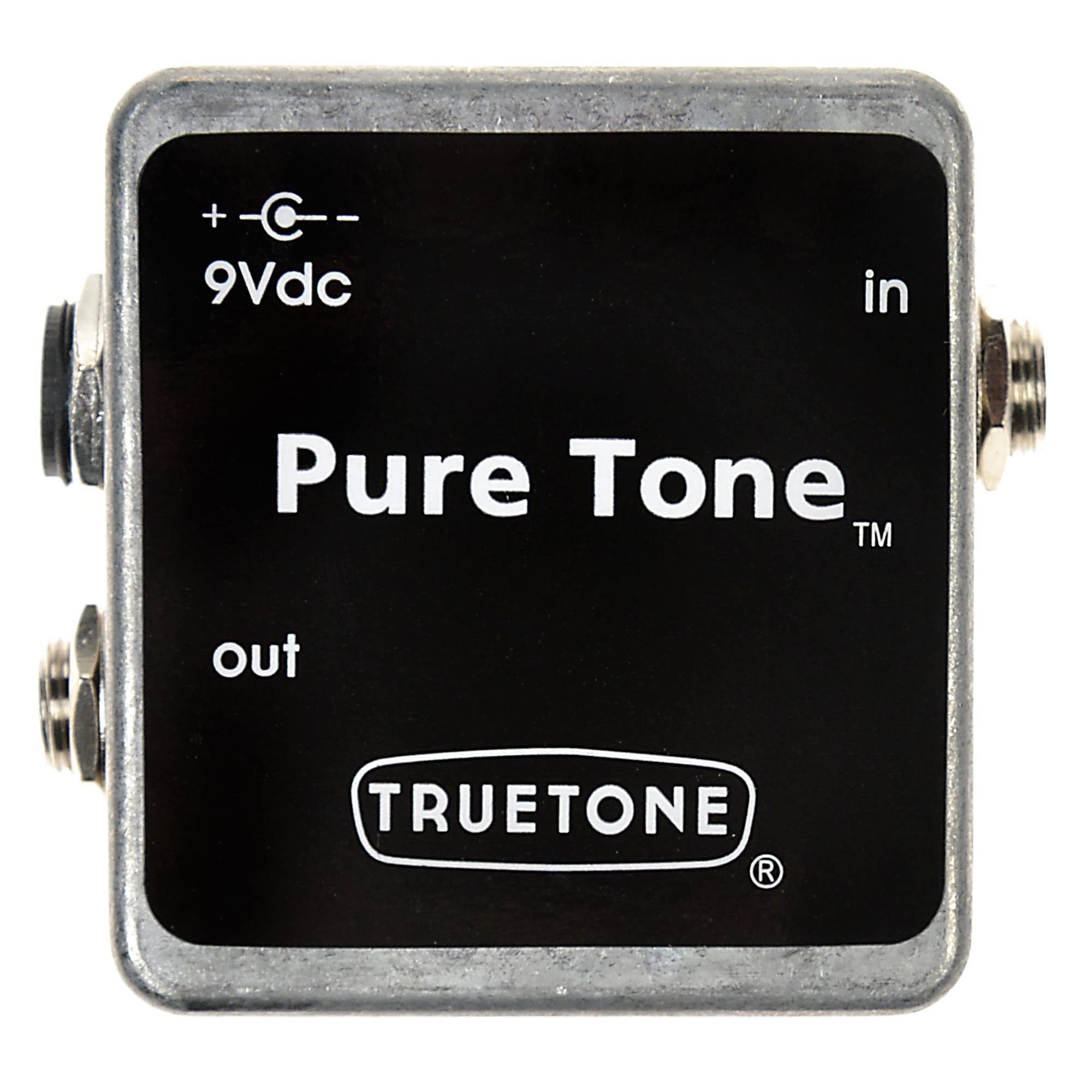
The Truetone CSPT is the benchmark for a no-frills, transparent buffer. Its sole purpose is to restore your high-end frequencies without adding any coloration of its own, and it does so masterfully. Users consistently report a ‘wow’ moment when engaging this pedal — muddiness from long chains or true-bypass effects vanishes, revealing clarity and articulation they didn’t realize was missing.
This buffer does impart a very slight gain bump over unity, which can be useful for pushing the front end of your amp slightly harder. However, some players who run a perfectly level signal chain may need to adjust their amp’s input gain to compensate. It lacks any controls — no switches, no knobs — which is exactly the point. It is an always-on device designed to be hidden under your board.
Weighing just 3.52 ounces and fitting in the palm of your hand, the CSPT is easy to mount with Velcro or zip ties in any nook. The build quality is solid, with top-mounted jacks for a cleaner cable layout. For , it competes directly with buffers costing twice as much, making it a smart choice for the player who wants the purest signal path possible without paying for extras they don’t need.
Why it’s great
- Completely transparent, neutral sound profile
- Tiny footprint fits anywhere on the board
- Dramatically restores lost high-end clarity
Good to know
- Slight unity gain bump may require amp adjustment
- No additional features like a power filter
- Always-on design — no bypass option
4. MOOER Audiofile Micro Guitar Pedal

The MOOER Audiofile is a clever anomaly in this list — it is primarily a Class A headphone amplifier that also serves as a signal buffer and clean boost. This makes it an excellent choice for the bedroom or apartment player who needs silent practice but also wants the benefit of a buffer in their chain. The analog Class A amplification circuit preserves the warmth and dynamics of your setup, delivering a satisfying sound through headphones without the need for a separate amp modeler.
It features both stereo and mono inputs, with stereo and mixed mono outputs, giving you flexibility for stereo effects rigs. The built-in analog speaker cabinet simulation is subtle but effective, smoothing out harsh high frequencies that can be fatiguing through headphones. When used as a buffer, the footswitch engages the boost function, offering a clean volume lift that works well for solos or pushing amp front ends.
There have been reports of the unit failing after a few months, which is concerning for reliability as a permanent board fixture. The 3.5mm headphone jack is fine for home use, but the 6.35mm input/output jacks feel solid. For the player who prioritizes silent practice and occasional live use, the dual functionality is hard to beat at the price point.
Why it’s great
- Dual purpose: headphone amp and signal buffer
- Analog Class A circuit sounds warm and dynamic
- Small footprint saves board space
Good to know
- Some units have experienced reliability issues
- Headphone output is 3.5mm, not 1/4 inch
- Not designed for high-volume live use as a buffer
5. JHS Pedals Little Black Buffer

The JHS Little Black Buffer is the gold standard for a no-nonsense, always-on buffer that prioritizes pure signal conversion. It takes your guitar’s high-impedance signal and converts it to a low-impedance signal, allowing it to drive long cable runs (over 50 feet) and extensive pedal chains without any noticeable degradation. The effect is immediate and obvious — your highs come back, your dynamics feel responsive, and your tone sounds like you’re plugged straight into the amp.
Its low-profile enclosure is specifically designed to be mounted underneath a pedalboard, keeping it out of sight and out of mind. The black powder coating ensures it blends in with the rest of your gear. It is a truly ‘set and forget’ pedal — no controls, no switches, just a single input and output jack. The current draw is a modest 100 milliamps, making it easy to power alongside other pedals on a standard supply.
Players with massive boards containing 15-20 true-bypass pedals report a restoration of clarity that feels like an entirely new guitar. It is also effective when placed in an amp’s effects loop to combat signal loss from the preamp to the power section. The only real ‘con’ is its price relative to budget mini buffers, but for the reliability and sonic transparency, the JHS is a standard bearer.
Why it’s great
- Exceptional high-impedance to low-impedance conversion
- Low-profile design fits under any pedalboard
- Pro-level build quality and reliability
Good to know
- More expensive than some basic mini buffers
- No additional features like a boost or noise gate
- Always-on design, so plan your power supply accordingly
6. JOYO D57 Buffer Pedal

JOYO’s D57 offers a unique dual-buffer architecture that sets it apart from many competitors. It contains two separate buffer groups — the ‘In Buffer’ is designed to be placed at the start of your chain for optimal guitar-to-pedal interface, while the ‘Out Buffer’ sits at the end of the chain to drive your amp’s input. This all-in-one approach is perfect for players who want a sandwich configuration without buying two separate pedals.
On top of the dual buffering, the D57 includes a footswitch-activated clean boost with a generous 20dB gain range. The boost circuit is clean and transparent, making it useful for solo volume jumps or pushing an overdriven amp further. The paint spraying technology results in a durable, state-of-the-art finish that resists scratches from stomping and transportation.
Some reviews mention the modulation feature as unnecessary, but for a buffer/boost combo, this is largely a non-issue. The true-bypass design ensures that when the pedal is off, your signal path remains completely passive. The main caveat is the physical size — it is larger than mini buffers, which may be a concern on a tight board, but the dual functionality justifies the footprint for many players.
Why it’s great
- Two independent buffer sections for full coverage
- 20dB clean boost adds practical versatility
- Durable paint finish and solid metal housing
Good to know
- Larger than single-purpose mini buffers
- Boost circuit may add noise at extreme settings
- Some features feel unnecessary for a buffer pedal
7. Moskyaudio Mini Clean Buffer

The Moskyaudio Mini Clean Buffer is a no-frills, ultra-affordable entry into the buffer game, designed for players on a tight budget who still want to tackle tone loss. Its zinc-aluminum alloy body is remarkably durable for the price, and the mini footprint (3.5 x 1.4 x 1.2 inches) means it can slide into any gap on your board. The single footswitch controls the on/off state, indicated by a clear LED.
Performance-wise, it delivers a noticeable restoration of high-end clarity and overall punch, performing admirably for basic signal recovery. Users with 4-5 pedals in their chain report a significant improvement in sound quality, comparing it favorably to more expensive units. However, it is worth noting that some users have reported the unit failing after a few months of use, which introduces a reliability concern for gigging musicians.
This buffer is best suited for the hobbyist or bedroom player who needs an inexpensive solution for a small pedalboard. It does not add any coloration, and the pure signal path keeps your tone natural. While it may not be the most durable option for constant touring, its price point makes it a risk-free experiment for anyone wondering if a buffer would improve their sound.
Why it’s great
- Extremely affordable entry point into buffering
- Tough zinc-aluminum alloy housing
- Simple, effective tone restoration
Good to know
- Reports of intermittent or premature failure
- No extra features beyond basic buffering
- May need a second unit for larger boards
FAQ
Do I need a buffer if I only have 3 pedals?
Can a buffer make my vintage fuzz pedal sound worse?
What is the difference between a buffer and a booster?
Where should I place the buffer on my pedalboard?
Do active pickups need a buffer?
Final Thoughts: The Verdict
For most users, the guitar buffer pedal winner is the Truetone CSPT Pure Tone Buffer because it offers completely neutral tone restoration at a price that undercuts many competitors. If you want a tuner and buffer in one compact package, grab the TC Electronic PolyTune 3 Noir. And for the pro who needs a buffer, noise gate, and boost with no compromises, nothing beats the Empress Buffer+.