
A rattling connection, a low-frequency hum that won’t quit, or a cable that dies mid-solo — these failures turn a great performance into a frustrating mess. The best guitar cables solve all three at once, providing a shield between your instrument and amplifier that simply disappears from the signal path.
I’m Mohammad Maruf — the founder and writer behind Drink4Good. I’ve spent countless hours analyzing conductor gauges, shielding architectures, and connector metallurgy to separate the genuine high-performance cables from the overpriced impostors.
A cable that preserves your instrument’s natural frequency response while rejecting environmental interference is the kind of subtle upgrade that improves every single note you play. After sorting through dozens of models, I’ve built this guide to the best guitar cables currently worth your attention.
How To Choose The Best Guitar Cables
The chemistry of your cable — the purity of the copper, the density of the shield, and the metal on the plug — determines whether your amp hears your fingers or a cloud of noise. Here is what separates a professional-grade instrument cable from a practice-room compromise.
Conductor Gauge and Material
Gauge number drops as thickness increases. A 20 AWG conductor works fine for short, stationary runs. A thicker 18 AWG conductor offers lower resistance and better transient response, especially when you coil the cable or run it longer than 15 feet. Oxygen-free copper (99.99% OFC) reduces oxidation over time, keeping the signal path clean years after purchase.
Shielding Architecture
A single layer of braided copper stops basic interference. A five-layer system — combining a braided OFC shield, aluminum foil, conductive PVC, an HDPE dielectric, and a thick outer jacket — blocks radio-frequency interference and the 60-cycle hum from nearby transformers and lighting. Cables marketed as “low-noise” or “anti-microphonic” add a carbon-impregnated layer that suppresses the crackle produced when the cable rubs against your clothing or the stage floor.
Connector Quality and Type
Gold-plated contacts resist corrosion and maintain a consistent electrical connection across thousands of insertions. A right-angle plug on the guitar end reduces strain on the input jack and keeps the cable profile low. Neutrik or REAN connectors (Neutrik’s budget-friendly sister line) are field-serviceable, meaning you can replace the plug without buying an entirely new cable. Straight connectors are easier to route through pedalboards but create more leverage stress at the amp jack.
Quick Comparison
On smaller screens, swipe sideways to see the full table.
| Model | Category | Best For | Key Spec | Amazon |
|---|---|---|---|---|
| Mogami Gold Instrument 10 | Premium | Studio recording & critical listening | Mogami 2524 core / 17.5 pF/ft capacitance | Amazon |
| AA AUDIO ACCESSORY Pro Series | Premium | Heavy touring & maximum durability | 18 AWG / 99.99% OFC / Kevlar reinforced | Amazon |
| KIRLIN IWB-202 | Mid-Range | Stage performance with visual flair | 20 AWG / braided shield / 95% coverage | Amazon |
| Pig Hog PH10R | Mid-Range | Reliable everyday practice & gigging | 8mm rubber jacket / right-angle plug | Amazon |
| Pig Hog PC-H10BKR | Entry-Level | Budget-friendly backup or pedalboard | Woven outer jacket / gold-plated plugs | Amazon |
In‑Depth Reviews
1. Mogami Gold Instrument 10
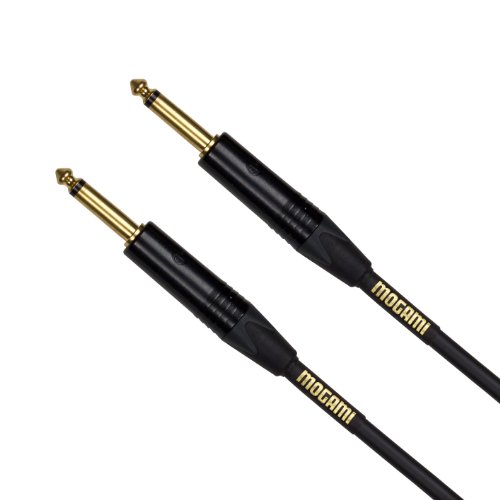
The Mogami Gold Instrument 10 is built around the company’s 2524 high-definition cable, a design that delivers a capacitance rating around 17.5 picofarads per foot — one of the lowest figures in the pro-audio world. Low capacitance preserves the highest frequencies in your signal chain, meaning your guitar’s natural harmonic content arrives at the amp intact rather than rolling off before it hits the preamp.
Mogami’s carbon-impregnated PVC layer between the conductor and the spiral shield stops handling noise cold. Drag the cable across a concrete stage floor or let it rub against your jeans — the conductive polymer absorbs the microphonic vibration that cheaper cables turn into audible crackle. The gold-plated 1/4-inch TS connectors with black epoxy finish resist corrosion and maintain consistent conductivity through years of repeated plugging.
This cable is the choice for players who record direct or use high-gain amps where every decibel of noise margin matters. It costs more than any other cable on this list, but the signal-to-noise improvement — many users report a 50 percent reduction in background hum — justifies the premium for anyone whose ears are trained to hear the difference.
Why it’s great
- Ultra-low capacitance preserves high-end clarity and dynamic feel
- Carbon-impregnated shield eliminates handling and microphonic noise
- Epoxy-coated connectors resist corrosion for long-term reliability
Good to know
- Premium price may exceed the budget for casual practice use
- Straight-to-straight connectors can be bulky at the guitar jack
2. AA AUDIO ACCESSORY Pro Series 10 ft
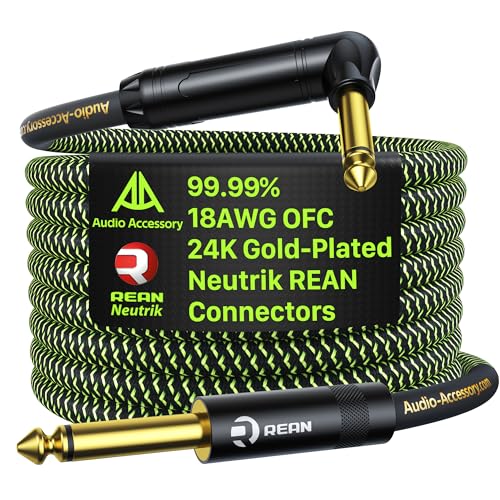
The Pro Series from AA AUDIO ACCESSORY uses an 18 AWG conductor made from 99.99 percent oxygen-free copper — a step up from the 20 AWG found in most cables at this price tier. Thicker wire reduces DC resistance along the cable run, which translates to better low-end punch and less signal degradation when you daisy-chain multiple pedals before the amp.
Kevlar reinforcement runs through the interior of the cable, providing tensile strength that prevents the conductor from snapping under repeated coil-and-uncoil cycles. The five-layer shielding system — braided OFC, aluminum foil, HDPE dielectric, PVC jacket, and the Kevlar layer itself — blocks both radio-frequency interference and the 60-cycle hum that bleeds in from nearby power supplies. The gold-plated Neutrik REAN connectors are field-serviceable, allowing you to repair a damaged plug rather than replacing the whole cable.
Multiple reviewers noted an immediate clarity improvement over generic cables, with one calling it “a noticeable clarity in my tone versus other cables almost twice the price.” The neon-green/black braided jacket is highly visible on a dark stage and resists kinking better than standard rubber sleeves. This cable is the strongest overall value for players who need touring-grade construction without the Mogami price tag.
Why it’s great
- 18 AWG oxygen-free copper provides lower resistance and stronger low-end
- Kevlar reinforcement prevents core breakage under heavy use
- Gold-plated Neutrik REAN connectors are repairable and corrosion-resistant
Good to know
- Braid pattern may be visually polarizing for traditional setups
- Neutrik connectors require a small tool for field repair
3. KIRLIN Cable IWB-202 Black Purple Wave 10FT
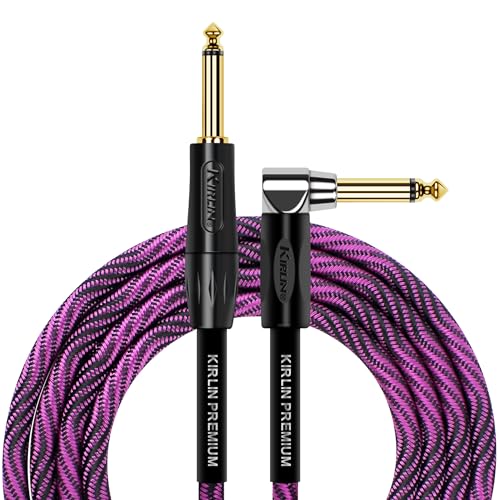
The KIRLIN IWB-202 uses a 20 AWG copper conductor with a braided shield that achieves 95 percent coverage — a solid figure that blocks most environmental interference without adding the stiffness of a foil-wrapped cable. The 7mm outer diameter woven jacket in black and purple wave pattern is both visually distinctive and functionally durable, resisting abrasion better than standard PVC sleeves.
The connectors are straight-to-right-angle, which is the ideal configuration for keeping the cable low-profile at the guitar while still allowing a straight run into a pedalboard or amp input. Gold-plated contacts on the heavy-duty metal plugs ensure oxidation resistance and a consistent electrical connection across hundreds of plug cycles. The included cable tie is a small convenience, but the real value here is the construction quality at a price point that undercuts most boutique brands by a significant margin.
User feedback consistently praises the build quality — “feels like quality” and “my more expensive cables don’t sound any better” appear repeatedly. The only trade-off is the 20 AWG conductor, which carries slightly more resistance than an 18 AWG cable, though most players won’t notice a difference in a 10-foot run. This is the right pick for gigging musicians who want a visually distinctive cable that performs reliably night after night.
Why it’s great
- 95 percent braided shield coverage blocks interference effectively
- Woven wave jacket is abrasion-resistant and stage-visible
- Heavy-duty gold-plated metal connectors feel substantial in the hand
Good to know
- 20 AWG conductor has slightly higher resistance than 18 AWG alternatives
- Straight-to-right-angle may not suit every pedalboard layout
4. Pig Hog PH10R 10 ft

The Pig Hog PH10R is built around an 8mm thick rubber outer jacket that provides genuine physical protection without turning the cable into a stiff hose. The material flexes freely in tight coils but resists cuts and abrasion far better than the thin PVC sleeves found on budget cables. That flexibility is a key advantage when routing the cable around pedalboards or through the legs of a microphone stand.
The right-angle to straight connector configuration puts the angled plug at the guitar end, reducing leverage stress on the instrument’s input jack. The gold-plated contacts inside the 1/4-inch plugs maintain a clean signal path, and multiple user reviews report “no noise, no hum” even in high-gain setups. The cable’s strain reliefs are noticeably thicker than entry-level alternatives, extending the lifespan at the most failure-prone points — the joint where plastic meets metal.
Reviewers who take this cable on tour report it holds up to daily abuse — “mine gets abused heavily on tour every day and it’s still holding strong” — while home users appreciate the tangle resistance and clean sound. The PH10R is the ideal everyday cable for players who want reliability without overthinking specs. It pairs well with a more specialized premium cable as a backup or secondary rig.
Why it’s great
- 8mm rubber jacket offers excellent durability while remaining flexible
- Right-angle plug at guitar end protects the input jack from strain
- Tour-tested construction with thick strain reliefs at both ends
Good to know
- Rubber jacket may tangle more easily than woven alternatives
- Not the lowest-capacitance option for ultra-clean studio work
5. Pig Hog PC-H10BKR Black Woven 10 ft

The Pig Hog PC-H10BKR swaps the rubber jacket of the PH10R for a woven fabric outer covering that resists kinking and reduces surface noise when dragged across a floor. The woven material also adds a layer of abrasion resistance that plain PVC cables lack, making this a solid choice for players who want a low-cost cable that won’t fail after a few months of regular use.
Both ends use gold-plated right-angle connectors, which is an unusual configuration at this price point — most budget cables put a straight plug on at least one end. Dual right-angles keep the entire cable run low-profile, which is helpful for pedalboard wiring or for players who want minimal visual clutter. The connectors feel less substantial than the Pig Hog PH10R’s metal barrels, but they maintain a snug fit with no crackle or dropout reported in the majority of user reviews.
One user specifically praised it for electric drum use, noting that the woven jacket is quieter than rubber when rubbed against a drum rack leg. The PC-H10BKR is best understood as an entry-level cable that punches above its weight in construction. It works as a primary cable for beginners, a practice-room spare, or a pedalboard patch cable where flexibility and low profile matter more than extreme noise rejection.
Why it’s great
- Woven jacket resists kinking and reduces surface handling noise
- Dual right-angle connectors keep the whole run low-profile
- Gold-plated plugs maintain clean contact at an entry-level price
Good to know
- Lighter gauge conductor than the 8mm PH10R version
- Connector barrel feels less robust than premium options
FAQ
Does a more expensive guitar cable really sound better?
How long should a guitar cable be for live performance?
Final Thoughts: The Verdict
For most users, the best guitar cables winner is the AA AUDIO ACCESSORY Pro Series because it delivers 18 AWG oxygen-free copper, Kevlar reinforcement, and repairable Neutrik REAN connectors at a price that undercuts premium brands by a wide margin. If you want the absolute lowest noise floor and capacitance figure, grab the Mogami Gold Instrument 10. And for a flexibly reliable everyday cable that won’t break the bank, nothing beats the Pig Hog PH10R.